


Shizuoka City Museum of History: A Visitor’s Guide to the Ieyasu Gallery, Tickets and Access
The ground floor is free and shows a road and stone walls excavated from the late Sengoku period. The second-floor main gallery costs ¥600 for adults. It is about a 15-minute walk from the north exit of JR Shizuoka Station. In autumn 2026 the third floor is closed to the main gallery, so only the second floor is open.
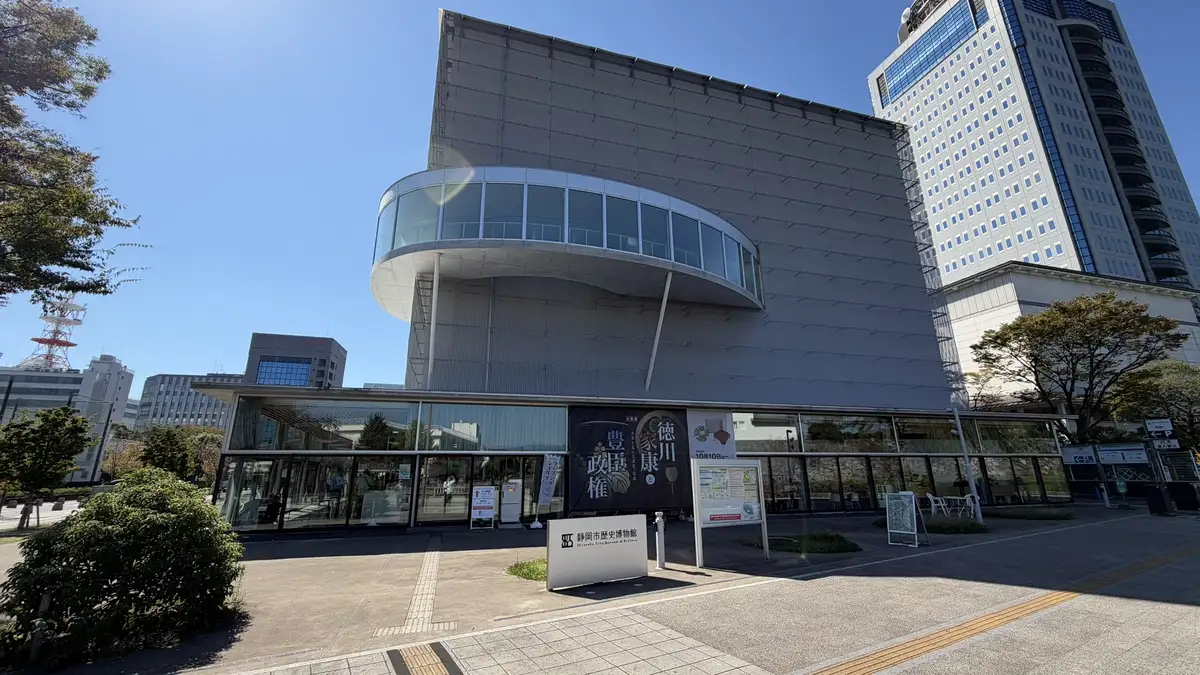
Shizuoka City Museum of History stands across the moat from the Higashi-gomon gate and Tatsumi Turret of Sunpu Castle Park. Sunpu is the old name for the Shizuoka area. Tokugawa Ieyasu lived here as a child under the Imagawa clan, and after handing the shogunate to his son Hidetada in 1605 he moved into Sunpu Castle in 1607. The museum is about a 15-minute walk from the north exit of JR Shizuoka Station (official figure), so it fits easily into a day around the station. From the museum’s windows you can see the reconstructed Tatsumi Turret across the moat.
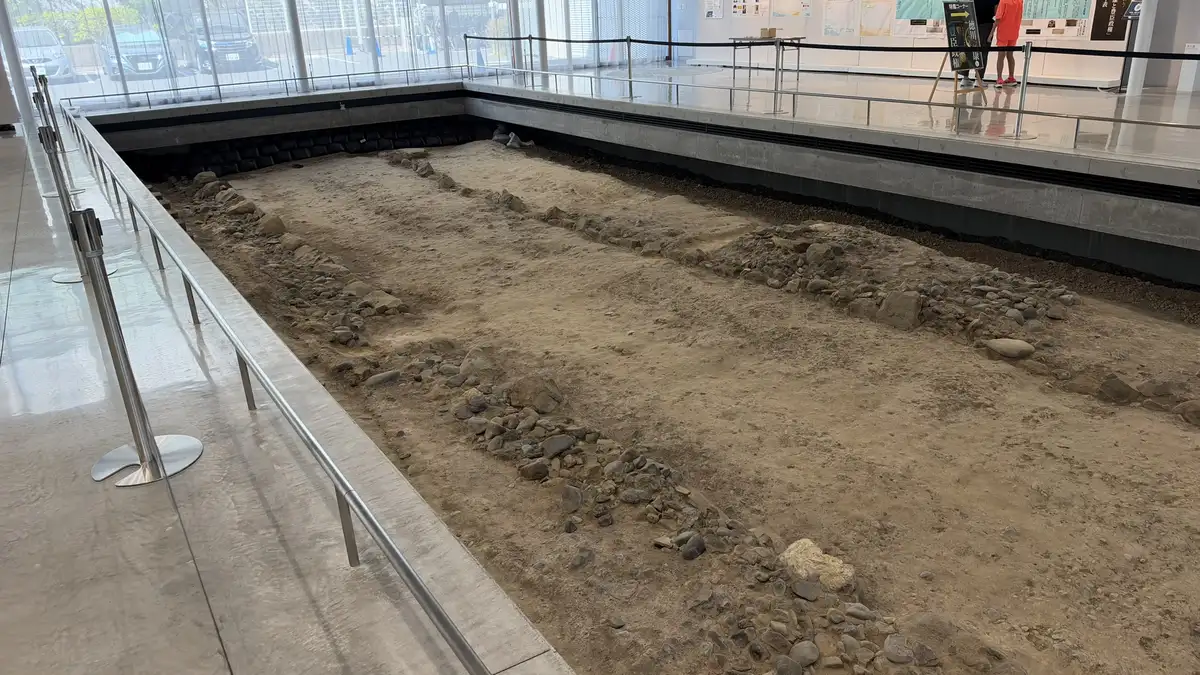
Entry to the ground floor is free. It holds a road and stone walls from the late Sengoku period, excavated before the museum was built and left on display where they were found. The second floor is a paid “main gallery” (¥600 for adults) covering Ieyasu’s life, Sunpu and the Imagawa clan, and Japan’s contacts with foreign countries. If you only want to see the ruins, the ground floor is enough. If you want the Ieyasu and foreign-relations displays, go up to the second floor.
Japanese guides often say “permanent exhibition”. The museum calls it the “main gallery” (kihon tenji). The themes stay the same, but individual items are rotated regularly, so what you see may differ from what this page describes. The displays here are as the author saw them on 11 October 2026.
The author would point visitors to two things. The first is the road and stone walls on the ground floor: the old stonework has been built into a modern building, and it is worth a look. The second is the second-floor material on Ieyasu’s dealings with foreigners, which goes beyond what most school history lessons cover. Letters and similar documents were mostly reproductions in the sections the author saw, but the displays still convey the period well. You do not need to know the Taiga drama “Dou Suru Ieyasu” or the series SHŌGUN to follow the museum; the page keeps drama and history apart and sticks to what the displays show.
The third-floor main gallery is closed from 25 September to 12 December 2026, and is due to reopen on 13 December according to the museum. From 10 October to 29 November the whole third floor hosts the special exhibition “Tokugawa Ieyasu and the Toyotomi Regime”. During this period the main gallery is available on the second floor only.
A ticket for the special exhibition alone is ¥600 for adults, and a combined ticket with the main gallery is ¥1,200. The author will write up the special exhibition and the related talk in a separate article.
What to See: The Excavated Ruins and the Ieyasu Gallery
Ground Floor: The Excavated Road and Stone Walls
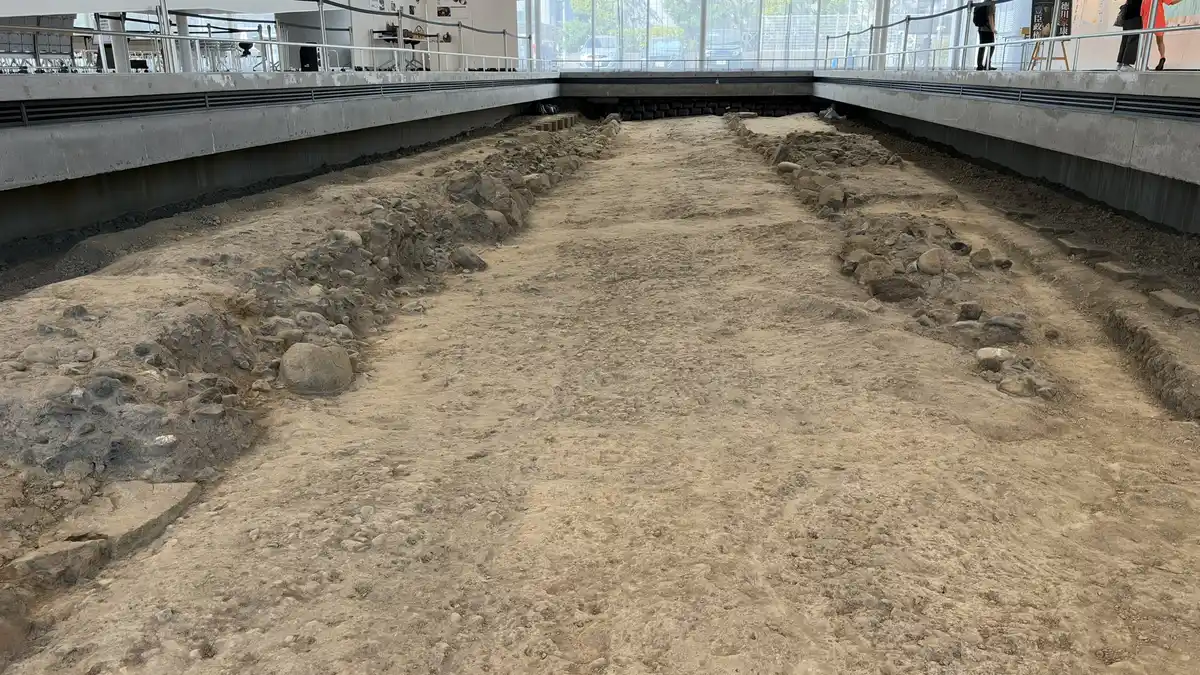
A road and stone walls from the late Sengoku period, found before the museum was built
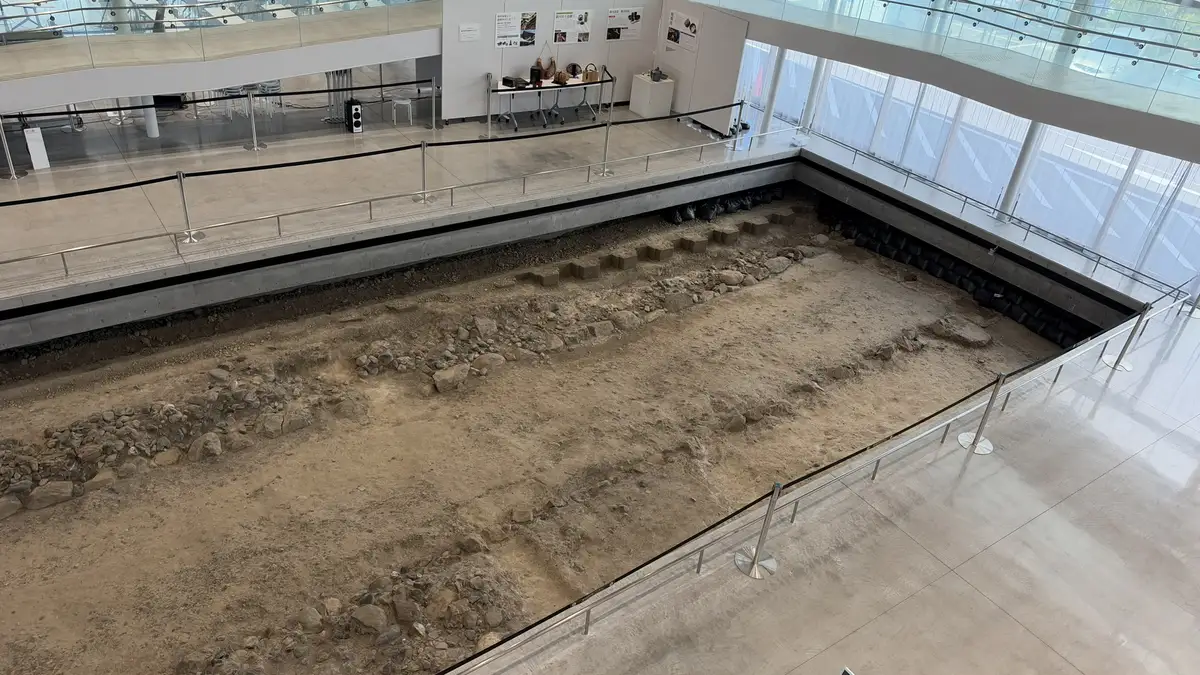
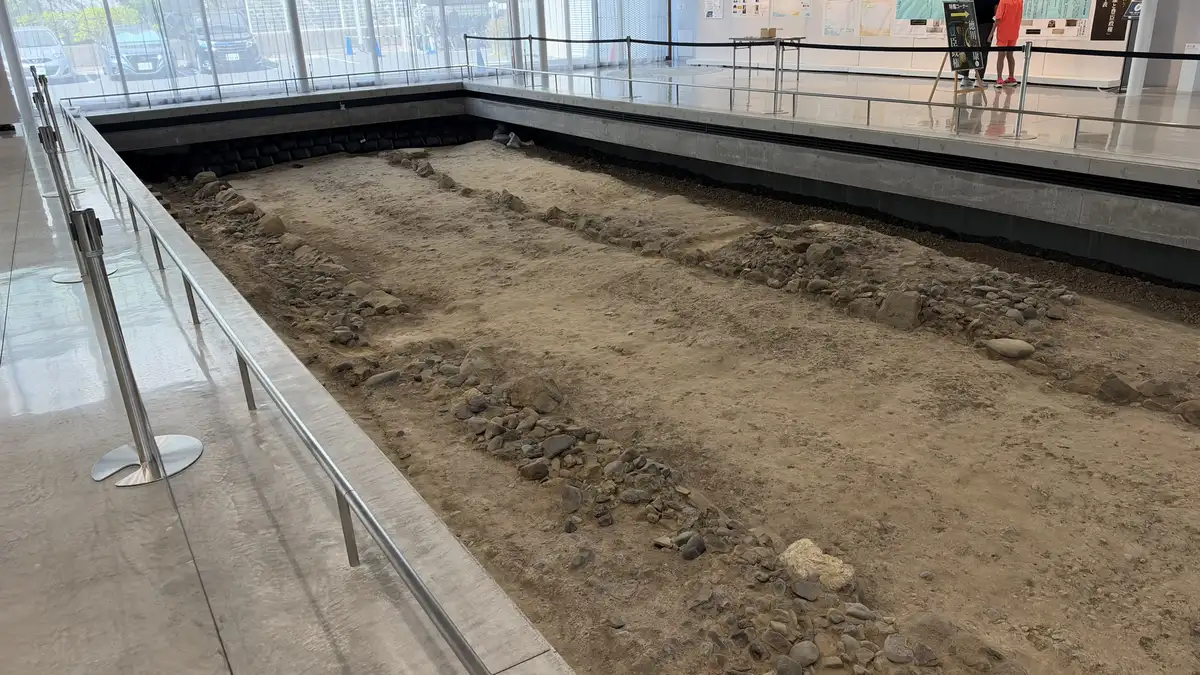
The remains are displayed on the ground floor, where a walkway lets you look along the earthen road and the low rows of stonework from an angle or from near road level. The author found the sight of the old stonework absorbed into a modern building well worth seeing.
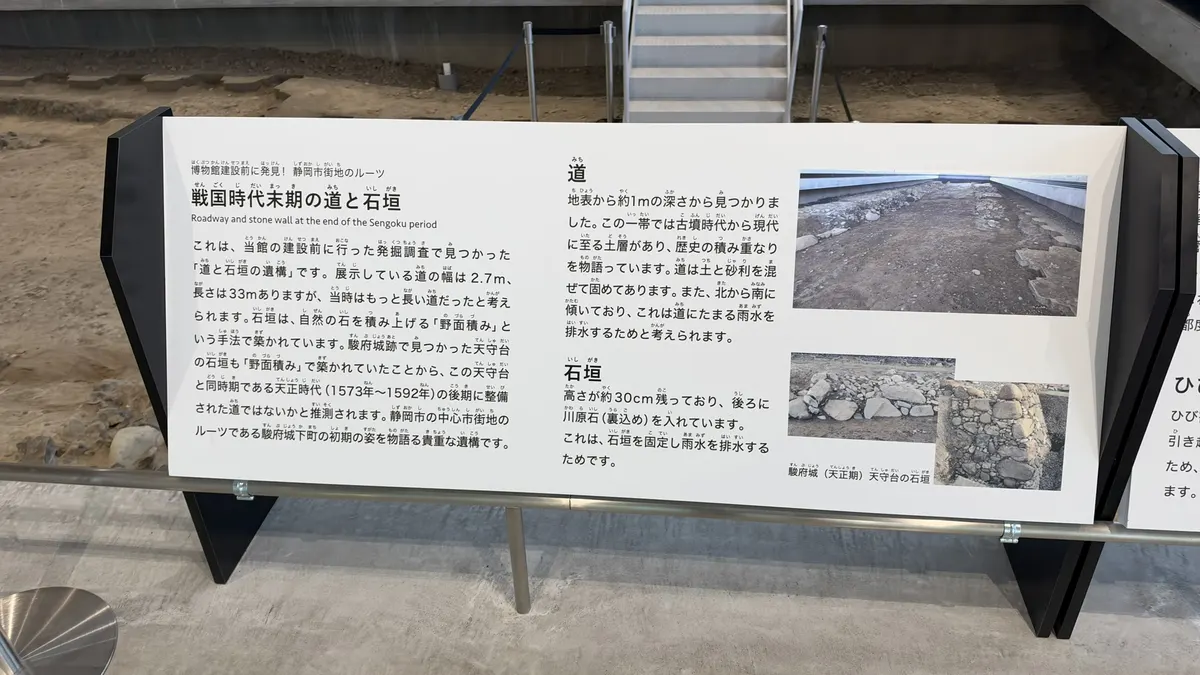
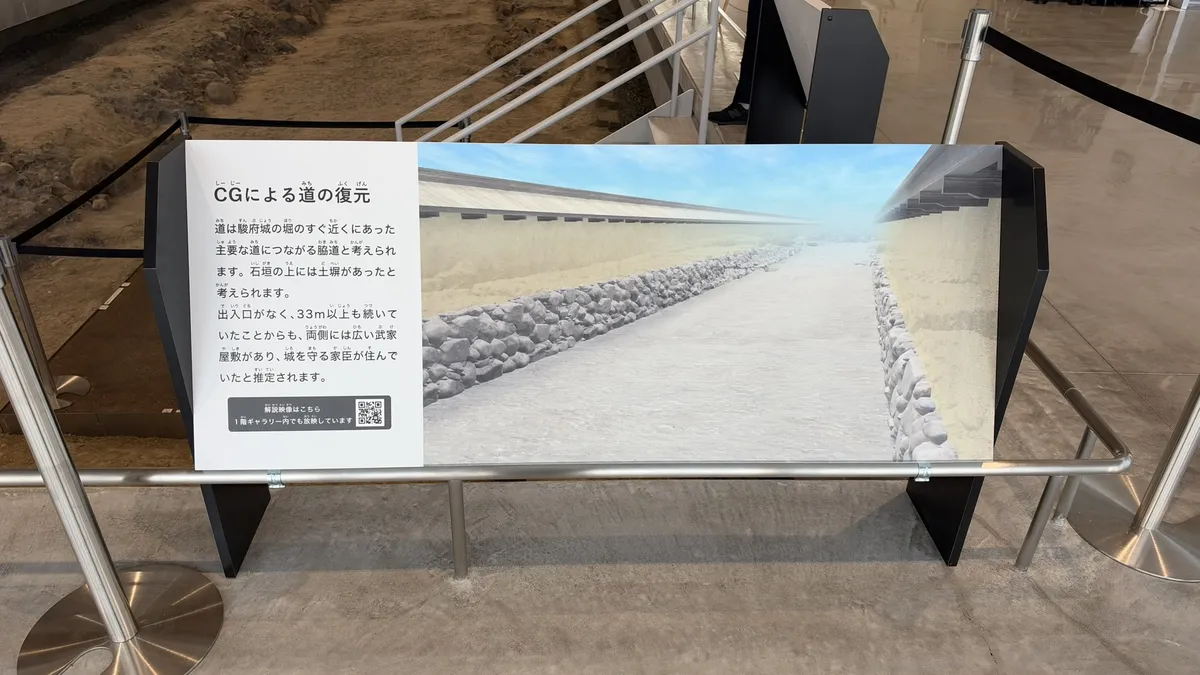
According to the panel, the road is 2.7 m wide and the displayed section is 33 m long, and it is thought to date from the later Tenshō era (1570s–1590s). A computer-graphics panel shows how the road may have looked, with stone walls and fences on both sides.
| How it was found | Excavation before the museum was built |
|---|---|
| Road width | 2.7 m |
| Displayed length | 33 m |
| Date | Later Tenshō era, an estimate given on the panel |
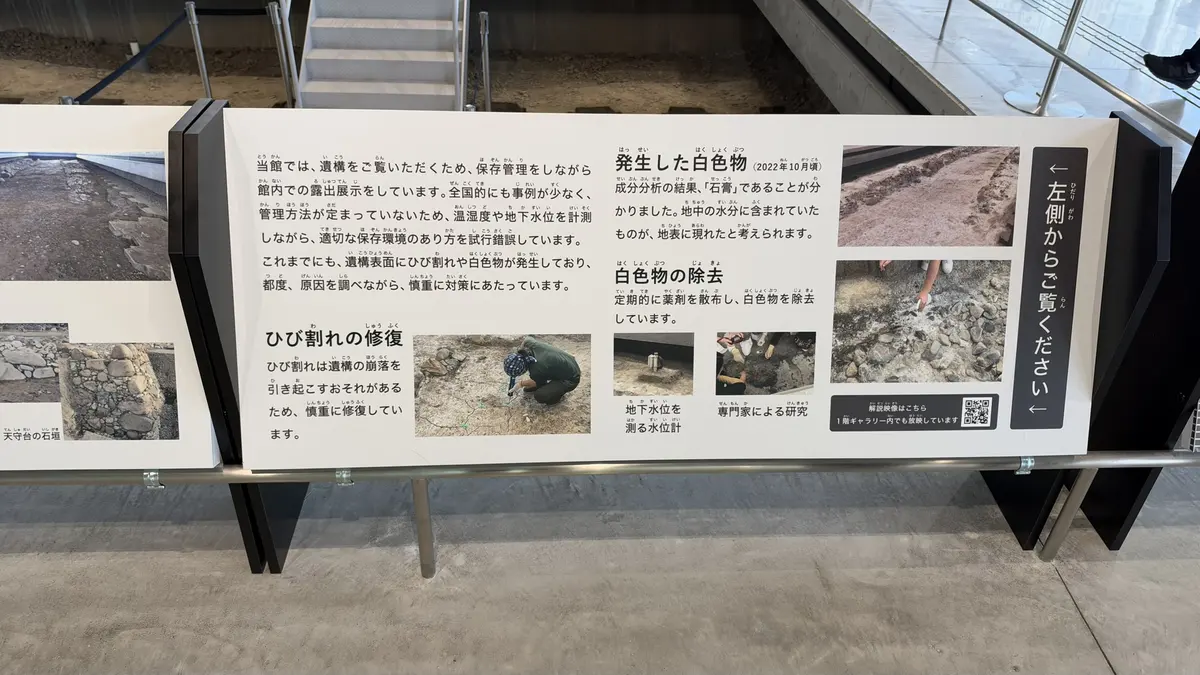
| Conservation | Crack repairs, treatment of white deposits identified as gypsum, and groundwater monitoring (panel) |
Tap a photo to enlarge it
Second Floor: The Main Gallery
Ieyasu’s life, Sunpu and the Imagawa clan, and contacts with the wider world
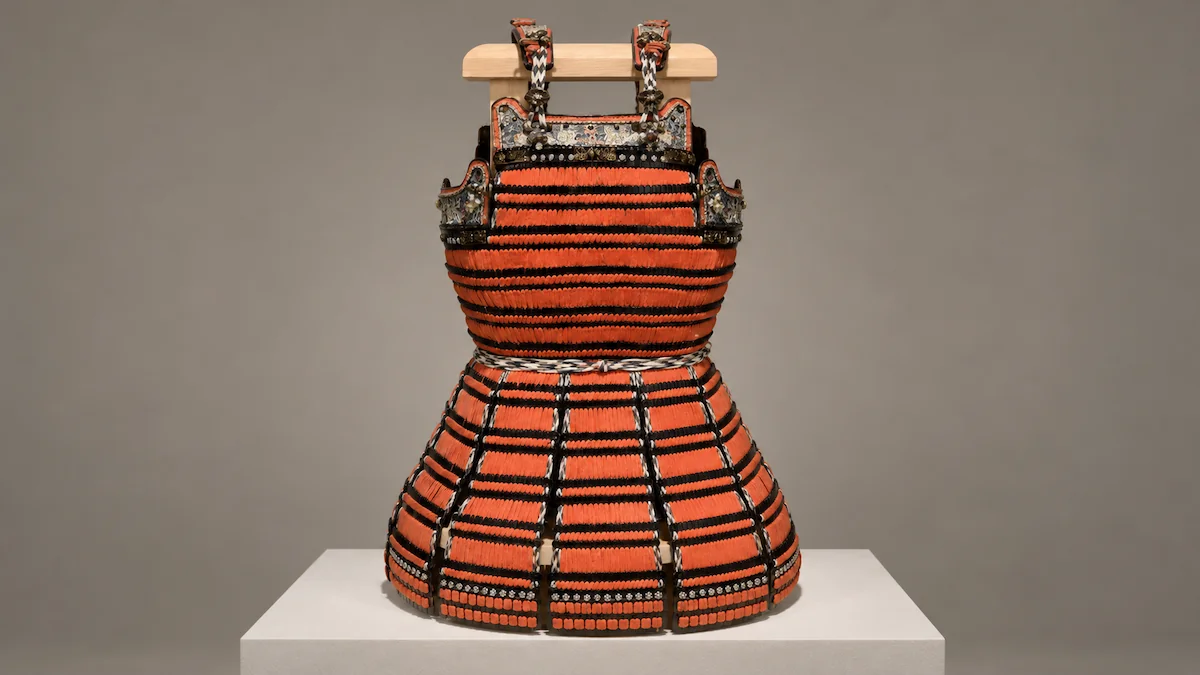
The official themes of the second floor are “Sunpu, Capital of Japan, and the World”, “The Life of Ieyasu” and “Sunpu, the Land That Raised Ieyasu”. “Capital” here is a theme title; it does not mean Sunpu was Japan’s official capital. According to the museum, Ieyasu spent 25 of his 75 years in Sunpu. He lived here as a child under the Imagawa clan, and after handing the shogunate to his son Hidetada in 1605 he moved into Sunpu Castle in 1607.
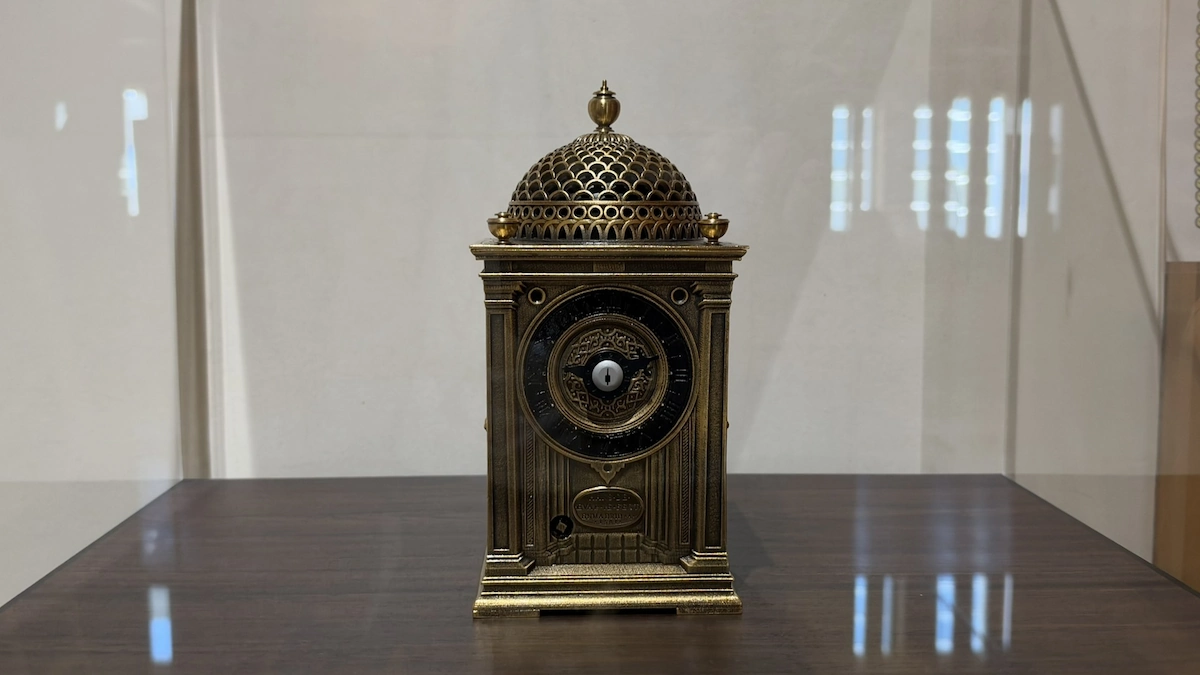
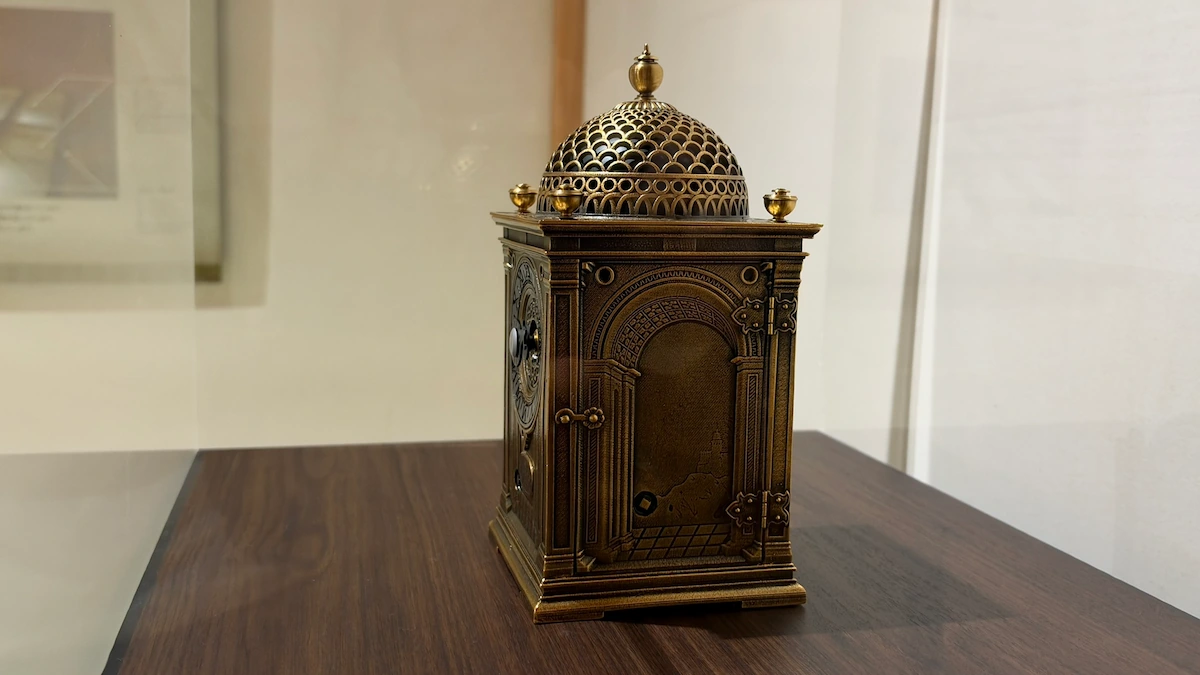
What stayed with the author were the reproductions of gifts presented in Ieyasu’s time, and the introductions to foreigners who dealt with him. A reconstructed telescope and a table clock were on display. The four people introduced were William Adams, Jan Joosten, Sebastián Vizcaíno and John Saris, and the author learned about Vizcaíno and Saris in detail for the first time. A reproduction of armor was also on show.
Photography is not allowed in the second-floor galleries, so this page has no photos of them.
Sunpu and the Imagawa clan before Ieyasu
The museum’s website says the Imagawa clan, based in Sunpu, raised Ieyasu as a child, and that Imagawa culture left a mark on Shizuoka today. The materials it introduces include a painting of Imagawa Yoshimoto in armor, titled “The Battle of Okehazama: Imagawa Yoshimoto”, and Yoshimoto’s kaō (a stylized signature). Ieyasu, then called Motoyasu, is said to have used a kaō close to Yoshimoto’s when he was 17 to 19. The “Life of Ieyasu” section also shows how Ieyasu’s own kaō changed with age, and a portrait of him as a deified figure (Tōshō Daigongen).
On an earlier visit, the author recalls a detailed explanation of the Imagawa clan before Ieyasu came to Sunpu. Items are rotated, so the pieces above may not have been on show on the day the author visited.
Foreigners and gifts
The table summarizes what the author saw on the second floor and the background to it. Name spellings can differ from those on the museum’s labels.
| Person | Background |
|---|---|
| William Adams | English navigator who served Ieyasu (known in Japan as Miura Anjin). Read more in William Adams (Miura Anjin): The Real Man Behind SHŌGUN’s John Blackthorne. |
| Jan Joosten | Dutchman who worked as a diplomatic adviser and interpreter for Ieyasu and also took part in the red-seal ship trade. |
| Sebastián Vizcaíno | Spanish envoy and explorer. He delivered a clock from King Philip III of Spain to Ieyasu. It was the king’s gift, not Vizcaíno’s own, and is said to have been thanks for the rescue of shipwrecked Spaniards. His aims in Japan also included searching for the legendary “islands of gold and silver” and surveying the Japanese coast. |
| John Saris | English captain who presented a telescope to Ieyasu in 1613. |
Other displays that caught the author’s eye
- A moving ukiyo-e, projected onto a wall.
- A wall display on relations with Europe and Asia, which shows how Sunpu was linked to other countries.
- A reconstructed copy of the Beniito-odoshi harumaki, a type of body armor. The original is kept at Shizuoka Sengen Shrine and is said to be the armor Ieyasu wore when he first put on armor as a boy. What is on show is the copy, not the original.
- A plaque and tableware connected with Maruyama Toshogu. This is the predecessor of Shinonome Shrine, which stands behind Shizuoka Sengen Shrine, and is a different shrine from Kunozan Toshogu. See the map below.
Where Maruyama Toshogu (Shinonome Shrine) stands
The Maruyama Toshogu mentioned in the second-floor display is the predecessor of Shinonome Shrine, which stands behind Shizuoka Sengen Shrine in Maruyama-cho, Aoi Ward. It is a different shrine from Kunozan Toshogu. It is said that the Toshogu inside Sunpu Castle was moved to the grounds of the temple that once looked after Shizuoka Sengen Shrine (then Fuchu Sengen Shrine).
A table clock reproduction you can photograph, in Hitsujisaru Turret
The table clock on the second floor cannot be photographed. A reproduction of a table clock is also on display inside Hitsujisaru Turret in Sunpu Castle Park, and photography is allowed there. The two photos below were taken by the author inside that turret (front and side). The turret is one of the park’s paid buildings.
Tap a photo to enlarge it
Tatsumi Turret from the Museum Windows
Sunpu Castle’s moat and turret, seen from inside the museum
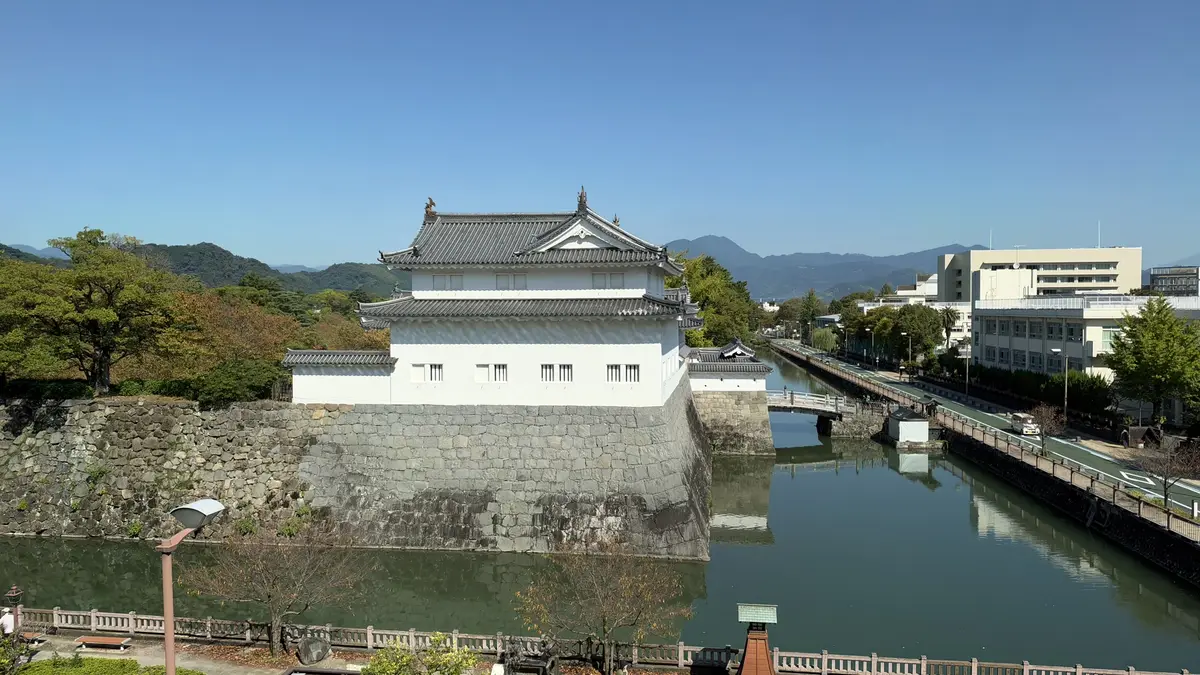
A passage with large windows looks out over the moat to Tatsumi Turret. The turret was reconstructed in 1989 and is not a building that survives from Ieyasu’s time. Once you have seen how the museum presents Sunpu Castle, a glance out of the window shows the reconstructed turret standing across the moat.
Higashi-gomon was reconstructed in 1996 and Tatsumi Turret in 1989. The castle park announced repair work on Higashi-gomon and Tatsumi Turret in autumn 2026 and says it remains open as usual (announced 5 September 2026). Work enclosures may or may not be visible depending on when you visit.
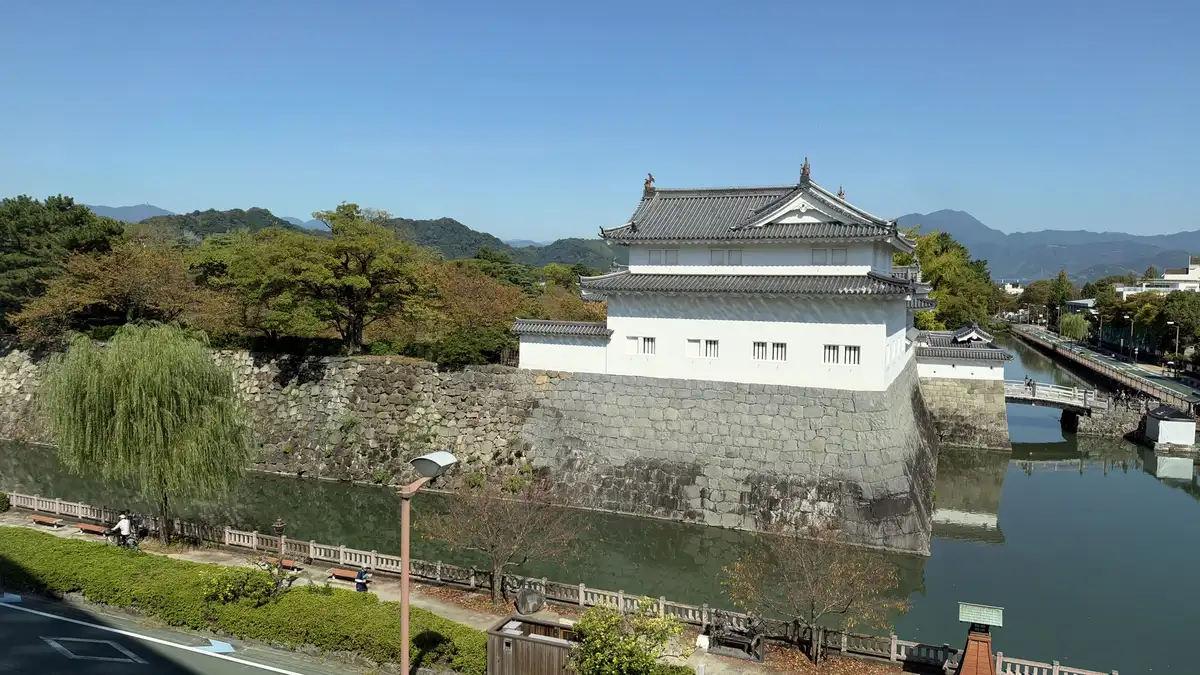
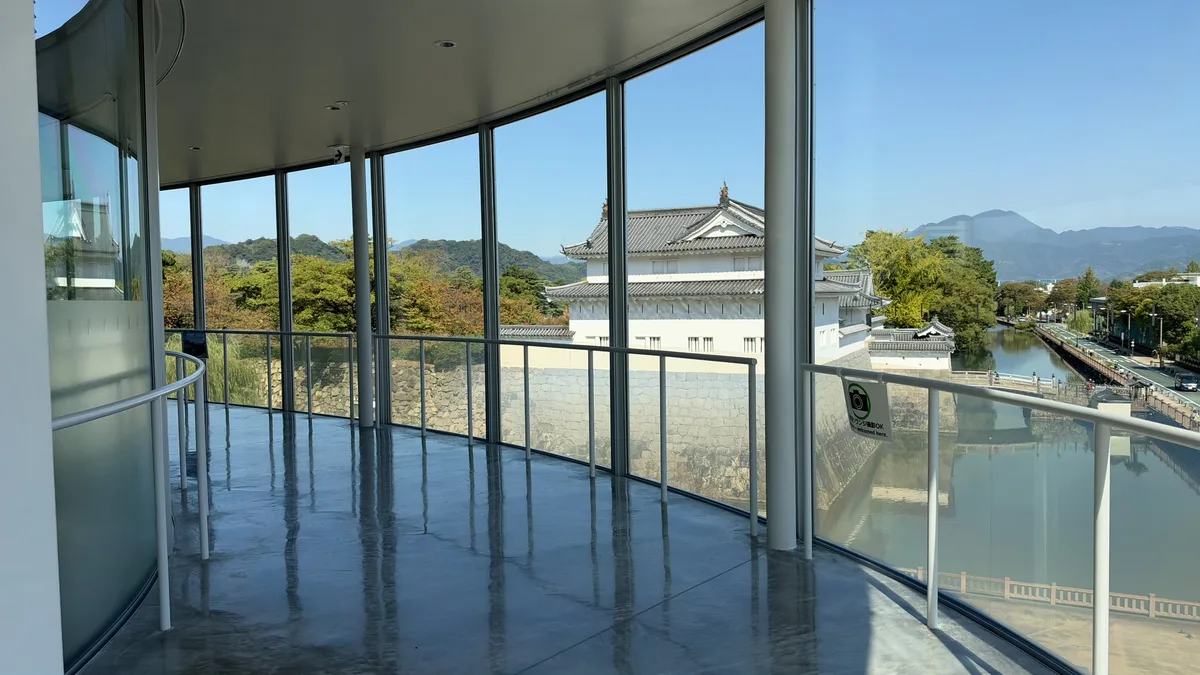
Tap a photo to enlarge it
Time Needed and Combining the Museum with Sunpu Castle
The author spent about 20 minutes in the second-floor main gallery. This is not a full read-through: the author has visited several times before and concentrated on the William Adams section and the items replaced in September 2026. A first-time visitor who reads everything should plan on longer. Allow about 5 to 10 minutes for the ground-floor ruins. The figures exclude the special exhibition and the related talk.
The author’s day on 11 October 2026
The author went straight from the station to the museum and saw the ground-floor ruins and the second-floor main gallery.
Hungry by then, the author had lunch at Ogawa, a Shizuoka oden restaurant, and afterwards bought rice crackers as souvenirs at Aoi Senbei Honke. Both will be covered on separate pages.
Of the park’s paid buildings, the author visited Hitsujisaru Turret and Momijiyama Garden, and had some tea.
The author attended the related talk “Shizuoka in the Time of Ieyasu and Hideyoshi”. It will be covered in a separate article.
After the talk, the author went through the Higashi-gomon gate, beside Tatsumi Turret, and on to Zuiryuji temple.
Which first: the museum or the park?
Walking from either JR Shizuoka Station or Shin-Shizuoka Station, you reach the museum before the castle park, so the museum first is the natural order and the one the author recommends. You get the background on Ieyasu and Sunpu first and then see the castle grounds. The exception is an afternoon start: the park’s paid buildings stop admitting visitors at 16:00, so do the park first.
| Order | Suits | Watch out for |
|---|---|---|
| Museum first (recommended) | A morning start, walking from the station and reaching the museum first. | The museum admits until 17:30, but the park’s paid buildings stop at 16:00, so do not spend too long inside the museum. |
| Park first | An afternoon start, or visitors who want to show a park ticket stub at the museum for the main-gallery discount. | The park’s last entry is 16:00. The museum does not say whether a stub discount can be applied after you have already bought a full-price ticket. |
Admission, Opening Hours and Ticket Choices
The ticket you need depends on how far you go. The table shows the total for one adult on the same day (checked on the official sites on 12 October 2026).
| What you see | Total | Breakdown and conditions |
|---|---|---|
| Museum ground floor only | ¥0 | No ticket needed. The second-floor main gallery is not included. |
| Main gallery | ¥600 | In autumn 2026 only the second floor is open. |
| Higashi-gomon and Tatsumi Turret + main gallery | ¥800 | Park ticket ¥200 + main gallery ¥600. |
| Park’s three buildings + main gallery | ¥860 | Three-building park ticket ¥360 + main gallery at the stub-discount price of ¥500, used on the same day. |
| The same range bought separately | ¥1,050 | ¥200 + ¥100 + ¥150 + ¥600. The difference from ¥860 is ¥190. |
| Special exhibition only (to 29 Nov) | ¥600 | The special exhibition and main gallery together are ¥1,200, or ¥1,100 with a park stub. |
| Set ticket the author bought (main gallery + special exhibition + park’s three buildings) | ¥1,300 | Bought at the museum counter on 11 October 2026. Bought separately, the park ticket (¥360) plus the combined museum ticket (¥1,200) comes to ¥1,560. |
¥800 and ¥860 cover different things. If you only plan to see Higashi-gomon and Tatsumi Turret in the park, there is no reason to buy the three-building ticket just for the discount. The park ticket does not include entry to the museum, which needs its own ticket. The park’s three paid buildings are Higashi-gomon and Tatsumi Turret, Hitsujisaru Turret and Momijiyama Garden.
Main-gallery tickets for high-school and university students and for Shizuoka City residents aged 70 or over are ¥420, and ¥150 for elementary and junior-high students. Elementary and junior-high students who live or study in Shizuoka City, and preschoolers, enter free. Bring proof if you qualify for a discount or free entry.
On 11 October 2026 the author bought, at the counter, a ticket covering the main gallery, the special exhibition and the park’s three buildings (Higashi-gomon and Tatsumi Turret, Hitsujisaru Turret and Momijiyama Garden) for ¥1,300. The three-building park ticket normally costs ¥360 and the combined museum ticket ¥1,200, so buying them separately comes to ¥1,560 (¥1,460 using the stub discount). This set did not appear on the museum’s price list or special-exhibition page, and the author has not checked whether it is still sold, so ask at the counter. Online sales are also available through the museum’s official ticket site (e-tix): regular tickets are paid by credit card or d-payment, cannot be changed, and can be cancelled until 8:00 on the day. Discounts and free entry are handled at the counter on the day.
Opening hours and closing days
| Museum | 9:00–18:00. Last entry to the galleries is 30 minutes before closing (17:30). Closed on Mondays; if Monday is a public holiday the museum opens and closes on the next weekday instead. Closed 29 December–3 January. |
|---|---|
| Sunpu Castle Park paid buildings | 9:00–16:30, last entry 16:00. Closed on Mondays; if Monday is a public holiday the park is open and no substitute day is taken. |
The museum can close temporarily between exhibitions. Over the New Year period the ticket site’s dates are one day wider on each side than the museum’s own, so check the official calendar if you visit around then. Official sources: museum visitor information, Sunpu Castle Park admission and hours and online ticket sales.
Getting There from Shizuoka Station and Tokyo
| Address | 4-16 Oite-cho, Aoi Ward, Shizuoka City, Shizuoka Prefecture |
|---|---|
| From JR Shizuoka Station | About 15 minutes on foot from the north exit (official figure) |
| From Shin-Shizuoka Station | About 8 minutes on foot (official figure) |
| By bus | Get off at “Kencho・Shizuoka Shiyakusho Aoi Kuyakusho-mae”, then walk about 6 minutes (official figure) |
| From Tokyo | Tokaido Shinkansen to Shizuoka. JR Central gives about 1 hour by Hikari and about 1 hour 20 minutes by Kodama (only some Hikari stop here). |
| From Kyoto | Tokaido Shinkansen to Shizuoka. Roughly 1 hour 40 minutes by Hikari and 2 hours 15 minutes by Kodama. |
| Station numbers | JR Shizuoka is CA17 on the Tokaido Main Line; Shin-Shizuoka is S01 on the Shizuoka Railway. |
If you arrive by Shinkansen or on the JR Tokaido Line, take the north exit of JR Shizuoka Station. There is no need to change to the Shizuoka Railway just to shorten the walk. If you come by the Shizuoka Railway, walk from Shin-Shizuoka Station. The walking times are official figures and do not include waiting at crossings or moving through the station. The maps below show the walking route from each station; treat the official times as your guide.
From Tokyo and Kyoto to Shizuoka Station
Shizuoka lies between Tokyo and Nagoya on the Tokaido Shinkansen. From either Tokyo or Kyoto, get off at Shizuoka Station and walk to the museum. Take a Hikari or Kodama: Nozomi trains do not stop at Shizuoka, and only about one Hikari an hour does, so check the timetable for the stops before you board.
| Departure | Hikari | Kodama | Source / note |
|---|---|---|---|
| From Tokyo | About 1 hour | About 1 hour 20 minutes | JR Central’s figures |
| From Kyoto | About 1 hour 40 minutes | About 2 hours 15 minutes | Rounded from train-planner listings |
Walking from JR Shizuoka Station
Outside the north exit of JR Shizuoka Station stand statues of Tokugawa Ieyasu and of his childhood self, Takechiyo. Walk to the museum from here.
Walking from Shin-Shizuoka Station
The author went straight from Shizuoka Station to the museum. To return, walk back to the north exit of JR Shizuoka Station. If you prefer the bus, get off at “Kencho・Shizuoka Shiyakusho Aoi Kuyakusho-mae” and walk about 6 minutes; check stops, times and fares for your date on the Shizutetsu Justline site. A timetable revision has been announced for 25 October. The Sunpu Roman Bus ended service on 30 September 2025, so older guidance about a direct “Roman Bus” no longer applies, including some of the official English pages.
English Guides, Photography and Luggage
The free “Pocket Curator” (Pocket Gakugei-in) app gives exhibit explanations and audio in Japanese, English, Chinese (simplified and traditional) and Korean, for iOS and Android. The museum does not promise that every exhibit or video is fully translated, so treat the app as a help rather than a complete English guide. The author did not use the app and cannot report on how it works in practice. Install it before you go if you want English explanations.
Photography is not allowed anywhere in the second-floor galleries. The museum says it is banned in most of its galleries, so check the signs elsewhere. The museum photos on this page show the ground-floor ruins, the view from the museum’s windows and the exterior. The ground floor has 70 coin lockers that return the ¥100 coin. Larger bags that do not fit can be left with the ground-floor information desk, if you ask.
Nearby Ieyasu Sites
Sunpu Castle Park is right next to the museum and can be done on the same day. Shizuoka Sengen Shrine and Kunozan Toshogu are in other parts of the city and are not a short walk away.
| Place | How it fits with the museum |
|---|---|
| Shizuoka Sengen Shrine | Introduced by the city’s tourism site as a shrine linked to Ieyasu. It stands at a separate location (Miyagasaki-cho, Aoi Ward) and some of its buildings are under renovation. The official route is by bus such as the Abe line, getting off at Akatorii. Shinonome Shrine (Maruyama Toshogu) stands behind it. |
| Kunozan Toshogu | The shrine’s own guide gives about 45 minutes by Nihondaira line bus from Shizuoka Station plus about 5 minutes by ropeway. Treat it as a separate trip, not a stop after the museum. |
Frequently Asked Questions
Yes. The ground floor is free and has the excavated road and stone walls. The second-floor main gallery needs a ticket.
No, they are separate tickets. For the October 2026 special exhibition there is a special-exhibition-only ticket (¥600 for adults) and a combined ticket with the main gallery (¥1,200). Choose the combined one if you want to see both.
Show the stub from the shared ticket for Higashi-gomon/Tatsumi Turret, Hitsujisaru Turret and the garden at the museum counter on the same day, and the adult main-gallery price becomes ¥500. The discount is handled at the counter.
Yes, and it closes on the next weekday instead. Sunpu Castle Park is open on a holiday Monday and takes no substitute day. The two systems differ, so check dates around long weekends.


comment