

Kyoto City Library of Historical Documents: Free Museum Guide and the 2026 Hideyoshi Exhibition
A small, free city facility on Teramachi Street, just east of the Kyoto Imperial Palace grounds. Despite the English name, it is not a public lending library: the ground floor holds a single exhibition room. I visited on 9 September 2026 to see the special exhibition on how Toyotomi Hideyoshi rebuilt Kyoto, and stayed about 40 minutes.
The Kyoto City Library of Historical Documents (京都市歴史資料館) is a municipal facility on Teramachi Street, immediately east of the Kyoto Imperial Palace grounds. The English name is misleading for visitors: this is not a lending library and not a research-only archive you need permission to enter. Anyone can walk in, free of charge, and see the exhibition in the single ground-floor room.
I went on the afternoon of Wednesday 9 September 2026 to see the special exhibition Toyotomi Hideyoshi and Kyoto: The Great Rebuilding of the City and Its Outskirts, which runs until 25 October 2026. I arrived at 14:30 and left at 15:10 — about 40 minutes in total.
Set expectations before you go: this is a museum of paper, not objects. What you see are old documents, official records and hand-drawn maps. There is almost no armour, no swords and no excavated pottery. What you get instead is the chance to look at how the vanished Kyoto of the 1580s and 1590s — Jurakudai palace-castle, the Odoi earthen rampart, Fushimi Castle — was written down at the time. If that is what you came for, it is remarkable value for nothing.
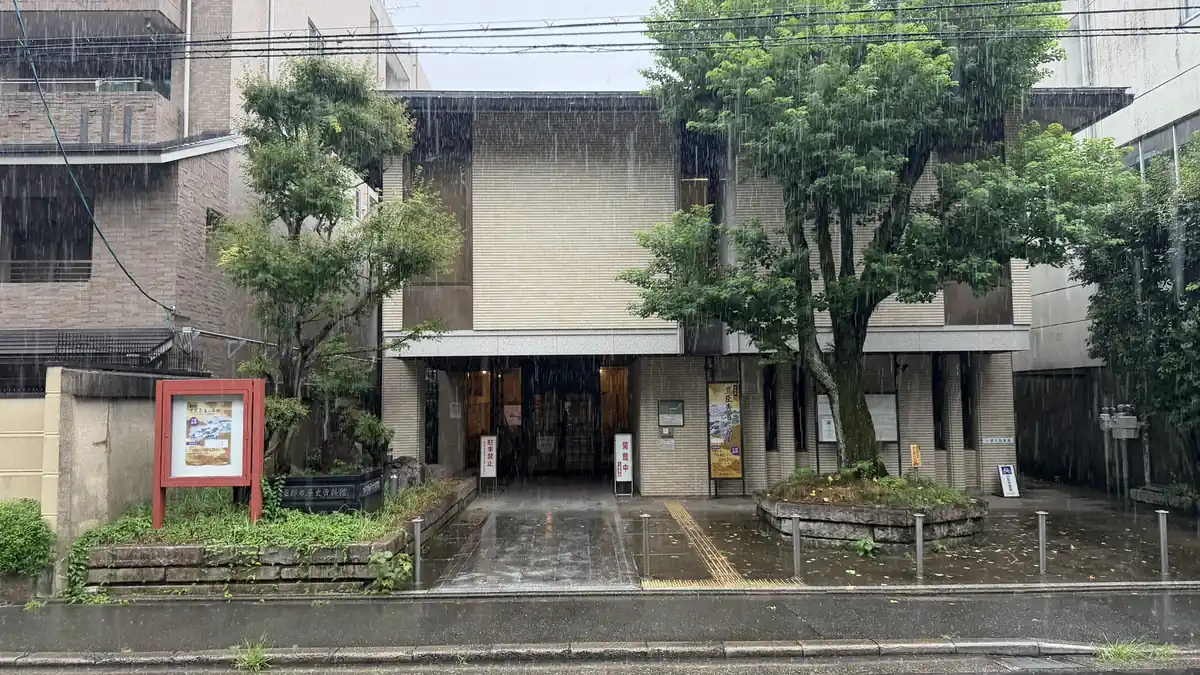
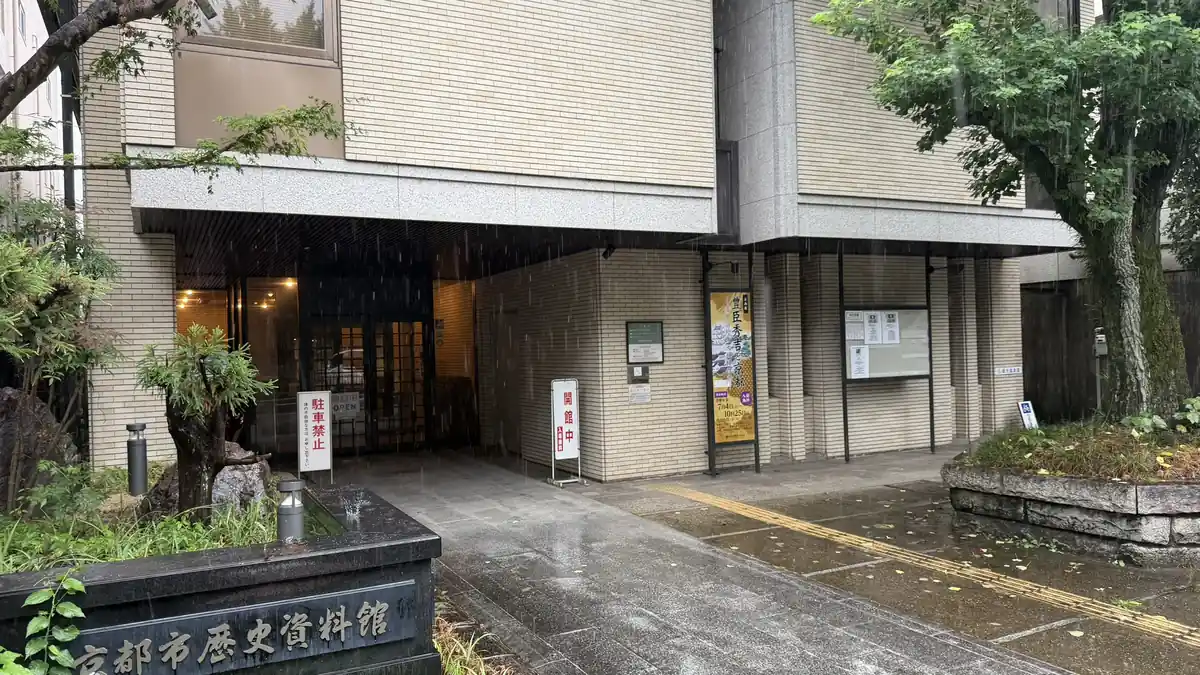
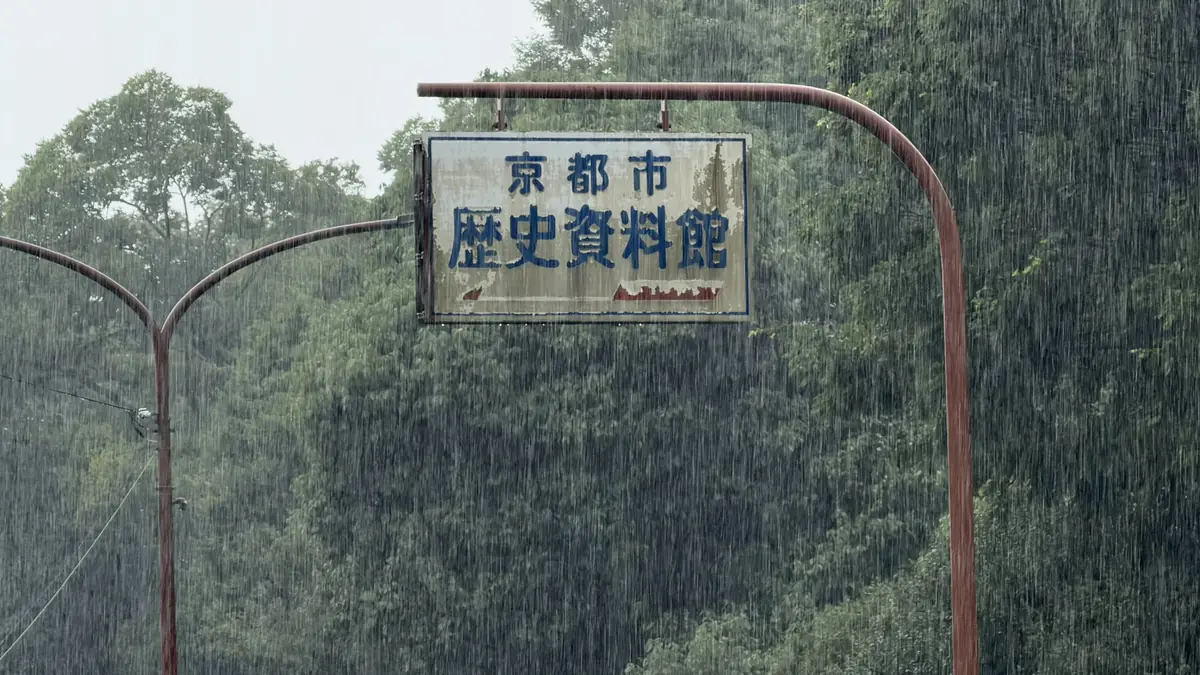
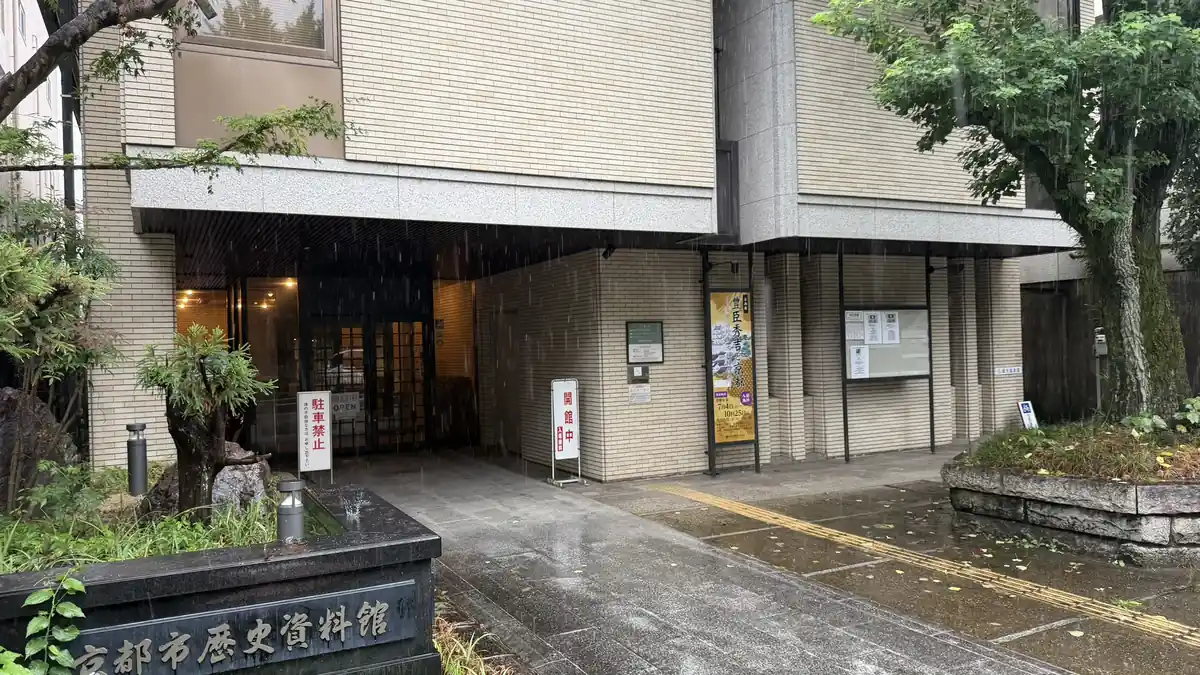
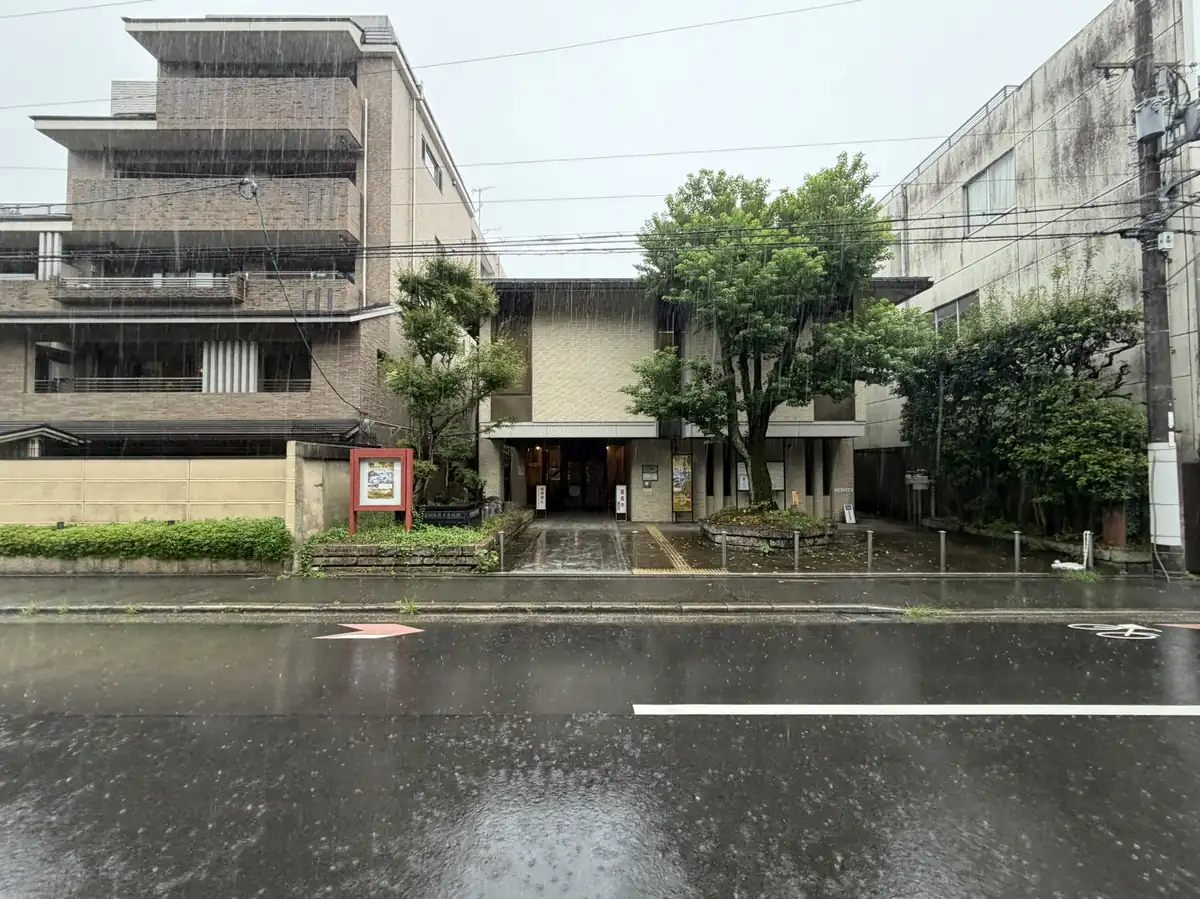
Tap any photo to enlarge. Look for the blue street sign reading 京都市歴史資料館.
Is it worth visiting? Who this place suits
| Worth it if | You want to see how Hideyoshi's rebuilding of Kyoto — Jurakudai, the Odoi rampart, the Tensho land division, Fushimi Castle — was recorded in documents of the period, rather than read a later summary. Also if you are curious why Kyoto's street blocks and temple districts look the way they do |
|---|---|
| Skip it if | You want armour, swords or excavated finds, or a large museum experience. There is essentially none of that here |
| Time needed | 30–60 minutes. I spent about 40 |
| Language | Captions and panels are in Japanese. See the note below before you decide |
| Crowds | On my visit — a rainy weekday afternoon — I was the only visitor |
| Combines well with | The Kyoto Imperial Palace grounds and a walk along Teramachi Street, both a few minutes away |
The language barrier, honestly assessed
This is the point that decides whether the visit works for you. The exhibits are written in kuzushiji, the flowing cursive script used in pre-modern Japanese documents. Almost no modern Japanese person can read it fluently either — I certainly could not. Every item has an explanatory panel, but those panels are in Japanese, and on my visit I did not see English captions.
What that means in practice: if you read Japanese, the panels carry the exhibition and it works well. If you do not, a phone camera translation app will get you through the panels, and the maps and drawings — which are the strongest items here — still reward looking at directly, because a plan of a castle reads the same in any language. I would not recommend making a special trip across Kyoto for this if you cannot read Japanese and have no translation app, but as a free 30-minute stop near the Imperial Palace it is still worthwhile.
A printed exhibition booklet is sold at the reception desk for 300 yen, and I bought one. It reproduces the section structure and the full list of exhibits. It is in Japanese, so treat it as a souvenir and reference rather than a way around the language barrier.
One practical rule to know before you arrive: on my visit, photography was prohibited throughout the interior. That is why the photographs on this page show only the outside of the building and the printed exhibition leaflet.
Hours, closing days and admission
| Name | Kyoto City Library of Historical Documents (京都市歴史資料館, Kyoto-shi Rekishi Shiryokan) |
|---|---|
| Address | 138-1 Matsukage-cho, Teramachi-dori Kojinguchi-sagaru, Kamigyo Ward, Kyoto 602-0867 |
| Opening hours | 9:00–17:00. The reception desk for historical enquiries and document viewing closes at 16:30 |
| Admission | Free |
| Closed | Mondays, public holidays, and 28 December – 4 January. The museum also closes three or four times a year for exhibition changeovers |
| Inside | Exhibition Room 1 (themed and special exhibitions), Exhibition Room 2 (panel displays and video), and a document reading room |
| Accessibility | Lift, accessible toilet and a wheelchair are available |
| Parking | None. Public transport is recommended by the museum |
Checked against the City of Kyoto's official visitor information page on 21 September 2026. Because unscheduled closures happen a few times a year, confirm before travelling.
The closing rule that catches people out: this museum is closed on Mondays and on Japanese public holidays. Many Japanese museums that close on Mondays stay open when a Monday falls on a public holiday and close the Tuesday instead. Here the two are listed as separate closing days, so a public holiday in the middle of the week is also a closed day. Check the calendar before building it into a long-weekend itinerary.
The 2026 exhibition: dates and rotations
| Exhibition | Toyotomi Hideyoshi and Kyoto: The Great Rebuilding of the City and Its Outskirts (豊臣秀吉と京都―洛中洛外の大規模改造―) |
|---|---|
| Dates | 4 July – 25 October 2026 |
| Venue | Exhibition Room 1, ground floor |
| Admission | Free |
| Rotations | Period I: 4 July – 9 August. Period II: 12 August – 13 September. Period III: 15 September – 25 October |
| Gallery talks | Saturday 26 September and Thursday 15 October 2026, from 14:00, about 40 minutes. Free, no booking required. Given by museum staff, in Japanese |
| After the exhibition | The museum plans to close from 26 to 30 October 2026 to install the next display |
Checked on the City of Kyoto exhibition page on 21 September 2026. The 18 July and 19 August gallery talks have already taken place.
The run is divided into three periods, and roughly half the items rotate. Of the 60 exhibits, 32 are shown for the whole run; the other 28 appear in one period only. I saw Period II (12 August – 13 September), so the items described below reflect that visit. In the section-by-section guide further down, each exhibit is listed with its display period so you can check whether a particular item will be out on your date.
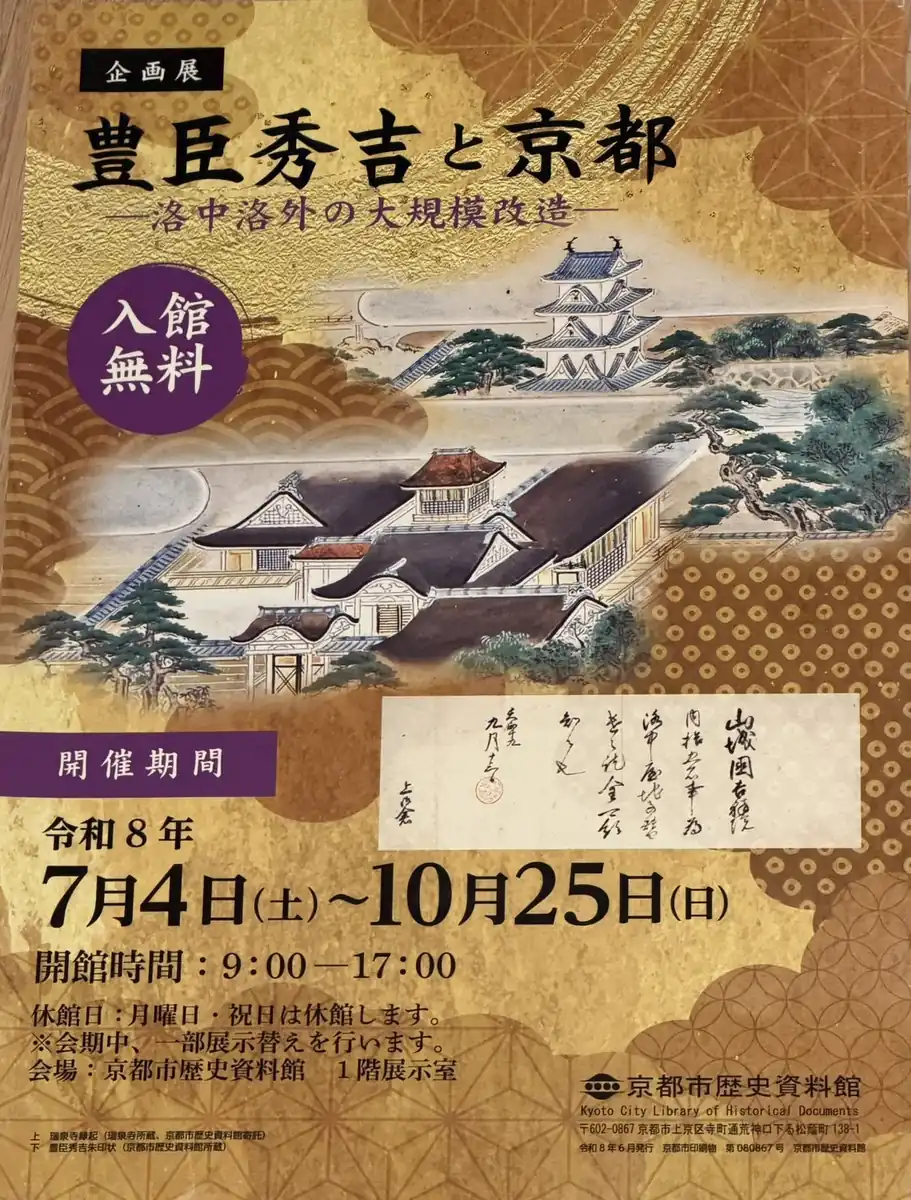
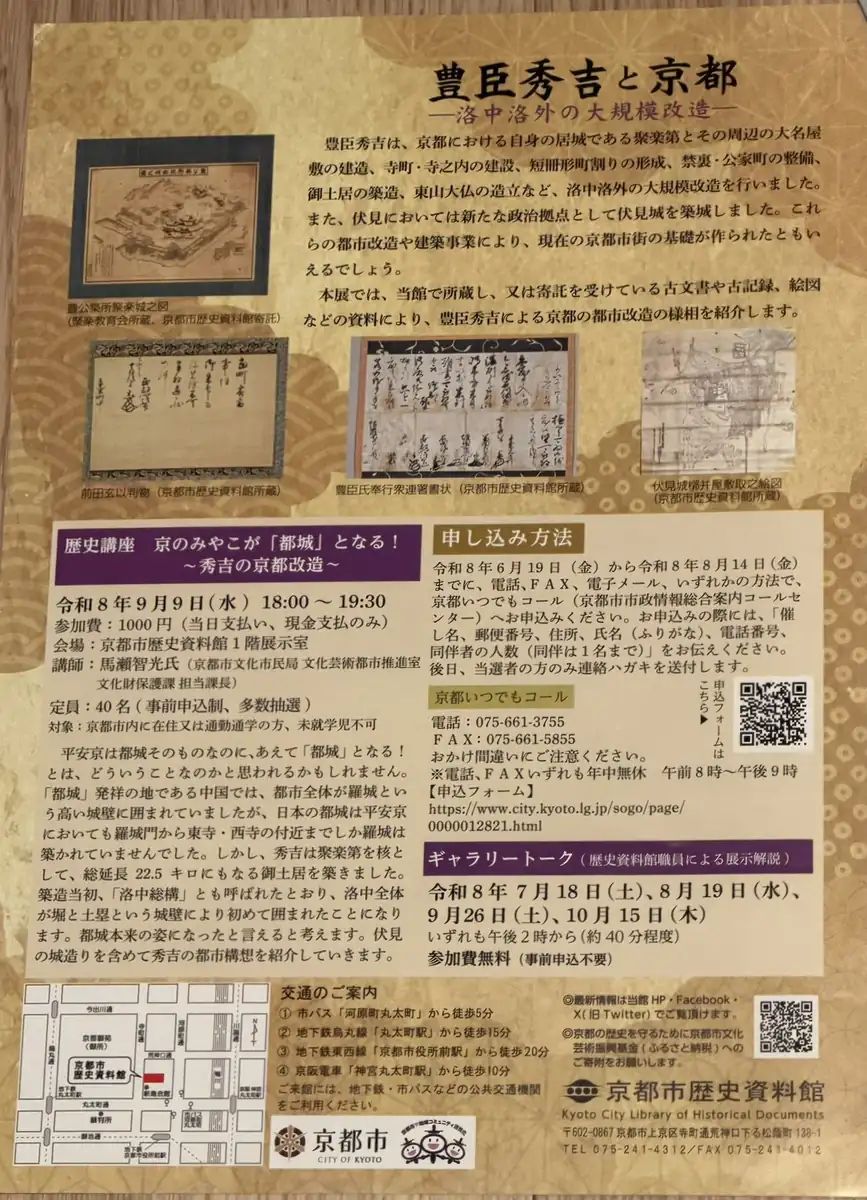
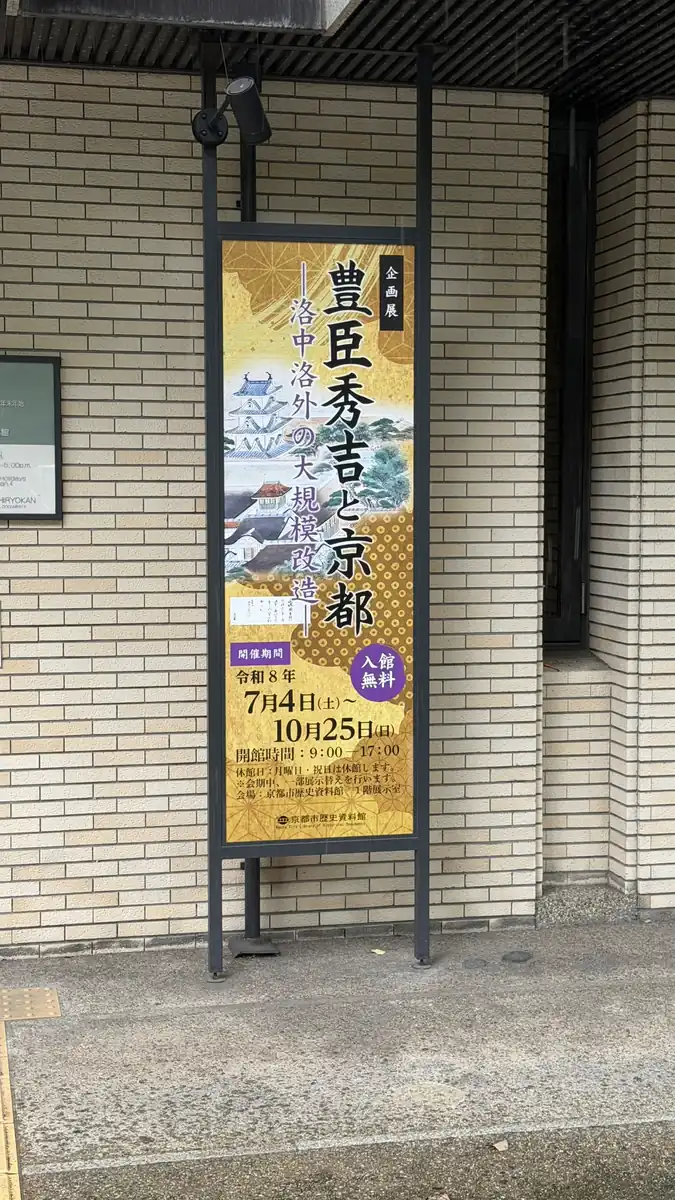
The leaflet handed out at the museum, and the sign at the entrance. Photographs by the author.
How to get there
The museum is in central Kyoto, on the east side of the Kyoto Imperial Palace grounds (Kyoto Gyoen). It is a short walk from several transport points, and no single one is dramatically better than the others — use whichever suits where you are coming from.
| Address | 138-1 Matsukage-cho, Teramachi-dori Kojinguchi-sagaru, Kamigyo Ward, Kyoto 602-0867 |
|---|---|
| City bus | Kawaramachi-Marutamachi stop (河原町丸太町) — 5 minutes on foot |
| Subway, Karasuma Line | Marutamachi Station (丸太町駅) — 10 minutes on foot |
| Subway, Tozai Line | Kyoto Shiyakusho-mae Station (京都市役所前駅) — 15 minutes on foot |
| Keihan Railway | Jingu-Marutamachi Station (神宮丸太町駅) — 10 minutes on foot |
| Landmark | East of the Kyoto Imperial Palace grounds, facing Teramachi Street. A tall vertical exhibition sign stands beside the entrance |
| Parking | None |
Walking times are the museum's own estimates from its official access page, checked on 21 September 2026. The printed leaflet sometimes gives different figures.
Three different places are called "Marutamachi", and they are not interchangeable. Marutamachi Station (丸太町駅) is on the Kyoto Municipal Subway's Karasuma Line, west of the Imperial Palace grounds. Jingu-Marutamachi Station (神宮丸太町駅) is a different station on the Keihan Railway, a private operator, east of the Kamo River. Kawaramachi-Marutamachi (河原町丸太町) is neither — it is a city bus stop. The subway and Keihan are separate companies with separate fares, and neither is covered by the Japan Rail Pass. IC cards such as ICOCA and Suica work on all of them.
Navigation is straightforward: set your map app to the address above, or simply aim for the east side of the Imperial Palace grounds and walk south along Teramachi Street. I had no trouble finding it. The building sits directly on the street, with a red notice board on the left of the entrance and the exhibition sign on the right, so it is recognisable as you approach even in bad weather.
What this place actually is — and what it is not
The museum opened in November 1982 as a city institution for preserving Kyoto's historical records, researching them, and making the results public through exhibitions, lectures and publications. According to the Kyoto City Tourism Association, the collection holds around 200,000 historical items and roughly 31,000 books. That figure describes what is stored, not what is on view: the ground-floor room shows a few dozen items selected for each exhibition.
Alongside Exhibition Room 1 there is a second exhibition room with panel displays and video, and a reading room where specialist books on Kyoto history and reproductions of old documents can be consulted; staff also answer historical enquiries. Those are facilities for research rather than sightseeing. On my visit I only saw the ground-floor exhibition room, and for a visitor passing through Kyoto that is the part that matters.
Three Kyoto institutions with confusingly similar names. The Kyoto City Library of Historical Documents (this page, on Teramachi Street) handles paper: documents, records and maps. The Kyoto City Archaeological Museum (Imadegawa-dori, also in Kamigyo Ward) handles excavated objects — it is a different building with a different collection. The Kyoto Prefectural Library and Archives (Rekisaikan, in Sakyo Ward) is a third, much larger prefectural library and archive. All three touch on Hideyoshi's rebuilding of Kyoto, but from documents, from the ground, and from the library shelf respectively.
Why Hideyoshi rebuilt Kyoto
Toyotomi Hideyoshi (1537–1598) rose from peasant origins to become the warlord who completed the unification of Japan after the death of his lord Oda Nobunaga in 1582. By the late 1580s he held effective power over the country, and Kyoto — still the emperor's capital — was where that power had to be made visible.
The Kyoto he inherited had been wrecked by a century of warfare. The northern and southern halves of the city, Upper Kyoto and Lower Kyoto, had become separate walled settlements rather than one continuous city. Hideyoshi's response was a rebuilding programme carried out over roughly a decade:
Jurakudai (聚楽第)
His own palace-castle in Kyoto, completed in 1587, with the residences of his daimyo — the regional lords under him — gathered around it. Demolished in 1595.
Teramachi and Tera-no-uchi
Buddhist temples scattered across the city were moved into two designated districts. Teramachi Street still carries the name, which means "temple town".
The Tensho land division
Named after the Tensho era (1573–1592). City blocks that had been roughly square were cut lengthwise into narrow strips, which is why Kyoto's plots are long and thin to this day.
The imperial palace and nobles' quarter
The residences of the court nobility were consolidated around the imperial palace, producing the layout that became today's Kyoto Imperial Palace grounds.
The Odoi (御土居)
An earthen rampart and moat encircling the city. The exhibition organisers put its total length at 22.5 km and note that it was also called the "outer wall of the capital" when first built.
The Great Buddha and the bridges
A colossal Buddha at Higashiyama, plus the rebuilding of Gojo Ohashi and Sanjo Ohashi, the two great bridges over the Kamo River.
Fushimi Castle (伏見城)
A new seat of government south of Kyoto, on the route to Osaka. Begun in 1592, destroyed by an earthquake in 1596, rebuilt on a different hill, and finally dismantled in 1623.
Those seven themes are exactly the seven sections of the exhibition. Walk through Kyoto today and you meet the results constantly: temples lined up along one street, blocks that run long and narrow, fragments of an earthen rampart surviving in odd corners of the city. This exhibition is where you can see the paperwork that produced them.
For viewers following the 2026 NHK historical drama Toyotomi Kyodai! ("The Toyotomi Brothers!"), about Hideyoshi and his younger brother Hidenaga, this is the other half of the story: what Hideyoshi was building while the battles were being fought. The exhibition itself has no production connection to the drama.
The exhibition section by section: all 60 items
The exhibition is divided into seven sections holding 60 items in total. Below, each section has a short description of what it covers and what stood out to me, and an expandable list of every item in that section with its display period, so you can check what will be out on your date. English titles are my own translations of the Japanese titles given in the museum's exhibit list; the Japanese title follows in brackets.
FY2026 Special Exhibition · Kyoto City Library of Historical Documents
Toyotomi Hideyoshi and Kyoto: All 60 ObjectsCheck the Phase I, II and III rotations by date
Explore all 60 objects tracing Hideyoshi's transformation of Kyoto—from Jurakudai and the Odoi earthworks to Fushimi Castle. Select a visit date to see exactly what will be on view.
- Dates
- July 4–October 25, 2026 · Phase I: Jul 4–Aug 9 · Phase II: Aug 12–Sep 13 · Phase III: Sep 15–Oct 25
- Venue
- First-floor Exhibition Room, Kyoto City Library of Historical Documents (admission free)
- About this list
- Checked against the venue's 60-object checklist. Phase labels have been converted to their actual date ranges.
Please also check the official exhibition page (Japanese) for opening hours and the latest notices.
Filter the objects
Search by object number, title or collection. Enter a planned visit date to show only objects on display that day; Mondays and public holidays are treated as closure days.
Date-based filtering is active, so phase filters are disabled.
Enter your planned visit and previous visit dates to show only objects you can see for the first time.
How display dates and English titles are handled
- Phase I runs July 4–August 9; Phase II, August 12–September 13; and Phase III, September 15–October 25.
- The checklist's phase labels have been converted to actual date ranges. Date comparison checks the selected date against each object's display period.
- Object numbers 1–60, Japanese titles, dates, collections, cultural-property status and display periods were checked against the venue checklist.
- Where an institution publishes an English title or romanized catalog title, that wording is used and linked in the source note below. The exhibition title and all other English object titles are editorial translations by Following the Shogun; the Japanese title is retained in every row.
- “Throughout*” follows the checklist's asterisk: the display location may change during the exhibition, including page or volume rotations.
- The library is closed on Mondays and public holidays. Date filtering accounts for Monday closures and public holidays during the exhibition.
- “Same title / rotation” groups separately catalogued objects with the same title or related materials rotated during the run. Identical English titles do not necessarily mean the same physical object.
Naming sources: Kyoto City Library of Historical Documents (Kyoto Museums Association); Nakamukashi Keishi Chizu (Bukkyo University Library); Miyako meisho zue, vol. 2 (Smithsonian Libraries); Hengaku Kihan (Transcription of Wooden Prayer Plaques at Shrines and Temples in Kyoto) (Tokyo Museum Collection).
| No. | Section | Object | Collection | Other venues | Media links |
|---|
No objects match these filters. Please change your selection.
How to read the lists. ◆ marks an item designated a Cultural Property by the City of Kyoto; ◇ marks a registered Cultural Property. "Whole run" means the item is shown for the full exhibition; "pages turned" means the item stays out but the page on display may change. Period I is 4 July – 9 August, Period II is 12 August – 13 September, and Period III is 15 September – 25 October 2026.
Kyoto before the rebuilding
What the city looked like before Hideyoshi touched it
The opening section sets the scene. The item I spent longest on in the whole exhibition was here: a map of old Kyoto (中昔京師地図) showing what stood where in the city, and whose residence occupied which plot. Reading a map like this is, for me, what makes the exhibition worth the trip — place names that are just words on a page suddenly acquire a position.
The other two items are account books recording how the city was actually run and paid for in the 1570s. Both come from the archive of the Tateiri family, Kyoto merchants, and are designated Cultural Properties by the city.
Items and display periods
- Map of old Kyoto (中昔京師地図) — whole run
- ◆Record of rice borrowed by the city, 1571 (元亀二年御借米之記) — whole run, pages turned
- ◆Monthly rice-provisioning ledger for Upper and Lower Kyoto, 1572 (上下京御膳方御月賄米寄帳) — whole run, pages turned
Jurakudai, Hideyoshi's Kyoto castle
A castle that stood for eight years, reconstructed from drawings
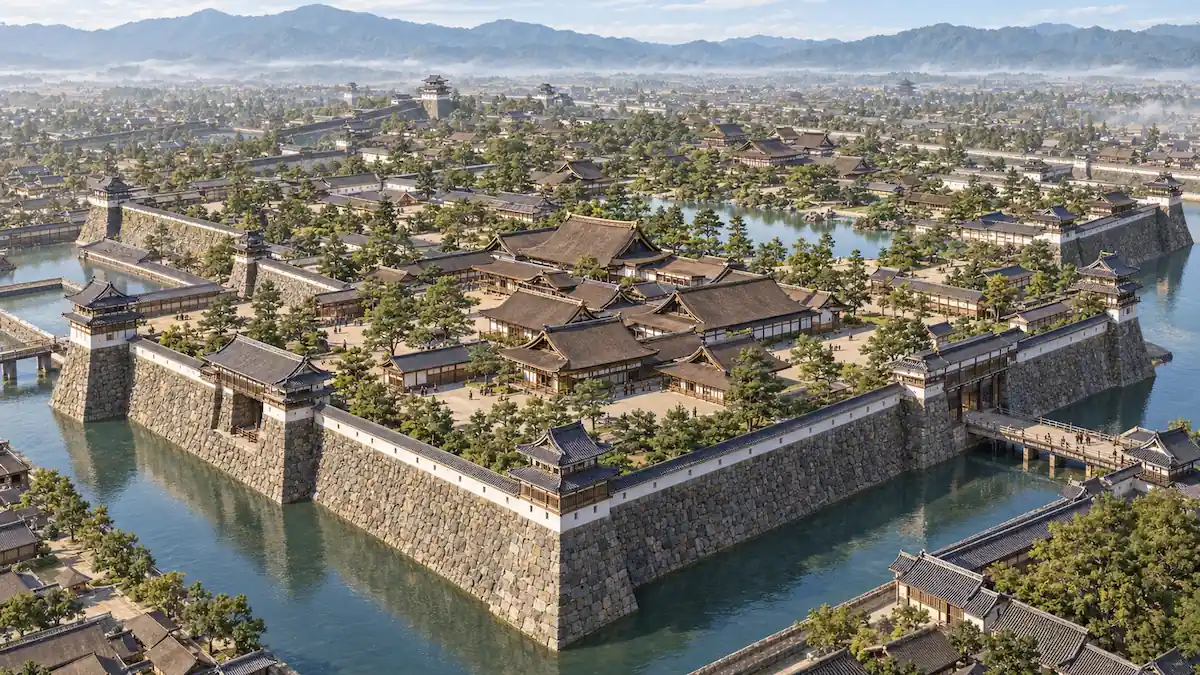
Jurakudai was the palace-castle Hideyoshi built for himself in Kyoto. It was finished in 1587, and in 1588 the emperor himself visited it — an extraordinary event that Hideyoshi had recorded in detail. Seven years later, after the forced suicide of his nephew and heir Toyotomi Hidetsugu, the whole complex was pulled down. Not one building survives above ground.
The single item that impressed me most in this exhibition is here: a plan of Jurakudai as built by Hideyoshi (豊公築所聚楽城之図), showing the castle ringed by moats and stone walls. Reading that a castle once stood somewhere is one thing; seeing its scale and layout drawn out is another. It is paired with a view of the site (豊公築所聚楽城趾形勝). Both were produced in December 1884 by the Juraku Education Society and are registered Cultural Properties of the city.
Items and display periods
- Rojin Zatsuwa, a collection of an elder's recollections (老人雑話) — whole run
- Vermilion-seal letter of Toyotomi Hideyoshi, 1585 (豊臣秀吉朱印状) — whole run
- Ruling issued by Maeda Gen'i, Hideyoshi's Kyoto administrator, 1585 (前田玄以判物) — whole run
- ◇View of the site of Jurakudai, 1884 (豊公築所聚楽城趾形勝) — whole run
- ◇Plan of Jurakudai as built by Hideyoshi, 1884 (豊公築所聚楽城之図) — whole run
- Origin record of Zuisen-ji temple, vol. 1, Edo period (瑞泉寺縁起巻一) — Periods I and II
- ◆Annotated record of the 1588 imperial visit (校注行幸記) — whole run, pages turned
- ◆Procession of the imperial visit to Jurakudai (聚楽行幸行列) — whole run, pages turned
- ◆Purchasing diary for the 1588 imperial visit (行幸賄方買物日記) — Period III only
- Map of Kennin-ji temple's fields around the former Jurakudai, 1698 (聚楽廻建仁寺御領田畑絵図) — whole run
What to look for
- Three items concern the emperor's 1588 visit. The most revealing is the purchasing diary (行幸賄方買物日記), a record of what was bought, and how much of it, to host an emperor. It is shown in Period III only.
- The 1698 map of temple fields around the former Jurakudai shows what happened to the land after the castle was destroyed.
- To visit the site itself, see our Jurakudai walking route, which maps the surviving markers and the spots where gold-leafed roof tiles were excavated.
The imperial palace and the nobles' quarter
Why the Imperial Palace grounds have the shape they do
Hideyoshi's rebuilding was not only about castles. This short section covers the consolidation of the court nobles' residences, which had been scattered across Kyoto, into a single quarter around the imperial palace. There is one item, a map of that quarter as it stood in the Keicho era (1596–1615), but it explains a great deal: if you have walked in the Kyoto Imperial Palace grounds and wondered why such a large rectangle of open parkland sits in the middle of the city, this is the answer.
Item and display period
- Map of the court nobles' quarter in the Keicho era (1903 copy) (慶長公家町之絵図) — whole run
The Great Buddha, Gojo Ohashi and Sanjo Ohashi
The only section with something you could pick up
This section covers the colossal Buddha Hideyoshi had cast at Higashiyama, and the rebuilding of the two main bridges over the Kamo River. The document on rice cakes, sake and work allocation for the Great Buddha project is a reminder that these were vast construction sites needing thousands of labourers, all of whom had to be fed and organised.
I said above that there are almost no objects here. This section holds the exception. The exhibit list includes a bronze giboshi finial from Sanjo Ohashi Bridge (三条大橋擬宝珠) — an onion-shaped ornament that sat on top of the bridge's railing posts — shown for the whole run, together with a rubbing of its inscription. After several rooms of paper, it is a jolt to meet something with weight.
Items and display periods
- Illustrated guide to famous places in Kyoto, Higashiyama vol. 4, 1864 (再撰花洛名勝図会東山之部巻四) — whole run
- ◆Record of rice cakes, sake and work allocation for the Great Buddha project (大仏普請衆餅・酒・地割書上) — Period III only
- Illustrated guide to the capital's famous places, vol. 2, 1786 (都名所図会巻之二) — whole run
- Bronze giboshi finial from Sanjo Ohashi Bridge (三条大橋擬宝珠) — whole run
- Rubbing of the inscription on the Sanjo Ohashi finial (三条大橋擬宝珠銘文拓本) — whole run
- Copy of the official noticeboard at the Sanjo Ohashi bridgehead (三条大橋詰御制札之写) — whole run
The Tensho land division, Teramachi and Tera-no-uchi
Where the street plan of modern Kyoto was decided
This is the section that pays off most directly when you walk around Kyoto afterwards. Hideyoshi had the city surveyed, cut its near-square blocks lengthwise into long narrow strips, and moved the temples into the designated districts of Teramachi and Tera-no-uchi. The reason temples line one particular street, and the reason Kyoto's plots are long and thin, both begin here.
What surprised me is how bureaucratic the evidence is. These are working municipal documents: surveys measuring the frontage of each house, ledgers of plot sizes, registers of householders, and written pledges from individual neighbourhoods undertaking to search for a wanted criminal. Rebuilding a capital, it turns out, looks like measuring, listing and issuing instructions street by street. Three of those criminal-search pledges are on display, one per period, each from a different neighbourhood.
Items and display periods
- ◆Survey of house frontages, Kiyamachi, 1587 (軒別間口書上(木屋町)) — Period I only
- ◆Survey of house plot sizes, 1587 (軒別坪数書上) — Period II only
- ◆Survey of house plot sizes, Akino-nomae-shinmachi, 1587 (軒別坪数書上(秋野野前新町)) — Period III only
- ◇Vermilion-seal letter of Toyotomi Hideyoshi, 22 Sept 1591 (豊臣秀吉朱印状) — Period I only
- ◆Vermilion-seal letter of Toyotomi Hideyoshi, 13 Sept 1591 (豊臣秀吉朱印状) — Period II only
- Copies of old Kyoto vermilion-seal and official documents, c.1818 (上古京御朱印類并御判物写) — Period III only
- ◆Register of householders, 1594 (家持衆書上帳) — whole run, pages turned
- Toyotomi Bukan, a directory of Toyotomi retainers, late Edo period (豊臣武鑑) — whole run
- Written oath of Shimo-Honnoji-mae-cho, 1595 (下本能寺前町起請文) — whole run
- ◆Pledge to search for a criminal, Saikyo Gyoe-cho, 1593 (犯人探索請状(西京行衛町)) — Period I only
- ◆Pledge to search for a criminal, Teramachi Shingyo-ji-mae-cho, 1593 (犯人探索請状(寺町信楽寺前町)) — Period II only
- ◆Pledge to search for a criminal, Shoshoi-shimo-cho, 1593 (犯人探索請状(少将井下町)) — Period III only
- Copy of a petition from the Reizei-Muromachi district, 1590 (冷泉室町惣中申状写) — whole run
- Record of handing over a public construction site, 1595 (御普請場渡申分) — whole run
- Old records of Kyoto (京都旧記録) — whole run
- Map of central Kyoto, 1715 (洛中絵図) — whole run
What to look for
- Two groups rotate one item per period: the three frontage and plot-size surveys of 1587, and the three criminal-search pledges of 1593. Whichever period you visit, you will see one of each kind.
- The map of central Kyoto of 1715 is shown for the whole run and lets you see the result of the land division as it stood a century later.
The Odoi earthen rampart
A 22.5 km wall that decided who was inside the city
The Odoi was an earthen rampart with an outer moat that Hideyoshi threw around the whole of central Kyoto. The exhibition organisers give its total length as 22.5 km and note that it was originally also called the "outer wall of the capital". With it, the city was enclosed for the first time — and the distinction between rakuchu (inside the capital) and rakugai (outside it) was drawn physically on the ground rather than merely spoken of.
What makes this short section interesting is that it does not stop at the building. It covers what the rampart was for — defence, but also flood protection — how the bamboo and trees planted on it were managed, and how the eastern stretch was dismantled during the Edo period. An Edo-period book of official notices is among the items, which is to say the section is about maintenance and decay as much as construction. Fragments of the Odoi still survive scattered around Kyoto.
Items and display periods
- Kyoto Oboegaki, a memorandum on the city, c. Genroku era (京都覚書) — whole run
- Map of Higashi-Shiokoji village (東塩小路村絵図) — whole run
- ◇Edo-period official notices (触書) — whole run
- Standards for temple and shrine plaques, late Edo period (扁額規範) — whole run
All four are shown for the whole run, so this section is the same whenever you visit.
Fushimi Castle
Built, flattened by an earthquake, rebuilt, then dismantled
The largest section. Fushimi, south of Kyoto on the route to Osaka, was where Hideyoshi built a new seat of government. Work on the first castle, on Shigetsu hill, began in 1592. An earthquake brought it down in 1596; it was rebuilt on nearby Kohatayama hill, passed to Tokugawa Ieyasu and his successors, and was finally dismantled in 1623. The section follows that whole arc.
The third item that stayed with me is here: a plan of Fushimi Castle and its residence plots (伏見御城槨并屋敷取之絵図) of 1788, showing the castle enclosures and which lord held which plot around them. Like the map of old Kyoto in Section I, it is a document you can actually read as a visitor, without deciphering the handwriting — and those, for me, were consistently the best things in the exhibition.
The other highlight is the paperwork of construction. Six reports record building materials requisitioned from temples in the Teramachi district, and three more cover receipts for roof tiles and the wages, paid in rice, for applying gold leaf to them. Together they show where a castle's materials came from and what they cost.
Items and display periods
- ◆Building-material report from Jokyo-ji temple, 1592 (寺町資材届書(浄教寺)) — Period I only
- ◆Building-material report from Shuncho-ji temple, 1592 (寺町資材届書(春長寺)) — Period I only
- ◆Building-material report from Seigan-ji temple, 1592 (寺町資材届書(誓願寺)) — Period II only
- ◆Building-material report from Seigan-ji temple, 1592 (寺町資材届書(誓願寺)) — Period II only
- ◆Building-material report from Myoden-ji temple, 1592 (寺町資材届書(妙伝寺)) — Period III only
- ◆Building-material report from Fukusho-ji temple, 1592 (寺町資材届書(福勝寺)) — Period III only
- ◆Petition to relocate Zokoan in Fushimi, 1593 (伏見蔵光庵替地願) — Period III only
- ◆Wage record in rice for gold-leafing Fushimi Castle roof tiles, 1594 (伏見城瓦箔押し手間代米書上) — Period I only
- ◆Receipt for roof tiles, Feb 1593 (瓦請取) — Period II only
- ◆Receipt for roof tiles, Nov 1593 (瓦請取) — Period II only
- Joint letter of the Toyotomi magistrates, Bunroku era (豊臣氏奉行衆連署書状) — whole run
- Plan of Fushimi Castle and its residence plots, 1788 (伏見御城郭并屋敷取之絵図) — whole run
- Picture of the great Fushimi earthquake, 1876 (伏見大地震之図) — whole run
- ◆Letter of Shinjo Naosada, 5 Aug 1600 (新庄直定書状) — Period I only
- Sketch map of the castle hill, 1871 (御城山略図) — whole run
- Sketch of the main enclosure facing south (本丸南向ノ略図) — whole run
- Sketch of Matsu-no-maru facing north (松ノ丸北向略図) — whole run
- Sketch of the Ninomaru terrace facing west (二ノ丸台西向略図) — whole run
- Sketch of the Nagoya terrace facing east (名護屋台東向ノ略図) — whole run
- Plan of the Kusakabe terrace at Fushimi Castle (伏見城日下部台絵図) — whole run
What to look for
- The six building-material reports rotate two per period: Jokyo-ji and Shuncho-ji in Period I, the two Seigan-ji documents in Period II, and Myoden-ji and Fukusho-ji in Period III.
- The six sketch plans from the Yoshimura family archive are all shown for the whole run. They record how the site of the castle was mapped after it had been dismantled.
- The picture of the great Fushimi earthquake of 1876 is also shown throughout, and is worth a look for how the 1596 disaster was still being depicted nearly three centuries later.
The video in the exhibition room
About 10 of my 40 minutes went on a video playing in the exhibition room. It was not about the special exhibition but about the castles of Kyoto more broadly: it begins by treating the earthen defences of the ancient capital as castles in the widest sense, moves through the many fortifications built in and around Kyoto during the warring-states century, then covers Jurakudai, the Odoi, Fushimi Castle and finally Nijo Castle. Watching it after the seven sections helps place Hideyoshi's decade of rebuilding within a much longer story.
It is in Japanese, but much of the value is visual, and there is seating. What plays may change over time, so do not count on seeing the same film.
If you only have 30 minutes
Based on my visit in September 2026, during Period II. This is a personal ranking, not the museum's recommended order. All three items below are shown for the whole run, so they are on display whenever you visit during the exhibition.
Nothing of Jurakudai survives above ground, and this drawing is where the castle becomes real: moats, stone walls, scale. Worth seeing whether or not you plan to walk the site afterwards — our Jurakudai walking route covers the ground itself.
Shows what stood where in the city before the rebuilding, and whose residence was on which plot. Seeing it early makes the rest of the exhibition easier to follow, because you know which part of the city each section is talking about.
The castle enclosures and the residence plots around them, drawn out clearly enough to read without deciphering handwriting. Especially useful if Fushimi is on your itinerary.
Conversely, if you are short of time, Section V can be skimmed. The municipal surveys and neighbourhood pledges are fascinating once explained, but the interest is in the explanation rather than in looking at the document, which makes them a poor use of a rushed thirty minutes — and a bad bet if you cannot read the Japanese panels. Save that section for a visit where you can take your time.
Related guides
Frequently asked questions
Admission is free. The museum is open from 9:00 to 17:00, with the desk for historical enquiries and document viewing closing at 16:30. It is closed on Mondays, on Japanese public holidays, and from 28 December to 4 January, plus three or four unscheduled closures a year for exhibition changeovers.
In practice it works as a small free museum. The English name translates a Japanese term meaning "historical materials centre". There is a reading room for consulting books and copies of old documents, but visitors normally come for the exhibition in the ground-floor room, which anyone can enter without booking or permission.
I arrived at 14:30 and left at 15:10, about 40 minutes, roughly 10 of which were spent watching a video in the exhibition room. Thirty to sixty minutes covers it. This is a stop to fit between other things in Kyoto, not a half-day destination.
On my visit the exhibit panels were in Japanese and I did not see English captions, nor an audio guide in any language. A phone camera translation app handles the panels adequately. The maps and architectural drawings, which are the strongest items, can be appreciated without reading anything.
On 9 September 2026, photography was prohibited throughout the interior. That is why this page shows only exterior photographs and the printed leaflet. Rules can change, so follow the signage on the day.
Essentially none. All 60 items in the 2026 exhibition are documents, records and maps, with one notable exception: the exhibit list includes a bronze giboshi finial from Sanjo Ohashi Bridge, in Section IV, shown for the whole run. If you want excavated material, the separate Kyoto City Archaeological Museum covers that side of the same history.
It runs from 4 July to 25 October 2026 in the ground-floor exhibition room, free of charge. There are three rotations: Period I from 4 July to 9 August, Period II from 12 August to 13 September, and Period III from 15 September to 25 October. Of the 60 items, 32 are shown throughout and the other 28 appear in one period only. The museum plans to close from 26 to 30 October 2026 to install the next exhibition.
Museum staff give gallery talks of about 40 minutes on Saturday 26 September and Thursday 15 October 2026, both starting at 14:00. They are free and need no booking, and are given in Japanese. The talks on 18 July and 19 August have already taken place.
Marutamachi Station on the Karasuma subway line and Jingu-Marutamachi Station on the Keihan Railway are both about 10 minutes on foot; the Kawaramachi-Marutamachi city bus stop is about 5 minutes. These are three different places with similar names, operated by different companies, so check which one your route actually uses. The museum is on the east side of the Kyoto Imperial Palace grounds, facing Teramachi Street, and has no car park.
No, they are separate institutions. The Kyoto City Library of Historical Documents, on Teramachi Street in Kamigyo Ward, holds documents, records and maps. The Kyoto City Archaeological Museum, on Imadegawa Street, displays objects recovered from excavations. The Kyoto Prefectural Library and Archives in Sakyo Ward is a third, unrelated institution.
On my visit, a rainy weekday afternoon, there were no other visitors and I could read the displays at my own pace. The exhibition room is small, so it could feel full with a group in it, but this is not a place where queues form.


comment