


Mt. Hiei Enryakuji Saito Precinct: 5 Highlights | Shakado Hall, Ninaido & Jodo-in
The moment you leave the vermilion-lacquered halls of Todo and step onto the path toward Saito, the air changes. The crowds fall away.
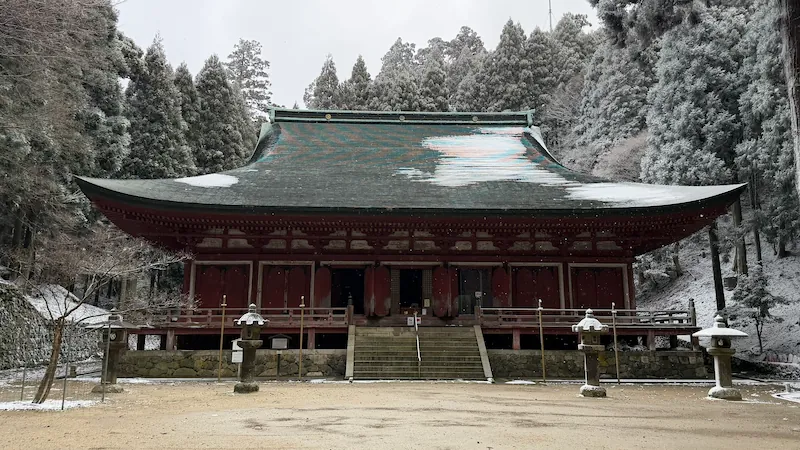
The moment you leave the vermilion-lacquered halls of Todo and step onto the path toward Saito, the air changes. The crowds fall away. The cedar forest deepens. Stone steps lead down to halls that emerge from the trees one at a time. Of the three Enryakuji precincts, Saito is the most intensely monastic — and the oldest surviving building on the entire mountain, Shakado Hall (1347), still breathes here as a living place of practice. On the day I visited, the shuttle bus wasn't running. I walked through the snow. When I reached Shakado Hall and found it completely deserted, I didn't feel like I was sightseeing. I felt like I had been temporarily let into a place that was still in active use. This is a different face of Enryakuji altogether.
Saito Precinct — Spots on This Page
About the Saito Precinct
The Saito precinct lies roughly one kilometer west of Todo and forms the second of Enryakuji's three distinct temple territories. It is said to have been established by Encho, the second Tendai Zasu (head of the Tendai school), and its central hall — Shakado (formally Tenpohrin-do) — is surrounded by the Ninaido twin halls (Jogo-do and Hokke-do), Jodo-in, and other structures scattered through deep cedar forest. Compared to Todo, Saito draws far fewer visitors and carries a markedly more austere, monastic atmosphere. The precinct was obliterated in Nobunaga's 1571 burning, and its reconstruction began in a notably different way: rather than building anew, Toyotomi Hideyoshi relocated Shakado Hall from Miidera Temple (a rival institution at the foot of the mountain) to serve as the Saito main hall. Saito was never rebuilt to the same scale or visual splendor as Todo — and that historical restraint is precisely what gives the precinct its character today. Visiting hours are normally 9:00–16:00 (9:30–16:00 in winter, December through February). The shuttle bus from Todo takes about 10 minutes.
Spot Details
Jodo-in 🎥 360°
The mausoleum of Saicho — the most sacred enclosure on Mt. Hiei, kept at the foot of steep stone steps deep in the cedar forest
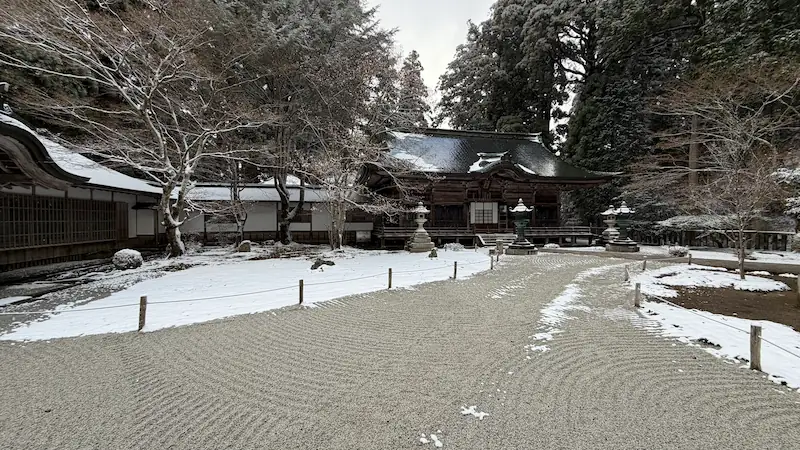
Jodo-in is the mausoleum compound of Dengyo Daishi Saicho, and it holds a quality of stillness that sets it apart from every other corner of the mountain. Saicho died in 822, and in 854 the monk Ennin (Jikaku Daishi) transferred his remains to this site and enshrined them here — establishing a sanctuary that has been maintained in his honor ever since. Jodo-in sits at the boundary between the Todo and Saito precincts, though it is officially classified as part of Todo. It lies at the foot of a steep stone staircase descending from near the Sanno-in area, which means visitors who don't know to look for it will often walk right past. Watch the signboards carefully. The layout — a worship hall (haiden), a Chinese-style gate (kara-mon), and the mausoleum itself arranged in a straight line along the approach — avoids all ornament in favor of a composed, grave formality appropriate to a founder's tomb. What makes the place unusual is that it remains actively tended: monks engaged in the juuninen rouzan (a 12-year mountain retreat during which practitioners are not permitted to leave the mountain — one of the most demanding forms of ascetic discipline in Tendai Buddhism) continue to serve here every day, treating Saicho as if still living. That ongoing human presence is what distinguishes Jodo-in from a mere historical monument.
Highlights
- The mausoleum of Dengyo Daishi Saicho: Known throughout the mountain as one of its most sacred precincts, Jodo-in is the place where reverence for Enryakuji's founder — as a person rather than as an institution — becomes most tangible. Monks of the 12-year mountain retreat serve here daily, and the sense of an actively maintained sanctuary rather than a preserved historical site is unmistakable.
- A composed, restrained layout: The haiden, kara-mon, and mausoleum aligned along a single approach path create a quiet formality — dignified without any display, which feels exactly right for a founder's tomb.
- Easy to miss — pay attention to the signs: The compound lies at the bottom of a steep stone staircase descending from near the Sanno-in, and its position is not immediately obvious. Keep an eye on the signboards or you will walk straight past it.
⏳ Time estimate: Quick visit 10 min / Thorough visit 20–30 min
🗺 Address: Sakamoto Honmachi / Sakamoto 4-chome, Otsu, Shiga
🚶 Access: Approx. 15-minute walk from the Hokke Soji-in East Pagoda; descend steep stone steps from near the Sanno-in
⭐ Recommended Historical Significance: ☆☆☆ Visual Impact: ☆☆ Experiential Value: ☆☆
| Year Founded | 854 (Ninjyu 4); principal surviving structures rebuilt c. 1662–1666 (Kanbun 2–6) |
|---|---|
| Founder | Jikaku Daishi Ennin |
| Structure & Features | Mausoleum complex comprising the worship hall (haiden), Chinese-style gate (kara-mon), and the mausoleum of Dengyo Daishi — all arranged along a single axis |
| Cultural Property Designation | The mausoleum of Dengyo Daishi, the kara-mon gate, and the haiden worship hall are all National Important Cultural Properties |
| Current Status | Standing |
| Notes | Officially part of the Todo precinct, though located at the Todo/Saito boundary. Monks undertaking the 12-year mountain retreat (juuninen rouzan) continue daily service here. |
Trivia & Background
- A 32-year gap: Saicho died in 822, but his remains were not moved to Jodo-in until 854 — 32 years later — when Ennin established this site as the mausoleum.
- The 12-year mountain retreat: The juuninen rouzan is one of the most demanding forms of religious practice in Japanese Buddhism — practitioners commit to remaining on the mountain for 12 continuous years without descending to the world below. Monks engaged in this practice serve at Jodo-in every day, tending the space as if the founder were still present. Nowhere else on the mountain is the continuity of Enryakuji's religious life this visible.
- Reconstruction: The principal surviving structures were rebuilt in the 17th century during the Enryakuji restoration effort that followed Nobunaga's burning, supported in part by Toyotomi patronage.
Minabuchi Benzaiten
One of Mt. Hiei's three Benzaiten shrines — a small, quietly persistent place of prayer at the entrance to Saito
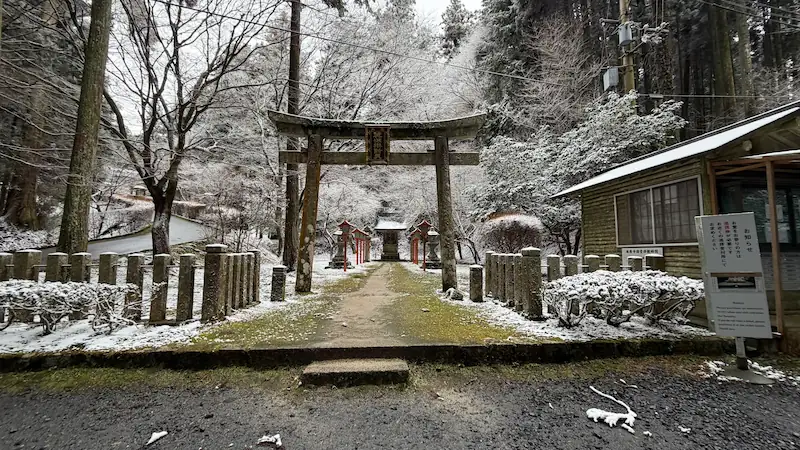
Shortly after entering the Saito precinct, you encounter Minabuchi Benzaiten — a small shrine that offers a different register of devotion from the grand halls of Shakado or Ninaido, and one that quietly expands your sense of how many layers of religious practice coexist on this mountain. A torii gate and shrine hall stand among the trees near the Saito parking area. In some goshuin (devotional seal stamp) guides, the principal deity is listed as Daibenzaiten-nyo (Great Benzaiten Woman) — one of several variant names for Benzaiten (Sarasvati), the goddess of music, eloquence, the arts, and flowing water, one of Japan's Seven Lucky Gods. Together with Mudo-ji Benzaiten in Todo and Hashizuka Benzaiten in Yokawa, it is sometimes presented as one of Mt. Hiei's three Benzaiten shrines. In a complex dominated by large Buddhist halls, the quiet persistence of this small Shinto-inflected sacred space is its own kind of presence. (Note: the coexistence of Buddhist halls and Shinto shrines in a single sacred complex reflects the pre-modern Japanese tradition of shinbutsu shugo — the syncretic blending of Buddhism and Shinto that shaped Japanese religious sites for over a thousand years before the two traditions were officially separated in the Meiji period.)
Highlights
- One of Mt. Hiei's three Benzaiten shrines: Taken together with its counterparts in Todo and Yokawa, this small shrine reflects the breadth of devotional practice woven into the mountain — not all of it on the monumental scale of the major halls.
- A torii and hall in the trees: A visual and atmospheric counterpoint to the grand Buddhist architecture nearby — the kind of quiet, half-hidden sacred space that gives a large temple complex its texture.
⏳ Time estimate: Quick visit 5 min / Thorough visit 10 min
🗺 Address: Sakamoto Honmachi, Otsu, Shiga (within Saito precinct)
🚶 Access: Approx. 10-minute walk from Jodo-in heading toward Saito, or a short walk from the Saito parking area
⭐ Recommended Historical Significance: ☆☆ Visual Impact: ☆ Experiential Value: ☆
| Structure & Features | Benzaiten shrine located a short distance below the Saito parking area; also referred to as Minabuchi Benten-do in some sources |
|---|---|
| Cultural Property Designation | Not designated |
| Current Status | Standing |
| Notes | Sometimes presented alongside Mudo-ji Benzaiten (Todo) and Hashizuka Benzaiten (Yokawa) as one of Mt. Hiei's three Benzaiten shrines |
Trivia & Background
- A deity with many names: Goshuin guides list the principal deity here as Daibenzaiten-nyo — one of several variant names and honorific forms used for Benzaiten across different sites and traditions in Japan.
- Spelling variation: The shrine appears in different sources as Minabuchi Benzaiten-sha and Minabuchi Benten-do — a minor inconsistency that is itself characteristic of the informal way many small sacred sites within large temple complexes have been documented over the centuries.
Jogo-do (Constant-Practice Hall) 🎥 360°
The left hall of "Benkei's Ninaido" — a meditation hall enshrining Amida Nyorai and sustaining the jogo zanmai (constant-practice samadhi) tradition
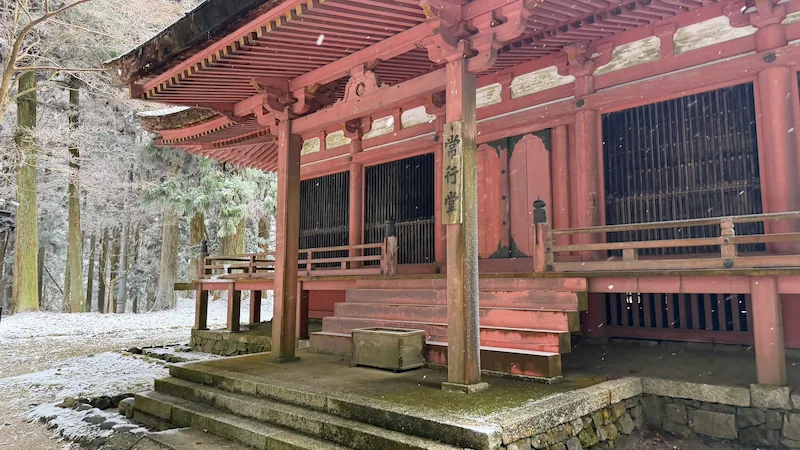
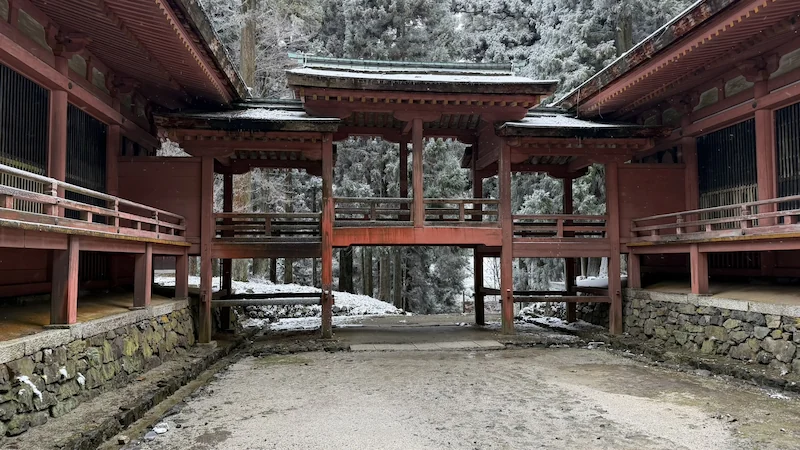
Jogo-do stands as the left-hand hall of the Ninaido pair in Saito, connected by a covered walkway to its mirror-image partner, Hokke-do. Its principal deity is Amida Nyorai (Amitabha Buddha), and the hall has long served as the training ground for jogo zanmai — one of the four forms of samadhi practice transmitted from China and formalized within the Tendai school by Saicho. The fact that this practice continues here is a direct demonstration that Enryakuji is not a museum of dead tradition. The building dates to 1595 (Bunroku 4), placing it in the Momoyama period — a moment of national reconstruction after decades of civil war, and in Enryakuji's case, the first organized effort to rebuild what Nobunaga had destroyed 24 years earlier. The pyramidal-roofed (hojo-zukuri) hall and its paired companion, identically proportioned and facing each other across a small clearing, create one of the most quietly striking views in the Saito precinct. When I arrived at Ninaido, there was no one around. Snow had settled on both roofs and along the covered walkway. No sound. The two halls faced each other across the clearing, connected and still. Nothing about that scene resembled a tourist attraction.
Highlights
- Twin-hall architecture: The paired composition — two identically proportioned halls facing each other across a clearing, joined by a covered walkway — is Saito's most distinctive visual and one of the most photographed sights on the mountain.
- A living practice hall: Enshrining Amida Nyorai and sustaining the jogo zanmai tradition, Jogo-do is one of the clearest reminders in Saito that Enryakuji's monastic functions have not been frozen in place for public display.
⏳ Time estimate: Quick visit 5 min / Thorough visit 10 min
🗺 Address: Sakamoto Honmachi, Otsu, Shiga
🚶 Access: Approx. 3–5 minute walk from Minabuchi Benzaiten
⭐ Recommended Historical Significance: ☆☆☆ Visual Impact: ☆☆ Experiential Value: ☆
| Year Built | 1595 (Bunroku 4) |
|---|---|
| Structure & Features | Five bays square; single-story pyramidal roof (hojo-zukuri) with a single-bay front porch; thatched-style roof. Principal deity: Amida Nyorai (Amitabha Buddha). Paired with Hokke-do and connected by a covered walkway. |
| Cultural Property Designation | National Important Cultural Property (designated jointly as "Enryakuji Jogo-do and Hokke-do") |
| Current Status | Standing |
| Notes | Paired with Hokke-do as "Ninaido"; interiors are not open to the public |
Trivia & Background
- Designated as a pair: Jogo-do's cultural property designation is held jointly with Hokke-do — the two halls are treated as a single architectural unit rather than as separate structures.
- The Benkei legend: Official tourism materials for the site describe a popular folk legend in which the warrior-monk Benkei — a figure comparable in Japanese cultural memory to Hercules or Samson, known for his superhuman strength — shouldered both halls simultaneously using the covered connecting walkway as a carrying pole (tenbinbo). The legend gives the pair their popular name: "Benkei's Ninaido" (Benkei's Shoulder-Carrying Halls).
Hokke-do (Lotus Hall) 🎥 360°
The right hall of the Ninaido — enshrining Fugen Bosatsu and preserving over 1,200 years of hokke zanmai practice
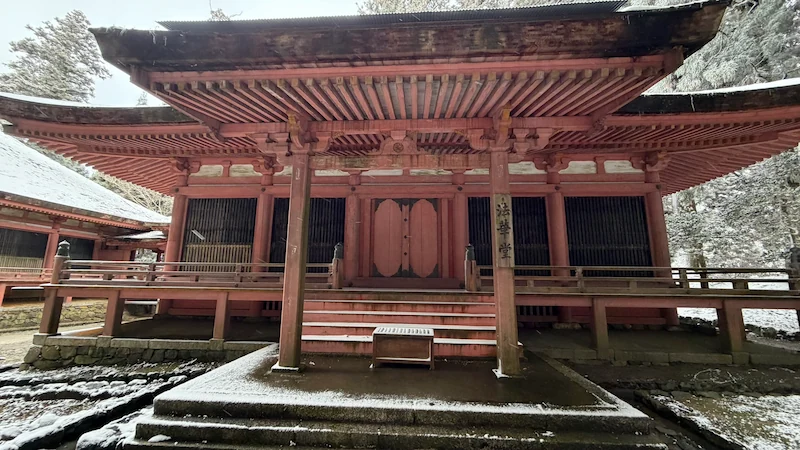
Facing Jogo-do across the central clearing of Saito, Hokke-do is the right-hand hall of the Ninaido pair. Its principal deity is Fugen Bosatsu (Samantabhadra Bodhisattva) — the bodhisattva of practice and meditation, typically depicted riding a white elephant and closely associated with the Lotus Sutra. The hall has transmitted the hokke zanmai — one of the four forms of samadhi practice formalized by Saicho — for more than 1,200 years. Like Jogo-do, it was built in 1595 (Bunroku 4), and the two halls share identical dimensions and structural form. The image of Hokke-do and Jogo-do standing together in the forest, joined by their covered walkway, is the defining scene of the Saito precinct. In the Momoyama-period reconstruction that gave us these buildings, the fact that both halls were raised at the same moment to the same design reflects an architectural intention — to make the pair inseparable, visually and symbolically. The stillness of the cedar forest around them, and the absence of decoration, gives the composition a gravity that ornamented buildings rarely achieve.
Highlights
- The paired composition: The near-symmetrical arrangement of Hokke-do and Jogo-do on either side of the clearing, joined by their covered walkway, is more affecting in person — particularly in snow or morning mist — than any description of it suggests.
- Over 1,200 years of living practice: The hokke zanmai tradition transmitted here predates the current building by seven centuries. The hall is a container for something that has outlasted multiple rounds of destruction and reconstruction.
⏳ Time estimate: Quick visit 5 min / Thorough visit 10 min
🗺 Address: Sakamoto Honmachi, Otsu, Shiga
🚶 Access: Directly adjacent to the previous spot, Jogo-do Hall
⭐ Recommended Historical Significance: ☆☆☆ Visual Impact: ☆☆ Experiential Value: ☆
| Year Built | 1595 (Bunroku 4) |
|---|---|
| Structure & Features | Five bays square; single-story pyramidal roof (hojo-zukuri) with a single-bay front porch; thatched-style roof. Principal deity: Fugen Bosatsu (Samantabhadra Bodhisattva). Paired with Jogo-do and connected by a covered walkway. |
| Cultural Property Designation | National Important Cultural Property (designated jointly as "Enryakuji Jogo-do and Hokke-do") |
| Current Status | Standing |
| Notes | Paired with Jogo-do as "Ninaido"; interiors are not open to the public |
Trivia & Background
- Designated as a pair: Like Jogo-do, Hokke-do's Important Cultural Property designation is held jointly — the two halls are treated as a single unit by Japan's cultural property system.
- The Benkei legend: The same folk legend that gives Jogo-do its popular nickname applies to this hall equally: Benkei is said to have shouldered both at once, using the covered walkway connecting them as a carrying pole. The image — of a single man supporting two full-scale temple halls on his shoulders — captures something of the outsized status Benkei holds in Japanese popular imagination.
When I reached Ninaido, there was no one else around. Snow had settled on both roofs and along the covered walkway between them. No sound at all. The two halls faced each other across the clearing, connected and still. Nothing about that scene looked like a tourist attraction. It felt more like having been let through a door that was usually closed — into a place that was clearly still in use, still meant for something, still present in a way that idle spaces are not.
── Visitor's Note (December 2025, Saito in snow)
Shakado Hall (Tenpohrin-do) 🎥 360°
The oldest surviving building at Enryakuji, 1347 — relocated from Miidera Temple by Hideyoshi after the Nobunaga burning to serve as the Saito main hall
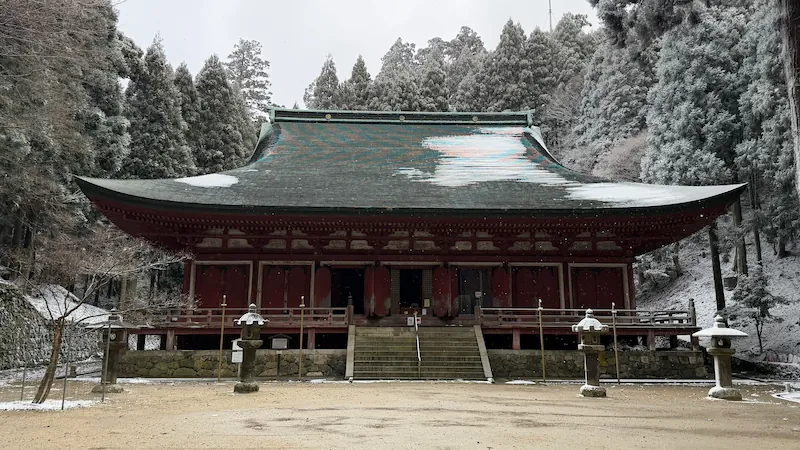
At the center of the Saito precinct stands Shakado Hall — formally Tenpohrin-do, also known as the Saito Main Hall — and it is the oldest surviving structure anywhere on the Enryakuji complex. The current building dates to 1347 (Jowa 3), placing it in the early Muromachi period, roughly two centuries before the Nobunaga burning. When the building that stood here was destroyed in 1571, the reconstruction of Saito was set in motion in an unusual way: in 1595, Toyotomi Hideyoshi relocated a hall from Miidera Temple — a rival institution on the eastern shore of Lake Biwa that had itself been a target and victim of Enryakuji's warrior-monks over the centuries — and established it as the new main hall of Saito. The decision to transplant a building from a historically antagonistic temple to serve as Enryakuji's main hall after Nobunaga's destruction is one of those historical ironies that the building itself quietly contains. The massive hip-and-gable-roofed structure, seven bays on each side, carries the tensed stillness that characterizes Saito throughout. One architectural feature worth noting: in keeping with a principle found in Tendai Buddhist hall design — and shared with Konpon Chudo in Todo — the stone floor of the inner sanctuary is set lower than the level on which worshippers stand, bringing the principal deity closer to the eye level of the person praying. Scale, age, and the sheer density of the building's accumulated time change the air around it. Standing before Shakado Hall alone in the snow, you don't feel like a visitor. You feel like someone who has been briefly permitted inside a place that is still, in all the ways that matter, in use.
Highlights
- The oldest surviving building on the mountain, 1347: Its existence here is the result of a layered history — built in the early Muromachi period, destroyed by Nobunaga, then transplanted from a rival temple by Hideyoshi. That sequence of origin, obliteration, and reconstruction through appropriation is compressed into the building's age.
- The Tendai interior arrangement: The recessed stone floor of the inner sanctuary — which brings the principal deity to the worshipper's eye level — is a design principle shared with Konpon Chudo in Todo and expresses the Tendai teaching that the Buddha and the human are not separated by hierarchy.
- Spring: Cherry blossoms around Shakado during Golden Week — Japan's national holiday cluster in early May — lay a soft seasonal color over the hall's weathered, unpainted exterior in a way that the more ornate buildings of Todo cannot quite replicate.
⏳ Time estimate: Quick visit 5 min / Thorough visit 10 min
🗺 Address: 4220 Sakamoto Honmachi, Otsu, Shiga
🚶 Access: Approx. 5-minute walk from Hokke-do Hall
⭐ Recommended Historical Significance: ☆☆☆ Visual Impact: ☆☆☆ Experiential Value: ☆☆
| Year Built | 1347 (Jowa 3) — the surviving structure |
|---|---|
| Builder | Founded by Encho; builder of the surviving structure not recorded |
| Structure & Features | Seven bays square; single-story hip-and-gable roof (irimoya-zukuri); copper-shingle roof in the thatched style. The stone floor of the inner sanctuary is set lower than the worshipper's level, bringing the principal deity closer to eye height — a characteristic feature of Tendai Buddhist hall design. |
| Restoration History | Destroyed in 1571 (Nobunaga burning); in 1595, Toyotomi Hideyoshi relocated the structure from Miidera Temple to its current site. |
| Cultural Property Designation | National Important Cultural Property (designated as "Enryakuji Tenpohrin-do") |
| Current Status | Standing |
| Destruction | The building that previously stood here was destroyed in Oda Nobunaga's assault on Mt. Hiei, 1571 (Genki 2) |
Trivia & Background
- Two names, one hall: The building is widely known as Shakado (Shakyamuni Hall) but its formal name is Tenpohrin-do (Hall of Turning the Dharma Wheel) — a title referring to the first teaching given by the historical Buddha after his enlightenment, which set the wheel of the Dharma in motion. It is also sometimes called the Saito Main Hall (Saito Chudo).
- A monthly goshuin opportunity: A special goshuin (devotional seal stamp) is available at Shakado on the 30th of each month — the day associated with Shakyamuni Buddha in the Japanese devotional calendar.
- The Miidera connection: Hideyoshi's decision to move a building from Miidera to serve as Enryakuji's main hall after the Nobunaga burning is one of the most historically loaded architectural relocations in Japanese history. For centuries, Enryakuji's warrior-monks had attacked and burned Miidera repeatedly in sectarian disputes. The fact that Hideyoshi used a Miidera building to restore Enryakuji — placing a rival temple's hall at the center of the mountain that had so often victimized it — is the kind of irony that Japanese history tends to leave undiscussed but fully in view.
Practical Visitor's Guide: Saito Precinct
Covering the Saito precinct alone takes approximately 1 to 1.5 hours. The natural walking order is: Jodo-in → Minabuchi Benzaiten → Ninaido (Jogo-do and Hokke-do) → Shakado Hall. Bear in mind that reaching Jodo-in requires descending a steep stone staircase from near the Sanno-in area, and the return climb takes time — budget generously. The compound is also easy to walk past if you're not watching for the signs. If you plan to collect goshuin (devotional seal stamps), confirm in advance which stamps are available at which locations; finding out after the fact often means retracing your steps across considerable distance.
During winter (December through February), visiting hours in the Saito and Yokawa precincts start at 9:30 — thirty minutes later than Todo. Shuttle bus service may be suspended in winter, in which case reaching Saito from Todo means a 20–30 minute walk along mountain trails. Waterproof trekking footwear is essential; sneakers or anything without grip will leave you wet and depleted long before you reach Shakado Hall. Confirm your return transport before leaving for the mountain, not after you arrive.
Enryakuji Saito Precinct FAQ
Covering all five spots at a relaxed pace takes about 1 to 1.5 hours. Jodo-in requires descending steep stone steps and climbing back up, so allow extra time for the return. Confirming goshuin stamp locations in advance will save you having to retrace your steps.
From Todo, take the shuttle bus — about 10 minutes. Bus service may be suspended during winter (December through February), in which case you'll need to walk about 20 to 30 minutes along mountain trails. Visiting hours are normally 9:00–16:00; in winter, 9:30–16:00.
The interiors are not open to the public. Both halls and the distinctive covered walkway connecting them can be viewed from outside. Both are designated National Important Cultural Properties, and the architectural character of the twin-hall composition comes through fully from the exterior.
Yes. Shakado Hall (formally Tenpohrin-do) is the oldest surviving structure at Enryakuji, dating to 1347 (early Muromachi period). After the building that stood here was destroyed in Nobunaga's 1571 burning, Toyotomi Hideyoshi relocated a hall from Miidera Temple to this site in 1595.
Yes. It lies at the bottom of a steep stone staircase descending from near the Sanno-in, and the approach is not immediately obvious. Jodo-in sits at the boundary between the Todo and Saito precincts and is officially part of Todo, so it can fall through the gap when visiting either area. Pay close attention to the signboards as you walk, particularly when approaching from the Saito shuttle bus stop.
Todo has many vermilion-lacquered halls and a visually striking, relatively open layout. Saito is quieter, less visited, and built largely in unpainted natural wood set among dense cedar forest. Arriving at Shakado Hall when no one else is around — especially in snow — feels less like sightseeing and more like having been briefly admitted to a place still very much in active use. The scale and age of Shakado carry a different kind of weight from anything in Todo.
Continue to the Other Precincts
Once you've finished Saito, take the shuttle bus to Yokawa or head back to Todo to explore the surrounding facilities. Going all the way to Yokawa completes the picture — by the time you've walked all three precincts, the way the mountain changes around you, precinct by precinct, becomes something you understand in your body rather than on a map.
☕ Support This Site
Following the Shogun is built on original fieldwork and on-site research.
If you found this guide useful, your support helps keep it going.

You can also support via QR code


comment