


Nobunaga’s Hidden Rock — A Small Legendary Site on the Kutsuki Retreat Route
A rock formation in the mountains of Kutsuki, Shiga, connected by local tradition with Oda Nobunaga’s retreat after the 1570 Kanegasaki crisis. Not the same site as Kanegasaki Castle.
What Is Nobunaga’s Hidden Rock?
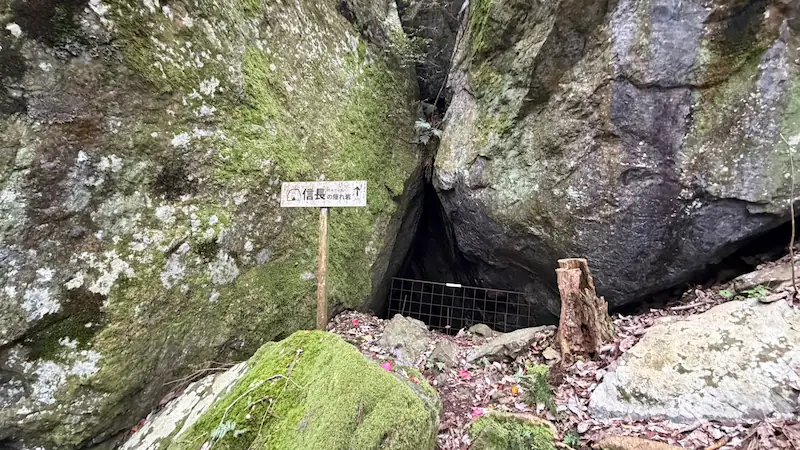
Nobunaga’s Hidden Rock (信長の隠れ岩) is a small legendary site in the Kutsuki area of Takashima City, Shiga Prefecture.
According to local tradition, this is the spot where Oda Nobunaga concealed himself among the rocks while waiting to confirm the intentions of local lord Kutsuki Mototsuna — during his retreat through Kutsuki after the Kanegasaki crisis of 1570.
Whether Nobunaga truly hid here cannot be confirmed from historical records. This is a site preserved through local tradition, not a verified historical monument. That said, for dedicated Nobunaga fans or anyone following the Kanegasaki Retreat route in person, it is a place worth seeking out.
Quick Summary
| What is it? | A rock formation in the mountains of Kutsuki, connected with Nobunaga’s 1570 retreat by local tradition |
|---|---|
| What remains today? | A large rock formation (natural), a gap between the rocks, an on-site signboard, an entrance sign by the road |
| Original or reconstructed? | Natural rock — untouched. This is not a monument or reconstruction. |
| Time needed | Approx. 15 minutes (based on our visit, including time for photos) |
| Best for | Dedicated Nobunaga fans; those tracing the Kanegasaki Retreat route |
| Footwear | Dirt mountain path — shoes with good grip strongly recommended |
| Getting there | Car is the most practical option. Limited bus service available. |
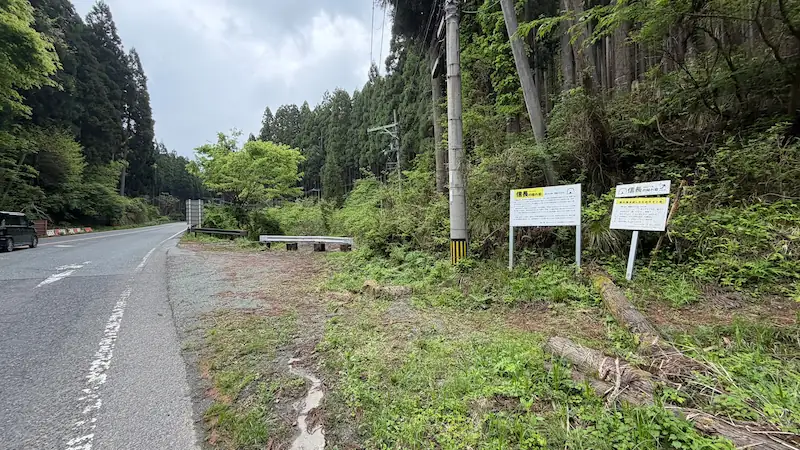
| Parking | A small informal space for approx. 2 cars was seen during our visit (not a confirmed official lot) |
| Not the same as | Kanegasaki Castle (Tsuruga, Fukui) — a completely different site in a different prefecture |
Is It Worth Visiting?
Nobunaga’s Hidden Rock is best suited for dedicated Nobunaga fans or those with a strong interest in the Kanegasaki Retreat and the Kutsuki-goe escape route.
Based on our visit, the rock formation is larger than you might expect, covered in moss, and has a quiet, atmospheric presence deep in the mountains. The contrast between the paved road at the entrance and the natural rock face a short walk up the path is striking in person.
The atmosphere in front of the rock — scale and surroundings in 360°
If you are not especially interested in Nobunaga or the events of 1570, the appeal may feel limited. This is not a major tourist attraction or a developed historical park. It is a small, quiet site that rewards those who come specifically to follow the history.
How to Get There
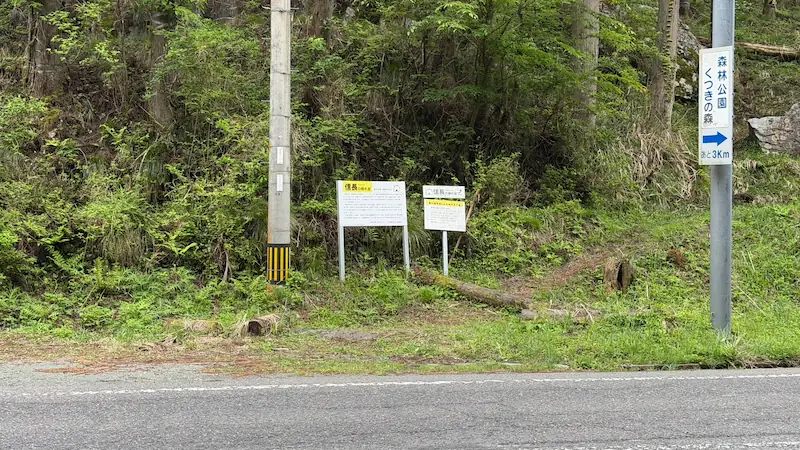
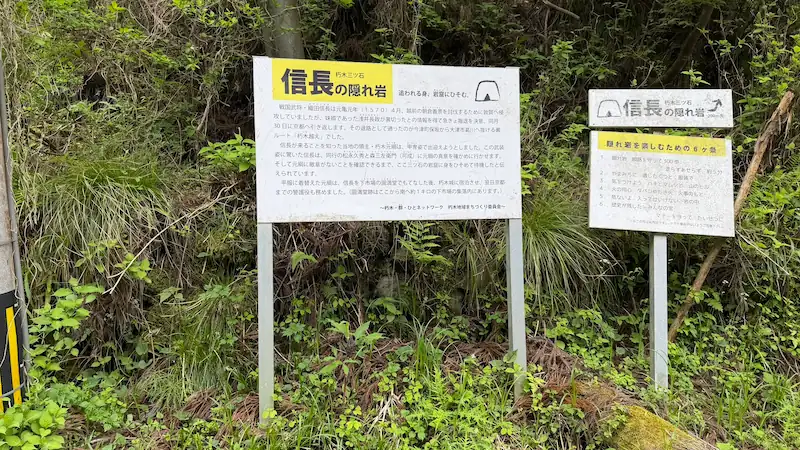
Location Kutsuki area, Takashima City, Shiga Prefecture (near Kutsuki-Ichiba)
Nearest station Adogawa Station, JR Kosei Line (JR-B16)
Best access By car (most practical)
From Kyoto Approx. 1 hour by JR Kosei Line to Adogawa Station (rough guide — confirm before travel)
By Car
Car is the most practical way to reach this site. Search for 「信長の隠れ岩」 in Google Maps and follow the directions. The entrance is marked by a sign along the road.
By Public Transport
- Nearest station: Adogawa Station, JR Kosei Line (JR-B16)
- Bus: Kojakutransit Kutsuki Line — from Adogawa Station to Kutsuki-Gakkomae bus stop
On-Site Navigation
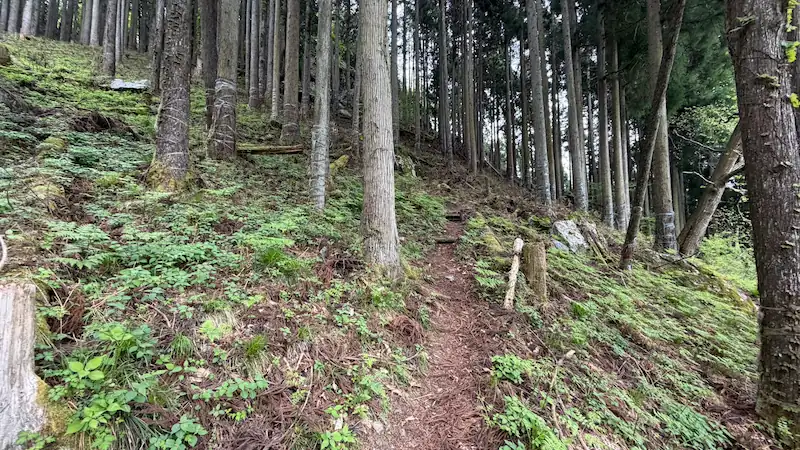
From the roadside entrance, follow the path uphill. There are no complex forks — it is a single trail. The path is lightly maintained but unpaved. Be careful underfoot, especially after rain.
Historical Background
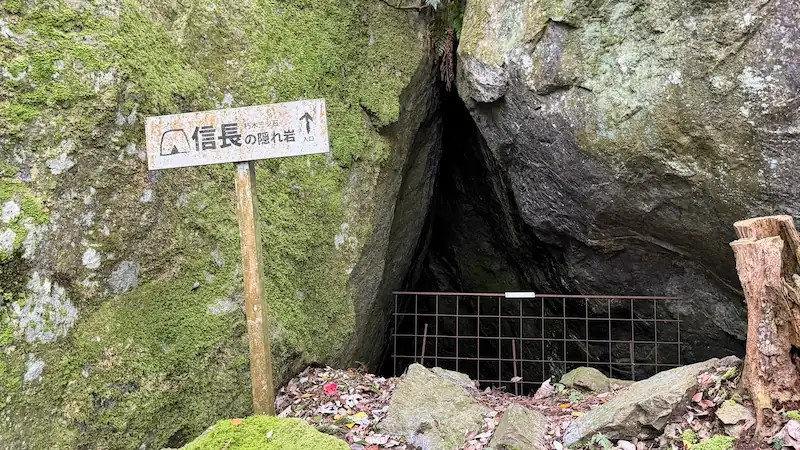
The Kanegasaki Retreat (1570)
In the fourth month of 1570, Oda Nobunaga was leading a campaign against the Asakura clan of Echizen Province (present-day Fukui). When his ally Azai Nagamasa of Omi unexpectedly turned against him, Nobunaga’s army was caught between enemies on two fronts. The withdrawal that followed is known as the Kanegasaki Retreat (金ヶ崎の退き口).
Toyotomi Hideyoshi and others served as the rearguard while Nobunaga escaped. One of the routes he is said to have taken on the way back to Kyoto passed through the Kutsuki area — a mountain passage known as Kutsuki-goe.
Kutsuki Mototsuna and the Rock
The chronicle Shincho Koki (信長公記) records that Nobunaga passed through Kutsuki and received hospitality from Kutsuki Shinanonojo (Kutsuki Mototsuna), the local lord. Mototsuna’s loyalties were uncertain at the time, and Nobunaga could not be sure whether he would be welcomed or obstructed.
Local tradition holds that Nobunaga hid among the rocks at this spot while waiting to confirm Mototsuna’s intentions. Once Mototsuna’s cooperation was assured, Nobunaga continued on to Kyoto.
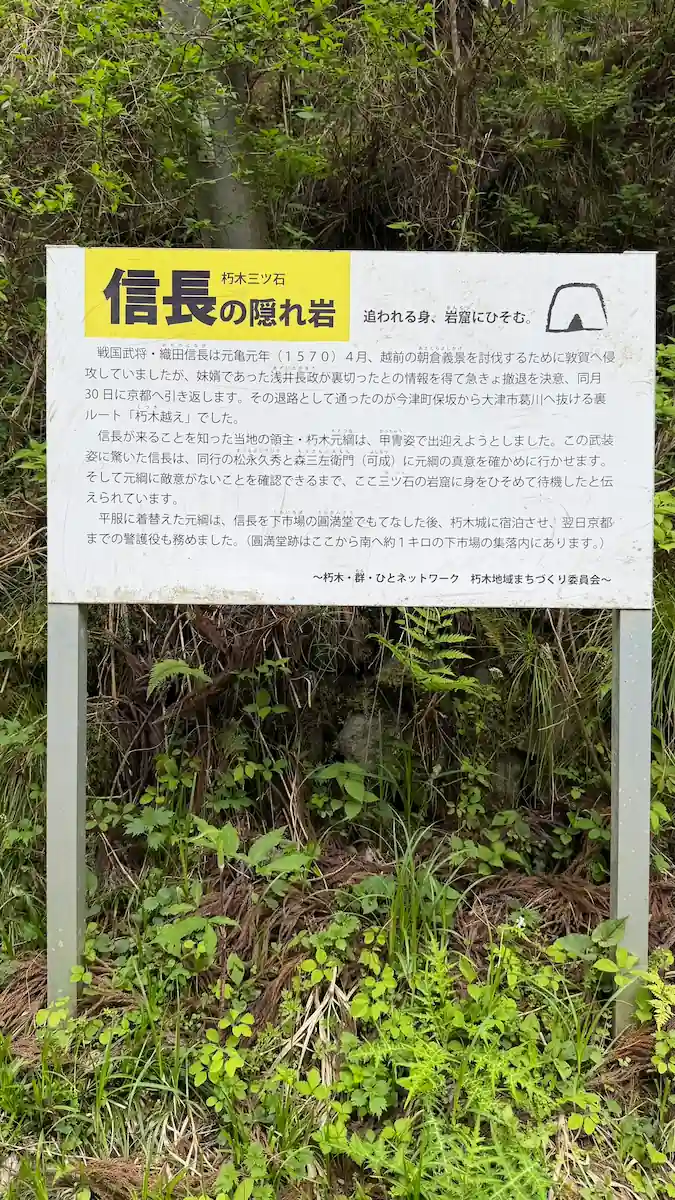
The on-site signboard describes how Nobunaga is said to have waited here among the rocks until he could confirm whether Kutsuki Mototsuna was an ally or an obstacle.
What Remains Today
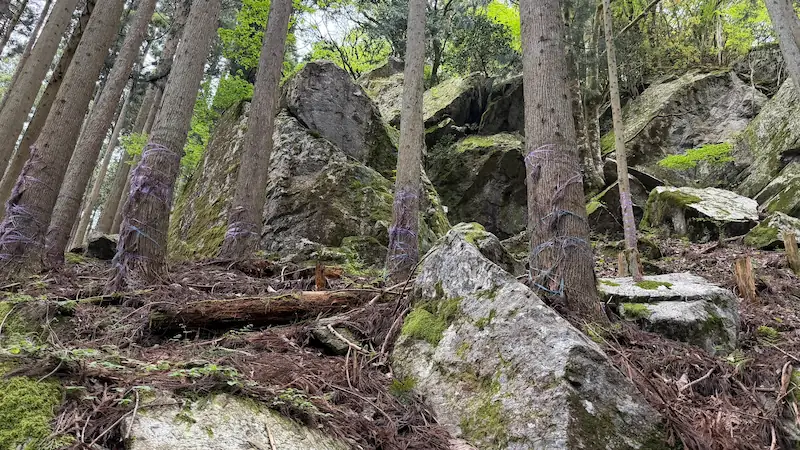
The rock formation itself is the main feature of the site. It is larger than most people anticipate. Moss covers much of the surface, giving it a quiet, aged quality that fits the surrounding mountain environment.
- The rock formation: A cluster of large rocks stacked together — natural, untouched
- The gap between the rocks: A space inside the formation, described by local tradition as where Nobunaga hid
- The on-site signboard: Explains the local legend
- The roadside entrance sign: A landmark visible from the road before you start up the path
Standing in front of the rock — the space and atmosphere in 360°
Key Sites (Core Spot Inventory)
CSI-01: Nobunaga’s Hidden Rock
The rock formation connected by local tradition with Nobunaga’s 1570 retreat
| Type | Legendary site / natural rock formation |
|---|---|
| Original / reconstructed | Natural rock — untouched. Not a monument or reconstruction. |
| Current state | The natural rock remains as a traditionally preserved site |
| What to see | Large rock formation, gap between rocks, on-site signboard |
| Note | “Nobunaga hid here” cannot be confirmed from historical records. This is a site of local tradition. |
CSI-02: Roadside Entrance
The access point from the road to the mountain path
| Type | Trailhead / entrance |
|---|---|
| Current state | Accessible |
| What to see | Entrance sign along the road, start of the mountain path |
| Note | Unpaved dirt path. Wear shoes with good grip. |
A 360° panoramic view of the area near the entrance leading to the rocks.
Further along the path toward the rock — 360° view
CSI-03: Michi-no-Eki Kutsuki Shinhonjin
Roadside rest station; a useful base for visiting the Kutsuki area
| Address | 777 Kutsuki-Ichiba, Takashima City, Shiga |
|---|---|
| Tourist info / products | 8:30–17:00 (official information; confirm before visiting) |
| Restaurant | 11:00–14:00 (official information; confirm before visiting) |
Note: We did not visit this facility during our trip to the rock. The information above is based on official sources.
CSI-04: Kutsuki-Ichiba Historic District
A former staging post on the Sabakaido (Mackerel Road)
The Kutsuki-Ichiba area retains traces of its history as a staging post on the Sabakaido — the historic route along which seafood was transported from the Japan Sea coast to Kyoto. This is also the area Nobunaga is believed to have passed through on his Kutsuki-goe retreat.
Note: We did not visit this area separately. Information based on general historical sources.
CSI-05: Kōshō-ji Temple / Former Shūrinji Garden
A nationally designated scenic garden with Ashikaga connections
| Address | 374 Kutsuki-Iwase, Takashima City, Shiga (within Kōshō-ji Temple) |
|---|---|
| Designation | National Scenic Garden (designated 1935) |
| Admission | ¥500 (official information; confirm before visiting) |
| Access | Approx. 30 min by bus from Adogawa Station; alight at Kutsuki-Gakkomae, then approx. 10 min on foot (check latest bus times) |
Associated with Ashikaga Yoshiharu, who took refuge in Kutsuki during a period of turmoil in the sixteenth century. Note: We did not visit this temple during our trip. Information based on official sources.
Local Tradition & Background Notes
Who Was Kutsuki Mototsuna?
Nobunaga’s Leather Hakama (信長の革袴)
Listed in Takashima City’s Cultural Heritage Plan
Nearby Spots
If you are visiting Nobunaga’s Hidden Rock, the following sites in the Kutsuki area may be worth combining into your itinerary.
| Site | Overview | Note |
|---|---|---|
| Michi-no-Eki Kutsuki Shinhonjin | Roadside rest station; tourism info, local products, restaurant | URL Japanese only |
| Kutsuki-Ichiba Historic District | Historic staging post on the Sabakaido | URL |
| Kōshō-ji Temple / Former Shūrinji Garden | National scenic garden; Ashikaga Yoshiharu connection | URL |
| Kanegasaki Castle (Tsuruga, Fukui) | The starting point of the Kanegasaki Retreat; a separate site in a different prefecture | URL |
Nobunaga’s Hidden Rock vs. Kanegasaki Castle
This is one of the most important things to understand before visiting. Nobunaga’s Hidden Rock and Kanegasaki Castle are completely different sites.
| Nobunaga’s Hidden Rock | Kanegasaki Castle | |
|---|---|---|
| Location | Kutsuki, Takashima City, Shiga Prefecture | Tsuruga City, Fukui Prefecture |
| Historical connection | A legendary spot on Nobunaga’s retreat through Kutsuki | The site where the Kanegasaki Retreat began |
| Current state | Natural rock formation; traditionally preserved site | Historic castle ruins; developed as a park |
Kanegasaki Castle is where the retreat started — on the Fukui side of the mountains. Nobunaga’s Hidden Rock is connected with a point further along the retreat, after Nobunaga had already crossed into Omi Province (Shiga). Same historical event; completely different geography.
Kanegasaki Castle Location (for reference)
Kanegasaki Castle Ruins — Tsuruga, Fukui Prefecture. A completely different site from Nobunaga’s Hidden Rock (Kutsuki, Shiga).
FAQ
A small legendary site in the Kutsuki mountains of Shiga Prefecture, connected by local tradition with Oda Nobunaga’s retreat after the 1570 Kanegasaki crisis. According to the tradition, Nobunaga hid among these rocks while waiting to confirm the intentions of local lord Kutsuki Mototsuna. Whether this actually happened cannot be verified from historical records.
The authenticity of the tradition is unknown. Historical records such as the Shincho Koki confirm that Nobunaga passed through the Kutsuki area and received hospitality from Kutsuki Mototsuna — but do not describe a specific hiding spot. The Shiga Cultural Heritage Association notes that the tradition’s authenticity is “unknown.” This is a place kept alive by local memory, not a formally verified historical site.
A large rock formation (natural, untouched), a gap between the rocks said by tradition to be where Nobunaga hid, an on-site signboard, and an entrance sign along the road. The rock is larger than most people expect, with moss covering the surface and a quiet mountain atmosphere.
Based on our visit, including time to take photos and take in the atmosphere, around 15 minutes. If you combine it with a stop at the Michi-no-Eki or Kōshō-ji Temple, allow additional time.
For dedicated Nobunaga fans or those following the Kanegasaki Retreat route in person, yes — it is a rewarding site to seek out. If you are not particularly interested in Nobunaga or the events of 1570, the appeal may be more limited. It is a quiet, small site rather than a major attraction.
The path is short and not technically difficult, but it is an unpaved dirt trail. After rain it can become slippery. Wear shoes with good grip — trainers at a minimum, hiking shoes if possible. No other special equipment is needed.
No. Kanegasaki Castle is in Tsuruga, Fukui Prefecture. Nobunaga’s Hidden Rock is in Kutsuki, Shiga Prefecture. They are connected by the same historical event but are in completely different locations. See the comparison table above for more detail.
Take the JR Kosei Line from Kyoto Station to Adogawa Station (approximately 1 hour, as a rough guide — confirm times before travel). From Adogawa, the Kojakutransit Kutsuki Line bus connects to the Kutsuki area (alight at Kutsuki-Gakkomae). Bus service is limited — always check the latest timetable before visiting. Driving is the more practical option for most visitors.
Related Articles



comment