


Ueno Toshogu Shrine: Tokugawa Ieyasu's Golden Shrine in Ueno Park
A practical guide based on repeated visits to Ueno Toshogu Shrine, explaining why the paid Golden Hall area is worth entering, how to view the Karamon Gate, where to take photos, and how to follow the best route through this Tokugawa landmark in central Tokyo
Quick Facts: Who It's For, Fees & Is It Worth It?
Ueno Toshogu Shrine is a gold-leafed Edo-period shrine inside Ueno Park, built in 1651 to honor Tokugawa Ieyasu, founder of the Tokugawa shogunate. The approach and Karamon Gate are free to view. Entering the inner precinct to see the Golden Hall up close costs ¥700 for adults — and based on repeated visits, it's worth paying. From outside the wall, you can tell the building is gold; from inside, you can actually see why.
Ueno Toshogu sits inside Ueno Park itself, about a 10-minute walk from JR Ueno Station, past Shinobazu Pond and the central fountain. That makes it easy to combine with a visit to the Tokyo National Museum, Ueno Zoo, or a walk around the pond — you don't need to plan a separate trip to see it.
Is this the same as Nikko Toshogu? No — they are two separate shrines. Nikko Toshogu is the original, much larger shrine complex about two hours from Tokyo. Ueno Toshogu was built in 1651, modeled after Nikko, specifically so that people in Edo who could not travel that far could still visit a Tokugawa shrine of comparable rank and decoration. If you've seen Nikko Toshogu, or are deciding between the two, Ueno offers a compact version of the same architectural style without leaving Tokyo.
How admission is structured: The precinct has two layers: the free area from the approach to the Karamon Gate, and the paid worship area, which includes the Kinshikiden Golden Hall, Eiyo Gongen Shrine, and the Great Camphor Tree. Visitors can worship up to the Karamon Gate for free, but entering inside the Sukibei Wall to see the shrine building up close requires the adult admission fee of 700 yen.
What Is Ueno Toshogu Shrine? Why an Early Edo-Period Shrine Still Survives in Central Tokyo
If you're walking through Ueno Park and see a golden shrine building through the trees — that's Ueno Toshogu. Built in 1651 by the third Tokugawa shogun, it's one of the few early Edo-period shrine buildings still standing in central Tokyo.
Ueno Toshogu Shrine was built to enshrine Tokugawa Ieyasu. In 1651(Keian 4), by order of the third shogun Tokugawa Iemitsu, it was rebuilt into a magnificent shrine complex modeled after Nikko Toshogu Shrine. The Golden Hall, Karamon Gate, and Sukibei Wall are all preserved today as National Important Cultural Properties, making this one of the few places in central Tokyo where visitors can directly see the architectural and decorative techniques of the early Edo period.
It is also known as an “immortal shrine building” because it survived three major disasters: the Battle of Ueno, the Great Kanto Earthquake, and the air raids on Tokyo during World War II. For travelers interested in Tokugawa history, Edo-period architecture, or historical sightseeing in Ueno, this is one of the most rewarding stops in the park.
When I first visited Ueno Toshogu Shrine, what stayed with me most was the surprise of finding such a lavish golden shrine building in the middle of Tokyo’s Ueno district. Ueno Park is usually associated with museums, the zoo, cherry blossoms, and Shinobazu Pond, so the sudden appearance of a richly gilded Tokugawa shrine feels almost unreal. That contrast between a busy urban park and a gold-covered Edo-period sanctuary is one of the shrine’s strongest first impressions.
After returning several times, however, I realized that Ueno Toshogu is not impressive only because it is gold. The Karamon Gate, the Kinshikiden Golden Hall, the Tokugawa hollyhock crests, and the carved details reveal more with each visit. On a first visit, the overall brilliance tends to dominate your memory. On later visits, the depth of the carvings, the texture of the gold, and the quietness inside the paid viewing area make the experience feel much richer.
Is the ¥700 Paid Area Worth It?|On-site Recommendation by Visit Type
One of the most practical questions at Ueno Toshogu Shrine is whether the free area is enough or whether you should pay to enter the shrine-front viewing area. After repeated visits, my answer is clear: if this is your first visit, the paid area is worth it. What you see, how close you can stand, and how the Golden Hall feels in person are all different once you enter inside the wall.
My conclusion: the paid viewing area is worth entering. The free area is already rewarding because you can see the Karamon Gate, but the experience changes once you step inside the Sukibei Wall. You see the Golden Hall more closely, notice details that are easy to miss from outside, and feel a calmness that is hard to imagine from the busy paths of Ueno Park.
The most difficult quality to convey through photos is the texture of the gold. In person, the Golden Hall is not simply a bright gold building. Its surface changes depending on the angle, the light, the shade from the trees, and your distance from the shrine. That layered quality is one reason the paid area feels more meaningful than viewing the shrine only from the outside.
If I had to explain Ueno Toshogu to an overseas visitor in one sentence, I would call it a golden Tokugawa shrine in central Tokyo—visually striking in a way that may remind some visitors of Kyoto’s Kinkaku-ji, though historically and religiously it is a very different site. The value here lies in the contrast: a gold-covered Edo-period shrine surviving inside one of Tokyo’s busiest public parks.
| Visitor type | Recommendation | Why it matters on site |
|---|---|---|
| Short on time | Enter the paid area if possible | You can technically walk in and out in about five minutes, but that only gives you a “checked it off” feeling. Even a short paid visit makes the Golden Hall much more memorable. |
| History lovers | Definitely enter | The density of the decoration, the Tokugawa crests, and the scale of the gold ornamentation make Tokugawa Iemitsu’s reverence for Ieyasu easier to feel. |
| Photography-focused visitors | Definitely enter | The Karamon Gate can be photographed for free, but the Golden Hall is the strongest subject. A slightly angled view helps show the depth and layered gold surfaces. |
| Visitors interested in Tokugawa Ieyasu or Edo history | Definitely enter | If you want to understand this as a Tokugawa sacred site, viewing the Golden Hall only from outside the wall feels incomplete. |
Highlights at a Glance
| Spot | Area | History | Visual impact | Experience | Status | Fee | Time needed |
|---|---|---|---|---|---|---|---|
| Oishi Torii Gate | Main approach | ★★★ | ★★ | ★ | ICP | Free | 3–10 min |
| Former Kaneiji Five-Story Pagoda | Zoo-side route | ★★★ | ★★★ | ★★ | ICP | Free route | 5–15 min |
| Shinobazu-guchi Torii Gate | Shinobazu approach | ★★★ | ★★ | ★ | — | Free | 3–10 min |
| Mizuyamon Gate | Approach | ★★ | ★★ | ★ | — | Free | 3–10 min |
| Kaguraden Hall | Approach | ★★ | ★★ | ★★ | — | Free | 3–10 min |
| Omizuya Purification Pavilion | Approach | ★★ | ★★ | ★ | — | Free | 3–10 min |
| Karamon Gate | Approach | ★★★ | ★★★ | ★★ | ICP | Free | 5–15 min |
| Kinshikiden Golden Hall | Paid area | ★★★ | ★★★ | ★★★ | ICP | 700 yen | 10–20 min |
| Eiyo Gongen Shrine | Paid area | ★ | ★ | ★★ | — | 700 yen | 5–10 min |
| Great Camphor Tree | Paid area | ★★ | ★★ | ★★ | — | 700 yen | 5–10 min |
| Obake Toro Lantern | Outside approach | ★★ | ★★ | ★ | — | Free | 5–10 min |
Recommended Walking Route
Ueno Toshogu Shrine can be entered either from the main approach through the Oishi Torii Gate or from the Shinobazu Pond side through the Shinobazu-guchi Torii Gate. For a first visit, I recommend starting from the main Oishi Torii Gate. The sequence feels more complete: you pass through the stone torii, walk along the approach, see the stone lanterns and Mizuyamon Gate, and gradually approach the Karamon Gate and Golden Hall.
The Shinobazu Pond-side entrance is quieter and a little more modest, so it does not create the same sense of arrival. However, it is historically important because the Shinobazu-guchi Torii Gate was moved from Momijiyama Toshogu inside Edo Castle. If you are interested in Tokugawa history, it is worth seeing after your main shrine visit rather than skipping it entirely.
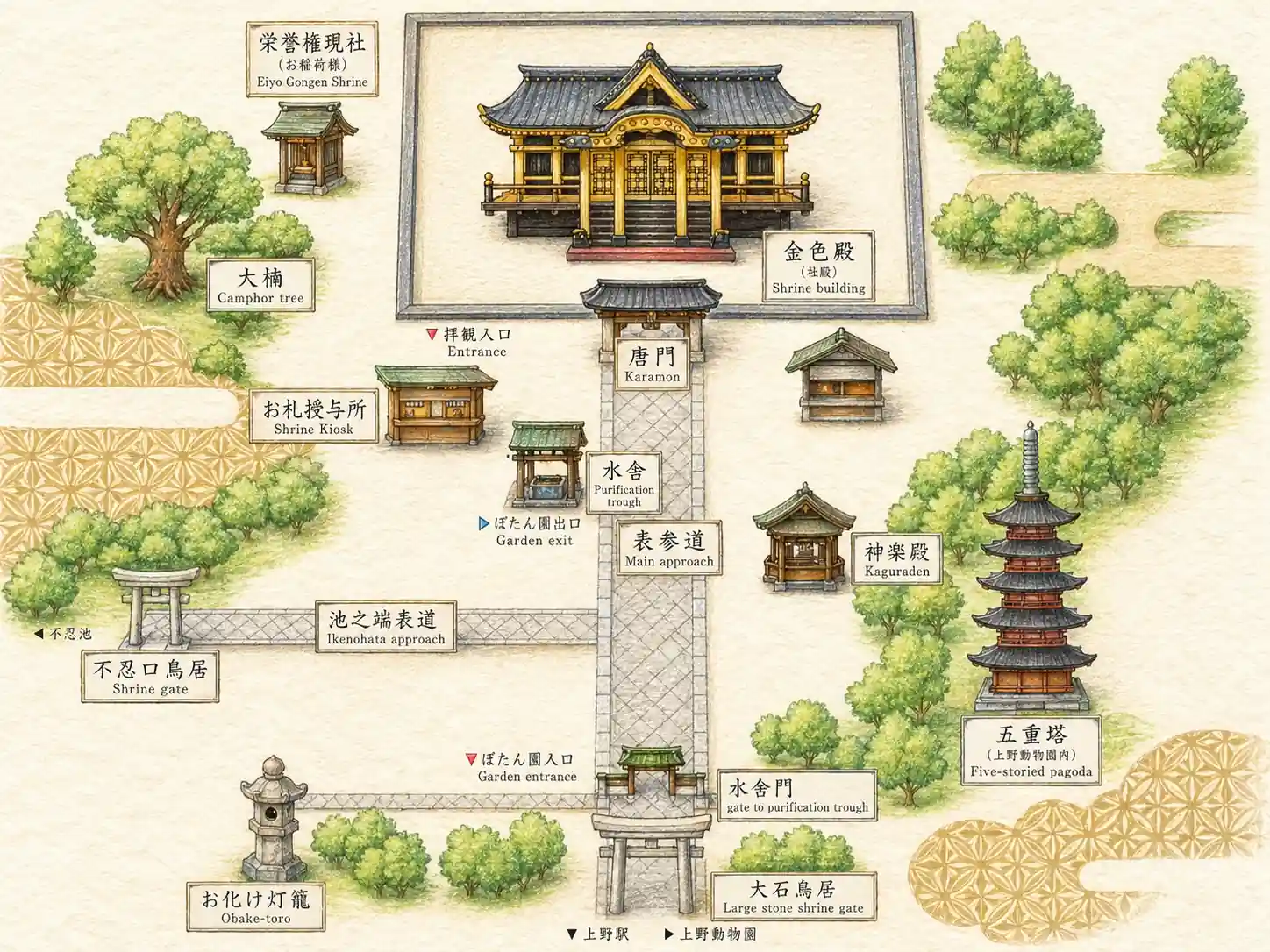
Station
(JY05)Park Exit, 10 min walk
ToriiApproach entrance
Kaguraden
OmizuyaMiddle approach
AdmissionPaid area
Eiyo GongenInner approach
Photo Tips from Repeated Visits|Where to Shoot Ueno Toshogu Shrine
If you want one main photo for Ueno Toshogu Shrine, choose the Golden Hall. Its gold surfaces feel especially striking because they appear in the middle of Ueno Park, surrounded by trees and city life. However, the space between the Karamon Gate and Golden Hall is not very wide, so a slightly angled composition often works better than trying to force a perfectly frontal shot.
| Subject | Best angle | On-site tip |
|---|---|---|
| Kinshikiden Golden Hall | Slightly angled | The angle helps show the depth of the building and the layered quality of the gold surfaces. |
| Karamon Gate | Front and slight angle | The front view shows the decorative density; the angled view shows the gate’s depth and structure. |
| Five-story pagoda | Approach side / pagoda route | You can see it from the approach, and the temporary route now allows a closer view on eligible days. |
| Stone lanterns and approach | Use depth or close-ups | They are less flashy than the buildings, but the lantern rows and Tokugawa crests can create atmospheric details. |
| Shinobazu-guchi Torii Gate | Include the stone steps | This is a quieter historical photo, best used to show the Edo Castle connection rather than visual spectacle. |
Detailed Guide to All 11 Spots
① Oishi Torii Gate
The main approach to Ueno Toshogu Shrine. A stone myojin-style torii made of Bizen granite, dedicated in 1633
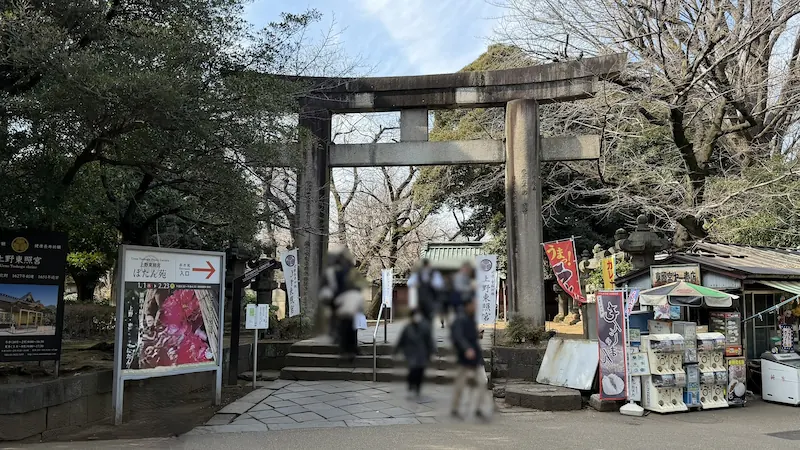
The Oishi Torii Gate standing at the main approach to Ueno Toshogu Shrine is a stone myojin-style torii dedicated in 1633(Kanei 10)by Sakai Tadayo in honor of Tokugawa Ieyasu. Made of Bizen granite, its solid and restrained appearance gives quiet weight to the entrance before the richly decorated shrine buildings ahead. Inscriptions on the pillars record both the original dedication and the 1734(Kyoho 19)repair, preserving the history of a gate that was once dismantled and buried before being excavated and returned to its original position.
Highlights
- A torii gate made of Bizen granite: Before entering the ornate shrine precinct, you can appreciate the sturdy beauty of a stone gate made from Bizen granite.
- Dedication and repair inscriptions: The pillars preserve inscriptions for Sakai Tadayo’s dedication and the 1734 repair, speaking to the gate’s early Edo-period origins.
- A seasonal approach: In spring, the route can be enjoyed with peonies and cherry blossoms; in autumn, with foliage and the dahlia exhibition; and at New Year, with winter peonies.
| Built | 1633(Kanei 10) |
|---|---|
| Donor | Sakai Tadayo |
| Structure | Stone myojin-style torii gate made of Bizen granite. |
| Repair history | Repaired in 1734(Kyoho 19). It was dismantled and buried during the Tenna era, then excavated and reconstructed in 1734. |
| Cultural status | National Important Cultural Property(designated December 22, 1942) |
| Notes | The bases of the pillars are buried as deep as about 4 meters underground. The gate survived the 1923 Great Kanto Earthquake. |
Trivia
- A buried torii: It was once dismantled and buried during the Tenna era, then excavated and restored to its original location in 1734.
- Granite that did not fall: Its construction, including deeply buried bases, is said to have helped it survive the Great Kanto Earthquake.
② Former Kaneiji Five-Story Pagoda
Rebuilt in 1639. A five-tiered tower rising among the trees of Ueno, and a masterpiece of early Edo-period religious architecture
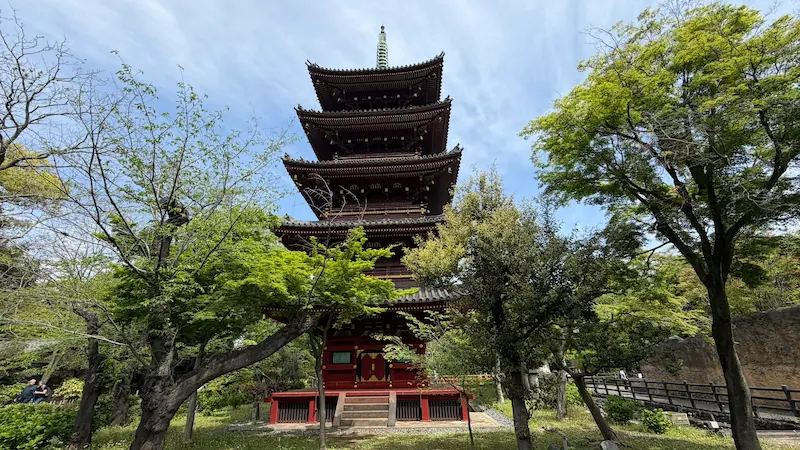
The five-story pagoda seen beside the approach to Ueno Toshogu Shrine is now known as the Former Kaneiji Five-Story Pagoda and is designated as a National Important Cultural Property. It was originally built in 1631 as the pagoda of Ueno Toshogu Shrine, and the surviving structure was rebuilt in 1639. Through the separation of Shinto and Buddhism and later changes in management, it has become a landscape where the histories of Toshogu Shrine and Kaneiji Temple overlap.
Highlights
- An early Edo-period five-story pagoda: Rebuilt in 1639, its five horizontal tiers blend beautifully with the trees of Ueno.
- Decoration on the first tier: The first tier includes carvings of the zodiac and dragons at the corners, with color restored during repairs in 2013–2014.
- About 36 meters tall: Rising to around 36 meters including the finial, it is one of the largest pagodas in Tokyo and stands prominently among the greenery of Ueno Park.
- A landscape unique to Ueno: The pagoda reflects both the shrine and temple histories that shaped Ueno Park.
| Original construction | 1631(Kanei 8) |
|---|---|
| Rebuilt | 1639(Kanei 16) |
| Builder / donor | Doi Toshikatsu |
| Structure | Three-bay five-story pagoda. About 36 m to the top of the finial. The fifth tier has copper roofing; the others have tile roofing. |
| Repairs | Partial dismantling repair in 1918. Repairs in 2013–2014 included lacquer, color, and wooden components on the first tier. |
| Cultural status | National Important Cultural Property(designated April 17, 1911) |
| Management | Tokyo Metropolitan Government(donated by Kaneiji Temple in 1958) |
Trivia
- From Toshogu pagoda to zoo landmark: It began as the pagoda of Ueno Toshogu Shrine, was transferred to Kaneiji after the Meiji separation of Shinto and Buddhism, and now stands inside Ueno Zoo under Tokyo Metropolitan management.
- Lost to a cherry-blossom viewing fire: The original pagoda burned down in 1639 after a fire caused by cherry-blossom viewers, then was rebuilt the same year by Doi Toshikatsu.
③ Shinobazu-guchi Torii Gate
Moved in 1873 from Momijiyama Toshogu inside Edo Castle. A quiet entrance from the Shinobazu Pond side
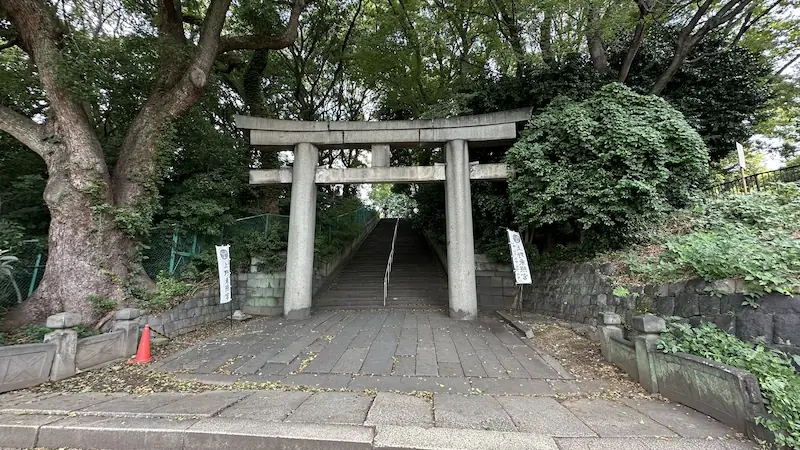
The Shinobazu-guchi Torii Gate, which leads into Ueno Toshogu Shrine from the Shinobazu Pond side, is easy to overlook on a first visit. Compared with the grand Oishi Torii Gate on the main approach, this entrance feels quieter and more modest. I also did not fully appreciate its importance at first.
Its value becomes clearer once you know the background: this granite torii gate was moved here in 1873(Meiji 6)from Momijiyama Toshogu inside Edo Castle. If you enter from the front for the best shrine experience, consider visiting this gate afterward. It is not the most visually spectacular spot, but it quietly preserves a link between Ueno Toshogu, Edo Castle, and the Tokugawa family.
Highlights
- Connection to Edo Castle and Momijiyama Toshogu: This gate was moved from Momijiyama Toshogu inside Edo Castle, making it one of the shrine entrances where Ueno’s link to Edo Castle can still be felt.
- Unusual Shinobazu approach steps: The approach has distinctive stone steps with alternating short and long rises.
- Good to combine with the Peony Garden: During the spring peony festival, autumn dahlia exhibition, and winter peony season, this side entrance works well with a visit to the Peony Garden.
| Moved here | 1873(Meiji 6) |
|---|---|
| Original location | Momijiyama Toshogu inside Edo Castle(donated by Kuroda Tadayuki) |
| Structure | Granite torii gate standing at the entrance to the Shinobazu approach from the pond side. |
| Cultural status | No information |
| Notes | The stone steps of the Shinobazu approach were built with private funds from worshippers. |
Trivia
- A torii not born in Ueno: This gate was not originally built in Ueno. It was moved in Meiji 6 from Momijiyama Toshogu inside Edo Castle.
- Stone steps built by worshippers: The Shinobazu approach steps were not built by the shogunate, but through private contributions from worshippers.
④ Mizuyamon Gate
An unusual gate repurposed from the roofed structure of the purification pavilion. Built in 1651 and moved in 1964
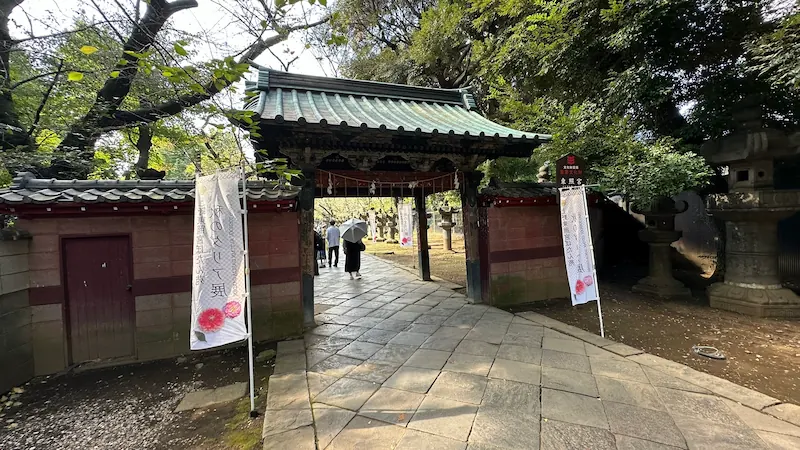
The Mizuyamon Gate, standing beyond the Oishi Torii Gate, began as the roofed structure of the purification pavilion that once stood before the shrine building. The original purification pavilion was donated in 1651(Keian 4)by the senior councilor Abe Shigetsugu, and in 1964(Showa 39)its roofed structure was moved and repurposed as a gate. A building once used for ritual cleansing was transformed into a gate on the approach, making this an example of architectural reuse characteristic of Ueno Toshogu Shrine.
Highlights
- A reused purification pavilion structure: Its origin as the roofed part of a water purification area gives it a different character from a standard shrine gate.
- Entrance to the stone-lantern approach: After passing through the Mizuyamon Gate, the approach opens into a path lined with stone lanterns donated by daimyo during the 1651 reconstruction.
| Original construction | 1651(Keian 4)as a purification pavilion |
|---|---|
| Moved as gate | 1964(Showa 39) |
| Donor | Abe Shigetsugu(senior councilor) |
| Cultural status | No information |
Trivia
- A gate with a different origin: Unlike a gate designed as a gate from the beginning, it preserves the memory of a former water purification structure.
- A quiet transition: It works as a visual pause before the highly decorated Karamon Gate and shrine-front area.
⑤ Kaguraden Hall
Dedicated in 1874 by the Fukagawa Kiba Association. A stage for sacred kagura and biwa performances
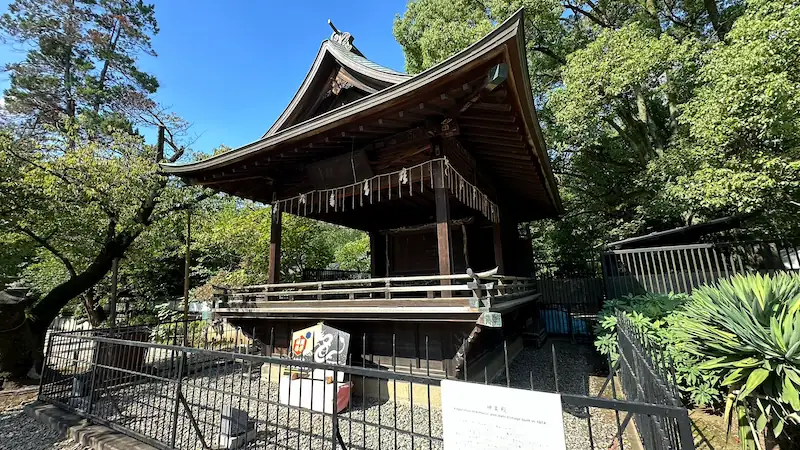
The Kaguraden Hall was dedicated in 1874(Meiji 7)by the Fukagawa Kiba Association as a building for ritual performing arts. Its balanced roofline adds a composed dignity to the shrine approach, and it continues to connect the faith and culture of Ueno Toshogu through performances such as sacred kagura and biwa music.
Highlights
- Beauty of the roofline: Against the trees along the approach, the elegant roofline stands out quietly and creates a calm highlight on the way to the Golden Hall.
- A space for traditional performing arts: As a place where sacred kagura and biwa performances are offered, it lets visitors sense not only worship but also the performing arts culture preserved at the shrine.
| Dedicated | 1874(Meiji 7) |
|---|---|
| Donor | Fukagawa Kiba Association |
| Use | Ritual performing arts including sacred kagura and biwa offerings |
| Cultural status | No information |
Trivia
- Linked to Kiba timber culture: The dedication by the Fukagawa Kiba Association reflects the connection between Edo-Tokyo’s merchant and craft communities and shrine patronage.
- A living stage: Rather than being purely decorative, it represents the ritual and performance culture of the shrine.
⑥ Omizuya Purification Pavilion
A purification space on the approach. The stone basin is associated with Komatsu stone from the Manazuru area
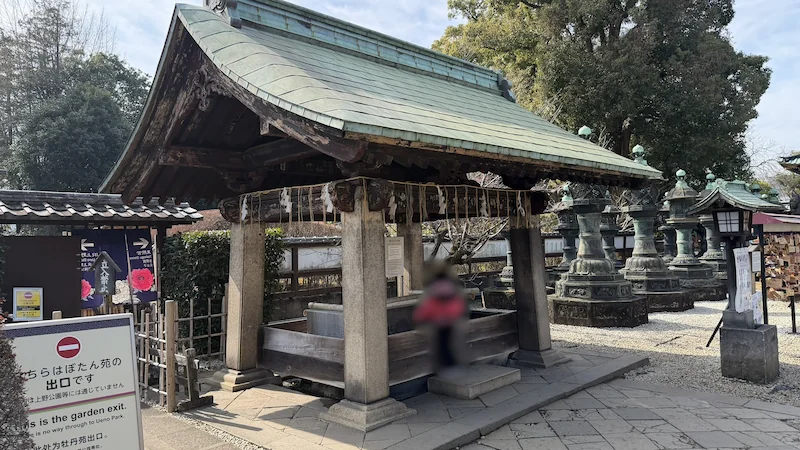
The Omizuya is the purification pavilion where visitors cleanse themselves before proceeding toward the shrine building. The water basin bears an inscription indicating that it was donated in 1651(Keian 4)by the senior councilor Abe Shigetsugu, quietly conveying the culture of early Edo-period offerings along the approach to the Golden Hall.
Highlights
- A water basin donated by Abe Shigetsugu: The basin preserves an inscription from Keian 4, allowing visitors to feel the precinct space developed during Tokugawa Iemitsu’s time from the ground level.
- Connecting worship etiquette and architectural appreciation: By cleansing your hands before proceeding toward the Golden Hall, you can prepare for worship while enjoying the spatial sequence of the shrine.
| Water basin donated | 1651(Keian 4) |
|---|---|
| Water basin donor | Abe Shigetsugu(senior councilor) |
| Water basin material | Komatsu stone |
| Notes | The roofed structure of the former purification pavilion once located to the front-right of the shrine building was moved in 1964 and repurposed as the Mizuyamon Gate. |
Trivia
- Komatsu stone basin: Records identify the water basin as Komatsu stone, a stone from the area around Manazuru in Kanagawa.
- Part of the approach sequence: Even small structures like this help create the ritual rhythm leading toward the main shrine building.
⑦ Karamon Gate
A karahafu-gabled gate from Tokugawa Iemitsu’s 1651 reconstruction. Ascending and descending dragons guard the front of the Golden Hall
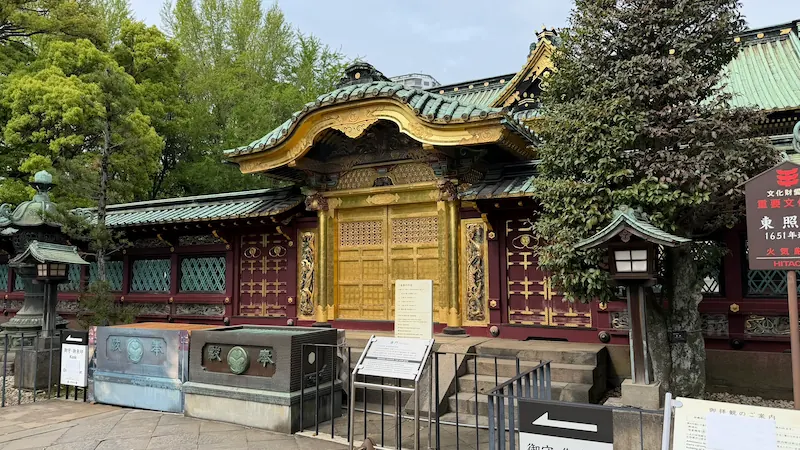
The Karamon Gate is the most important highlight you can see from the free area. It stands directly in front of the Golden Hall and was built in 1651(Keian 4)when Tokugawa Iemitsu reconstructed the shrine complex in a style modeled after Nikko Toshogu Shrine. The curved karahafu gable, gold leaf, mineral-pigment colors, dragon carvings, bird motifs, and Tokugawa hollyhock crests are packed into a surprisingly small surface area.
On a first visit, the Golden Hall may dominate your memory, but after repeated visits the Karamon Gate becomes just as important. Its appeal lies in the density of the details: the ascending and descending dragons, the openwork carvings, and the way the gate frames the shrine building behind it. For photography, a straight-on view shows the decorative richness, while a slightly angled view gives the gate more depth.
Highlights
- Karahafu gate form: The curved gable facing the shrine building heightens the sense of tension as you approach the Golden Hall.
- Ascending and descending dragons with openwork carvings: Dragon, golden pheasant, and silver pheasant carvings are arranged with remarkable density, allowing visitors to see early Edo decorative art up close.
- The meaning of the dragon that lowers its head: The downward-facing dragon is called an “ascending dragon,” carrying the idea that truly great people lower their heads in humility.
| Built | 1651(Keian 4) |
|---|---|
| Construction | Part of the reconstruction ordered by Tokugawa Iemitsu |
| Structure | One bay by one bay, mukai-karamon gate with copper roofing and a four-legged karahafu structure |
| Cultural status | National Important Cultural Property(designated April 17, 1911) |
| Carvings | Ascending and descending dragons on the inner and outer sides of the pillars, openwork carvings of golden and silver pheasants above, and a kanko-dori motif on the inner side |
Trivia
- Modeled after Nikko Toshogu: The Karamon Gate was built during Iemitsu’s 1651 reconstruction to bring the shrine closer to the style of Nikko Toshogu.
- Raw color and raised color techniques: Both ikisaishiki, coloring over gold leaf with mineral pigments, and okigami-saishiki, raised decorative coloring, are used here.
⑧ Kinshikiden Golden Hall(Shrine Building)
Built by Tokugawa Iemitsu in 1651. A golden gongen-zukuri shrine building and the heart of Tokugawa memory in the woods of Ueno
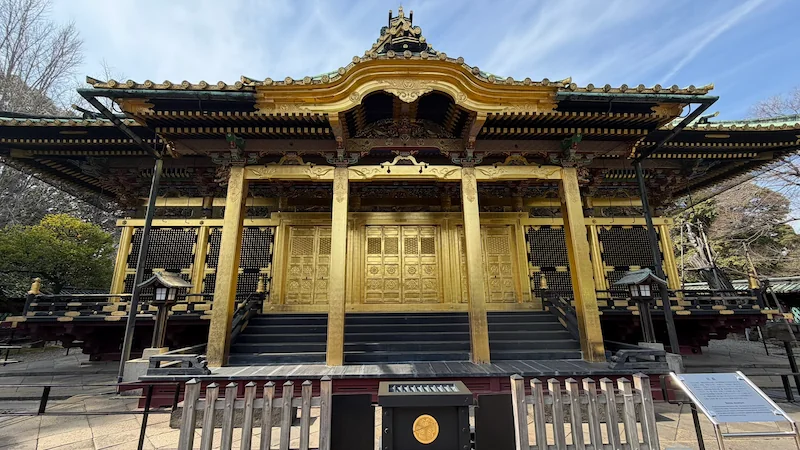
The Kinshikiden Golden Hall is the one sight I most strongly recommend seeing at Ueno Toshogu Shrine. On a first visit, the surprise is simple: there is a richly gilded Tokugawa shrine building in the middle of Tokyo’s Ueno Park. But after several visits, the appeal becomes deeper than the gold itself. The carvings, painted details, Tokugawa hollyhock crests, and layered architecture all reveal how carefully the building was made.
The shrine was originally founded in 1627(Kanei 4), and the surviving building was rebuilt in 1651(Keian 4)by order of the third shogun Tokugawa Iemitsu in a form modeled after Nikko Toshogu Shrine. Built in the gongen-zukuri style, in which the worship hall, connecting hall, and main sanctuary are linked together, it combines gold leaf, mineral-pigment coloring, and carvings of hawks, peonies, phoenixes, and lions.
The paid viewing area changes the experience. From outside, you can understand that the building is golden, but from inside the Sukibei Wall you can better feel the texture of the gold, the depth of the shrine building, and the quietness around it. The gold does not appear as a flat surface; it changes with light, shadow, angle, and the surrounding greenery. That is the part photographs struggle to convey.
🔗 Kinshikiden Special Door Opening on-site report →
Highlights
- Golden shrine architecture in central Tokyo: This is a rare place where you can see a surviving early Edo-period golden shrine building in the middle of Tokyo.
- A paid area that changes the visit: Entering inside the Sukibei Wall makes the gold texture, sculptural depth, and quieter atmosphere much easier to appreciate.
- Gongen-zukuri structure: The worship hall, connecting hall, and main sanctuary are joined into one sacred architectural composition.
- Gold leaf and richly colored carvings: Hawks, peonies, phoenixes, and a-un lions are decorated with gold leaf and mineral pigments, allowing visitors to experience the luxurious decorative techniques of the early Edo period up close.
- A shrine building that survived three disasters: This miraculous structure survived the Battle of Ueno, the Great Kanto Earthquake, and the Tokyo air raids. It is said that an incendiary bomb that fell behind it during the air raids failed to explode.
| Founded | 1627(Kanei 4) |
|---|---|
| Present shrine building | Rebuilt in 1651(Keian 4) |
| Builder | By order of Tokugawa Iemitsu |
| Structure | Gongen-zukuri shrine architecture linking the worship hall, offering hall, and main sanctuary. The main sanctuary is a three-bay-square irimoya-style building; the offering hall uses a ryosage-zukuri form; and the worship hall is an irimoya-style structure with a chidori gable, three-bay projecting porch, and eaves karahafu. All are roofed with copper tiles. |
| Repair history | A preservation and restoration project was completed over about five years from 2009 to 2014. |
| Cultural status | National Important Cultural Property(designated April 17, 1911) |
| Enshrined deities | Tokugawa Ieyasu, Tokugawa Yoshimune, and Tokugawa Yoshinobu |
Trivia
- A Nikko Toshogu for the people of Edo: Tokugawa Iemitsu ordered the reconstruction as a magnificent shrine building modeled after Nikko Toshogu, for people in Edo who could not travel all the way to Nikko.
- Raw color and raised color techniques: Both ikisaishiki, coloring over gold leaf with mineral pigments, and okigami-saishiki, raised decorative coloring, are used.
- An unexploded incendiary bomb: During the Tokyo air raids, an incendiary bomb fell behind the Golden Hall but failed to explode, allowing the shrine building to survive.
⑨ Eiyo Gongen Shrine(Otanuki-sama)
Donated in the Taisho era. A deity of strong luck, associated with “surpassing others,” and popular for exams, job hunting, and victory prayers
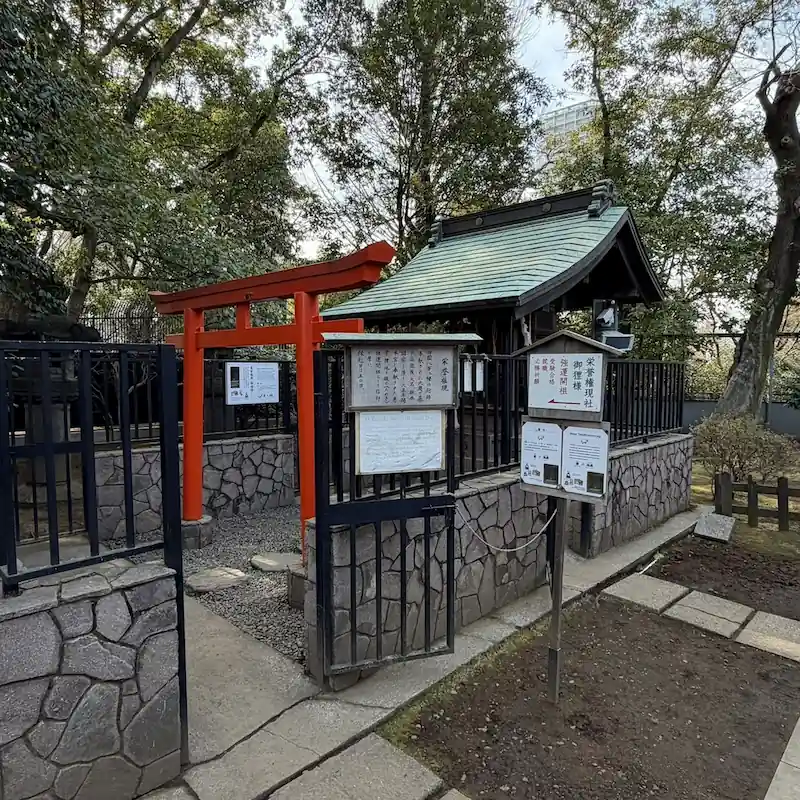
Eiyo Gongen Shrine is a small shrine standing beside the Golden Hall. Also known as Otanuki-sama, the deity was once said to bring misfortune to the places where it was enshrined during the Edo period. After being donated to Ueno Toshogu Shrine in the Taisho era, however, it came to be worshipped as a deity that grants strong luck.
The Japanese word tanuki also evokes the phrase “ta o nuku,” meaning “to surpass others.” For this reason, the shrine is especially popular with people praying for success in entrance exams, job hunting, competitions, and victory-related goals.
Highlights
- A deity of strong luck: The shrine is especially associated with prayers for good fortune, exams, employment, and victory.
- The wordplay of tanuki: The phrase “ta o nuku,” or “to surpass others,” gives the deity a special appeal for competitive goals.
- A small but memorable stop: Located inside the paid area, it is easy to visit together with the Golden Hall and sacred tree.
| Donated | Taisho era |
|---|---|
| Also known as | Otanuki-sama; founder of strong luck |
| Benefits | Strong luck, exams, job hunting, victory |
| Location | Paid viewing area(inside the Sukibei Wall) |
| Cultural status | No information |
Trivia
- A deity once associated with misfortune: During the Edo period, it was said to bring disaster to places where it was kept, including the Ooku. After being donated to Ueno Toshogu in the Taisho era, it came to be worshipped as a deity of strong luck.
- Not in the free area: It is located inside the same paid area as the sacred tree and the shrine-front worship area.
⑩ Great Camphor Tree(Sacred Tree)
More than 600 years old and over 8 meters around. A sacred tree said to predate the founding of Ueno Toshogu Shrine
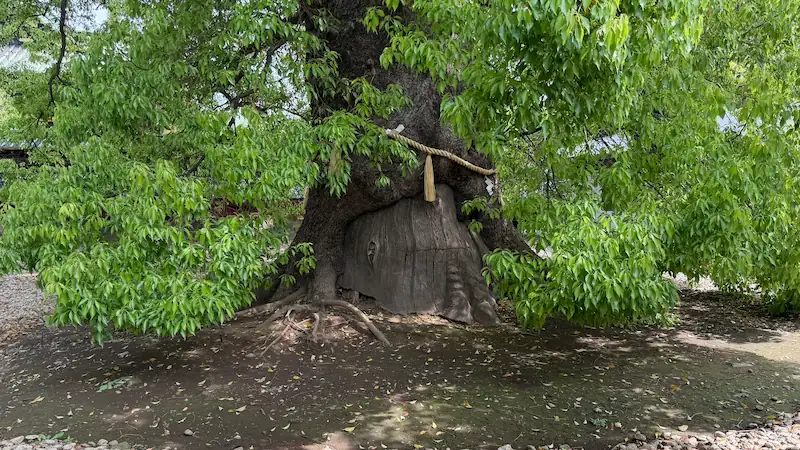
The great camphor tree is the sacred tree standing inside Ueno Toshogu’s paid viewing area. It is said to have watched over this place since before the shrine was founded in 1627. The tree is estimated to be more than 600 years old, with a trunk circumference of over 8 meters, and is described as the largest in Ueno Park. The view of its deep green presence facing the gold-leaf shrine building allows visitors to feel both early Edo-period architectural beauty and the long natural time of Ueno. A quiet seating area is located in front of the sacred tree, making it a place to calm the mind before worship.
Highlights
- A sacred tree over 600 years old: Said to have stood here before Ueno Toshogu was founded in 1627, this great camphor tree is notable for its massive trunk.
- View from the quiet resting place: Sitting near the sacred tree lets you step away from the bustle of Ueno and feel the tree’s presence in silence.
- Contrast between gold and green: The sight of the camphor tree standing against the Golden Hall is one of Ueno Toshogu’s most characteristic combinations of architecture and nature.
| Estimated age | More than 600 years |
|---|---|
| Trunk circumference | Over 8 m(said to be the largest in Ueno Park) |
| Species | Camphor tree |
| Location | Paid viewing area(inside the Sukibei Wall) |
| Notes | A quiet resting area stands before the sacred tree. The inner approach passes around the tree toward the Golden Hall. |
Trivia
- A tree older than the shrine: Ueno Toshogu was founded in 1627, but the great camphor tree is introduced as a sacred tree that has watched over the site since before the shrine existed.
- A landmark of the inner approach: Near the camphor tree is the inner path that circles the sacred tree and leads toward the Golden Hall.
⑪ Obake Toro Lantern
One of Japan’s three great stone lanterns. Dedicated in 1631, it stands outside the shrine precinct near the Oishi Torii Gate
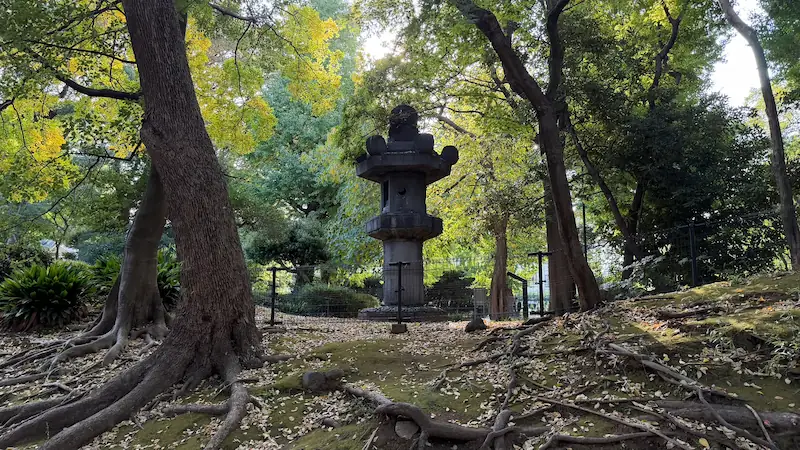
The Obake Toro Lantern is a massive stone lantern standing near the entrance to Ueno Toshogu Shrine. It was dedicated in 1631(Kanei 8)by Sakuma Katsuyuki and is called “Obake Toro,” or “monster lantern,” because of its size. Together with the great stone lanterns of Atsuta Jingu in Nagoya and Nanzenji in Kyoto, it is counted as one of Japan’s three great stone lanterns.
Highlights
- One of Japan’s three great stone lanterns: It is ranked alongside the large stone lanterns of Atsuta Jingu and Nanzenji, combining scale with historical prestige.
- Powerful presence at the approach entrance: Standing beside the Oishi Torii Gate, it conveys the faith and status of daimyo donors who supported Ueno Toshogu.
- Part of a group of over 200 stone lanterns: More than 200 stone lanterns stand throughout the grounds, and this giant lantern is their symbolic presence.
| Dedicated | 1631(Kanei 8) |
|---|---|
| Donor | Sakuma Katsuyuki |
| Nickname | Obake Toro, or “monster lantern,” because of its size |
| Status | One of Japan’s three great stone lanterns |
| Current condition | Still standing beside the Oishi Torii Gate |
| Notes | There are more than 200 stone lanterns throughout Ueno Toshogu Shrine. |
Trivia
- Older than the Golden Hall reconstruction: Dedicated in 1631, it predates Tokugawa Iemitsu’s 1651 reconstruction of the Golden Hall and is one of the oldest surviving donated objects in the precinct.
- The stone lanterns of Ueno: More than 200 daimyo-donated stone lanterns line the shrine grounds, and this giant lantern is their most symbolic example.
Access and Practical Information
Ueno Toshogu Shrine Basic Information
| Address | 9-88 Ueno Park, Taito City, Tokyo |
|---|---|
| Hours | Summer(Mar–Sep)9:00–17:30 / Winter(Oct–Feb)9:00–16:30 Paid viewing area and goshuin reception close 30 minutes earlier(subject to weather changes) |
| Admission | Worship(approach–Karamon Gate): Free Paid viewing area(Golden Hall, Eiyo Gongen Shrine, Great Camphor Tree): Adults 700 yen / Elementary school students 300 yen / Groups of 20 or more 600 yen |
| Goshuin | Available near the entrance to the paid viewing area. Until 17:00 in summer and 16:00 in winter(30 minutes before closing). Offering generally around 500 yen(subject to change). |
| By train | JR Ueno Station (JY05)(Park Exit)/ Tokyo Metro Ueno Station (G16/H18) — about 10 minutes on foot. Ueno Station (JY05) is about a 10-minute ride from Tokyo Station (JY01) on the JR Yamanote Line, costing 200 yen. |
| From Shinobazu side | Tokyo Metro Yushima Station (C13) or Nezu Station (C14) — about 10–15 minutes on foot |
| Nearby in Ueno Park | Tokyo National Museum, Ueno Zoo, Shinobazu Pond — all within easy walking distance |
| Official site | https://www.uenotoshogu.com/ |
Goshuin: Shrine Seals at Ueno Toshogu
Goshuin (御朱印) are red-stamped calligraphy certificates issued by shrines and temples as a record of your visit — not simply a souvenir. Ueno Toshogu offers three types: the standard goshuin, a limited-edition festival seal printed on handmade Japanese paper, and a dedicated seal for the Eiyo Gongen-sha (the raccoon dog shrine). All are available at the reception desk near the entrance to the paid inner precinct.
① Standard Goshuin
Hand-brushed calligraphy with seasonal illustration
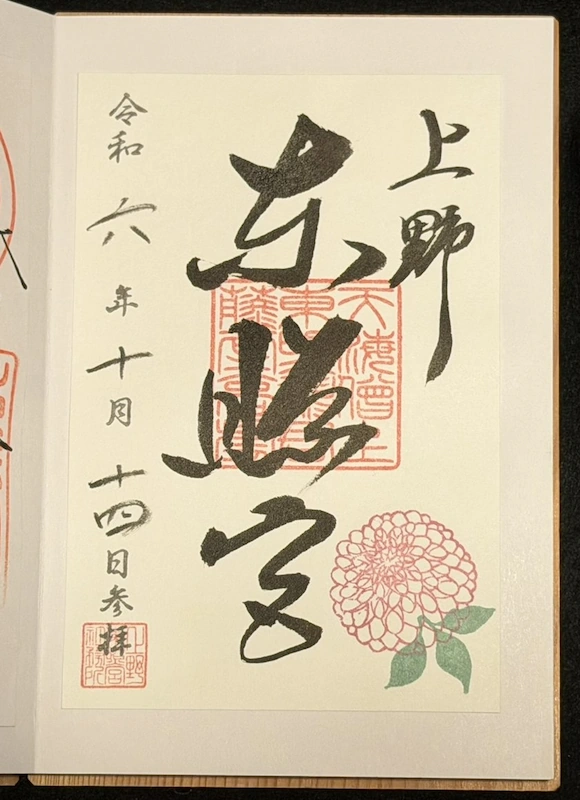
The standard goshuin features hand-brushed calligraphy reading "Ueno Toshogu" in bold ink, a central red stamp, and a seasonal illustration. The example shown is from October 2024 and includes a dahlia — the shrine's autumn flower. The illustration changes with the season, so each visit yields a different design.
② Grand Festival Special Goshuin
Handmade washi × letterpress printing — a collector's piece
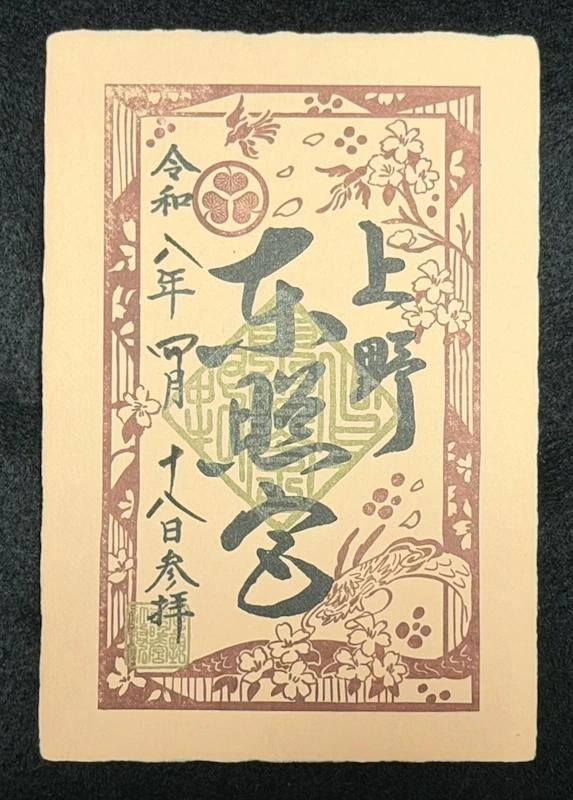
Each sheet of paper for this edition is hand-laid by artisans in Echizen, Fukui Prefecture — one of Japan's oldest washi-producing regions. Because every sheet is made individually, slight variations in thickness and edge texture are part of the design. The letterpress printing adds another layer of texture: raised ink, natural pressure irregularities, and subtle ink breaks give the finished seal a tactile warmth that offset printing cannot replicate.
The gold central stamp is a revival of a goshuin design used at Ueno Toshogu during the Meiji and Taisho eras. The surrounding artwork features cherry blossoms, a dragon, and the Tokugawa triple hollyhock (aoi) crest at the top.
③ Tanuki Goshuin (Otanuki-sama Seal)
"Outpace the competition — I grant you strength"
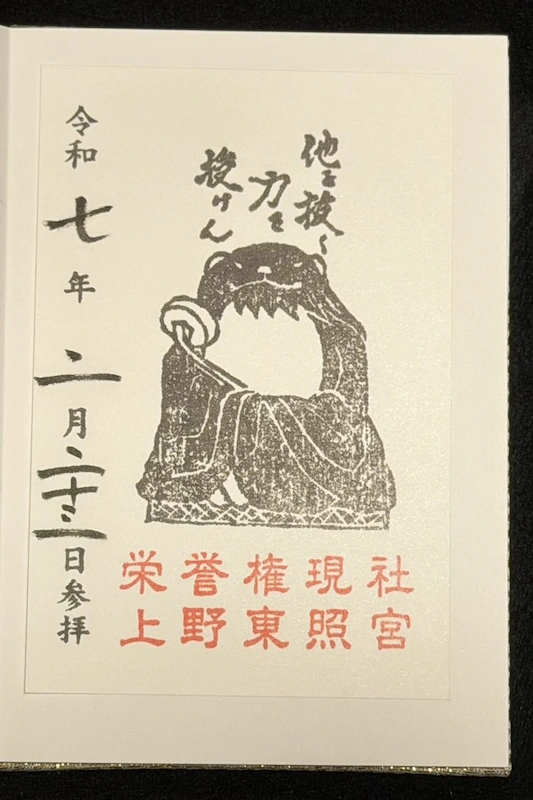
This seal belongs to the Eiyo Gongen-sha, a small sub-shrine dedicated to a raccoon dog deity (tanuki) located within the paid inner precinct. The stamped design shows the deity seated in formal robes, accompanied by the phrase "他を抜く、力を授けん" — roughly, "Outpace the competition; I grant you strength."
The wordplay here is intentional: tanuki (raccoon dog) sounds like ta wo nuku, meaning "to surpass others." The seal is popular with visitors praying for exam success, job hunting, and competitive endeavors of all kinds.
Frequently Asked Questions
Ueno Toshogu Shrine enshrines Tokugawa Ieyasu, also revered as Tosho Daigongen, along with Tokugawa Yoshimune and Tokugawa Yoshinobu.
No, they are separate shrines. Nikko Toshogu is the original, much larger shrine complex in Nikko, about two hours from Tokyo. Ueno Toshogu was built in 1651 in a similar style for the people of Edo who could not travel all the way to Nikko. Visiting Ueno Toshogu gives you a compact, easy-to-reach experience of the same Tokugawa decorative style.
The approach to the shrine and the Karamon Gate can be visited for free. The paid viewing area, including the Golden Hall, Eiyo Gongen Shrine, and the sacred camphor tree, costs 700 yen for adults, 300 yen for elementary school students, and 600 yen for groups of 20 or more. Special openings such as the Kinshikiden Special Door Opening require a separate fee, usually 1,000 yen for adults.
The shrine is open from 9:00 a.m. to 5:30 p.m. in summer, from March to September, and from 9:00 a.m. to 4:30 p.m. in winter, from October to February. Entry to the paid viewing area and goshuin reception end 30 minutes earlier. The shrine may close during severe weather.
Ueno Toshogu Shrine is about a 10-minute walk from JR Ueno Station (JY05) Park Exit or Tokyo Metro Ueno Station (G16/H18). Walk through Ueno Park, continue beyond the large fountain, and the main stone torii gate will appear on the right. You can also enter from the Shinobazu Pond side through the Shinobazu-guchi approach.
Yes. Ueno Toshogu sits inside Ueno Park, within easy walking distance of the Tokyo National Museum, Ueno Zoo, and Shinobazu Pond, so it pairs naturally with a half-day or full-day visit to the park.
The five-story pagoda currently stands inside Ueno Zoo. Since March 2026, a temporary pagoda walking route from the Ueno Toshogu approach side has been open on zoo operating days, allowing visitors to see the pagoda up close without entering the zoo. Please check the official Ueno Zoo website for details.
If you simply walk in and out, you can technically finish in about five minutes, but that only gives you the feeling of having checked the place off a list. If you want to photograph the Karamon Gate and Golden Hall properly, allow at least 30 minutes. For the Golden Hall, sacred camphor tree, and five-story pagoda route, plan for 30 to 60 minutes. If the Peony Garden is open, add at least another 15 to 30 minutes depending on your pace.
Normally, visitors worship from outside and cannot enter the shrine building. Once a year, usually for several days in mid-April, the Kinshikiden Special Door Opening is held, allowing visitors to view the golden interior decorations from outside. The special opening usually costs 1,000 yen for adults. Please check the official website for current dates.
The spring peony festival is usually held from mid-April to early May, while winter peonies are usually displayed from early January to late February. A dahlia exhibition is held in autumn. These events are paid attractions, generally around 1,000 yen for adults, and can be enjoyed together with a shrine visit.
Goshuin shrine seals are available near the entrance to the paid viewing area. Reception generally closes at 5:00 p.m. in summer and 4:00 p.m. in winter, 30 minutes before the paid viewing area closes. The offering is usually around 500 yen, though it may change.
Yes. Based on repeated visits, the paid viewing area is worth entering, especially for first-time visitors. The free area lets you see the Karamon Gate, but once you enter inside the Sukibei Wall, the Golden Hall looks different: the gold texture, depth of the building, fine carvings, Tokugawa hollyhock crests, and quiet atmosphere become much easier to appreciate.
For a first visit, the main approach through the Oishi Torii Gate is recommended. Entering from the front lets you experience the shrine in sequence, from the stone torii and lantern-lined approach to the Karamon Gate and Golden Hall. The Shinobazu Pond-side entrance is quieter and more modest, but it is historically interesting because its torii gate was moved from Momijiyama Toshogu inside Edo Castle.
The Golden Hall is the strongest main photo subject because its gold surfaces create a striking contrast with the trees and the urban setting of Ueno. For the Karamon Gate, a slightly angled view often works better than a straight-on shot because it gives the gate more depth. The stone lanterns and approach are less flashy, but close-ups of the Tokugawa hollyhock crest and lantern details can produce atmospheric photos.
The hardest thing to capture in photos is the texture of the gold. In person, the Golden Hall does not look like a flat gold surface. Its appearance changes with light, shadow, viewing angle, and the surrounding greenery. This is one reason the paid area is more satisfying than viewing the shrine only from outside.
☕ このサイトを応援する
Following the Shogunは現地取材をもとに制作しています。
記事が役に立ったと感じていただけたら、サポートいただけると励みになります。

QRコードからもサポートできます


comment