Northern Stronghold: Where Toyotomi Hideyori & Lady Yodo Made Their Last Stand
Personally visited · 7 spots · Free entry · Rarely visited · 1615 death-site monument · Hidden Bailey · Higo Stone · Aoyamon Gate · On-site photos
The Northern Stronghold is the least-visited yet most historically charged area of Osaka Castle. This is where the Toyotomi clan ended in 1615, where defensive design is etched into stone, and where massive monoliths bear witness to the political power of the Edo period. All 7 spots are free to visit.
The 7 Spots
1. Hidden Bailey (Kakushi Kuruwa)
Toyotomi Hideyoshi’s secret defensive enclosure — designed to manipulate and trap enemy forces
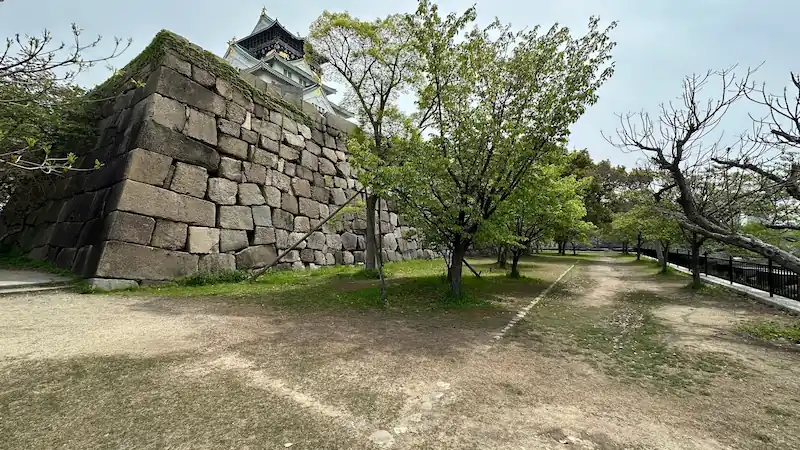
Tucked away on the northwest side of Osaka Castle lies the Hidden Bailey (Kakushi Kuruwa) — a narrow bailey that many visitors miss entirely. Because it is difficult to notice from the main route, it is generally thought to have been a place where soldiers could be concealed. Its angled stone walls and walkways still restrict sightlines and movement, and today it remains a peaceful forested corner of the castle grounds.
| Period | Early Edo period (current visible stonework) |
|---|---|
| Attribution | A little-noticed bailey generally thought to have been used to conceal soldiers |
| Feature | Angled stone walls and a narrow layout that restrict sightlines |
| Admission | Free |
| Visit Duration | ~10–30 min |
- Hard to notice: The bailey is easy to miss from the main circulation route, which is why it is commonly called the Hidden Bailey.
- Concealed-soldier theory: It is generally thought to have been a place where soldiers could be hidden from view.
- Stone-wall close-up: This is one of the quieter places in the castle to examine masonry at close range.
- Inscribed stones nearby: Several kokuinseki bearing old carved marks can be found in the surrounding area.
2. Inscribed Stone Square (Kokuinseki Hiroba)
80 engraved stones from 64 feudal domains — a roll call of Edo-period political power
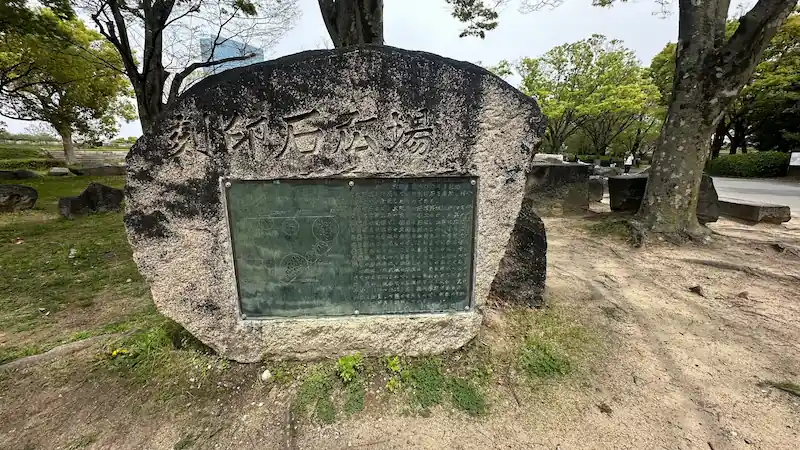
Located in the Yamazato-maru on the northern side, the Inscribed Stone Square was established in 1983 to commemorate the 400th anniversary of Osaka Castle’s construction. It displays around 80 stones bearing engraved marks — clan crests, stonemason symbols, and characters — from the 64 feudal domains mobilised by the Tokugawa Shogunate to build the castle’s stone walls between 1620 and 1629. Each inscription is a historical record of the political and logistical forces behind one of Japan’s greatest castle construction projects.
| Established | 1983 — 400th anniversary of Osaka Castle |
|---|---|
| Stones Displayed | ~80 stones from excavations and restoration work |
| Domains Represented | 64 western domains mobilised by Tokugawa Shogunate |
| Admission | Free |
| Visit Duration | ~20–60 min |
- Arranged by excavation zone: The stones are displayed according to where they were unearthed — providing clues about which regions contributed to specific parts of the fortress.
- Yanata wedge holes: Some stones still bear wedge holes used during the quarrying process — a window into Edo-period stone-cutting technique.
- Not Toyotomi era: A common misconception — all currently existing stone walls date from the Tokugawa reconstruction (1620–1629), not Hideyoshi’s time.
3. Site of Seppuku of Toyotomi Hideyori and Lady Yodo
May 8, 1615 — where Japan’s most powerful clan made its final, tragic stand
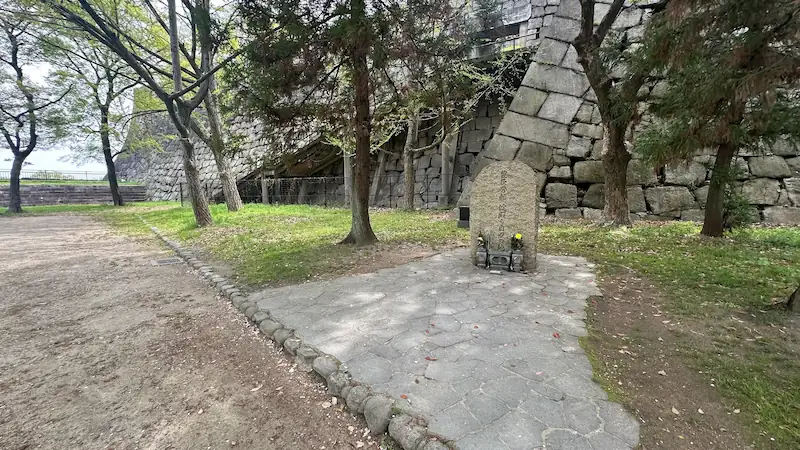
On May 8, 1615, during the Summer Siege of Osaka, Toyotomi Hideyori and his mother Lady Yodo are said to have taken their own lives here in the Yamazato-maru compound, marking the end of the Toyotomi clan. The City of Osaka erected a monument at this site in 1997. Lady Yodo was the daughter of warlord Azai Nagamasa, niece of Oda Nobunaga, and concubine of Toyotomi Hideyoshi. Nearby stands a memorial tower for attendants traditionally said to have died with them.
| Date | May 8, 1615 (Summer Siege of Osaka) |
|---|---|
| Monument Erected | 1997 by the City of Osaka |
| Location | Yamazato-maru compound, Northern Stronghold |
| Admission | Free |
| Visit Duration | ~20–30 min |
- End of an era: The Toyotomi clan’s fall here marked the final collapse of Toyotomi power at Osaka.
- Lady Yodo’s lineage: Daughter of Azai Nagamasa and niece of Oda Nobunaga — her life connected several major Sengoku houses.
- 1997 monument: The current stone marker was erected by the City of Osaka.
- Nearby memorial: A memorial tower nearby commemorates attendants traditionally said to have died with them.
4. Gokurakubashi Bridge
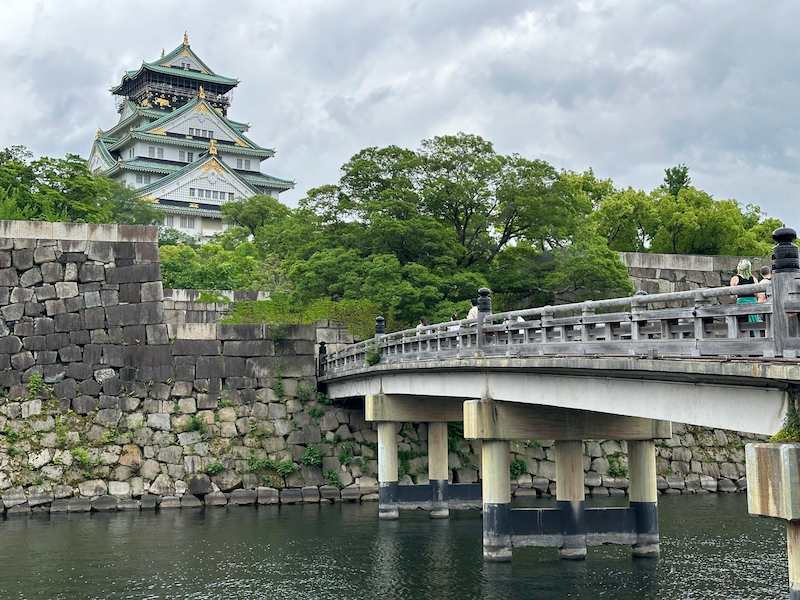
Bridge to Paradise — the most iconic reflection view of the Main Tower over the inner moat
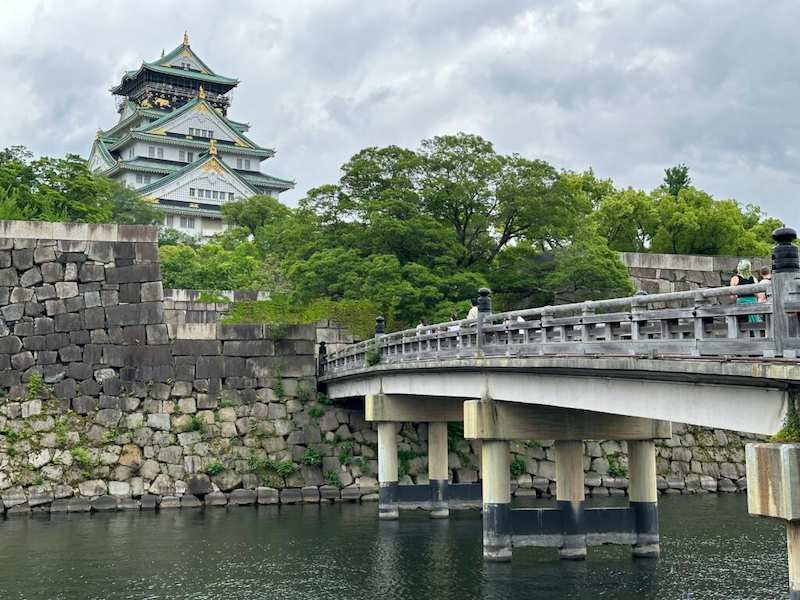
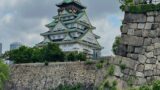
Gokurakubashi (“Bridge to Paradise”) connects the inner Honmaru with the Ninomaru and offers one of the most iconic views at Osaka Castle — the Main Tower reflected in the inner moat. A luxurious bridge of this name was built by Toyotomi Hideyoshi in 1596 to welcome envoys from Ming China. After Hideyoshi’s death, its timbers were moved first to Hōkoku Shrine in Kyoto and later to Hōgon-ji on Chikubu Island. A Tokugawa-period wooden bridge stood in roughly the same place, but it burned in the Boshin War. The current structure was rebuilt in 1965 using reinforced concrete while retaining traditional ornamental railings. It spans 54 metres across the inner moat.
| Originally Built | 1596 (Toyotomi Hideyoshi); current structure 1965 |
|---|---|
| Length | 54 metres |
| Admission | Free |
| To Station | ~9 min walk to Osaka Business Park Station |
| Visit Duration | ~5–15 min |
- 1596 ceremonial bridge: Hideyoshi had a lavish Gokurakubashi built to welcome envoys from Ming China.
- Best reflection shot: Morning light from the east creates the clearest moat reflection of the tower.
- Hidden gem: Far less crowded than the main castle entrance — often peaceful even during peak tourist season.
- Architectural legacy: Timbers from the Toyotomi-period bridge were later reused at Hōkoku Shrine in Kyoto and then at Hōgon-ji on Chikubu Island.
5. North Partition Gate
A border gate between Sannomaru and Ninomaru — usually closed, occasionally open for special events
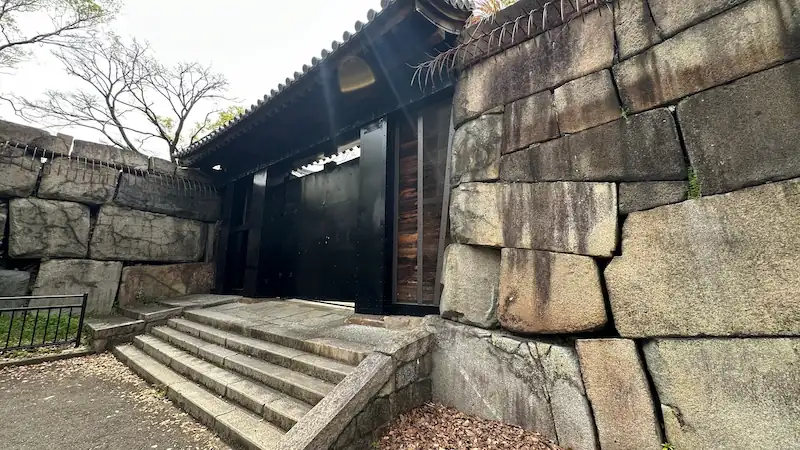
The North Partition Gate was one of the gates used to divide sections of Tokugawa-period Osaka Castle. The original gate was lost after the Meiji Restoration. The current structure was reconstructed in 1965 and differs from the Edo-period gate that once stood here. It is usually closed to the public but is sometimes opened for special events. The surrounding stone walls and moats still preserve much of the historic atmosphere of this side of the castle.
| Year Built | Edo period original; reconstructed 1965 |
|---|---|
| Current Status | Generally closed; occasionally open for special events |
| Admission | Free (exterior) |
| Address | Osaka Castle 2-2, Chuo Ward, Osaka |
| Visit Duration | ~15 min (exterior) |
- Rare opening: When opened during Nishinomaru Garden events, visitors can pass through and access areas typically off-limits.
- Intact stone walls: Edo-period stonework and moats surrounding the gate remain in excellent condition.
- Hokoku Shrine nearby: Standing close to Toyokuni Shrine, this area connects northern castle history with Hideyoshi’s legacy.
6. Higo Stone
Second-largest monolith in the castle grounds — falsely attributed to Kato Kiyomasa
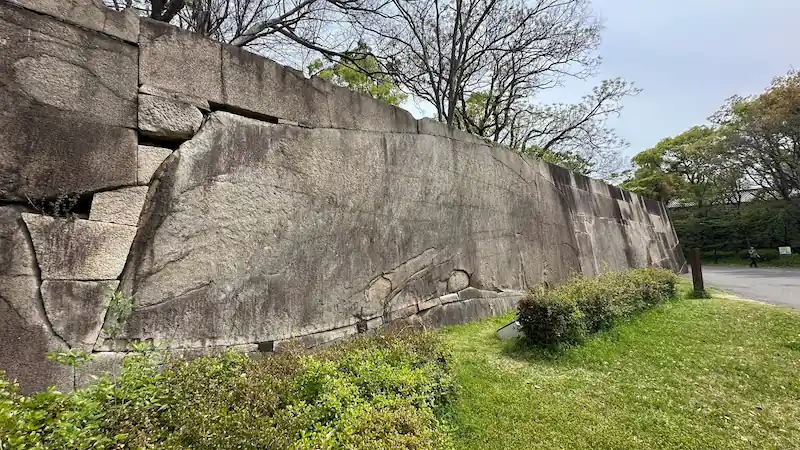
Towering in the masugata of the Kyobashi Gate, the Higo Stone is the second-largest giant stone in Osaka Castle grounds, with a surface area of approximately 54.17㎡ — roughly the size of 33 tatami mats. It was long said to have been brought by Kato Kiyomasa, which is why the stone came to be called “Higo Stone,” but current interpretation generally connects it with the Okayama Ikeda clan, which handled this section of the Tokugawa reconstruction. Iron wedges embedded beneath the stone helped stabilise it.
| Size | ~54.17㎡ — second largest monolith in Osaka Castle |
|---|---|
| Year Installed | Circa 1620s (Edo period) |
| Current Attribution | Generally connected with the Okayama Ikeda clan rather than Kato Kiyomasa |
| Location | Kyobashi Gate masugata, Northern Stronghold |
| Visit Duration | ~15–20 min |
- Surprising origins: Popular belief credits Kato Kiyomasa, but the stone is now generally connected with the Okayama Ikeda clan.
- Iron wedge stabilisation: Wedges embedded beneath the stone prevented shifting — ingenious engineering for a 17th-century installation.
- Tenka Fushin showcase: Ikeda Tadakatsu’s role reflects the Tokugawa policy of using stone transport as a demonstration of feudal loyalty and financial power.
7. Aoyamon Gate
The demon gate of Osaka Castle — kept closed during the Edo period to ward off misfortune
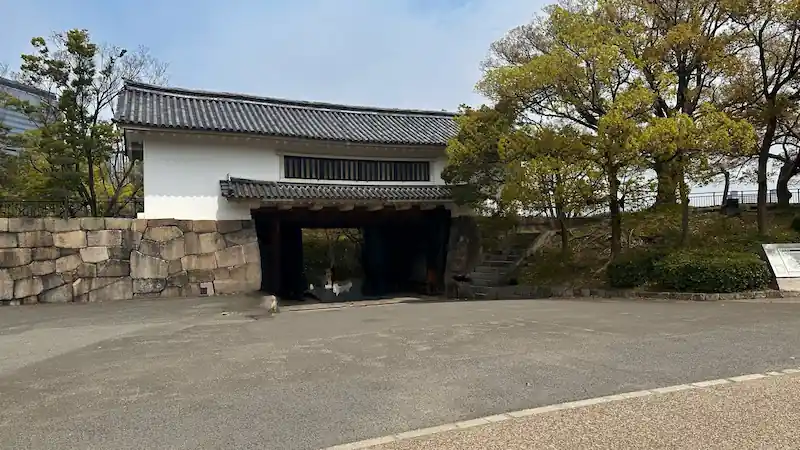
Aoyamon Gate stands at the northeastern entrance to the Ninomaru. Constructed around 1620 as part of the Tokugawa reconstruction, it features a masugata courtyard and a distinctive demasugata — an extended outer section that further traps invaders. During the Edo period, the gate was considered a “kimon” (demon gate) due to its northeastern position, and was typically kept closed to ward off misfortune. Damaged in the Meiji Restoration and WWII air raids, it was reconstructed in 1970. The nearby Soroban-bashi (retractable bridge) foundation is still visible outside the gate.
| Year Built | Circa 1620 (Genna 6); reconstructed 1970 |
|---|---|
| Feature | Yaguramon gate with rare demasugata extension |
| Cultural Property | Part of Osaka Castle Historic Site |
| Access | ~5 min walk from Osaka Business Park Station |
| Visit Duration | ~15–20 min |
- Kimon (demon gate): The northeast was traditionally considered an unlucky direction — the gate was kept closed during the Edo period to contain this spiritual threat.
- Demasugata: An extended outer defensive courtyard — rarer than the standard masugata and more effective at trapping invaders.
- Soroban-bashi foundation: The foundation of the former retractable bridge is still visible just outside the gate — a rare surviving trace of castle infrastructure.
- Closest to Osaka Business Park Station: The most convenient exit point for visitors arriving or departing via the Osaka Metro Nagahori Tsurumi-ryokuchi Line.


comment