


-3.webp)
Koriyama Castle Ruins: An 11-Stop Walking Guide to Toyotomi Hidenaga's Castle, with 360° Panoramas
A 7-minute walk from Kintetsu Koriyama Station, free to enter, and covered by 12 on-site 360° panoramas — this guide walks the designated route from the Ōteguchi entrance to the castle keep platform, site by site.
On this page
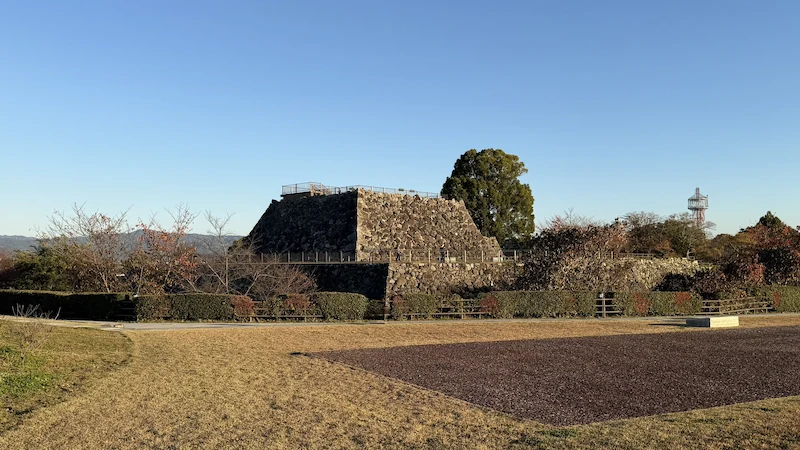
If the 2026 Taiga Drama series Toyotomi Brothers! has sparked your interest in Toyotomi Hidenaga, the historic site of Koriyama Castle Ruins is the first place to walk. Following the designated route from the Ōteguchi entrance — past the reconstructed gatehouse, across the inner moat, through to the main compound and up to the castle keep platform — gives you a felt sense of the defensive logic Hidenaga built into the very entry points of his domain headquarters.
Good for: Visitors who want to walk from the station / those who want to see stone walls and masugata enclosures / checking what's accessible in the rain / picking up a castle stamp / planning a route that works for families with children or older visitors
Time needed: Adjustable — from a brisk walk hitting the highlights to a leisurely half-day that takes in the exhibition facilities and surrounding castle town
Common navigation issues: On the Kintetsu Koriyama side, a level crossing and an uphill slope are your cues that you're approaching the castle / the Ōteguchi approach bends at the entrance, which can disorient first-time visitors
What this article covers:
· Directions from Kintetsu Koriyama Station (B30) and JR Koriyama Station (JR-Q34), with navigation tips
· Recommended route: Ōteguchi → Main compound → Castle keep platform
· Notes for rainy days and winter visits; rest stops and toilet locations
· Yanagisawa Shrine, where to get a goshuin (shrine stamp), and how to navigate during major events
Getting There, Parking & Admission
Fastest route (straight to the ruins from the station)
Approximately 7 minutes on foot from Kintetsu Koriyama Station (B30); approximately 15 minutes from JR Koriyama Station (JR-Q34). The park is accessible 24 hours (toilet facilities have seasonal hours).
Recommended route (turning the drama's energy into an on-site discovery)
Walking in the sequence of Ōteguchi (Kurogane-mon Gate Ruins → reconstructed gatehouse → Gokuraku Bridge → main compound → castle keep platform) lets the bends in the approach and the concept of flanking fire (yokoya) click into place as you move through them. If timing allows, visiting the Taiga Drama Museum on the ground floor of the Yamato Koriyama Castle Hall first — to build context — and then returning to the stone walls at the Ōteguchi adds another layer to everything you'll see.
Access
Kintetsu Koriyama Station (Kintetsu Kashihara Line, B30) — approximately 7 minutes on foot (approx. 0.62 km)
JR Koriyama Station (Yamatoji Line, JR-Q34) — approximately 15 minutes on foot
From Osaka Namba: approximately 35–45 minutes by Kintetsu (change at Yamato-Saidaiji; varies by train and connection)
From Kyoto: approximately 35–50 minutes by Kintetsu (limited express, change at Yamato-Saidaiji; varies by train and connection)
Practical shinkansen station: Kyoto Station (one transfer via the Kintetsu Kyoto and Kashihara lines)
Recommended transport: Public transport — parking near the castle is limited
On-site difficulty: The grounds include slopes and stone steps, and reaching the top of the keep platform means climbing stone steps. Sturdy footwear is recommended. The area around the Ōteguchi entrance is comparatively level.
By car: Approximately 6.5 km (about 14 minutes) from the Koriyama IC on the Nishi-Meihan Expressway
Parking
Parking directly around the castle is limited, and public transportation is the recommended way to arrive. A small free lot sits near the Bairin-mon gate, but space is minimal.
A larger temporary lot in front of the Koriyama Castle Information Hall holds around 80 vehicles. During the Taiga Drama Museum period (April 8, 2026 – January 31, 2027), it charges ¥500 for stays beyond two hours and operates 9:00–17:30; it is closed entirely during the castle festival (March 24 – April 7). Outside those windows it is free, with seasonal hours (7:00–19:00 in summer, 7:00–17:00 in winter).
The DMG MORI Yamato Koriyama Castle Hall parking lot (170 spaces) offers the first two hours free, then ¥500 thereafter, and is open 9:00–21:30. It is not reserved exclusively for Taiga Drama Museum visitors, so it can fill up.
During especially busy periods such as the castle festival, park-and-ride shuttle services have sometimes been arranged from locations including Apita Yamatokoriyama and Aeon Mall Yamatokoriyama. Availability and locations vary by year, so check with the Yamato Koriyama Tourist Association before visiting during peak dates.
Admission & Hours
| Castle grounds (park) | Open 24 hours, free |
|---|---|
| Castle keep platform | Apr–Sep 7:00–19:00 / Oct–Mar 7:00–17:00, free |
| Koriyama Castle Information Hall | Same hours as the keep platform, free (extended to 21:00 during the castle festival) |
| Yanagisawa Bunko | 9:00–17:00 (last entry 16:30). ¥300 general / ¥200 students (reading room only: free). Closed Mondays, 4th Tuesdays (open if a public holiday), Obon, New Year, and exhibition changeovers. |
| Jōshi Kaikan (ground floor only) | Weekends and public holidays, 10:00–16:00, free. Not open on weekdays. |
| Taiga Drama Museum (Yamato Koriyama Castle Hall) | 10:00–17:00 (last entry 16:30). ¥600 adults / ¥300 elementary–junior high. Open March 2, 2026 – January 22, 2027; closed for New Year (Dec 28 – Jan 4) and additional maintenance closure days. |
Getting Here from Osaka, Kyoto & Nara (Tōdai-ji)
Without local knowledge of the Kansai region, it isn't always obvious where Yamatokoriyama actually is. Here's how to get here from three common starting points — Osaka, Kyoto, and the Nara / Tōdai-ji area — each with a route map. Tap a heading to open the map.
From Namba Station, take the Kintetsu Nara and Kashihara lines (change at Yamato-Saidaiji) to Kintetsu Koriyama Station — roughly 35–45 minutes, depending on the train and connection. From JR Osaka Station (Umeda), a subway-to-Kintetsu transfer also works, but the direct Kintetsu service from Namba is the simplest option.
This map shows the general route (Namba Station to Kintetsu Koriyama Station). Check a transit app for current timetables.
From Kyoto Station, take the Kintetsu Kyoto and Kashihara lines (change at Yamato-Saidaiji; limited express available) to Kintetsu Koriyama Station — roughly 35–50 minutes, depending on the train and connection.
This map shows the general route (Kyoto Station to Kintetsu Koriyama Station). Check a transit app for current timetables.
Tōdai-ji is about a 20-minute walk from JR Nara Station or Kintetsu Nara Station. From Kintetsu Nara Station, take the Kintetsu Nara and Kashihara lines (change at Yamato-Saidaiji) to Kintetsu Koriyama Station — roughly 30–45 minutes in total, including walking and connection time. A JR Yamatoji Line route from JR Nara Station to JR Koriyama Station is another option.
This map shows the general route (Tōdai-ji to Kintetsu Koriyama Station). Check a transit app for current timetables.
Goshuin (Castle Seals)
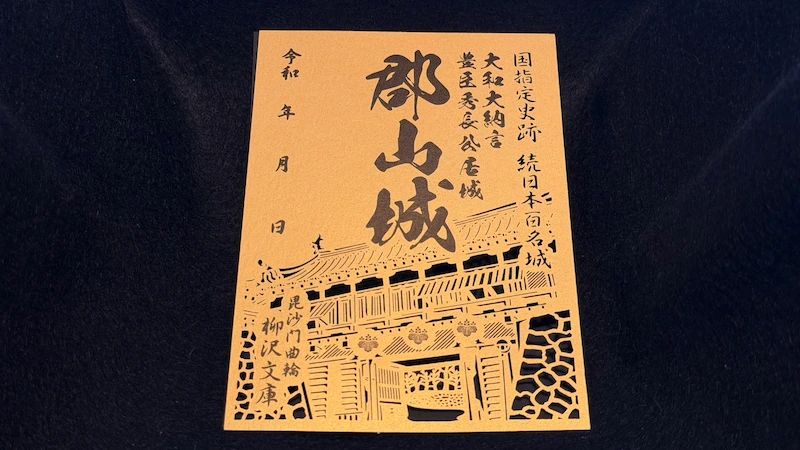
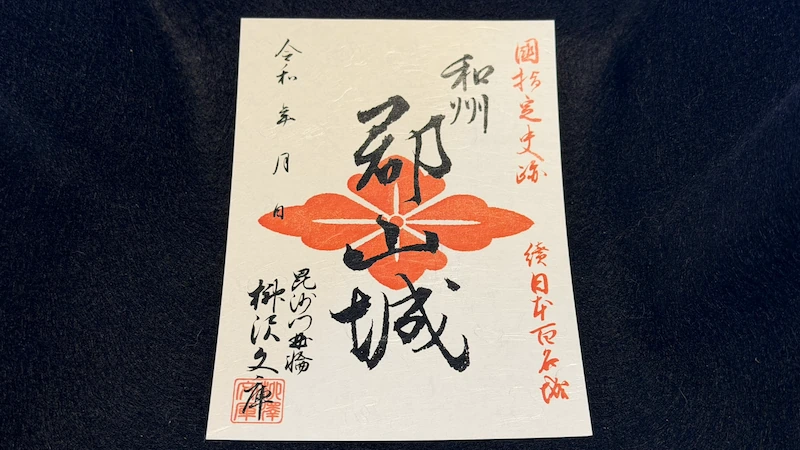
Two different goshuin designs are sold for Koriyama Castle. Both are worth picking up if you're collecting, since the designs and paper stock differ noticeably.
Where to Buy
Availability, stock, and closure days can change — confirm current details before visiting.
| Yamato Koriyama Tourist Association | Goshuin No. 1 (¥800) and No. 2 (¥300). Open 9:00–17:00. Closed New Year. TEL 0743-52-2010 |
|---|---|
| Yanagisawa Bunko | Goshuin No. 1 (¥800) and No. 2 (¥300). Open 9:00–17:00. Closed Mondays, 4th Tuesdays, Obon, New Year, and during exhibition changeovers (purchase is still possible on non-regular-closure days during changeovers). TEL 0743-58-2171 |
Site by Site
Kurogane-mon Gate Ruins
Where the entrance was designed to force a turn
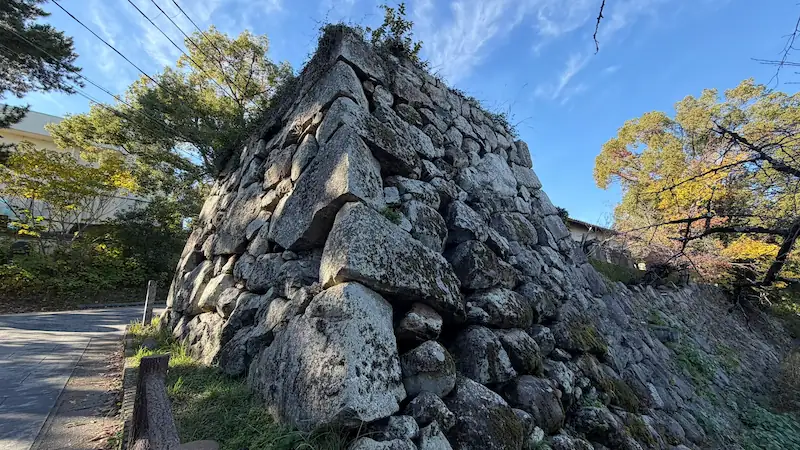
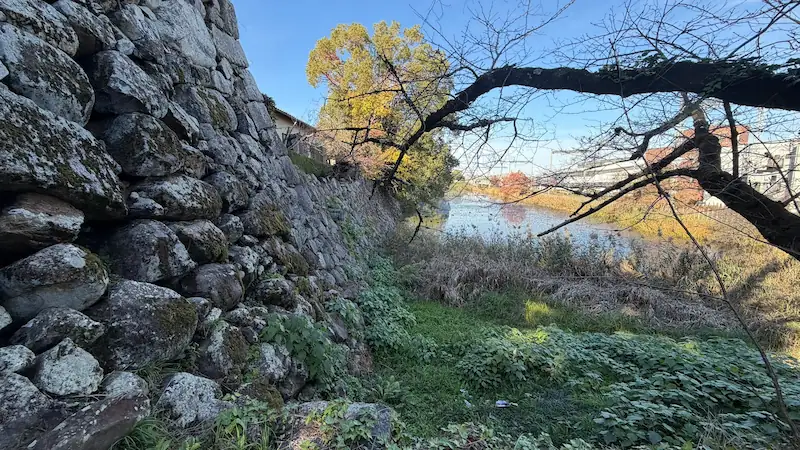
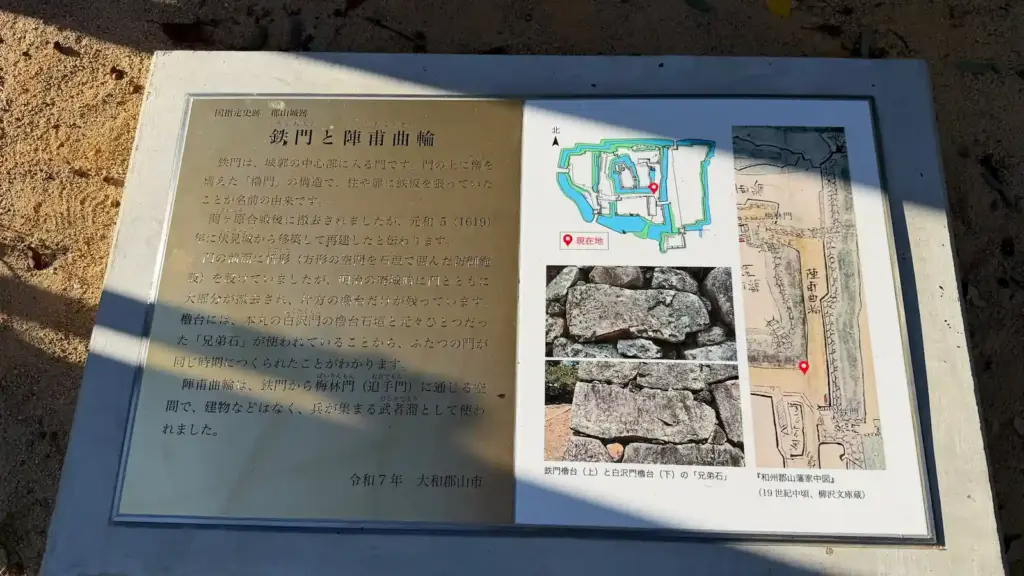
Cross the Kintetsu level crossing, climb the slope as the sounds of the surrounding streets fall away, and a massive stone wall rises to force a turn in your path. This is the Kurogane-mon Gate site — "kurogane" meaning iron — at Koriyama Castle. The gate itself no longer stands, but the masugata enclosure formed by the surviving stone walls carries the unmistakable logic of early modern Japanese castle design: no enemy passes straight through. (A masugata is a square killing ground built directly in front of a castle gate, forcing attackers to stop and change direction under fire from multiple sides — a standard feature of Sengoku-period castle architecture.)
The castle's transformation into a major administrative base for the Kinai region — the heartland of Japan surrounding the old capital — began in Tenshō 13 (1585), when Toyotomi Hidenaga took possession and set about rebuilding on a scale that would encompass the castle town itself within a continuous outer moat.
The gate structure as it stood in the Edo period had another history layered onto it: when Matsudaira Tadaakira became lord in Genna 5 (1619), castle gates — including the "iron gate" — were reportedly relocated or reconstructed using materials from Fushimi Castle, the former power center of the Toyotomi regime near Kyoto. A gate carrying the memory of Toyotomi Fushimi, transplanted to the castle of Hidenaga's legacy — the refined stonework still standing here has been quietly carrying that story ever since.
- The sheer mass of the turret platform stonework: Standing close and looking up, the weight of the stone becomes the castle's presence. For photographs, stepping back to frame the ridgeline of the wall gives cleaner results.
- The bend in the masugata approach: The road turns before you reach the gate — by design. Walking that turn puts you in the position of an attacker whose sightlines and footing have just been controlled.
- Seasonal highlight: In spring, around 600 cherry trees line the moat and the annual castle festival fills the grounds. The approach through the Kurogane-mon site makes for a particularly striking entry point during cherry blossom season.
- A surprising historical layer: The Kurogane-mon is associated with a group of gates relocated to Koriyama from Fushimi Castle during Matsudaira Tadaakira's tenure. The transfer of power from Toyotomi to Tokugawa is, in a sense, written into the gate's own relocation history.
- For the detail-oriented visitor: Koriyama Castle's stone walls contain numerous repurposed stones — grave markers, Buddhist statues, foundation stones. The castle keep platform's north face includes what is known as the "upside-down Jizō," a stone Buddha figure embedded in the wall inverted. Stone wall enthusiasts can trace a rewarding "repurposed stone hunt" from the Kurogane-mon site all the way to the keep platform.
- The Hidenaga connection: Toyotomi Hidenaga entered the castle in Tenshō 13 (1585) and undertook the large-scale development that turned Koriyama into a Kinai administrative powerhouse. Standing at the Kurogane-mon site, you're at the point where Hidenaga's foundational design and the later memory of Fushimi Castle were laid one on top of the other.
Tap any photo to enlarge
Access & visit time ⏳ Quick visit: approx. 5 minutes Leisurely visit: approx. 10 minutes 🗺 255 Shironai-cho, Yamato Koriyama, Nara (within Koriyama Castle Ruins Park) 🚶 Approximately 7 minutes on foot from Kintetsu Koriyama Station (B30) (approx. 0.62 km) Ratings & details| Construction date | (Original location) Fushimi Castle construction period, Bunroku–Keichō era (1590s) / (At Koriyama Castle) Relocated/installed in Genna 5 (1619) |
|---|---|
| Builder | Toyotomi Hidenaga (foundations) · Matsudaira Tadaakira (relocation and development) |
| Structure / features | Masugata (square enclosure) gate with high turret platforms on either side. Stone walls show the refined craftsmanship of the Edo period. |
| Restoration history | Across the wider castle ruins: the Ōtemon gate was reconstructed in 1983 (Shōwa 58); the Ōte Mukai Turret and Ōte East Corner Turret were reconstructed by around 1987 (Shōwa 62). The castle keep platform underwent stone wall restoration and viewing facility construction from 2013–2016, completed in March 2017. |
| Current condition | Gate structure no longer standing. Stone wall remnants (turret platforms) survive as the Kurogane-mon Gate site. |
| Loss / damage | Gates, turrets, and other structures were lost when the castle was decommissioned around Meiji 6 (1873), including through sale and repurposing. |
| Cultural property designation | Nationally designated historic site: "Yamato Koriyama Castle Ruins" (designated 2022) |
| Notes | The ruins are maintained as a public park. On weekends and holidays, free guided tours by trained "stone wall storytellers" are available on site. |
Ōte East Corner Turret 🎥 360°
A reconstructed turret holding the flanking-fire position over the main gate
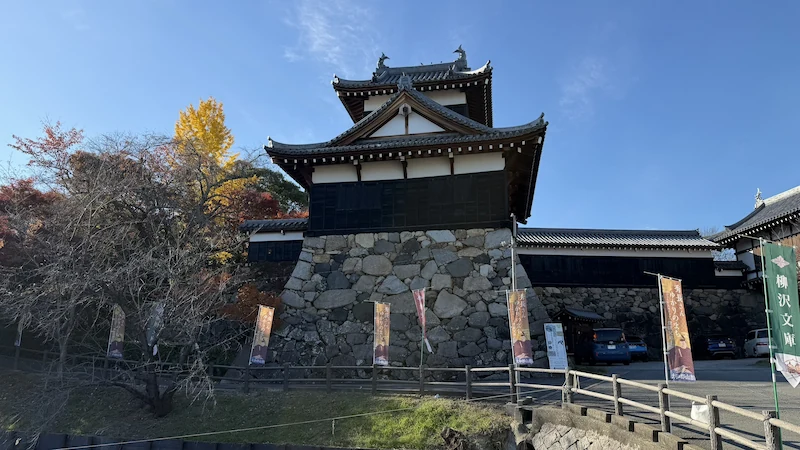
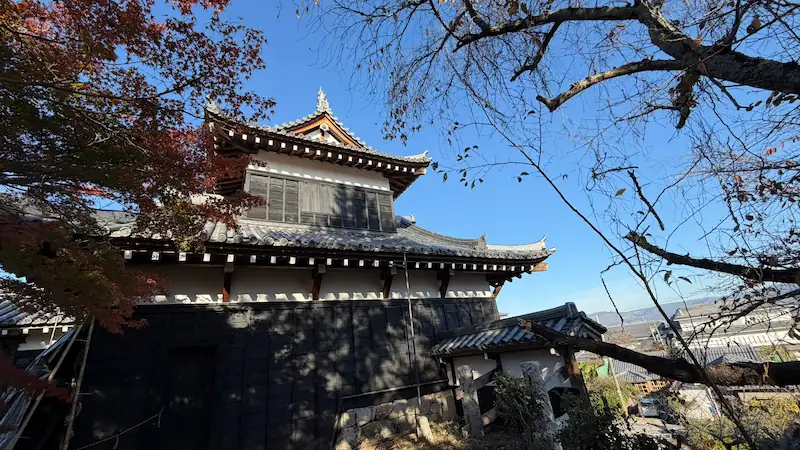
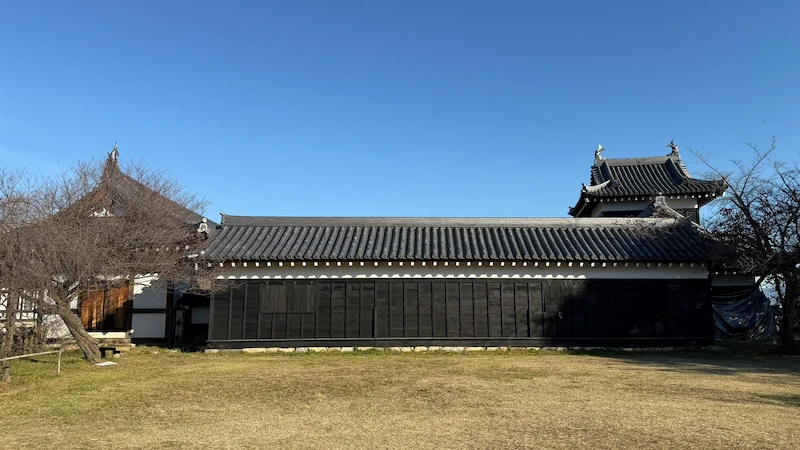
From the Kurogane-mon site, following the curve of the stone walls deeper into the castle grounds, the main entrance complex of the Ōteguchi comes into view. Holding the corner with quiet authority is the Ōte East Corner Turret.
When Toyotomi Hidenaga undertook his major rebuilding of Koriyama Castle, the result was a fortification that was designed not just to look formidable but to function as a complete defensive system. This turret is where that logic is most visibly expressed. Its positioning commands the approach to the main gate from the side — what castle architecture calls yokoya, or flanking fire — the principle by which a castle doesn't just resist an attacker head-on but catches them in a crossfire they can't see coming. The tension of that geometry is still legible in the space today.
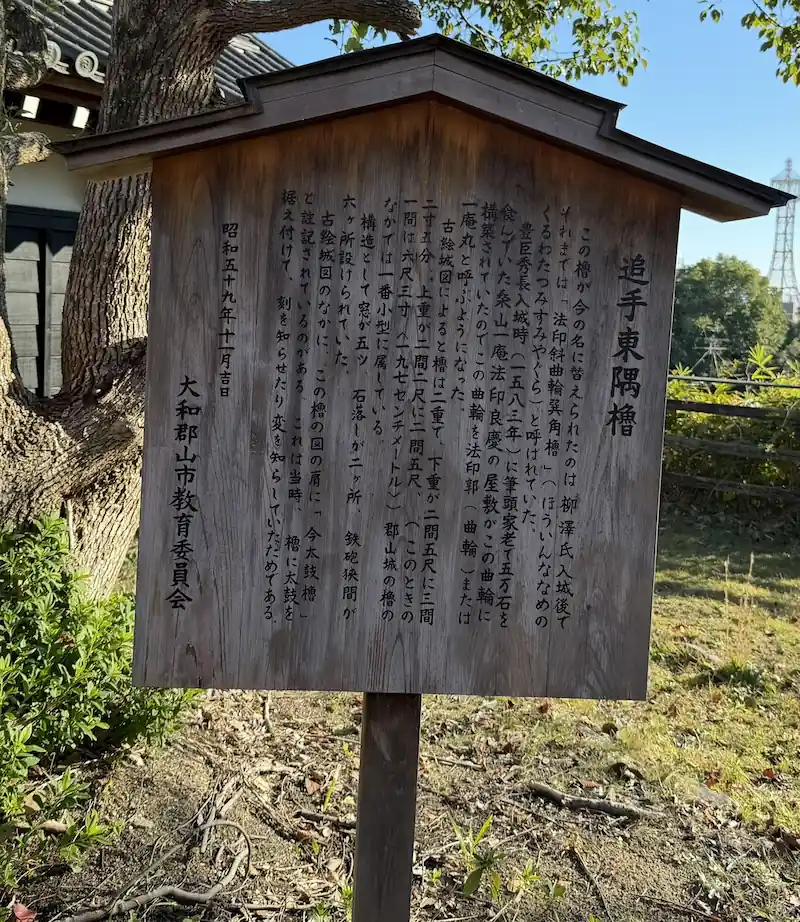
The turret acquired the name "Ōte East Corner Turret" after Yanagisawa Yoshisato's entry into the domain in the mid-Edo period; before that, it stood on a section of the castle associated with Tsutsui Junkei — an earlier lord — and was known by older names including "Hōin-dan Tatsumi-kado Turret," after the compass direction it occupied.
The original structure was lost when the castle was decommissioned in the Meiji period, but what stands today was reconstructed in 1984 (Shōwa 59) using traditional timber joinery — driven by citizen fundraising and the collective determination to restore a recognizable symbol to the castle skyline. The defensive knowledge accumulated across the centuries since Hidenaga's time, and the present-day resolve to keep it visible, share the same roof here.
- The two-story turret's flanking position: It doesn't face the gate — it angles toward it. The defensive rationale of controlling the approach from the side rather than head-on is something you can feel just from where you're standing.
- The Tamon corridor connection and the masugata concept: The turret was linked to the Ōte gate by a roofed corridor (tamon), creating an entrance space that functioned as a controlled trap rather than a simple passage. For photographs, an angled approach that catches the stone wall's geometry works best.
- Seasonal highlight: Spring brings the castle ruins' cherry blossoms — listed among Japan's top 100 cherry blossom sites — to the moat edges. From early February to mid-March, a potted plum blossom exhibition (bonsai-style plum displays) is also held in the area.
- A name that tracks the castle's changing hands: The name "Ōte East Corner Turret" became standard only after Yanagisawa Yoshisato's arrival; before that, the turret was known by different names. The history of what this structure was called maps directly onto the succession of lords who held this castle.
- For the detail-oriented visitor: Excavations in the vicinity reportedly turned up roof tiles associated with Tamon-yama Castle — suggesting that the building materials of nearby castles fed into Koriyama's construction. The connections between Hidenaga's building projects and the wider landscape of the region are still being traced.
- The long arc: Hidenaga refined the castle's entry logic; Edo-period lords built out the turrets; citizens of the modern era reconstructed them. The Ōte East Corner Turret is a place where that generational handover is physically present.
Tap any photo to enlarge
360° Panorama| Construction date | Edo period (exact date unknown) / Reconstructed in timber in 1984 (Shōwa 59) |
|---|---|
| Builder | (Original) Unknown — part of Koriyama domain castle development / (Reconstruction) Yamato Koriyama City, supported by citizen fundraising |
| Structure / features | Two-story timber construction. A key flanking-fire (yokoya) position covering the main gate approach from the side. |
| Restoration history | Demolished in 1873 (Meiji 6) / Reconstructed in 1984 (Shōwa 59), along with the Tamon corridor connecting it to the Ōte Mukai Turret |
| Current condition | Exists as a reconstructed turret |
| Loss / damage | Removed in 1873 with decommissioning of the castle |
| Cultural property designation | Nationally designated historic site: "Koriyama Castle Ruins" (designated November 10, 2022) |
| Notes | Roof tiles reportedly associated with Tamon-yama Castle (built by Matsunaga Hisahide) have been excavated nearby. The Tamon corridor connected this turret to the Ōte Mukai Turret. |
Ōte Mukai Turret 🎥 360°
The pivot of the Ōteguchi's flanking-fire defense
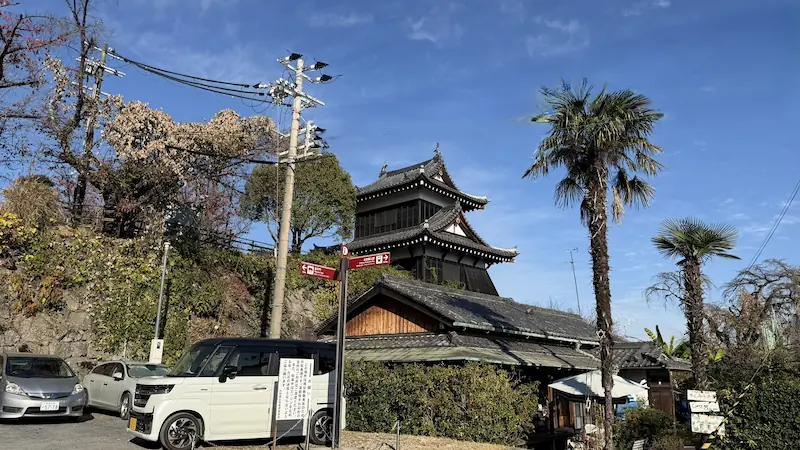
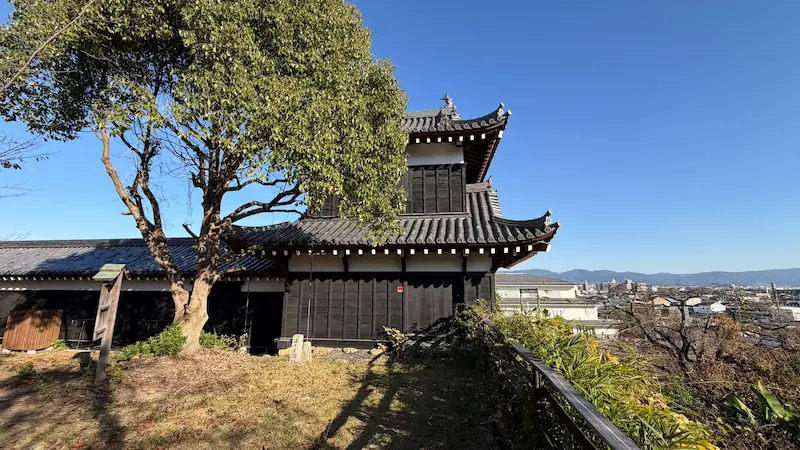
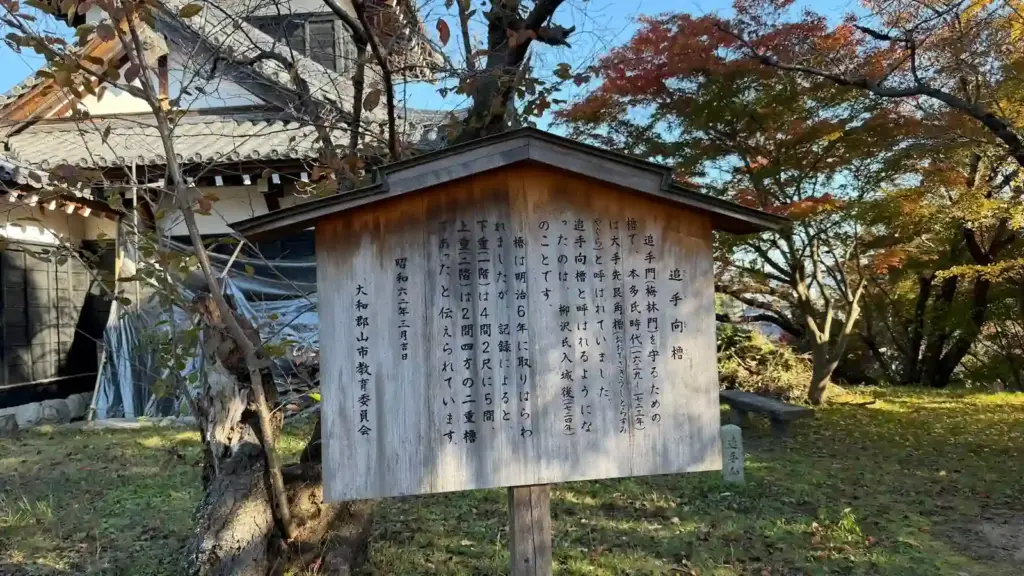
The Ōteguchi approach at Koriyama Castle was developed on the structural framework laid down during Toyotomi Hidenaga's tenure, and successive lords continued to layer defensive refinements on top of it. The Ōte Mukai Turret is the pivot of that system — its defining feature being a flanking-fire (yokoya) position that angles across the approach to the Ōtemon gate (also known as the Bairin-mon). The dimensions recorded on the interpretive signage on site — lower story: approximately 8.5 meters × 10 meters; upper story: approximately 4 meters square — give you something concrete to hold in mind as you stand before it and gauge the pressure that space was designed to exert.
The angled placement — receiving an approaching visitor's sightline obliquely rather than straight on — is the expression of a design philosophy that knew exactly where the castle was vulnerable and refused to leave that opening unaddressed. From Hidenaga's time forward, through successive changes of lord, that core principle — no direct approach to the entrance goes uncontrolled — was carried forward intact.
The turret's naming history is itself worth noting. During the Honda clan's period of governance in the 17th century, it was known as the "Ōtesaki Ushitora-kado Turret." Ushitora is the old directional term for northeast — the kimon, or "demon gate," the direction traditionally considered spiritually vulnerable in Japanese cosmology. The turret wasn't only a military installation; it was also a spiritual guardian, holding the dangerous quarter of the compass against unseen forces. The name carries that double function.
Lost with the castle's decommissioning in the Meiji period, it was reconstructed in timber in 1987 (Shōwa 62) through a citizen-led initiative. Together with the East Corner Turret, the Tamon corridor, and the main gate, this corner of the castle grounds presents a coherent ensemble — the Sengoku period's defensive logic, the Edo period's refinements, and the contemporary will to preserve, held in a single view.
Special Opportunity: From January 22, 2026, through January 31, 2027, the "Hidenaga and the History of Koriyama" event offers rare public access to the building's interior. Don't miss this chance to see areas usually hidden from view!
- The angled approach to the gate: The turret doesn't confront the approach directly — it receives it from an angle, controlling the attacker's direction without being visible head-on. The castle's defensive rationality can be experienced here purely through where you're standing.
- The ensemble view with the main gate and Tamon corridor: This is the visual core of the castle's entrance complex — reconstructed structures lined up in a way that makes a coherent composition. Standing back to take in the main gate and turrets together is the recommended approach for photographs.
- Seasonal highlight: From winter into early spring, the Ōtemon area hosts the Bonbai-ten — an exhibition of potted plum blossom arrangements displayed in miniature bonsai style — which pairs well with the castle's austere stonework (dates vary by year).
- The compass and the castle: "Ushitora," the northeast direction embedded in the turret's older name, was the kimon — the direction associated with spiritual danger in traditional Japanese belief. A turret named for its compass bearing was also, implicitly, a spiritual guardian. The name was eventually dropped, but what it pointed toward remains.
- For the detail-oriented visitor: The original dimensions are recorded on the interpretive sign on site. For castle architecture enthusiasts, those numbers translate directly into a sense of the scale and pressure the entrance once projected.
- The long arc: The entry logic Hidenaga built was refined by successive Edo-period lords, then restored to visibility by modern citizens. The Ōte Mukai Turret is the most immediate place to experience Hidenaga's "entrance philosophy" — not in a display case, but in the layout of the space around you.
Tap any photo to enlarge
360° Panorama| Construction date | Edo period (exact date unknown) / Reconstructed in 1987 (Shōwa 62) |
|---|---|
| Builder | (Original) Koriyama domain castle administration (details unknown) / (Reconstruction) Yamato Koriyama City, as part of a broader citizen-supported restoration initiative |
| Structure / features | Two-story timber construction. A critical flanking-fire (yokoya) defense position covering the approach to the main gate. |
| Restoration history | Demolished in 1873 (Meiji 6) / Reconstructed in 1987 (Shōwa 62) as part of the wider Ōteguchi restoration program |
| Current condition | Exists as a reconstructed turret |
| Loss / damage | Removed in 1873 with decommissioning of the castle |
| Cultural property designation | Nationally designated historic site: "Koriyama Castle Ruins" (designated November 10, 2022) |
| Notes | Known as "Ōtesaki Ushitora-kado Turret" during the Honda clan's tenure; renamed "Ōte Mukai Turret" after the Yanagisawa clan's arrival. Together with the main gate and Tamon corridor, it forms the visual identity of the Ōteguchi entrance complex. |
Ōtemon Gate (Bairin-mon) 🎥 360°
The castle's main gate, rebuilt in kōraimen style
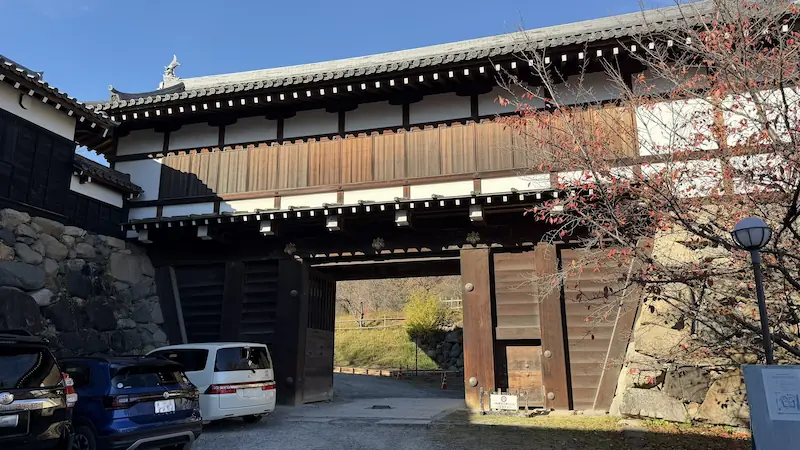
Stand at the Ōteguchi entrance and the castle's main gate fills the road in front of you. This is the Ōtemon Gate — also known as the Bairin-mon, or "plum grove gate." Just before you pass through, the stone wall projections and the bent approach create a space that is unmistakably something other than a simple passage. The clean white plaster and timber joinery carry a composed formality, but behind that surface is the operational reality of a castle entrance that regulated the movement of people and goods in and out of a major administrative center. That combination — of aesthetic control and practical authority — is still present here.
Koriyama Castle was transformed into a Kinai administrative powerhouse during the tenure of Toyotomi Hidenaga, who entered in Tenshō 13 (1585). This main gate can be understood as the point where Hidenaga's vision of a governance headquarters crystallized into built form — a threshold between the administered city and its commanding center.
The current gate was reconstructed in timber in 1983 (Shōwa 58), driven by citizen activism — including the organization "Association for Thinking About Tomorrow's Castle and Castle Town." The form reproduced is the kōraimen style (a type of two-roofed Japanese castle gate in which the main roof sits over the gateway and two smaller roofs cover the gate posts), rebuilt through careful study of historical paintings and archaeological surveys.
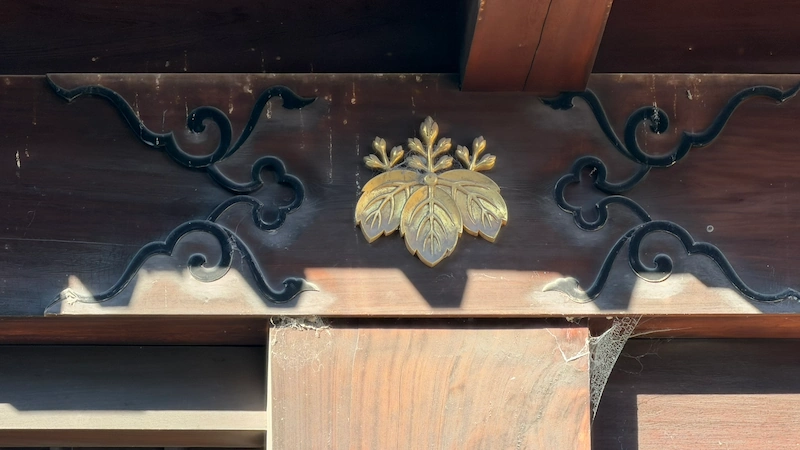
From February through March, plum blossoms drift through the air around the gate — a subtle reminder of the name "Bairin-mon," which the gate acquired from the plum grove that once stood nearby. The white plaster walls and strong timber framing make this one of the most photogenic views in all of Yamato Koriyama.
- The gate as the castle's defining image: The Ōtemon is the visual centerpiece of the entrance complex and one of the most photographable reconstructed structures in the castle ruins. For best results, approach from an angle that includes the stone wall lines alongside the gate.
- The masugata approach: The path doesn't go straight through — the bends and the surrounding stone walls make clear that this entrance was a defensive device, not simply a doorway.
- Seasonal highlight: Early February to mid-March is plum season. The Bairin-mon name has its roots here — and during that window, the gate's original meaning and the seasonal scenery come together in a way that's otherwise hard to picture.
- The entrance as Hidenaga's opening statement: On-site interpretive signage notes that substantial castle construction began after Hidenaga's arrival, with the main gate understood as having been established at this location during that period. The entrance, in other words, was where his vision of a governance headquarters began.
- A citizen-built landmark: The reconstruction was carried out with the organizational support of local residents' groups. The gate that stands today is, in a literal sense, a structure that the community chose to bring back.
- The Hidenaga connection: Hidenaga developed Koriyama Castle as the hub of his administration across Yamato, Kii, and Izumi. Standing at the Ōtemon, you're at the threshold through which that administration began — and where the scale of what he built is first felt in the body rather than read on a page.
| Construction date | (Original gate) Believed to have been built at this location from Tenshō 13 (1585) onward / (Current structure) Reconstructed in timber in 1983 (Shōwa 58) |
|---|---|
| Builder | (Original) Associated with castle development under Toyotomi Hidenaga / (Reconstruction) Yamato Koriyama City (Board of Education, etc.), with citizen volunteer support |
| Structure / features | Timber kōraimen-style gate. Defensive masugata (square enclosure) directly inside the gate. |
| Restoration history | Lost during castle decommissioning in the Meiji period; reconstructed in timber in 1983 (Shōwa 58). Surrounding structures including the Ōte Mukai Turret (1987) were rebuilt in subsequent phases. |
| Current condition | Exists as a reconstructed gate |
| Loss / damage | Gate and associated structures lost with the castle's decommissioning in 1873 (Meiji 6) |
| Cultural property designation | Nationally designated historic site: "Koriyama Castle Ruins" (designated November 10, 2022) |
| Notes | The gate is also known as Bairin-mon ("plum grove gate"); the plum season (early February to mid-March) is an ideal time to visit, with the Bonbai-ten plum exhibition held concurrently. The citizen-led castle reconstruction movement here, in the 1970s–80s, was among the earliest of its kind in postwar Japan. |
Jōshi Kaikan (Former Nara Prefectural Victory Commemorative Library) 🎥 360°
A Meiji-era library relocated into the castle ruins
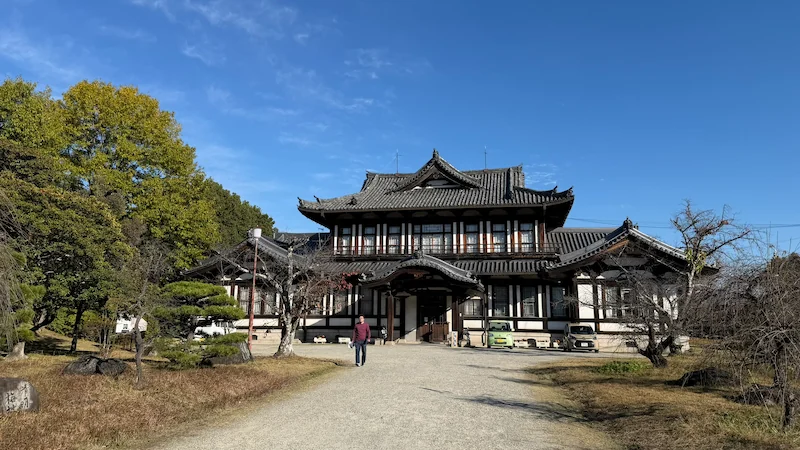
Walking through the castle ruins — surrounded by stone walls and earthworks carrying the unmistakable weight of the Sengoku period — a building appears that seems to belong to an entirely different world: an elegant Meiji-era structure with a sweeping temple-style roof. This is the Jōshi Kaikan, the "Castle Site Hall."
It was originally built in 1908 (Meiji 41) as the Nara Prefectural Victory Commemorative Library — a public library constructed to mark Japan's victory in the Russo-Japanese War, situated at the time within Nara Park. When demolition was proposed in the 1960s, advocates for architectural preservation made the case to save it, and in 1970 (Shōwa 45) the building was relocated to the castle ruins and preserved there.
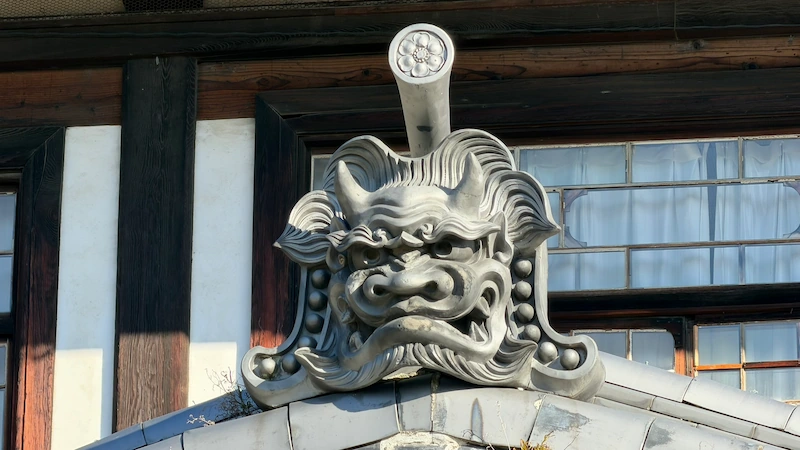
The building's appeal lies in the meeting of Meiji-era engineering and traditional Japanese aesthetics. The bold karahafu gable (a curved, ornamental bargeboard typical of shrine and temple architecture) over the main entrance, and the timber truss structure inside, represent the characteristic Meiji approach of wrapping Western structural techniques in the visual language of Japanese tradition. The result fits into the castle ruins with surprising naturalness — a building that seems to have always belonged here, even though it arrived more than a century after Hidenaga's time.
A building once dedicated to knowledge, now occupying the administrative heart of the castle that Toyotomi Hidenaga built — across different centuries and entirely different purposes, two pillars of Yamato culture find themselves sharing a landscape.
- A temple roof in a castle: The curved eaves and decorative facade are striking. The building settles into the castle ruins with a naturalness that's hard to explain until you see it in person.
- The story of its survival: A building that narrowly avoided demolition, saved and moved to an entirely new location — the journey the building itself has taken is part of what makes standing in front of it interesting.
- Seasonal highlight: In spring, castle cherry blossoms; in late winter, plum blossom season. The heavy roof paired with seasonal flowers photographs beautifully.
- A Meiji commemorative building: This was built as a "victory library" to mark Japan's success in the Russo-Japanese War of 1904–05 — a conflict that marked Japan's emergence as a modern military power and generated a wave of commemorative construction across the country.
- For the detail-oriented visitor: The building is not always open — generally accessible on weekends and public holidays during designated hours, first floor only. Timing your visit accordingly is worthwhile.
- Two histories, one landscape: Hidenaga's castle grounds hosting a Meiji public library — the Sengoku period and the modern era sharing the same physical space. It's an unusual combination, but it works.
Tap any photo to enlarge
360° Panorama| Construction date | Completed October 30, 1908 (Meiji 41) as the Nara Prefectural Victory Commemorative Library |
|---|---|
| Builder | Nara Prefecture (designed by Hashimoto Uhei) |
| Structure / features | Two-story timber construction with tiled roof. Temple-style exterior combined with Meiji-era timber truss structure inside. |
| Restoration history | Relocated from Nara Park to the Koriyama Castle ruins in 1970 (Shōwa 45). The name "Jōshi Kaikan" was chosen through public nomination in 2006 (Heisei 18). |
| Current condition | Standing and in active use within the castle ruins. |
| Loss / damage | The building itself survives; it is no longer at its original location in Nara Park. |
| Cultural property designation | Nara Prefecture-designated tangible cultural property (structure). Registered name: "Former Nara Prefectural Victory Commemorative Library." |
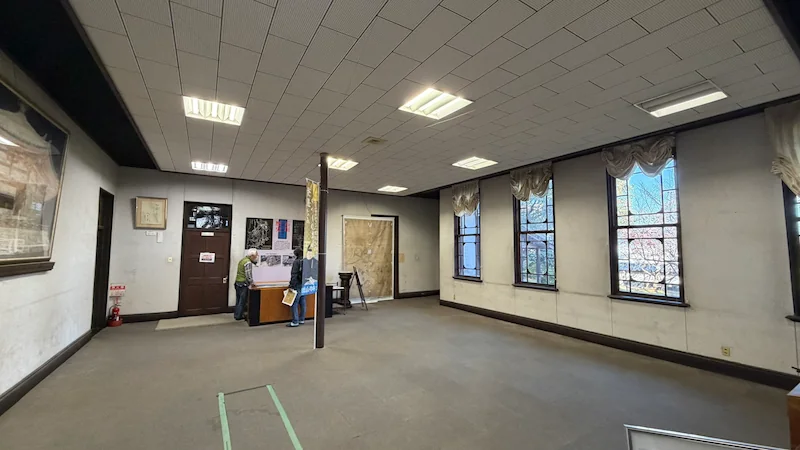
| Notes | Generally open to the public on weekends and public holidays, 10:00–16:00; first-floor hall only (not open on weekdays). The ground-floor lobby often contains displays and materials related to the history of Koriyama Castle — a useful stop during a walking tour. |
Yanagisawa Bunko (Former Yanagisawa Count Family Koriyama Villa) 🎥 360°
The domain's archive, held in a former count's villa
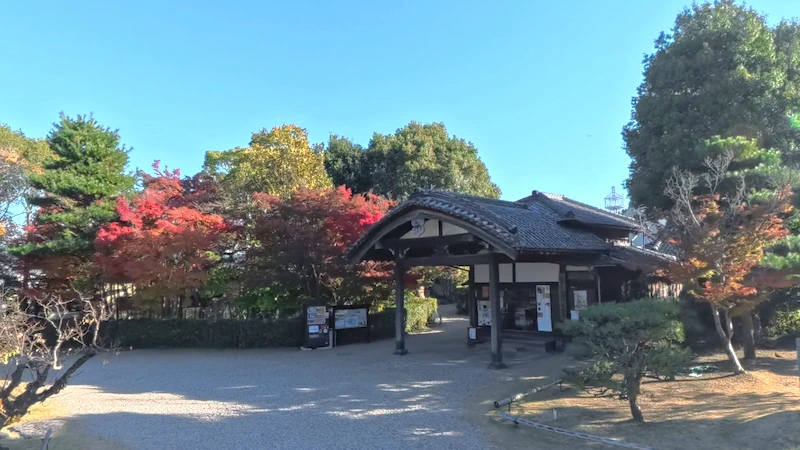
If the reconstructed structures at the Ōteguchi entrance are the castle's "face," the Yanagisawa Bunko is the place that holds the castle's memory. After Toyotomi Hidenaga established the structural framework of Koriyama Castle, the domain passed in the mid-Edo period to Yanagisawa Yoshisato, who came from Kōfu. The Yanagisawa family governed this domain until the Meiji period, and it is the historical records of those successive lords — preserved and made accessible here — that form the Bunko's core collection.
The building stands on what was once the Bishamon compound (Bishamon-no-kuruwa) within the castle grounds, as part of the former Yanagisawa count family's Koriyama villa. The first thing that stops you is the entrance portico — a porte-cochère with a graceful curved karahafu gable sweeping upward above the doorway. The building's refined Meiji-era Japanese architecture settles into the surrounding stone walls and moat with a composure that feels entirely natural.
Inside, tens of thousands of historical documents are held in the collection, including the Yanagisawa-ke Nenroku — the official administrative records of the Koriyama domain. Where the castle ruins let you see what Hidenaga built, the Bunko lets you read what happened on the stage he created. Sensing the day-to-day reality of the samurai administrators who governed this place, through the documents they left behind, is a different kind of encounter with history — and one that sharpens everything you've already seen in the ruins around it.
- The entrance portico: The curve of the karahafu gable against the tiled roof is the building's most photographed feature. With the castle's stone walls as a backdrop, the refinement of the Meiji Japanese architecture stands out.
- Reading the castle's history through documents: Three times a year, the Bunko mounts exhibitions drawing on the domain records and Yanagisawa family materials in its collection. The ruins make more sense after you've spent time with what was written in them.
- Seasonal highlight: The surrounding trees turn in autumn, setting off the building's roof and eaves in warm color. In spring, the castle ruins' cherry blossoms and a visit to the Bunko make a natural pairing.
- A specialist archive inside a castle: The Yanagisawa Bunko was established in 1960 following a donation of materials from the Yanagisawa family. A specialist historical archive located within active castle ruins is, as places go, fairly unusual.
- For the detail-oriented visitor: The reading room can be used free of charge even when the paid exhibition is running. If you have time, reading historical documents in a building on the grounds of a castle is an experience worth having on its own terms.
- Hidenaga's stage, the Yanagisawa family's records: The Yanagisawa Bunko holds the accumulated administrative memory of the domain that Hidenaga built and subsequent lords governed. It's the place where his castle can be followed not just through stone and earth, but through the paper trail of everyone who came after him.
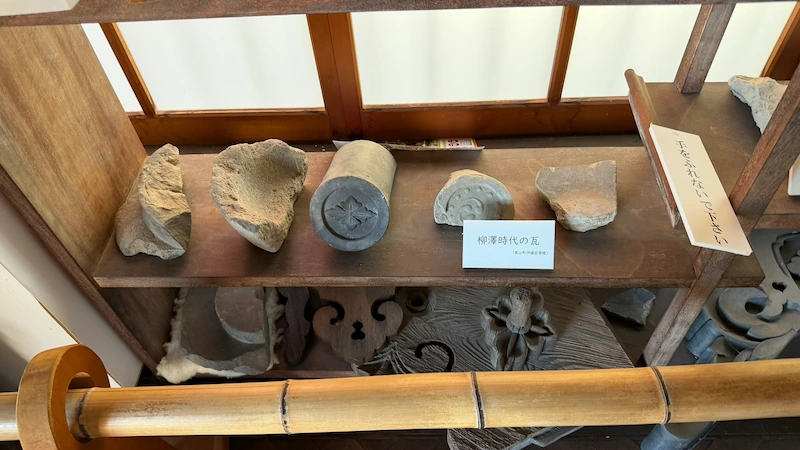
| Construction date | Around 1905 (Meiji 38) as the Yanagisawa count family's Koriyama villa / Foundation established in 1960 (Shōwa 35); opened as Yanagisawa Bunko in autumn the following year |
|---|---|
| Builder | Yanagisawa count family (Yanagisawa Yasunori — also functioned as a private library) |
| Structure / features | Modern Japanese-style timber construction with tiled roof. Distinctive porte-cochère entrance; interior combines traditional Japanese reception rooms with Western-influenced elements. |
| Restoration history | Maintained and developed as an exhibition and reading room facility from the 1960s onward |
| Current condition | Standing; open to the public as exhibition and reading rooms |
| Loss / damage | No significant losses (maintained and in active use) |
| Cultural property designation | Part of the nationally designated historic site, Koriyama Castle Ruins / Building designated as a Yamato Koriyama City Landscape-Important Structure |
| Notes | Open 9:00–17:00 (last entry 16:30). Closed Mondays, 4th Tuesdays (open if a public holiday), and during exhibition changeovers. Admission: ¥300 general / ¥200 students (reading room only: free). The collection includes transcriptions connected to Yanagisawa Yoshiyasu's beloved Rikugi-en garden in Tokyo, and materials related to the Nōh music tradition of the Koriyama domain — reflecting the Yanagisawa family's long commitment to scholarship and the performing arts. |
Gokuraku Bridge 🎥 360°
The ceremonial approach to the main compound, back after 150 years
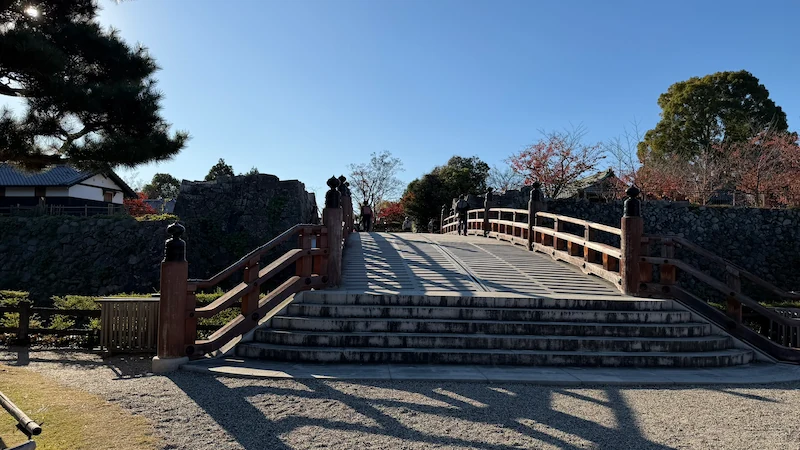
After roughly 150 years, the main approach to the castle's innermost compound has come back to life. The Gokuraku Bridge spans the inner moat of Koriyama Castle, connecting the castle keep compound with the Bishamon compound — a crossing that once carried the ceremonial weight of official arrival at the political center.
In the era of Toyotomi Hidenaga's major reconstruction, this crossing point was a closely controlled line of defense on the approach to the castle's core. It appears in Edo-period castle maps (from the Shōhō era, 1644–1648), and the name "Gokuraku" — meaning "paradise" or "pure land" — is associated with the Yanagisawa family's tenure. One tradition holds that the name referred to the magnificent palace and gardens visible on the far side of the bridge, framed as a kind of earthly paradise. Whatever its origin, the name marked this as a threshold into a privileged space.
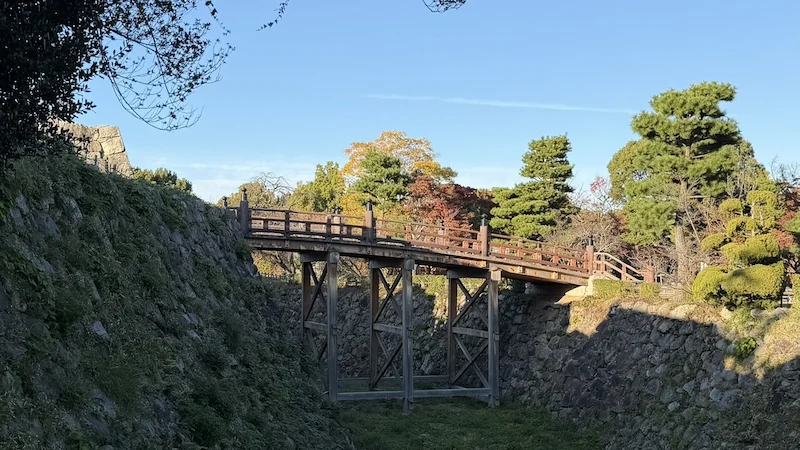
The bridge was lost in the Meiji period and remained absent for well over a century. In 2021, funded largely through citizen and corporate donations totaling approximately 480 million yen (roughly $3.5 million USD), it was rebuilt. The graceful arching profile, with ornamental finial-topped railings (hōju pillars), complements the deep moat and stone wall shadows with a precision that feels designed rather than coincidental. Hidenaga's structural foundations, the aesthetic sensibility of successive lords, and the present-day decision to restore what was lost — the Gokuraku Bridge holds all three.
- The arched silhouette: The hōju-topped railings and the arc of the bridge frame the moat and sky cleanly. This is one of the most photogenic spots in the entire castle ruins.
- The moat below and the stone walls above: Standing on the bridge and looking down into the moat, then up at the stone walls — the defensive beauty of Koriyama Castle is framed most completely from this single vantage point.
- Seasonal highlight: In spring, during the Yamato Koriyama Castle Festival, the entire castle grounds come alive and cherry blossoms against the bridge's warm-toned railings make for striking photographs.
- A bridge with a layered history: Depicted in Edo-period castle maps, renamed across successive lordships, removed in the Meiji era, and rebuilt in 2021 — the Gokuraku Bridge's own timeline traces the castle's administrative history in miniature.
- For the detail-oriented visitor: The rebuilt bridge looks like a timber bridge but is structurally a hybrid — a steel frame clad in wood. Structural safety requirements for a publicly accessible bridge made the hybrid approach necessary; knowing this makes the seamlessness of the result more impressive.
- The Hidenaga connection: This bridge sits on the main approach axis of the castle Hidenaga rebuilt — the line from the Ōteguchi entrance through to the keep compound. Yanagisawa Yoshisato is credited with the name "Gokuraku"; Hidenaga laid the foundations on which the bridge has always stood.
| Construction date | Original construction date unknown (depicted in Shōhō-era castle maps, 1644–1648) / Rebuilt: completed February 2021 |
|---|---|
| Builder | Original: Unknown (by the castle lord of the period) / Rebuilt: Public Interest Foundation "Koriyama Castle Historic Site and Yanagisawa Bunko Preservation Society" |
| Structure / features | Hybrid structure combining steel framing and timber cladding. Exterior faithfully reproduces the traditional arched form with hōju-topped railings. |
| Restoration history | Ground-breaking ceremony in March 2020; public opening in March 2021 |
| Current condition | Rebuilt bridge; open to pedestrians |
| Loss / damage | Believed to have been removed following the Meiji-era castle decommissioning |
| Cultural property designation | Bridge itself: not individually designated / Location (Koriyama Castle Ruins): nationally designated historic site (designated November 10, 2022) |
| Notes | Before the Yanagisawa family's arrival (1724), the bridge was known as "Genkan-mae Hashi" (front gate bridge); the name "Gokuraku Bridge" appears in Yanagisawa-era castle maps. The reconstruction cost approximately ¥480 million, funded substantially through citizen and corporate donations — bringing the bridge back after roughly 150 years. |
Hakutaku-mon Gate Turret Ruins 🎥 360°
The final, tightened approach to the main compound
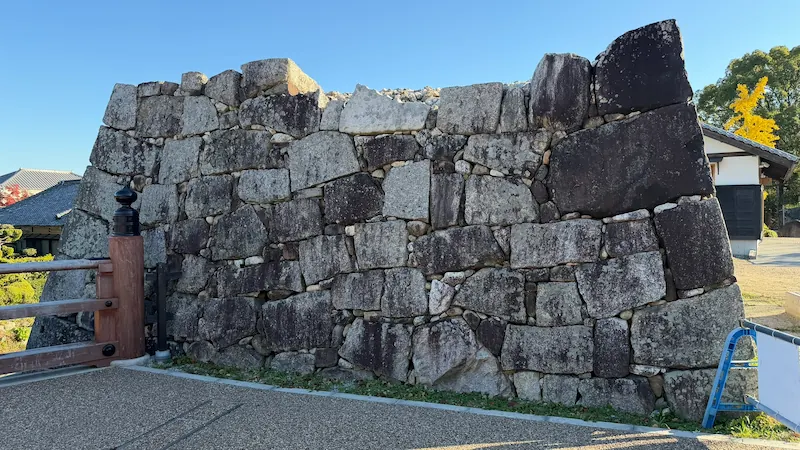
The moment you clear the far end of the Gokuraku Bridge, the atmosphere of the castle shifts perceptibly. You are now at the final approach to the main compound (Tenshū-kuruwa). This was once the site of the Hakutaku-mon gate, flanked by solid turret platforms on both sides.
The name "Hakutaku" refers to a sacred creature from Chinese mythology — a wise, benevolent beast said to appear before virtuous rulers and drive away calamity. Placing that name on the gate to the main compound carried meaning beyond military function: it framed the space beyond as sacred ground, the unsullied domain of just governance. (In Japanese traditional belief, place names often carried spiritual and cosmological significance; a gate named for a protective supernatural being was understood as providing both physical and spiritual defense.)
Since Toyotomi Hidenaga developed Koriyama Castle into an administrative center for the Kinai region in 1585, this approach has carried the weight of official ceremony — the final passage before reaching the seat of power. Recent archaeological investigations using 3D laser measurement have confirmed the locations of gate foundation stones and drainage channels cut in stone, making this one of the best-documented sections of the castle ruins in terms of what has been physically verified under the surface.
- Where the approach tightens: Crossing the Gokuraku Bridge and arriving here, you feel the final compression before entering the main compound. The orientation of the stone walls and the change in ground level encode the defensive design without a word of explanation.
- The north and south turret platform stone walls: Recent conservation work has made the outlines cleaner and more legible. Observing the corner joinery and the character of individual stones in person delivers more than any photograph.
- Seasonal highlight: During cherry blossom season, the flow of visitors through the castle grounds peaks, and the sensation of following an actual ceremonial approach route becomes more vivid. Evening light softens the stone wall shadows in ways that reward a slow pace.
- What archaeology has confirmed: Recent investigations at the Hakutaku-mon site turned up gate foundation stone alignments and stone drainage channels — making this one of the areas of the castle ruins where it is possible to discuss the original layout with reference to physical evidence rather than inference alone.
- For the detail-oriented visitor: The conservation work expanded beyond the originally planned scope, requiring additional coordination with municipal authorities and an extension of the project timeline. The care involved in "preservation by dismantling and reconstruction" becomes legible when you stand in front of the stone work that resulted.
- The Hidenaga connection: This is the far end of the approach axis Hidenaga engineered — the final threshold before the castle's administrative core. It's a less theatrical spot than the main gate or the keep platform, but for anyone interested in how a castle was actually designed to function, it's one of the most direct places to grasp Hidenaga's logic of entry and control.
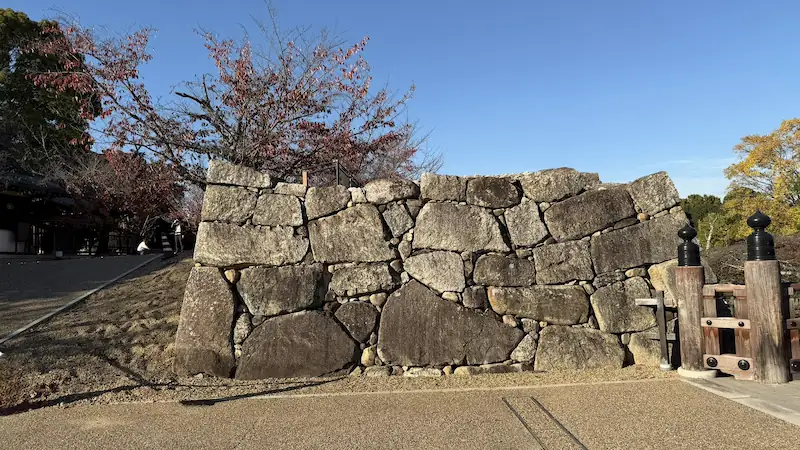
| Construction date | Unknown (Edo-period castle development). Archaeological investigation and conservation work carried out 2018–2019 (Heisei 30 – Reiwa 1) |
|---|---|
| Builder | Castle lord of the domain (as part of Edo-period castle maintenance) |
| Structure / features | Turret platform stone walls (south and north platforms) flanking the Hakutaku-mon gate entrance to the main compound. Gate foundation stones and stone drainage channels confirmed through excavation. |
| Restoration history | Stone wall dismantling, repair, and heritage feature display carried out 2018–2019, using current conservation techniques. |
| Current condition | Turret and gate no longer standing. Turret platform stone walls and surrounding heritage features preserved. |
| Loss / damage | Gate, turrets, and most castle structures demolished or sold during Meiji-period decommissioning. |
| Cultural property designation | Nationally designated historic site: "Koriyama Castle Ruins" (designated November 10, 2022) |
| Notes | The Gokuraku Bridge–Hakutaku-mon section is the main ceremonial approach route to the castle's inner core — the sequence best suited for experiencing the castle as it was meant to be entered. |
Yanagisawa Shrine
A Meiji-era shrine at the heart of the main compound
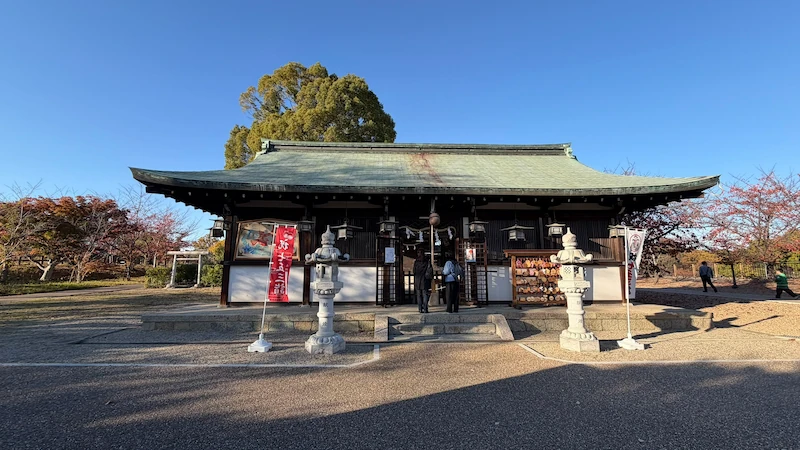
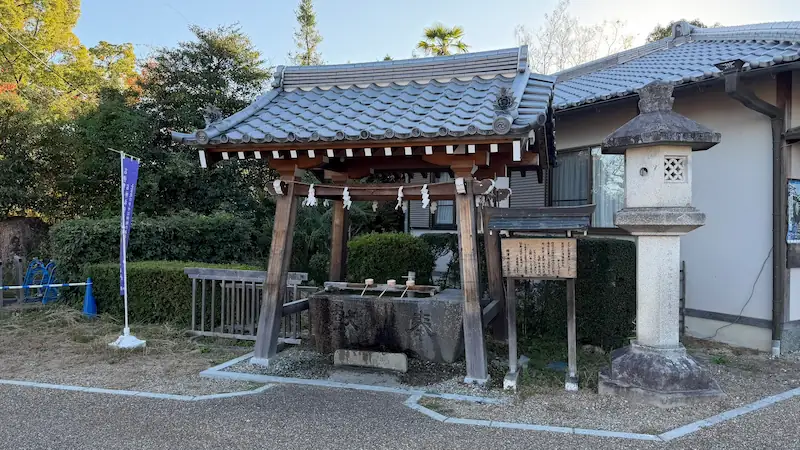
Clear the final approach at the Hakutaku-mon and the space opens — and there, in the quiet at the heart of the main compound, stands Yanagisawa Shrine. A castle that was once the nerve center of Sengoku-period power has become, over the centuries, a place of prayer. That transition — from fortification to sacred ground — is part of what makes this spot worth pausing at.
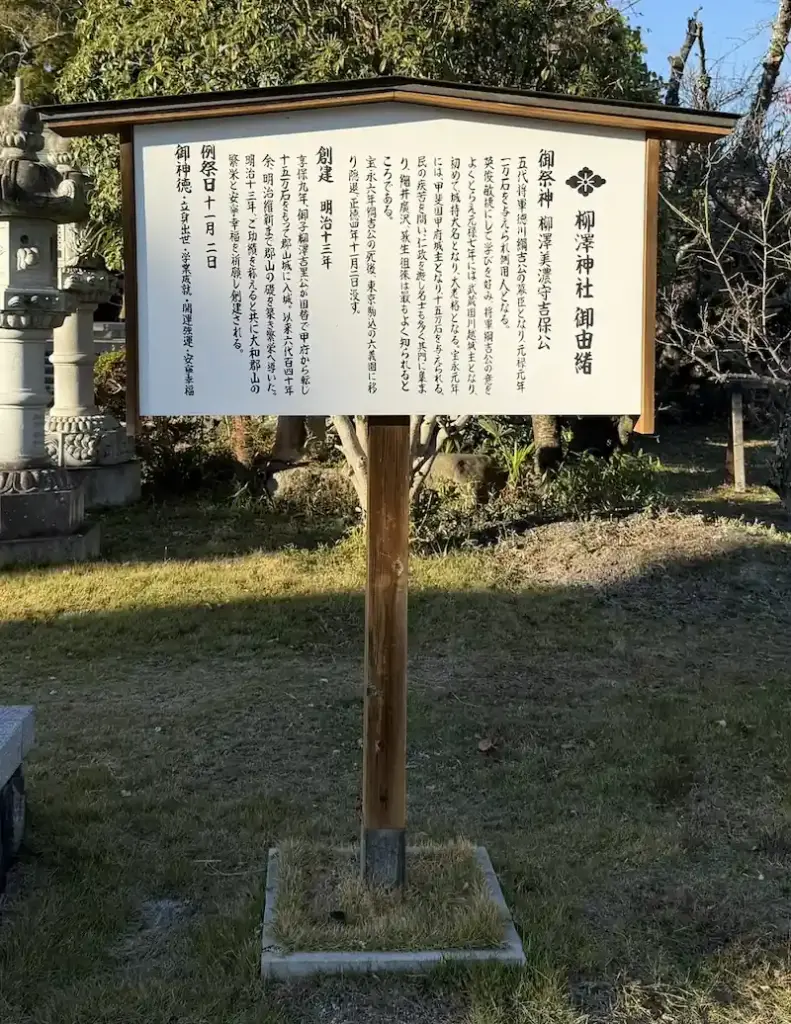
The main compound of Koriyama Castle — developed by Toyotomi Hidenaga as the political stage for his administration of the Kinai region — became, in Meiji 15 (1882), the site of a shrine founded by former domain retainers to honor Yanagisawa Yoshiyasu, the first lord of the Yanagisawa family. Yoshiyasu is known in Japanese history as the chamberlain (sobayōnin) to the fifth Tokugawa shogun, Tsunayoshi, and as a man of considerable learning — a scholar and poet as well as an administrator. That cultivated sensibility has its presence here.
The stone lanterns lining the approach, the understated formality of the shrine buildings — the atmosphere here is entirely different from the castle's defensive stonework just steps away. Lords changed, functions shifted from governance to veneration, but this has remained a center of the city's life. The unhurried passage of time in the shrine grounds carries that continuity quietly.
- Standing inside the main compound: The presence of a place of worship at the castle's core shifts how the surrounding ruins read. Coming through the Hakutaku-mon approach and arriving here, the sense of having reached the center is real.
- The Yoshiyasu connection: The enshrined figure is Yanagisawa Yoshiyasu — which means this spot can serve as the place where the castle's succession of lords (Hidenaga → various fudai lords → Yanagisawa) becomes grounded in an actual person rather than a list of names.
- Seasonal highlight: During the spring Yamato Koriyama Castle Festival, a goldfish judging competition is held in front of the shrine hall. Cherry blossoms, the castle ruins, and the local goldfish culture — three things Yamato Koriyama is known for — all in one place.
- A Meiji foundation on a Sengoku stage: Yanagisawa Shrine was established in 1880 by former retainers of the old domain — a commemorative shrine in the modern sense rather than an ancient religious foundation. The Sengoku castle's inner compound hosting a Meiji-era memorial shrine is an unusual combination, and it's entirely characteristic of how Japanese historical sites tend to accumulate layers.
- For the detail-oriented visitor: The shrine was originally built on the second compound (ni-no-maru) before being relocated to the main compound in 1882. Its current position at the heart of the castle is not where it began.
- The long arc: Hidenaga's main compound became the Yanagisawa family's seat of power; that seat became a Meiji-era shrine; that shrine remains a functioning place of worship in the middle of a nationally designated historic site. The main compound has been the center of this city's identity across more than four centuries of change.


Tap any photo to enlarge
Access & visit time ⏳ Quick visit: approx. 10 minutes Leisurely visit: approx. 30 minutes 🗺 〒639-1011 2-18 Shironai-cho, Yamato Koriyama, Nara (main compound, Koriyama Castle Ruins) 🚶 Approximately 1 minute on foot from the previous site, Hakutaku-mon Gate Turret Ruins (approx. 0.06 km) Ratings & details| Founded | Established Meiji 13 (1880) / Relocated to the main compound in June, Meiji 15 (1882) |
|---|---|
| Founded by | Former domain retainers and people connected to the old Koriyama domain |
| Structure / features | Located within the main compound of Koriyama Castle Ruins. Shrine hall and approach with stone lanterns; the open air of the main compound is part of the experience. |
| Restoration history | Relocated to its present position in June, Meiji 15 (1882) |
| Current condition | Standing; open to visitors at all times |
| Loss / damage | No significant losses recorded |
| Cultural property designation | Shrine itself: no individual designation / Location (Koriyama Castle Ruins): nationally designated historic site (designated November 10, 2022) |
| Notes | Seasonal opening hours are noted: until 7:00 PM in summer; until 6:00 PM in winter; extended hours during festivals and the castle festival period. |
Castle Keep Platform (Koriyama Castle Keep Platform Viewing Facility) 🎥 360°
The center of the center — Hidenaga's platform over the Yamato Basin
Turning from Yanagisawa Shrine and approaching the stone walls of the castle keep platform, the full extent of Koriyama Castle's commanding presence over the surrounding landscape becomes immediately clear. This is the center of the center — the platform constructed by Toyotomi Hidenaga following his arrival in Tenshō 13 (1585), when large-scale development of the castle as the administrative core of Yamato accelerated.
For many years the platform was closed to the public due to structural deterioration of the stone walls. Following four years of restoration work from 2013 to 2016, it reopened as a public viewing facility in March 2017. From the top, the view opens across the Yamato Basin — the Great Audience Hall of the ancient Heijō Palace (seat of Japan's 8th-century imperial capital at Nara), the pagodas of Yakushi-ji Temple, and the green slope of Mount Wakakusa are all visible. That view is not incidental: a castle keep this tall, commanding this sight line, was an explicit statement of authority to everyone living within its range.
Archaeological investigation during the restoration confirmed the presence of foundation stone alignments and gold-leaf roof tiles, establishing that a castle keep with a ground-floor footprint of approximately 13 meters × 15 meters existed here during the Toyotomi period. Standing on the wind-swept stone platform, with the foundation stones of that lost structure somewhere beneath your feet, the political weight Hidenaga invested in this place — the administrative center of a domain worth over a million koku — becomes a physical reality rather than a historical abstraction.
- The stone walls up close: Standing beside the keep platform and looking up, the mass of the stone work is the castle at its most direct. Tracing the ridgeline of the corner — the precise angle at which the courses meet — gives photographs their best geometry.
- The view from the top: The Great Audience Hall of the ancient Heijō Palace, the pagodas of Yakushi-ji, and Mount Wakakusa are visible from the viewing deck. Evening light brings out the best in the stone wall shadows.
- Seasonal highlight: Cherry blossoms in spring, autumn foliage, and early-spring plum season all frame the keep platform in ways that change the experience entirely. The platform is the highest point in the castle grounds — and the best vantage point in any season.
- Confirmed by excavation: The restoration investigation found foundation stone alignments and gold-leaf roof tiles from the Toyotomi period. The keep platform is not a site where the castle's grandeur has to be imagined from scratch — there is physical evidence for it, confirmed under the surface.
- For the detail-oriented visitor: Events surrounding the completion of the restoration included demonstrations and exhibits related to the shura — the massive wooden sledge used historically to haul large stones across rough terrain. The ingenuity behind moving stones this large is part of the story of how Hidenaga's castle was actually built.
- The Hidenaga connection: This is the highest point from which Hidenaga surveyed his domain — the place where his administration of Yamato province was most physically expressed. The view from the keep platform is, in a real sense, the view he intended everyone below to be aware of.
.webp)
-2.webp)
-4-718x1024.webp)
-5.webp)
Tap any photo to enlarge
360° Panorama| Construction date | Believed to have been developed during the Toyotomi regime period (Hidenaga → Hideyasu) from Tenshō 13 (1585) onward |
|---|---|
| Builder | Toyotomi Hidenaga (continued by Toyotomi Hideyasu) |
| Structure / features | Stone-walled keep platform at the north end of the main compound. Viewing deck installed after restoration; partial viewing of foundation stones and panoramic views of the Yamato Basin available. |
| Restoration history | Stone wall restoration and viewing facility construction carried out over four years, 2013–2016; completed March 2017; opened to the public March 26, 2017. |
| Current condition | Keep platform stone walls survive. Keep no longer standing; platform open as a viewing facility. |
| Loss / damage | Stone wall deformation, displacement, and damage accumulated over 400+ years; temporarily closed due to collapse risk (resolved through restoration). |
| Cultural property designation | Location (Koriyama Castle Ruins): nationally designated historic site (designated November 10, 2022) |
| Notes | The platform elevation is approximately 81 meters above sea level, accounting for the exceptional views. |
Koriyama Castle Information Hall 🎥 360°
Where the whole layout finally clicks into place
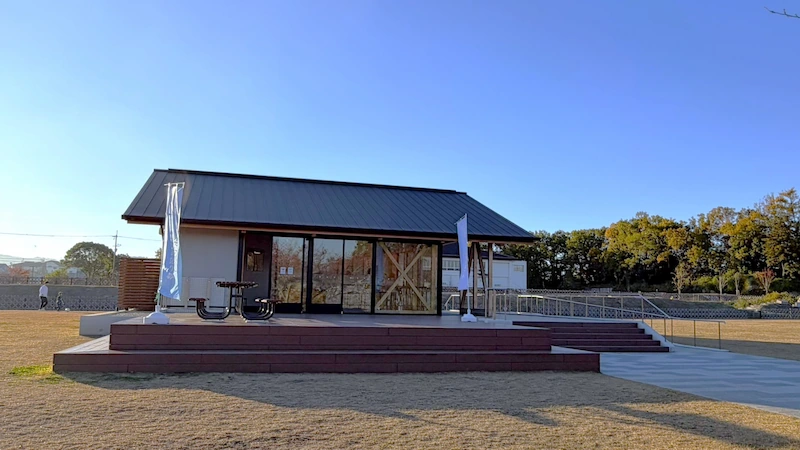
After the keep platform — after the wind, the panorama, and the stone walls — descending to earth and finding somewhere to breathe and absorb is exactly what the moment calls for. The Koriyama Castle Information Hall, which opened in November 2023, occupies what was known in the Edo period as the "Midori-kuruwa" (green compound), where the domain's storehouses once stood. It's the most recent addition to the castle grounds, and the most practical: a rest stop, an orientation center, and a way to make everything you've just seen click into a coherent whole.
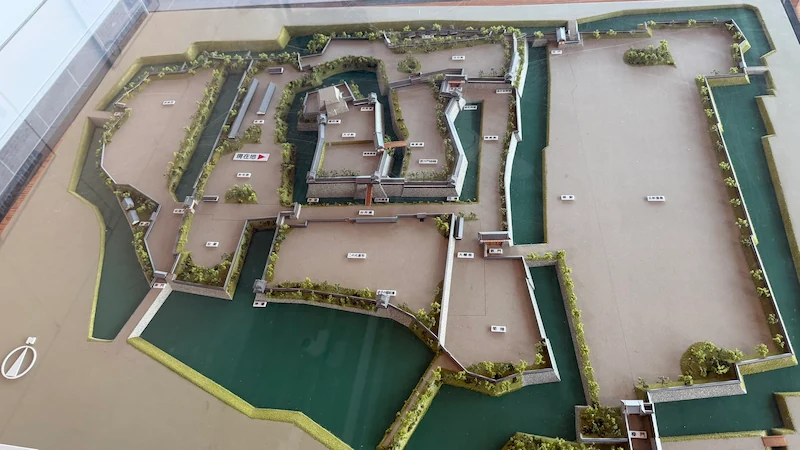
This is the best place to re-read the ruins through the lens of Toyotomi Hidenaga's castle. Under his oversight, Koriyama Castle evolved into a massive fortified urban complex — the entire castle town enclosed within a continuous outer moat, a design known as sōgamae. A detailed reconstruction model inside the hall makes the spatial logic of that system visible in a way that standing among the individual components cannot: the moats, the earthworks, and the compounds resolve into a unified design, and the scale of what Hidenaga built becomes genuinely legible for the first time.
The hall also has clean rest facilities and accessible toilets — practical things that make a real difference mid-walk. Seeing the model here and then going back out to look at the site with fresh eyes is a worthwhile use of twenty minutes.
- The scale model and the castle layout: The model makes the relationship between the compounds, moats, and outer enclosure visible as a whole. Once you've seen the sōgamae design at this scale, the individual elements you've walked through resolve into a single connected logic.
- A practical base for the walk: Rest facilities and accessible toilets are here. Building in a stop at the Information Hall keeps the rest of the route comfortable.
- Seasonal highlight: The Koriyama Castle Information Hall area hosts the Koriyama Market (Kōriyama ichi-no-hi) morning market event. Castle ruins in the morning, with an outdoor market around you, is a particular kind of experience.
- Brand new: The Koriyama Castle Information Hall opened in November 2023, making it the most recent addition to the ruins' visitor infrastructure — and the most visitor-oriented facility on site.
- For the detail-oriented visitor: The hall issues a "goldfish stamp" (free) and sells a "goldfish stamp booklet" (paid), tying the castle visit into the broader goldfish town walking experience that makes Yamato Koriyama distinctive among Japanese castle towns.
- The Hidenaga connection: The castle's overall layout was essentially established during Hidenaga's tenure. The Information Hall model makes his design decisions visible at a glance — and once you've seen it, the placement of every gate, turret, and moat you've already walked past makes a new kind of sense.

Tap any photo to enlarge
360° Panorama| Opened | November 2023 (new construction) |
|---|---|
| Established by | Yamato Koriyama City (as a visitor information and rest facility within the Koriyama Castle Ruins historic site) |
| Structure / features | Exhibition room with interpretive panels and scale models; rest and information hub with accessible toilet facilities. |
| Restoration history | Opened November 2023 (new construction) |
| Current condition | Standing; free admission |
| Loss / damage | N/A |
| Cultural property designation | Facility itself: not individually designated / Location (Koriyama Castle Ruins): nationally designated historic site (designated November 10, 2022) |
| Notes | No pets. Open hours: April–September 7:00–19:00; October–March 7:00–17:00 (extended to 21:00 during the castle festival period). |
A personal ranking based on our on-site visit in January 2026. It is not the official recommended order published by Yamato Koriyama City or the local tourism association.
The highest point in the castle grounds, reopened to the public in March 2017 after stone wall restoration and viewing facility work carried out between 2013 and 2016. It looks out over the Yamato Basin, and the walls here contain many repurposed stones, including the “upside-down Jizō” on the north face. Entry is free, but opening hours change with the season (7:00–19:00 April–September; 7:00–17:00 October–March), so visit this first if you are arriving late in the day.
Buildings lost when the castle was decommissioned in 1873 were rebuilt here in timber between 1983 and 1987, driven by a local citizens’ campaign. This is the only part of the site where reconstructed architecture stands together as a group, and it is covered by 360° panoramas.
An arched bridge with hōju-bashira railing posts, rebuilt in February 2021 after roughly 150 years. On the suggested route it sits between the Ōteguchi entrance area and the main enclosure, so you pass it naturally if you follow the route in order.
A free exhibition facility opened in November 2023. Scale models and explanatory panels give you the overall shape of the castle. It sits at the end of the route, and it makes more sense after you have walked the grounds. It also has an accessible restroom.
A Meiji-era building completed in 1908 and designated a Nara Prefectural Tangible Cultural Property, but the interior is generally open only on weekends and public holidays, 10:00–16:00, and only the ground-floor hall. There is no general weekday opening, so on a weekday visit the exterior is enough.
Visiting with the Taiga Drama Museum
From March 2, 2026, through January 22, 2027, the "Toyotomi Brothers! Yamato Koriyama Taiga Drama Museum" is open on the ground floor of the DMG MORI Yamato Koriyama Castle Hall, right next to the castle ruins (admission ¥600 for adults). Pairing the museum with the free castle grounds is the most complete way to experience how the drama's version of Hidenaga's castle-building connects to what actually survives on site. The schedule below is a planning example built from opening hours and the walking distances between stops; how long each facility takes depends on how closely you look.
Arrive for the 10:00 opening. Time inside varies with how closely you read the exhibits.
Around a 10-minute walk from the museum, arriving around 11:00.
Around 11:40. Yanagisawa Bunko has an admission fee.
Around 12:10.
Around 12:30.
Around 13:15.
Around 13:35. This planning example comes to roughly 3–4 hours in total.
Pairing this with the "Hidenaga and the History of Koriyama" exhibition at the East Turret (January 22, 2026 – January 31, 2027, admission ¥300) adds the archaeological finds from Hidenaga's era alongside the physical remains you'll have just walked through.
Closed for New Year (December 28 – January 4), plus several maintenance closure days through the run (March 27, April 21, April 28, June 2, June 16, September 1, September 8, November 17, November 24, and December 1). Check the official site (hidenaga-yamatokoriyama.jp) before visiting.
Hours, closure days, admission fees, and parking conditions can change without notice around events and facility maintenance — particularly during the Taiga Drama Museum period, when congestion, traffic control, and parking terms are more likely to shift. Please confirm current details with Yamato Koriyama City and the Hidenaga Project official site (hidenaga-yamatokoriyama.jp) before your visit.
FAQ
Approximately 7 minutes on foot from Kintetsu Koriyama Station (B30); approximately 15 minutes from JR Koriyama Station (JR-Q34). If approaching via the Ōteguchi entrance, the path bends at the start — expect to follow the stone walls around a corner rather than walk straight to the gate.
The castle grounds, the keep platform viewing facility, and the Koriyama Castle Information Hall are all free. Yanagisawa Bunko charges ¥300 general / ¥200 students (the reading room alone is free). The Taiga Drama Museum, at the separate DMG MORI Yamato Koriyama Castle Hall, charges ¥600 for adults and ¥300 for elementary–junior high students.
Parking near the castle is limited, and public transportation is recommended. A small free lot sits near the Bairin-mon gate; a larger temporary lot near the Information Hall (about 80 spaces) and the DMG MORI Yamato Koriyama Castle Hall lot (170 spaces) are also available, with fees that vary by season and event period — see the Parking section above for details.
Adjustable — from a focused short walk hitting the key points to a full leisurely circuit that includes indoor facilities such as the Yanagisawa Bunko. Allow extra time during peak periods like the castle festival, when crowds and photo opportunities slow the pace.
The park itself is accessible 24 hours, but stone steps and stone wall paths become slippery when wet, so appropriate footwear is essential. For toilets and indoor facilities, check hours in advance if visiting early morning or evening.
The shrine office at Yanagisawa Shrine handles goshuin stamps and prayer requests. No official hours are published, so confirm before visiting — the office is not always staffed. Extended hours may apply during the castle festival period.
Yes — they're separate. Yanagisawa Shrine issues its own shrine goshuin at its shrine office. Koriyama Castle also sells two of its own castle goshuin, sold at the Yamato Koriyama Tourist Association and at Yanagisawa Bunko; see the Goshuin section above for designs and prices.
Both. The stone walls, turret platforms, moats, and earthworks are original historic fabric. The main gate and several turrets are timber reconstructions. The castle keep platform is original stonework, restored and open as a viewing facility.
It varies by area. The stretch around the Ōteguchi entrance (Kurogane-mon Gate Ruins to the reconstructed gatehouse and Jōshi Kaikan) is comparatively level, and the Koriyama Castle Information Hall has rest facilities and accessible toilets. From Gokuraku Bridge up through the main compound to the keep platform, however, the route is a continuous run of slopes and stone steps, with further stone steps to reach the top of the platform — so the keep platform is difficult to reach with a stroller or wheelchair. Splitting the visit between the Ōteguchi area and the main compound is the practical approach.
Related Pages
Guides that pair well with a visit to the castle ruins: the Hidenaga sites outside the walls, the two exhibition reports, and the stone-marker walks covering gates and enclosures this page does not reach.
Toyotomi Hidenaga — Profile and Related Sites
Back to the Main Page

☕ Support This Site
Following the Shogun is built on original fieldwork and on-site research.
If you found this guide useful, your support helps keep it going.

You can also support via QR code


comment