


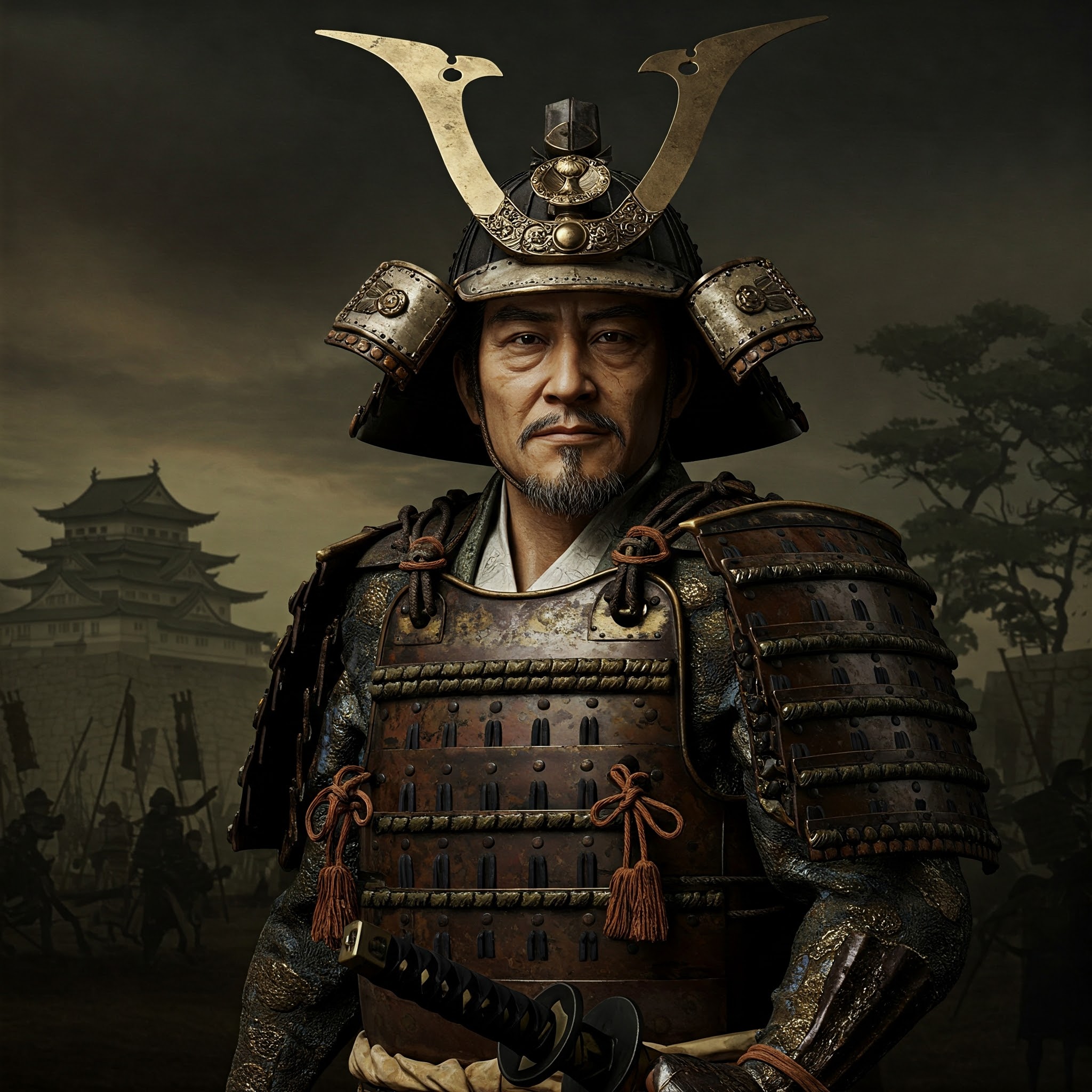
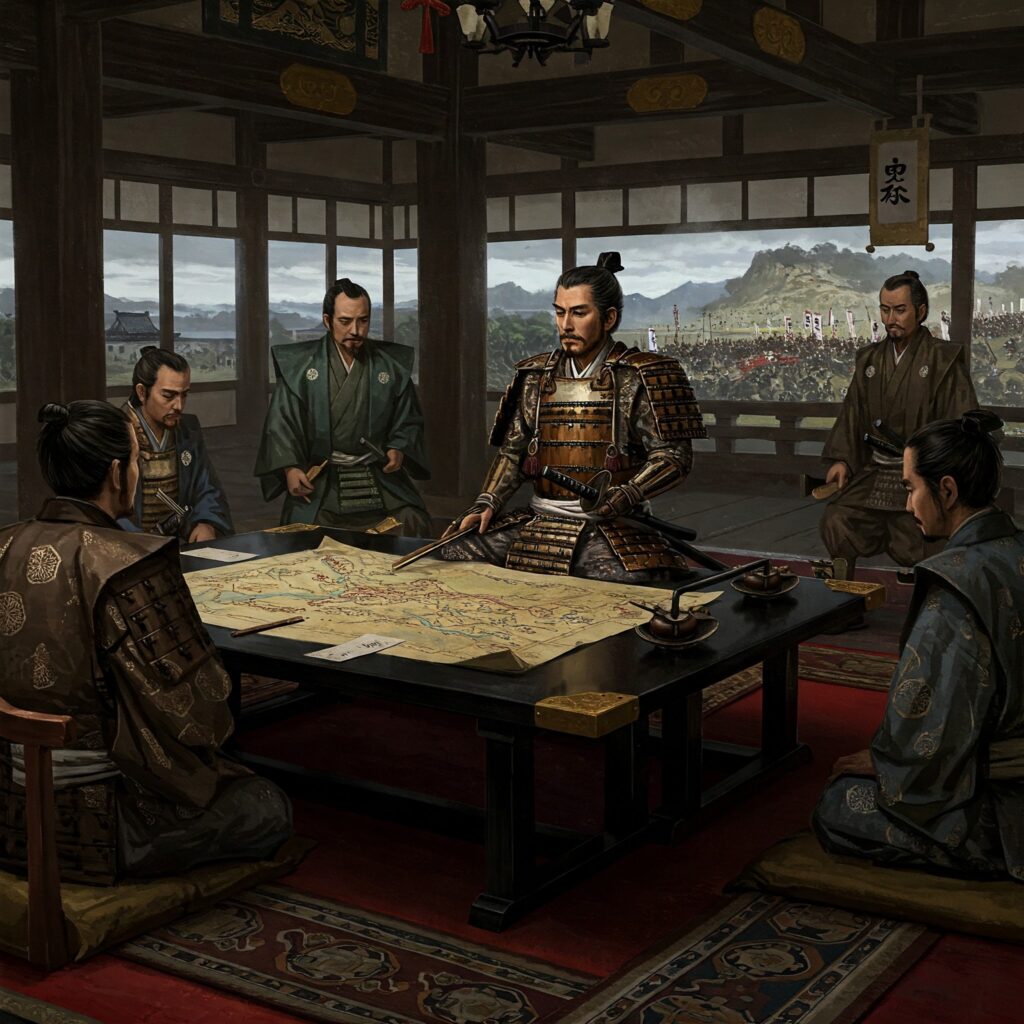
The Life of Tokugawa Ieyasu: Hostage, Warlord, First Edo Shogun
Tokugawa Ieyasu went from child hostage to founder of the Edo shogunate. His life, his battles, what he actually changed, and how SHOGUN’s Toranaga differs.
- Who Was Tokugawa Ieyasu?
- Quick Facts
- Childhood and the Hostage Years (1543–1560)
- Independence After Okehazama (1560)
- The Kiyosu Alliance of 1562: Ieyasu and Oda Nobunaga
- Mikatagahara and Nagashino: Surviving the Takeda (1570–1575)
- Nobunaga’s Death, the Iga Crossing, and Coming to Terms With Hideyoshi (1582–1590)
- The Move to the Kanto and the Building of Edo (1590)
- The Five Elders and Sekigahara (1598–1600)
- Shogun in 1603 — and Retired Shogun in 1605
- The Osaka Campaigns, Death and Enshrinement (1614–1616)
- What Ieyasu Changed — and What Later Tokugawa Rulers Added
- Ieyasu and SHOGUN’s Yoshii Toranaga
- Visit the Real Sites
- Frequently Asked Questions
Who Was Tokugawa Ieyasu?
Tokugawa Ieyasu (1543–1616) was the warlord who won the Battle of Sekigahara in 1600 and, three years later, was appointed sei-i taishogun — shogun — by the imperial court. The government he founded, the Tokugawa or Edo shogunate, ran Japan from the city of Edo (today’s Tokyo) until 1868.
He is usually grouped with Oda Nobunaga and Toyotomi Hideyoshi as one of the three men who ended Japan’s long civil war. The division of labour is worth being precise about: Nobunaga broke the old order, Hideyoshi brought most of the country under a single authority by 1590, and Ieyasu turned that authority into a dynasty that outlived him by two and a half centuries.
This page covers his life. If you want to see the places — the castles, the Toshogu shrines, the battlefields — the travel hub is linked at the bottom.
Arrived here from SHOGUN? Lord Yoshii Toranaga is a fictional character built on Ieyasu, and the series ends at roughly the point where his actual achievement begins. Jump to what lines up and what the drama changes, the 1562 Kiyosu alliance, or how he really died.
Quick Facts
| Born | 31 January 1543 (Tenbun 11, 12th month, 26th day) at Okazaki Castle, Mikawa Province — now Okazaki, Aichi Prefecture. Japanese sources often write the year as 1542, because they use the lunar-calendar year rather than the Western one. |
|---|---|
| Names | Childhood name Takechiyo; as an adult Matsudaira Motoyasu; permitted to take the surname Tokugawa in 1566. |
| Father | Matsudaira Hirotada, lord of Okazaki. |
| Died | 1 June 1616 (Genna 2, 4th month, 17th day) at Sunpu Castle, now Shizuoka City. Age 75 by Japanese count, 73 by Western reckoning. |
| Main bases | Okazaki → Hamamatsu (1570) → Sunpu (1586) → Edo (1590) → Sunpu again in retirement (1607). |
| Best known for | Victory at Sekigahara (1600); appointment as shogun (1603); the Osaka campaigns that destroyed the Toyotomi (1614–1615). |
| Burial and enshrinement | Buried at Kunozan in Shizuoka in 1616. Enshrined at Nikko from 1617 under the divine title Tosho Daigongen. |
Childhood and the Hostage Years (1543–1560)
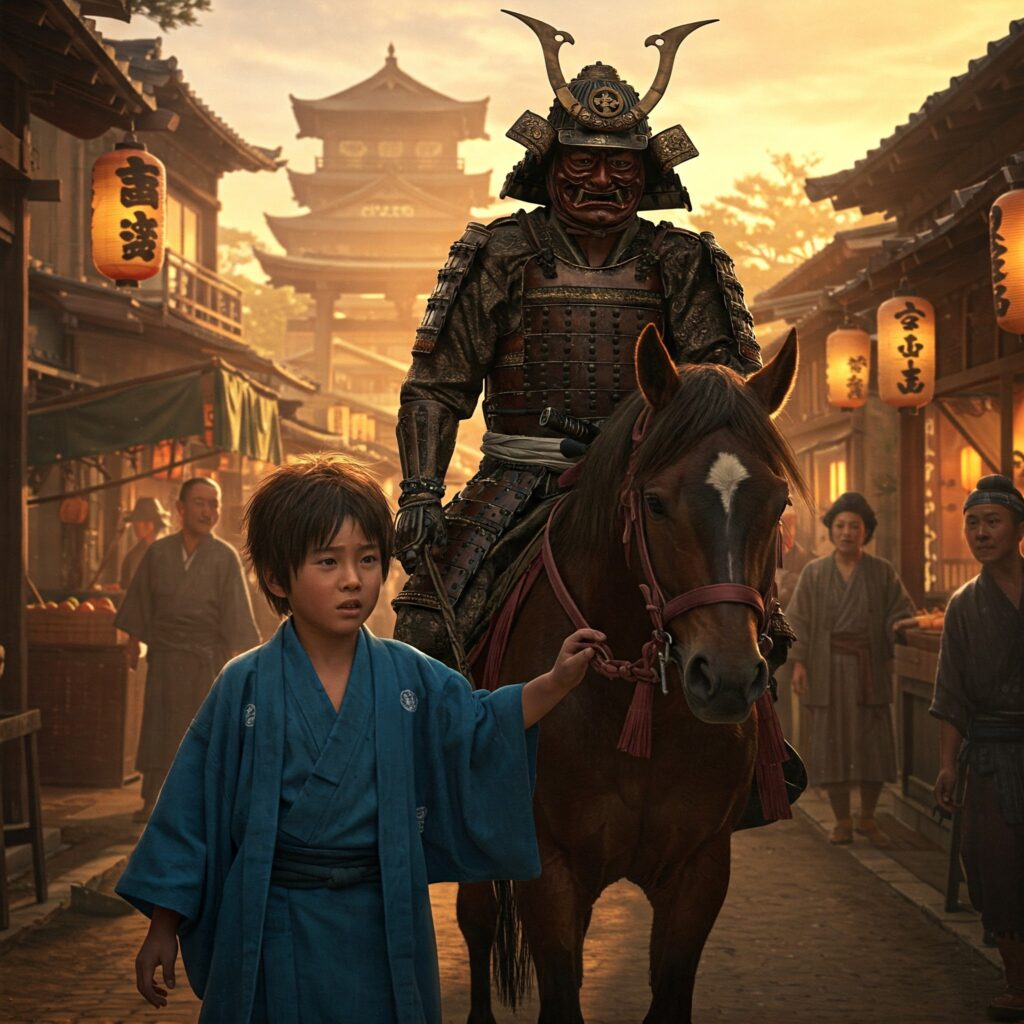
Ieyasu was born into a weak house. The Matsudaira held Okazaki in Mikawa Province, a small territory squeezed between two much stronger neighbours: the Oda of Owari to the west and the Imagawa of Suruga to the east. Small houses in that position survived by attaching themselves to a larger one, and the currency of those arrangements was hostages — usually children.
In 1547, at the age of six, Takechiyo was to be sent east to Imagawa Yoshimoto. He never arrived. He was intercepted and taken to the Oda instead. The standard account is that this was engineered by Oda Nobuhide — Nobunaga’s father — to pull Mikawa into the Oda orbit, rather than a voluntary switch of sides by his father Hirotada.
In 1549 the Imagawa general and monk Taigen Sessai took Anjo Castle in Mikawa and captured Oda Nobuhiro, Nobunaga’s elder half-brother. Nobuhiro was traded back to the Oda; Takechiyo was handed over to the Imagawa and taken to Sunpu, the Imagawa capital in what is now Shizuoka City. He stayed there, in effect a well-treated political prisoner, until he was in his late teens.
A word of caution about a popular story. It is often said that the boy Takechiyo and the boy Nobunaga became friends during the Oda years. The two were certainly in Owari at the same time, and Nobunaga was around thirteen, but there is no reliable contemporary record of the two meeting, let alone becoming friends. Treat it as tradition rather than established fact.
The hostage years matter less as personal drama than as political training. He grew up inside the Imagawa administration, learned how a large domain was actually run, and returned to Mikawa knowing his neighbours from the inside.
Independence After Okehazama (1560)
In 1560 Imagawa Yoshimoto marched west with a large army and was killed at Okehazama by a much smaller Oda force. Ieyasu — then Matsudaira Motoyasu, fighting on the Imagawa side — did not follow the collapse. He withdrew to Okazaki, took back his father’s castle, and stopped taking orders from Sunpu.
The Kiyosu Alliance of 1562: Ieyasu and Oda Nobunaga
In 1562 he came to terms with Oda Nobunaga. In English this is usually called the Kiyosu Alliance, after Kiyosu Castle in Owari, where Nobunaga was based and where the agreement is traditionally said to have been sealed. Two things are worth separating here, because most short accounts run them together.
From the early 1560s Ieyasu and Nobunaga stopped fighting each other and began to operate as allies, and that alignment held until Nobunaga’s death in 1582. For an alliance in this period, that is remarkably long.
The name “Kiyosu Alliance” and the scene of Ieyasu travelling to Kiyosu to meet Nobunaga in person. Neither the Mikawa Monogatari nor the Shincho Koki — the two nearest-contemporary narrative sources — describe such an event. The story comes through the later Mikawa Go Fudoki, compiled generations afterwards. Japanese historians also use other names for the same alignment, such as the Shokutoku or Bisan alliance.
The alliance was also not sentimental. It was geography: Nobunaga needed his eastern flank quiet so he could push west, and Ieyasu needed a free hand to take Mikawa and then Totomi. The idea that it grew out of a boyhood friendship is a retrospective story, not a documented cause.
He spent the rest of the 1560s consolidating Mikawa, including putting down a serious revolt by Ikko Buddhist leagues among his own retainers, and in 1566 was permitted to take the surname Tokugawa.
Why He Changed His Name Four Times
English readers meet this man under several different names, which is a common source of confusion. Renaming was normal for a samurai, and in his case each change marks a change of political position rather than personal preference.
| Takechiyo | His childhood name, used through the hostage years. |
|---|---|
| Matsudaira Motoyasu | His adult name under the Imagawa. The moto was granted by Imagawa Yoshimoto — a standard mark of a patron’s favour, and a standing reminder of who his lord was. |
| Matsudaira Ieyasu, 1563 | He dropped the moto. Discarding a character given by Yoshimoto was a public statement that he no longer belonged to the Imagawa. It came at roughly the same time as the betrothal of his son to Nobunaga’s daughter. |
| Tokugawa Ieyasu, 1566 | With Mikawa under his control he obtained imperial permission to take a new surname, together with court rank and the title Mikawa-no-kami. |
The 1566 change was not decoration. A court-recognised surname and rank gave a provincial warlord a standing in Kyoto that the Matsudaira name did not carry, and the claim of Minamoto descent that came bundled with it was the legal basis on which, thirty-seven years later, he could be appointed shogun at all.
Mikatagahara and Nagashino: Surviving the Takeda (1570–1575)
In 1570 Ieyasu moved his headquarters east to Hamamatsu in Totomi Province and fought alongside Nobunaga at the Anegawa in northern Omi, against the Asai and Asakura. That was the alliance working as designed.
Then came the hardest years of his career. Takeda Shingen of Kai moved south into Totomi. On 25 January 1573 — the 12th month of Genki 3, which is why Japanese sources date it 1572 — the two armies met on the Mikatagahara plateau north of Hamamatsu. Ieyasu had roughly eleven thousand men, including reinforcements sent by Nobunaga, against a Takeda army of around twenty thousand.
He lost badly. This is worth stating plainly, because English summaries of Ieyasu sometimes turn Mikatagahara into a victory or a clever trap. It was neither. He was beaten in the field and escaped back into Hamamatsu Castle with a fraction of his force. What saved him was not the battle but what followed: Shingen fell ill and died in 1573, and the Takeda advance stopped.
In 1575 the Takeda came back under Shingen’s son Katsuyori and besieged Nagashino Castle, held for Ieyasu by his retainer Okudaira Sadamasa. The relief army was a joint Oda–Tokugawa force, and the battle that followed on 28 June 1575 broke the Takeda as a first-rank power. Nagashino is usually told as a Nobunaga story, and the famous account of massed arquebus volleys behind palisades has been heavily debated by historians; Ieyasu’s part is less dramatic but concrete — it was his castle, his vassal, and his province being defended.
Nobunaga’s Death, the Iga Crossing, and Coming to Terms With Hideyoshi (1582–1590)
In the summer of 1582 Nobunaga was killed at Honno-ji in Kyoto by his own general Akechi Mitsuhide. Ieyasu was near Osaka at the time with only a small escort, deep inside territory that had just become hostile.
His escape east through the mountains of Iga back to Mikawa — the Iga-goe, or Iga crossing — is one of the best-known episodes of his life. The core fact is not in doubt: he got out, fast, through difficult and dangerous country, with help from local Iga and Koga men who later entered Tokugawa service. The details, including how close he came to being killed, come mainly from later Tokugawa-period accounts and vary between them.
The scramble for Nobunaga’s inheritance was won by Toyotomi Hideyoshi. In 1584 Ieyasu and Hideyoshi fought each other in the Komaki and Nagakute campaign. Militarily Ieyasu had the better of it — Nagakute was a clear Tokugawa tactical win — but the campaign ended in a negotiated settlement rather than a decision, and Hideyoshi kept building his position elsewhere. In 1586 Ieyasu went to Kyoto and formally submitted, becoming a very large vassal rather than a rival.
The Move to the Kanto and the Building of Edo (1590)
In 1590 Hideyoshi destroyed the Hojo of Odawara, the last major independent power in eastern Japan, and gave their eight Kanto provinces to Ieyasu — on condition that he give up his ancestral holdings in Mikawa, Totomi, Suruga and beyond.
Historians read this two ways at once, and both readings are reasonable. It made Ieyasu the largest landholder in Japan after Hideyoshi himself. It also pulled him several hundred kilometres away from the capital and from his own family’s power base, which is exactly what you would do to a dangerous subordinate.
He chose as his headquarters a modest castle on the edge of a marshy bay: Edo. Over the following decades the Tokugawa rebuilt it into the largest fortress in the country and drained, filled and canalised the land around it. The choice looks obvious now only because it worked. Nothing about Edo in 1590 made it the natural capital of Japan.
The Five Elders and Sekigahara (1598–1600)
Hideyoshi died in 1598 leaving a five-year-old heir, Toyotomi Hideyori. To hold the settlement together he had created a council of five senior lords, the go-tairo or Five Elders, with Ieyasu the wealthiest among them, alongside a board of five administrators drawn from Hideyoshi’s own officials.
The arrangement did not hold. Ieyasu began making marriage alliances and land grants that the settlement did not authorise; opposition formed around Ishida Mitsunari, one of the administrators. It is a distortion to reduce this to a duel between two men. Sekigahara was a nationwide realignment in which most major houses had to choose a side, and a number changed their minds more than once.
The armies met at Sekigahara in Mino Province on 21 October 1600. Ieyasu commanded the Eastern Army; Mitsunari was the organising figure of the Western Army, though its nominal commander-in-chief was Mori Terumoto, who was not on the field. The battle was decided within a day, and the deciding factor was largely political: Kobayakawa Hideaki and others changed sides during the fighting. Calling the victory a triumph of tactics understates how much of the work Ieyasu had done beforehand, in letters.
Sekigahara did not make Ieyasu ruler of Japan by itself, but it let him redistribute the country’s provinces on his own terms — and that redistribution is what made everything after it possible.
Shogun in 1603 — and Retired Shogun in 1605
In 1603 the imperial court appointed Ieyasu sei-i taishogun. He established his government at Edo.
Two years later he did something that tells you more about his intentions than any battle: he resigned. In 1605 the title passed to his son Tokugawa Hidetada. Ieyasu was sixty-two and in good health, and he did not stop governing — he moved to Sunpu and ruled from there as ogosho, the retired shogun, until his death.
The point of the manoeuvre was public and unmistakable. The shogunate was hereditary and it belonged to the Tokugawa. Whatever anyone still hoped for the young Toyotomi Hideyori in Osaka, the succession question had been answered in advance, while the man who could enforce the answer was still alive.
The Osaka Campaigns, Death and Enshrinement (1614–1616)
Hideyori remained at Osaka Castle with a large treasury and a following of masterless samurai. In 1614 a dispute over the wording of an inscription on a temple bell — commissioned by the Toyotomi, and read by the Tokugawa as an insult — became the pretext for war. Modern historians generally treat the bell incident as a manufactured grievance rather than a genuine cause.
The winter campaign of 1614 ended in a truce under which Osaka Castle’s outer defences and moats were filled in. Fighting resumed the following summer, and in 1615 the castle fell. Hideyori and his mother Yodo-dono died; the Toyotomi line ended.
Ieyasu died at Sunpu on 1 June 1616. Following his instructions, his remains were interred at Kunozan, on the hill above Suruga Bay, and Hidetada had a shrine built there — Kunozan Toshogu, completed in December 1617 and designated a National Treasure in 2010. In 1617 he was granted the divine title Tosho Daigongen and enshrined at Nikko, far to the north of Edo.
Whether his body was later moved from Kunozan to Nikko is a long-running argument that has never been settled, since neither mausoleum has been opened. Kunozan states that the remains were buried there and Nikko is the site of his enshrinement as a deity. Both shrines can be visited today.
What Ieyasu Changed — and What Later Tokugawa Rulers Added
Popular summaries tend to credit Ieyasu personally with the whole Tokugawa system. Some of it is his; a good deal of it was built by his son and grandson. The distinction is easy to get right.
The hereditary shogunate at Edo. Founded 1603, secured by the 1605 handover to Hidetada.
A wholesale redistribution of domains after Sekigahara, which set the pattern of trusted, related and formerly hostile houses that shaped Japanese politics for the next 250 years.
Licensed overseas trade. The red-seal ship (shuinsen) system was begun under Hideyoshi, but the oldest surviving red-seal permit dates from 1604 under Ieyasu, who systematised it and appointed a magistrate at Nagasaki. Red-seal voyages went mainly to Southeast Asian ports — Siam, Luzon, Annam, Cambodia. Trade with Chinese and European merchants was handled separately.
Edo itself, as a planned city and the centre of government.
Buke Shohatto, the Laws for the Military Houses (1615). Drafted by the monk Konchiin Suden at Ieyasu’s direction, read out to the assembled lords by Ieyasu at Fushimi Castle, and then formally promulgated by the reigning shogun, Hidetada. So it is accurate to say the code was issued under Ieyasu’s direction in Hidetada’s name — and inaccurate to call it simply “Ieyasu’s law.”
Sankin kotai, the alternate attendance system. Lords were being required to leave family in Edo during Ieyasu’s lifetime, but the system as it is usually described — a fixed, scheduled rotation binding on all daimyo — was codified in 1635 by the third shogun, Tokugawa Iemitsu, in a revision of the Buke Shohatto, nineteen years after Ieyasu’s death.
The closed-country policy. The bans on overseas travel and the expulsion of the Portuguese belong to the 1630s, again under Iemitsu. Ieyasu’s own instinct was the opposite: he wanted foreign trade.
About “260 Years of Peace”
The phrase is a useful shorthand and it is genuinely remarkable: from 1615 to the 1860s Japan had no civil war between great houses and no foreign war. Two qualifications keep it honest. First, the period was not free of violence — the Shimabara Rebellion of 1637–38 killed tens of thousands, and rural protest and urban rioting recur throughout the era. Second, the peace was maintained by an order that was rigid by design, with a fixed status system and tight control of movement, religion and foreign contact. It was stability, and it had a price.
Ieyasu and SHOGUN’s Yoshii Toranaga
Yoshii Toranaga, the lord played by Hiroyuki Sanada in FX’s Shogun, is a fictional character modelled on Ieyasu. James Clavell’s novel and both screen adaptations change names throughout, which frees the story from having to match the record.
What Lines Up
A senior lord on a council of regents governing for a dead ruler’s child heir — the Five Elders after Hideyoshi’s death in 1598.
A rival on that council who becomes the focus of the opposition — Ishida Mitsunari, reworked as Ishido Kazunari.
An English pilot who arrives on a Dutch ship and enters the lord’s service — William Adams, who reached Japan aboard the Liefde in 1600, reworked as John Blackthorne.
A single decisive battle that settles the question — Sekigahara.
What the Drama Changes
The series covers roughly a year; the real sequence from Hideyoshi’s death to the shogunate took five.
Blackthorne’s importance to the outcome is dramatic invention. Adams was a genuine and valued adviser on ships, navigation and foreign affairs, and he was granted an estate at Miura — but he did not shape the succession.
Toranaga’s claimed Minowara descent is invented. Ieyasu’s own claim of Minamoto ancestry — the legal basis for holding the title of shogun — is regarded by historians as a convenient genealogical construction.
Ieyasu’s life did not end at Sekigahara. The sixteen years after it — the shogunate, the handover to Hidetada, Osaka — are where the system that lasted was actually built.
From History to Screen: Meet Yoshii Toranaga
The other two leads have real counterparts as well. Blackthorne is William Adams, who is buried in Japan and has sites you can visit from Tokyo; Lady Mariko is based on Hosokawa Gracia, whose death at Osaka in 1600 was real, though she and Adams never met. The full cast is covered in our guide to SHOGUN characters and the historical figures who inspired them.
Visit the Real Sites
Almost every stage of the life above has a place attached to it that you can still stand in: Okazaki, where he was born; Hamamatsu, where he lost at Mikatagahara; Sunpu, where he was a hostage and later died; Edo Castle, now the Imperial Palace East Gardens in central Tokyo; and the two Toshogu shrines, at Kunozan and Nikko, where he was buried and enshrined. Our travel hub sorts them by region and says plainly which structures are original and which are 20th-century reconstructions.
→ Tokugawa Ieyasu sites in Japan: castles, Toshogu shrines and battlefields
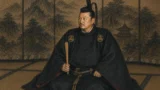
For the other two unifiers, see our guides to Oda Nobunaga and Toyotomi Hideyoshi.
Frequently Asked Questions
He was born on 31 January 1543 at Okazaki Castle in Mikawa Province — today Okazaki City in Aichi Prefecture. Japanese sources often give the year as 1542, because the lunar-calendar date falls in the twelfth month of Tenbun 11, which straddles the Western new year.
He died at Sunpu Castle, now Shizuoka City, on 1 June 1616, aged 75 by the Japanese count and 73 by Western reckoning. The familiar story that fried sea bream killed him does not survive the dates: he ate the dish in January 1616 and lived another three months. Medical historians reading the recorded symptoms more often suggest stomach cancer, though no examination was ever made and the diagnosis remains an interpretation.
Each change marked a change of allegiance. He was Takechiyo as a child and Matsudaira Motoyasu under the Imagawa, the moto having been granted by Imagawa Yoshimoto. In 1563 he dropped that character, publicly cutting the tie. In 1566, with Mikawa under his control, he obtained imperial permission to take the surname Tokugawa along with court rank.
No — he was the first Tokugawa shogun. The office is far older: Minamoto no Yoritomo was appointed in 1192 and founded the first shogunate, and the Ashikaga held the title from the fourteenth century until 1573. Ieyasu founded the third and last of Japan’s shogunates, which is why English-language sources often call him simply the shogun.
Sixteen are usually counted: eleven sons and five daughters. His eldest son Nobuyasu was forced to take his own life in 1579, and his third son Hidetada succeeded him as shogun in 1605.
Because Sekigahara had not settled the question. Hideyoshi’s son Hideyori remained at Osaka Castle with a large treasury and a following of masterless samurai, and while he did, an alternative to Tokugawa rule existed. In 1614 an inscription on a temple bell became the pretext; the winter campaign ended with the castle’s moats filled in, and the summer campaign of 1615 destroyed both the castle and the family.
Not on his own, and not first. Toyotomi Hideyoshi brought the country under a single authority by 1590. Ieyasu won control of that authority at Sekigahara in 1600 and turned it into a hereditary shogunate that lasted until 1868. He is better described as the man who made unification permanent than as the man who achieved it.
His clearest defeat was Mikatagahara in January 1573, against Takeda Shingen, and it was severe. He also failed to force a decision against Toyotomi Hideyoshi in the Komaki and Nagakute campaign of 1584, although he won the fighting at Nagakute itself. Presenting him as an undefeated commander is inaccurate.
The alignment between Ieyasu and Oda Nobunaga from the early 1560s is well attested and lasted until Nobunaga’s death in 1582. The name “Kiyosu Alliance” and the meeting at Kiyosu Castle are later tradition: neither the Mikawa Monogatari nor the Shincho Koki records the event, which comes down through the later Mikawa Go Fudoki.
No. Requiring lords to keep family in Edo began in his lifetime, but the fixed rotation known as sankin kotai was codified in 1635 by the third shogun, Tokugawa Iemitsu, in a revision of the Buke Shohatto — nineteen years after Ieyasu died.
He died at Sunpu in 1616 and, on his own instructions, was interred at Kunozan in what is now Shizuoka City, where Kunozan Toshogu was completed in 1617. In 1617 he was also enshrined at Nikko as Tosho Daigongen. Whether his remains were later moved to Nikko has been argued for centuries and is unresolved, because neither mausoleum has been opened.
No. Toranaga is a fictional character closely modelled on Ieyasu. The council of regents, the rival regent, the English pilot and the decisive battle all have real counterparts, but the timeline is compressed, the pilot’s influence is enlarged, and Toranaga’s Minowara ancestry is invented.
← Back to the Tokugawa Ieyasu travel hub
☕ Support This Site
Following the Shogun is built on original fieldwork and on-site research.
If you found this guide useful, your support helps keep it going.

You can also support via QR code

