


Mt. Hiei Enryakuji Yokawa Precinct: 3 Highlights | Birthplace of the Omikuji
Reaching Yokawa is when you finally understand in your body how large Enryakuji really is. From Todo to Saito, then onward to Yokawa — each time you cross another ridge, the crowds thin further and the silence deepens.
Yokawa Precinct — Spots on This Page
Reaching Yokawa is when you finally understand in your body how large Enryakuji really is. From Todo to Saito, then onward to Yokawa — each time you cross another ridge, the crowds thin further and the silence deepens. It was here at Yokawa that I realized I had no way back. I ended up walking down the mountain to Sakamoto on foot, and that journey itself became part of understanding what this place is. Yokawa is the most remote of the three precincts, deep in the mountain to the north. Yokawa Chudo — a striking vermilion hall said to be modeled on the ships that carried Japanese envoys to Tang Dynasty China — stands at the center, with Ganzan Daishi-do, the hall credited as the birthplace of the omikuji fortune slip, and Eshin-do, the quiet retreat where the monk Genshin wrote the text that would shape Japanese Pure Land Buddhism, scattered among the cedar trees nearby. The stillness here is genuine precisely because so few people make it this far.
About the Yokawa Precinct
Yokawa is the third of Enryakuji’s three temple territories, founded by Jikaku Daishi Ennin and located approximately four kilometers north of Todo and four kilometers from Saito, deep in the mountain. It is the quietest and least visited of the three areas — a meditation precinct surrounded by dense forest, where the sense of an active monastic mountain is most undiluted. Yokawa Chudo, with its vivid vermilion stage-style architecture, forms the center; nearby are Ganzan Daishi-do (also known as Shiki-kodo), widely associated with the invention of the omikuji fortune slip, and Eshin-do, the site where the monk Genshin is said to have written his foundational texts of Japanese Pure Land Buddhism. Like the rest of Enryakuji, Yokawa was obliterated in Nobunaga’s 1571 burning, and its reconstruction came later and more slowly than in Todo or Saito. Most of what stands here dates from the Edo period or later, and the precinct has never been developed into anything resembling a tourist destination — which is precisely what gives it its character. Access is by shuttle bus from Todo (approx. 15 minutes; winter service may be suspended). Visiting hours: 9:00–16:00 normally; 9:30–16:00 in winter (December through February).
Spot Details
Yokawa Chudo Hall 🎥 360°
A vermilion hall modeled on a Tang Dynasty envoy ship — the visual anchor of the mountain’s deepest precinct
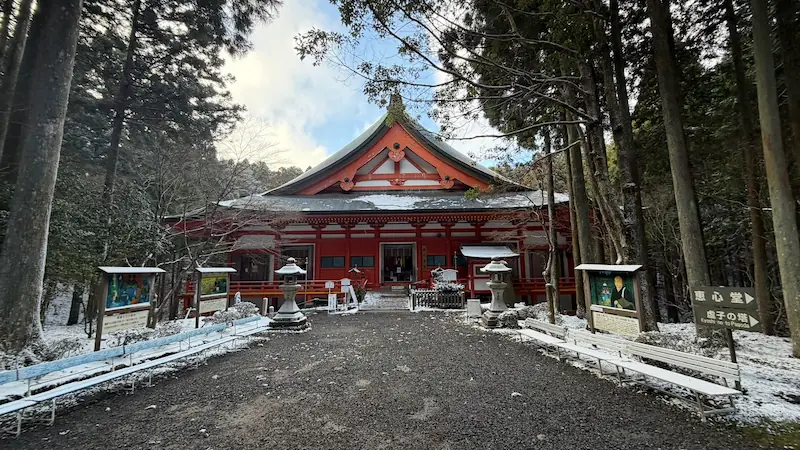
At the center of the Yokawa precinct stands Yokawa Chudo Hall — the main hall of this territory, originally founded by Ennin in 848 under the name Konpon Kannon-do (Root Hall of Kannon). The current building was rebuilt in 1971, and its exterior is immediately distinctive: a stage-style structure (butai-zukuri) in vivid vermilion lacquer, said to have been modeled on the flat-bottomed vessels used by Japanese imperial envoy missions to Tang Dynasty China between the 7th and 9th centuries. These voyages — on which monks like Ennin himself traveled to study Buddhism on the continent — were one of the great cultural transmission events in Japanese history, and the hall’s shape is a deliberate reference to them. The central section of the hall is set roughly two meters lower than the surrounding platform, creating an unusual interior spatial relationship in which the principal deity — a standing figure of Sho Kannon (the “Holy Kannon,” one of the most venerated forms of Avalokiteshvara Bodhisattva) — faces the worshipper from below. Appearing suddenly through the deep cedar forest, the hall’s vermilion against the surrounding green or winter grey creates one of the most arresting visual encounters on the mountain. This building has been destroyed by fire and war repeatedly — including Nobunaga’s burning of 1571 — and rebuilt each time, which is a measure of how important the site remained. The principal wooden Sho Kannon standing figure and the adjacent Yokawa Bell Tower are both designated National Important Cultural Properties.
- Emerging from deep forest: The effect of rounding a path through dense cedar trees and suddenly encountering a full-scale vermilion hall — with no crowds, no noise — is one of the more genuinely surprising moments on the mountain. The contrast with the surrounding stillness makes the color and scale hit harder than they would in any open setting.
- The lowered interior space: The central section set roughly two meters below the platform level creates an unusual worship space worth experiencing — the arrangement brings the principal deity into a different relationship with the person standing before it.
- Photography across all seasons: The hall’s vermilion works against cherry blossoms in spring, fresh green leaves in early summer, autumn maples, and snow in winter — it photographs well in any season.
⏳ Time estimate: Quick visit 15 min / Thorough visit 20 min
🗺 Address: 4220 Sakamoto Honmachi, Otsu, Shiga
🚶 Access: Approx. 15 minutes by shuttle bus from Todo; approx. 10 minutes from Saito
⭐ Recommended Historical Significance: ☆☆☆ Visual Impact: ☆☆☆ Experiential Value: ☆☆
| Year Founded | 848 (Kashō 1); current structure rebuilt 1971 (Showa 46) |
|---|---|
| Founder | Jikaku Daishi Ennin |
| Structure & Features | Stage-style (butai-zukuri) vermilion hall said to be modeled on Tang Dynasty imperial envoy ships. The central section is set approx. 2 meters below the surrounding platform. Principal deity: Sho Kannon (Holy Kannon Bodhisattva). |
| Restoration History | Destroyed multiple times by fire, including Nobunaga’s 1571 burning; rebuilt in 1971 |
| Cultural Property Designation | Principal wooden Sho Kannon standing figure: National Important Cultural Property. Yokawa Bell Tower: National Important Cultural Property. |
| Current Status | Standing |
| Notes | Opening hours: 9:00–16:00 (9:30–16:00 December through February) |
- Original name: Yokawa Chudo was founded under the name Konpon Kannon-do (Root Hall of Kannon) and later given its current name. It is one of several major halls on the mountain whose original designation has been superseded over the centuries.
- What’s designated — and what isn’t: The 1971 building itself carries no cultural property designation; it is the principal wooden Sho Kannon standing figure inside, and the adjacent Bell Tower, that hold Important Cultural Property status.
- 400 years of absence: The 1971 reconstruction followed the Nobunaga burning of 1571 by exactly 400 years. That interval — during which no main hall stood at the center of the Yokawa precinct — is a measure of how completely the 1571 destruction erased what existed here, and how long the mountain’s most remote precinct waited for its center to be restored.
Ganzan Daishi-do (Shiki-kodo) 🎥 360°
The birthplace of the omikuji fortune slip — where history, scholarship, and popular devotion converge in the deepest part of Yokawa
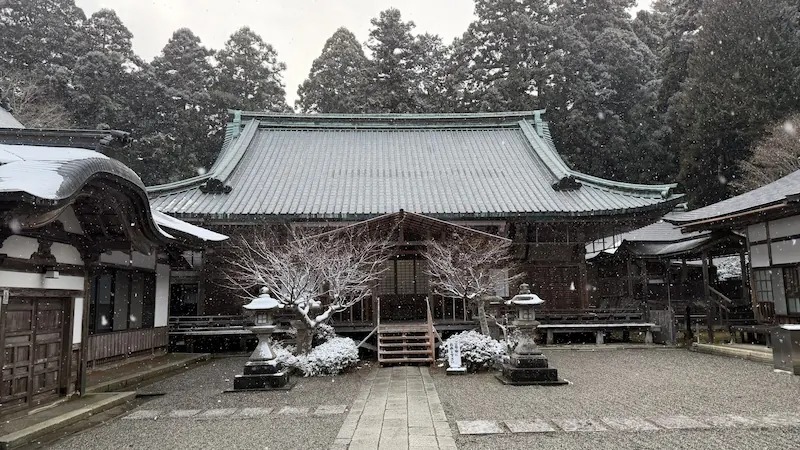
A short walk deeper into Yokawa from the main hall, Ganzan Daishi-do stands on the site of the former residence of Ryogen (912–985), the monk revered as the great reviver of the Tendai school and one of the most influential figures in Enryakuji’s history. In 967 (Kōhō 4), by imperial command of Emperor Murakami, the site was designated a Shiki-kodo — a hall for the year-round lecture and debate of the great Mahayana sutras, held in each of the four seasons (shiki). After Ryogen’s death, the hall became a principal site of devotion to him under the name Ganzan Daishi-do (Hall of the Great Teacher of Ganzan — “Ganzan” referring to the first month of the year, during which Ryogen died). The surviving building dates to 1652 (Jōō 1), rebuilt by imperial wish of Emperor Gomizunoo after the disruptions of the preceding century. Its unpainted natural wood construction and composed hip-and-gable roof sit quietly in the deep forest of Yokawa in a way that ornamented buildings rarely achieve. Ganzan Daishi-do is widely recognized as the birthplace of the omikuji — the small paper fortune slips found today at virtually every shrine and temple in Japan, drawn by tens of millions of people annually for guidance on everything from health and travel to marriage and business. (The omikuji tradition involves drawing a numbered slip from a container, then receiving a corresponding paper with a fortune written on it — the result ranges from great blessing to great curse, and tying an unfavorable slip to a designated rack at the temple or shrine is said to leave the bad fortune behind.) The precise origins of the omikuji are debated by historians, but this hall is the site most widely and officially associated with their invention. The hall also continues to offer the Tsuno Daishi — a distinctive protective charm depicting Ryogen in a horned, demon-like form said to ward off evil spirits — a tradition that has its own long folk history in Japan. Because so few visitors reach Yokawa, and fewer still make their way to this hall, the quiet here when I arrived was complete.
- The birthplace of the omikuji: This is the site most widely associated with the invention of the omikuji — a form of divination that has become embedded in Japanese culture at a scale that makes it essentially invisible to those inside it, but immediately striking to visitors from outside. Drawing an omikuji at the hall where the practice originated carries a different weight from drawing one at a souvenir stand.
- The Shiki-kodo tradition: The hall’s original function was as a year-round venue for sutra lecture and formal Buddhist debate. For all its remote quiet, Yokawa was also a center of serious intellectual activity within the Tendai school.
- Autumn: When the maples are at their peak, the fall color surrounding the hall’s unpainted natural wood exterior creates a particularly striking contrast — understated architecture and maximum seasonal color.
⏳ Time estimate: Quick visit 10 min / Thorough visit 15 min
🗺 Address: Sakamoto Honmachi / Sakamoto 4-chome, Otsu, Shiga
🚶 Access: Approx. 5-minute walk from Yokawa Chudo Hall
⭐ Recommended Historical Significance: ☆☆☆ Visual Impact: ☆☆ Experiential Value: ☆☆
| Year Founded | Designated Shiki-kodo in 967 (Kōhō 4); current building erected 1652 (Jōō 1) |
|---|---|
| Builder | Not recorded; current building rebuilt by imperial wish of Emperor Gomizunoo |
| Structure & Features | Five bays wide, four bays deep; single-story hip-and-gable roof (irimoya-zukuri); copper-strip sheeting. Unpainted natural wood exterior. |
| Restoration History | Current building constructed 1652 by imperial order of Emperor Gomizunoo |
| Cultural Property Designation | National Important Cultural Property (designated as “Enryakuji Shiki-kodo”) |
| Current Status | Standing |
| Notes | Together with the Ganzan Daishi Mausoleum, this hall forms the devotional center of the Ganzan Daishi cult at Yokawa. Tsuno Daishi protective charms are available here. |
- From private residence to public hall: The site began as Ryogen’s own living quarters — his private retreat within the Yokawa precinct, known as Joshinho. It was redesignated as the Shiki-kodo during his lifetime by imperial command, then after his death became the primary site of his cult.
- Two names, one designation: The building is officially designated as “Enryakuji Shiki-kodo” by Japan’s Agency for Cultural Affairs, but is widely known as Ganzan Daishi-do. The cultural property designation documentation notes that together with the Ganzan Daishi Mausoleum worship hall, it forms the devotional core of the Ganzan Daishi cult at Yokawa.
- Rebuilt by a different patron: While much of Enryakuji’s reconstruction after the Nobunaga burning proceeded under Toyotomi and early Tokugawa patronage, the current Ganzan Daishi-do was rebuilt in 1652 by imperial wish of Emperor Gomizunoo — a patron whose involvement gives this particular hall a distinct place in the complex’s reconstruction history.
At Yokawa, the sense that Enryakuji is not a single temple but a mountain — a civilization spread across ridges and forests — finally became something I understood rather than just accepted. Todo, Saito, Yokawa: each crossing feels like entering a different world, and the silence deepens with every one. It was here that I realized I had no way back, and ended up walking down to Sakamoto on foot. That walk — through the forest, down the mountain, alone — was itself part of understanding what this place actually is. The quiet at Ganzan Daishi-do, when I arrived and found no one there, was the kind of quiet you don’t manufacture for visitors. It was just there.
── Visitor’s Note (December 2025, Yokawa in winter)
Eshin-do 🎥 360°
Where Genshin wrote the Ojoyoshu — the quiet hall in the deepest part of Yokawa where Japanese Pure Land Buddhism began
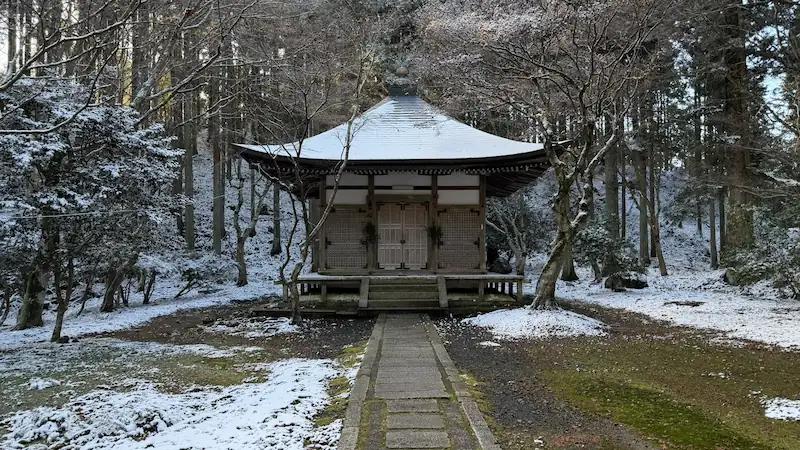
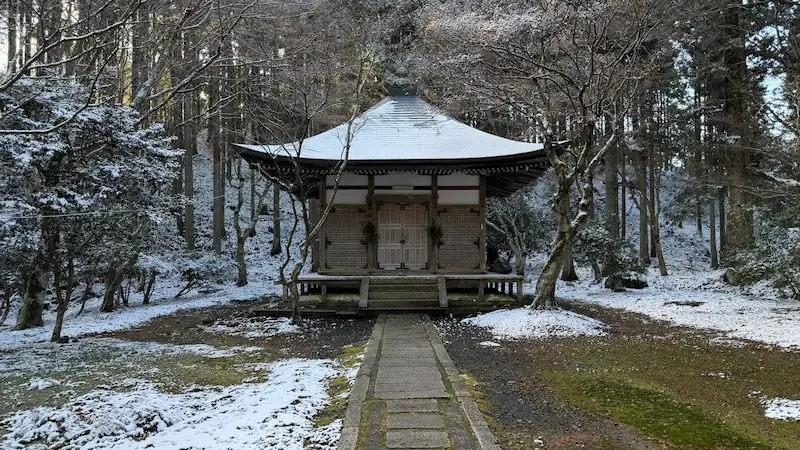
In the quiet cedar forest of Yokawa stands Eshin-do — the site traditionally associated with the monk Genshin (942–1017), also known as Eshin Sozu. The hall enshrines Amida Nyorai (Amitabha Buddha) and serves as a nembutsu zanmai training ground, preserving a practice centered on the repeated invocation of Amida Buddha’s name. Temple accounts hold that it was here that Genshin wrote his two most consequential works: the Ojoyoshu (985 AD), a systematic description of the Buddhist realms of rebirth, above all the Western Pure Land of Amida Buddha to which practitioners aspire — a text whose vivid depictions of paradise and hell made it one of the most widely read religious works in Japanese history — and the Nijugo Zanmai-shiki, a manual for communal nembutsu practice. These writings laid the foundations of Japanese Pure Land Buddhism and exerted direct influence on Honen (1133–1212) and Shinran (1173–1263), who would go on to found the Jodo and Jodo Shinshu schools respectively — the latter today the largest Buddhist denomination in Japan. If you visit the Daiko-do in Todo and stand before the wooden figures of Honen and Shinran, then come to this hall and consider that the texts which shaped their entire religious vision were written in this small, unremarkable building in the forest, the connection between the two places is hard to miss — and so is the reason the mountain is called the “mother mountain of Japanese Buddhism.” The interior is not open to the public; the visit is made from the approach path outside.
- Where the Ojoyoshu was written: The chain that connects this hall to the wooden figures of Honen and Shinran in the Todo Daiko-do — Genshin’s writings here, their influence on those two monks, the founding of schools that would come to define Japanese Buddhist practice for tens of millions of people — runs through a single mountain. Eshin-do is the origin point of that chain.
- A nembutsu hall still in use: Eshin-do enshrines Amida Nyorai and maintains the nembutsu zanmai practice. The religious functions at Yokawa are still running, not preserved as exhibits.
- Summer: The approach path is surrounded by deep green foliage in summer. Eshin-do is the most understated of the three Yokawa spots, and worth lingering at.
⏳ Time estimate: Quick visit 5 min / Thorough visit 10 min
🗺 Address: 4225 Sakamoto Honmachi, Otsu, Shiga
🚶 Access: Approx. 3-minute walk from Ganzan Daishi-do
⭐ Recommended Historical Significance: ☆☆☆ Visual Impact: ☆ Experiential Value: ☆
| Structure & Features | Nembutsu zanmai training hall enshrining Amida Nyorai (Amitabha Buddha). Traditionally identified as the site of Genshin’s retreat. |
|---|---|
| Cultural Property Designation | Not designated |
| Current Status | Standing |
| Notes | Temple accounts state that Genshin wrote the Ojoyoshu and the Nijugo Zanmai-shiki here. Interior not open to the public. |
- The Ojoyoshu and its reach: Genshin’s Ojoyoshu, written here in 985, was one of the most widely read books of any kind in pre-modern Japan, not only among Buddhist texts. Its detailed descriptions of the Pure Land and the various hell realms shaped the visual imagination of an entire civilization: the paradise and hell imagery in Japanese painting, sculpture, literature, and folk belief for the next several centuries owes much to this single work written in this small hall in the forest.
- The chain from Yokawa to Todo: Genshin’s writings influenced Honen, who built on them to found the Jodo school; Honen’s teachings influenced Shinran, who founded Jodo Shinshu — today the largest Buddhist denomination in Japan. Standing before the figures of Honen and Shinran in the Todo Daiko-do, then coming here, allows you to trace the intellectual and spiritual chain from this hall outward to a significant portion of Japanese religious history.
- Closed interior: Eshin-do is explicitly noted as closed to the public in Enryakuji’s official materials. The visit is made from outside, from the approach path, as an act of contemplation rather than inspection — which, given what the hall represents, seems appropriate.
Practical Visitor’s Guide: Yokawa Precinct
Covering all three spots at a relaxed pace takes approximately 40 to 60 minutes. The natural walking order is: Yokawa Chudo → Ganzan Daishi-do → Eshin-do. The three halls are within a reasonably compact area, but Yokawa itself is the most remote point on the mountain, so factor in shuttle bus transit time from Todo (about 15 minutes) or Saito (about 10 minutes) when planning the day. Goshuin (devotional seal stamps) are available here, but the locations are not always obvious — confirm in advance which stamps are offered where. Finding out after the fact that you missed one typically means a long walk back.
During winter (December through February), visiting hours in the Yokawa precinct begin at 9:30. Shuttle bus service may be suspended entirely, in which case reaching Yokawa from Todo requires hiking the Tokai Nature Trail — a walk of well over 100 minutes each way. Confirm your return transport before leaving for the mountain. If the shuttle is not running and you find yourself at Yokawa as the afternoon closes, the descent to Sakamoto on foot is your only option. That walk is manageable, but it needs to be a choice made before you set out, not a surprise discovered at dusk. Always check the official Enryakuji website for current transport conditions before visiting in winter.
Enryakuji Yokawa Precinct FAQ
Covering all three spots at a relaxed pace takes about 40 to 60 minutes. Factor in the transit time from Todo (about 15 minutes by shuttle bus). Confirm goshuin stamp locations in advance to avoid having to retrace your steps.
From Todo, take the shuttle bus — about 15 minutes. From Saito, about 10 minutes. Walking via the Tokai Nature Trail from Todo takes well over 100 minutes. Shuttle service may be suspended in winter, so check the official Enryakuji website before heading out. Visiting hours are normally 9:00–16:00; in winter (December through February), 9:30–16:00. Always confirm your return transport before you leave.
Ganzan Daishi-do (also known as Shiki-kodo) in the Yokawa precinct. The monk Ryogen (Jie Daishi), revered as the great reviver of the Tendai school, is credited with devising the omikuji — the paper fortune slips drawn at shrines and temples across Japan today. The tradition continues here: both omikuji and the Tsuno Daishi protective charm are available at the hall. While the precise origins of the omikuji are debated by historians, Ganzan Daishi-do is the site most widely associated with its invention.
Yokawa Chudo (rebuilt 1971) has an exterior said to have been modeled on the flat-bottomed ships used by Japanese imperial envoy missions to Tang Dynasty China between the 7th and 9th centuries — voyages on which monks like Ennin himself traveled to study Buddhism. The hall’s central section is set approximately two meters lower than the surrounding platform, creating a striking stage-style (butai-zukuri) structure in vivid vermilion lacquer. It is one of the most visually distinctive halls on the mountain, and the effect of encountering it suddenly through deep cedar forest is hard to forget.
Eshin-do is the site traditionally associated with the monk Genshin (Eshin Sozu, 942–1017). Temple accounts hold that Genshin wrote the Ojoyoshu (985 AD) and the Nijugo Zanmai-shiki here — works that laid the foundations of Japanese Pure Land Buddhism and directly shaped the thinking of Honen and Shinran, the founders of the Jodo and Jodo Shinshu schools. Standing before the figures of Honen and Shinran in the Todo Daiko-do, then visiting this hall, completes a chain of influence that runs through a single mountain. The interior is not open to the public.
Yokawa is the most remote of the three precincts, the least visited, and the most completely enveloped in deep mountain forest. It has neither the visual grandeur of Todo nor the austere historical weight of Saito — what it has is a depth of stillness that the other two precincts can’t quite replicate. The sense that Enryakuji is not a single temple but an entire mountain civilization becomes most fully real here. Because so few people come this far, the quiet at Ganzan Daishi-do is the genuine article.
Continue to the Other Precincts
From Yokawa, take the shuttle bus back to Todo or Saito. Walk all three precincts and you notice how the mountain changes, ridge by ridge. The buildings are worth seeing, but the walking between them is what the place is actually made of.
☕ Support This Site
Following the Shogun is built on original fieldwork and on-site research.
If you found this guide useful, your support helps keep it going.

You can also support via QR code


comment