


Mt. Hiei Enryakuji Temple: Complete Guide to Todo, Saito & Yokawa
Enryakuji is not one temple but three precincts — Todo, Saito, and Yokawa — spread across a mountain that has shaped nearly every major school of Japanese Buddhism since 788.
On This Page
Enryakuji is not a single temple. It is a vast religious landscape — three distinct precincts called Todo, Saito, and Yokawa, where roughly 100 halls and pagodas are scattered across a mountain. The moment you see the full map, you realize the scale isn’t just a figure of speech. And once you start walking, the distances between areas, the shifting silence, the altitude and the cold all speak to what Enryakuji really is in a way no photograph can. Since 788, when the monk Saicho built his first hermitage here, this mountain has been called the “mother mountain of Japanese Buddhism” — the training ground that shaped the founders of nearly every major Buddhist school in Japan, including Honen, Shinran, Dogen, and Nichiren. It remains an active place of monastic practice to this day.
What Is Enryakuji Temple?
Enryakuji, the head temple of the Tendai Buddhist school, traces its origins to 788 (the 7th year of the Enryaku era), when the monk Saicho — later venerated as Dengyo Daishi — established a small hermitage called Ichijo Shikan-in on Mt. Hiei. The entire mountain, rising to 848 meters above sea level, forms a single sacred precinct. In 1994, the complex was inscribed as a UNESCO World Cultural Heritage Site as part of the “Historic Monuments of Ancient Kyoto.” Its three main areas — Todo, Saito, and Yokawa — together contain around 100 halls and structures scattered across the mountainside. At its peak, the complex was so vast it was known as the “Three Thousand Halls of Eizan,” a phrase conveying not just size but immense religious and political influence. That all changed in 1571, when the warlord Oda Nobunaga launched a devastating assault that razed virtually every building on the mountain and in the surrounding village of Sakamoto at its foot. Attacking a fortified mountaintop complex was no small undertaking, and the thoroughness of the destruction indicates how seriously Nobunaga treated the threat the temple posed. What stands today was largely rebuilt during the 17th century under the patronage of Toyotomi Hideyoshi, Tokugawa Ieyasu, and Tokugawa Iemitsu.
On a map, Todo, Saito, and Yokawa look like one unified temple. On foot, they feel like three entirely different worlds. With each precinct you enter, the crowds thin, the air changes, and the mountain draws you deeper in. The walking is the point here as much as the buildings are: the distances and the silence between the halls do the explaining. I came expecting to see a temple and spent the day covering ground instead.
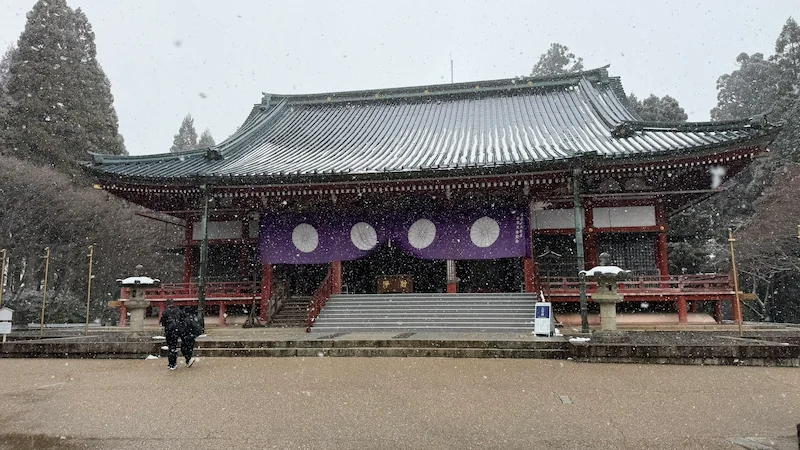
── Visitor’s Note (December 2025, Enryakuji in snow)
Nobunaga’s Burning of Enryakuji
In September 1571, Oda Nobunaga launched a full-scale assault on Enryakuji, reducing virtually every hall and pagoda across Todo, Saito, and Yokawa to ash — along with the temple town of Sakamoto at the mountain’s base. At the time, Enryakuji was far more than a religious institution. It controlled vast estates, maintained its own armed warrior-monks (sohei), and wielded deep influence over the political affairs of the Kinai region (the area around present-day Kyoto and Osaka). The immediate pretext was that the temple had sheltered Nobunaga’s enemies, the Asai and Asakura clans. But the underlying motive was the elimination of a rival power center that had long challenged secular authority. The burning of Enryakuji remains one of the most stark acts of destruction in Japanese history.
Walking the mountain today gives those events a different kind of weight. Consider how long it took to build a religious complex of this scale in such a remote and unforgiving location — hauling timber and stone up a mountain with no roads, no machinery, over centuries. Then consider that it was all gone in a single day. Most of what visitors see now dates from the Toyotomi and Tokugawa reconstruction period of the 17th century, rebuilt under the patronage of the very warlords who succeeded Nobunaga’s legacy.
Highlights by Precinct
Todo Precinct
The founding ground of Enryakuji — 7 key sites anchored by the National Treasure Konpon Chudo Hall
This is where Saicho built his first hermitage in 788, making it the spiritual origin of the entire complex. At the center stands the Konpon Chudo — a National Treasure currently undergoing major restoration, though it remains open for worship. Surrounding it are Monju-ro Gate, Daiko-do (Great Lecture Hall), Daikoku-do, Kaidan-in (Ordination Hall), Amida-do, and the Hokke Soji-in East Pagoda. Todo is easily reached by a 10-minute walk from Enryakuji Cable Station, and the Enryakuji Bus Center nearby makes it the natural hub for reaching the other precincts. Of the three areas, Todo is the most visually striking, with its vermilion-lacquered halls and open plazas. Inside the Daiko-do stand the statues of the great Buddhist reformers who trained here — Honen, Shinran, Dogen, Nichiren, and others — which is where the phrase “mother mountain of Japanese Buddhism” stops being an abstraction.
- Konpon Chudo (National Treasure, under major restoration) · Monju-ro (Important Cultural Property)
- Daiko-do (ICP) · Kaidan-in (ICP) · Amida-do
- Daikoku-do — the reputed birthplace of Japan’s Daikoku-ten (god of fortune) devotional tradition
- Estimated time: 1.5 to 2 hours
Saito Precinct
The oldest surviving building on the mountain (1347) — Shakado Hall and the twin halls of Ninaido
About one kilometer west of Todo, Saito has a markedly different character — quieter, more austere, with a stronger sense of active monastic life. The area’s centerpiece is Shakado (formally Tenpohrin-do), built in 1347 and the oldest surviving structure on the entire Enryakuji complex. Nearby stand the twin halls of Ninaido — Jogo-do and Hokke-do — connected by a covered walkway that arches between them, creating one of the mountain’s most photographed silhouettes. Also here is Jodo-in, a small, immaculately maintained compound housing the mausoleum of Saicho himself. Compared to Todo, Saito sees far fewer visitors, and the cedar forests that surround its halls create an atmosphere that sits somewhere between a temple and a forest hermitage. Standing before Shakado in winter snow, with no one else around, you’re less aware of being a tourist than of having been temporarily admitted into a place that is still very much in use.
- Shakado — oldest building on the mountain (1347, Important Cultural Property)
- Ninaido twin halls: Jogo-do and Hokke-do (both Important Cultural Properties)
- Jodo-in (ICP) — mausoleum of Saicho · Minabuchi Benzaiten Shrine
- Estimated time: 1 to 1.5 hours
Yokawa Precinct
The mountain’s deepest stillness — birthplace of the omikuji fortune slip and the origins of Japanese Pure Land Buddhism
Located about four kilometers north of Todo, Yokawa is the most remote and least visited of the three precincts. Making the trip out here is what gives you the scale of Enryakuji: a monastic complex the size of a mountain rather than a single temple. The precinct’s focal point is Yokawa Chudo Hall, a striking vermilion structure rebuilt in 1971 on a raised platform modeled after the flat-bottomed ships used on imperial envoy missions to Tang Dynasty China. Nearby is Ganzan Daishi-do (also known as Shiki-kodo), an Important Cultural Property said to be where the omikuji — the paper fortune slips now found at Shinto shrines and Buddhist temples across Japan — were first devised in the 9th century by the monk Ryogen. Also here is Eshin-do, associated with the monk Genshin, who wrote the Ojoyoshu (985 AD), the foundational text of Japanese Pure Land Buddhism — a tradition that would eventually spread to tens of millions of followers. Few people make it this far, and the quiet that results is the main reason to come.
- Yokawa Chudo — rebuilt 1971; the enshrined Sho Kannon standing figure is an Important Cultural Property
- Ganzan Daishi-do (Shiki-kodo) — reputed birthplace of the omikuji fortune slip (Important Cultural Property)
- Eshin-do — the contemplative retreat of the monk Genshin, author of the Ojoyoshu
- Estimated time: 40 to 60 minutes
What to Know Before You Visit
Enryakuji is not a temple you simply walk around in an hour. It is a mountain traversed across multiple precincts, and your choice of footwear and how much time you allow will determine the quality of your visit more than anything else. The moment you arrive by cable car, check the full site map. The distances shown on paper bear little resemblance to what it actually feels like to cover them on foot.
During winter (December through February), shuttle bus service between the precincts may be suspended entirely. When that happens, moving from Todo to Saito and Yokawa means hiking along mountain trails — over 100 minutes on foot from Todo to Yokawa. Visiting in sneakers or anything without ankle support is a serious mistake in snow, wet conditions, or on icy paths. Waterproof trekking shoes are strongly recommended year-round, and essential in winter. If collecting goshuin (devotional seal stamps available at participating temples and shrines throughout Japan), confirm the stamping locations in advance — missing one often means retracing your steps across considerable distance.
Admission Fees & Visiting Hours
Fees & Hours
| Admission (3-precinct combined pass) | Adults ¥1,000 / Middle & High School Students ¥600 / Elementary School Students ¥300 Kokuhoden (Treasure Hall): Adults ¥500 · Students ¥300 · Elementary ¥100 (separate fee) |
|---|---|
| Visiting Hours | Todo: 9:00–16:00 year-round (last entry 15:45) Saito & Yokawa: 9:00–16:00 (winter Dec–Feb: 9:30–16:00) ※ Hours may be shortened due to snowfall or other conditions |
| Online Tickets | Web tickets for the combined pass have been available since October 2023. Purchasing in advance lets you skip the on-site queue. |
| Group Dharma Talks | Walk-in registration at the Daiko-do reception desk, accepted 9:00–15:30. No advance booking — first-come, first-served on the day. |
Getting There
Access
| From Shiga (Sakamoto Route) | JR Kosei Line → Hieizan-Sakamoto Station (JR-B27) → bus approx. 7 min to Sakamoto Cable Station → Sakamoto Cable approx. 11 min → Enryakuji Cable Station → 10-min walk to Todo ※ Alternatively: Keihan Ishiyama-Sakamoto Line → Sakamoto-Hieizanguchi Station (OT21) → bus approx. 4 min to Sakamoto Cable Station |
|---|---|
| From Kyoto (Yase Route) | Eizan Electric Railway → Yase-Hieizanguchi Station (E08) → Eizan Cable → Eizan Ropeway → Mountain Summit ※ The ropeway has seasonal closures — check current schedules before visiting |
| By Car | Use the Oku-Hiei Driveway. Separate parking areas are available at Todo, Saito, and Yokawa. |
| Between Precincts | Shuttle bus: Todo ↔ Saito approx. 10 min · Todo ↔ Yokawa approx. 15 min ※ May be suspended in winter — confirm in advance |
| Official Website | https://www.hieizan.or.jp/ (always verify current hours and fees before visiting) |
How Long Will It Take?
Time Needed
| Todo only | Approx. 1–2 hours |
|---|---|
| Todo + Saito | Approx. 3 hours |
| All 3 precincts (Todo, Saito & Yokawa) | Approx. 3.5–5 hours (including transit time) |
| Winter note | If shuttle buses are suspended, all movement between precincts is on foot via mountain trails (Todo → Yokawa: 100+ min). Waterproof, insulated footwear is essential. Confirm your return transport before heading up. |
Seasonal Highlights
SpringLate April to Golden Week (early May): Cherry blossoms. The Saito precinct is particularly beautiful around Golden Week — Japan’s national holiday period that runs from late April into early May — when the delicate blooms soften the weathered facade of Shakado Hall.
Early SummerLate April to June: Fresh green maple leaves (aomomi) envelop the entire mountain. The foliage around Konpon Chudo in Todo is especially vivid during this period.
AutumnLate October to November: Peak fall color season, when around 2,000 maple trees set the mountainside ablaze. The contrast between the crimson lacquerwork of Amida-do and the surrounding autumn leaves is one of the mountain’s most striking sights.
WinterDecember to February: Even on days when the city below is clear, the summit can be deep in snow, and the gap between the two is part of what sets this place apart from a temple on flat ground. Stone lanterns capped with white, rooftops turned silver, the silence between the halls: winter Enryakuji is unlike any other season. That said, warm and waterproof clothing is non-negotiable, and shuttle bus availability must be confirmed before you set out.
Enryakuji FAQ
A combined pass covering all three precincts — Todo, Saito, and Yokawa — costs ¥1,000 for adults, ¥600 for middle and high school students, and ¥300 for elementary school students. The Kokuhoden (temple treasure hall) requires a separate fee: ¥500 for adults, ¥300 for middle and high school students, and ¥100 for elementary school students.
The Todo precinct is open year-round from 9:00 to 16:00 (last entry at 15:45). Saito and Yokawa operate from 9:00 to 16:00 (9:30 to 16:00 during winter, December through February). Hours may be shortened due to snowfall or other conditions — always check the official website before your visit.
From the Shiga side (Sakamoto Route): Take the JR Kosei Line to Hieizan-Sakamoto Station (JR-B27), then a short bus ride to Sakamoto Cable Station, ride the Sakamoto Cable (approx. 11 min) to Enryakuji Cable Station, and walk about 10 minutes to reach the Todo precinct. From the Kyoto side (Yase Route): Take the Eizan Electric Railway to Yase-Hieizanguchi Station (E08), then ride the Eizan Cable and Ropeway to the summit. Drivers can use the Oku-Hiei Driveway.
Allow 1–2 hours for Todo alone, about 3 hours for Todo and Saito combined, and 3.5–5 hours (including transit) to cover all three precincts. Shuttle buses run between areas, though service may be suspended in winter — confirm before you go.
Shuttle buses are the most practical option. Todo to Saito takes about 10 minutes; Todo to Yokawa takes about 15 minutes. Service may be suspended during winter, so check in advance. Walking from Todo to Yokawa along mountain trails takes well over 100 minutes. Always confirm your return transport before heading out.
The renovation, which began in 2016, is part of a roughly 15-year project and is expected to continue until around 2031. Worship remains possible throughout the works, and a special viewing platform lets visitors observe the roof repairs up close — a rare opportunity that will disappear once the restoration is finished.
Spring (late April to Golden Week): Cherry blossoms, with the Saito precinct looking its best around early May. Early summer (late April to June): Fresh green maples wrap the entire mountain. Autumn (late October to November): Around 2,000 maple trees turn the mountainside brilliant red and gold. Winter (December to February): The summit can be blanketed in snow even on clear days in the city below, and the stillness that settles over the mountain is unlike any other season — though warm, waterproof gear and advance confirmation of shuttle bus schedules are essential.
☕ Support This Site
Following the Shogun is built on original fieldwork and on-site research.
If you found this guide useful, your support helps keep it going.

You can also support via QR code


comment