
Here’s a streamlined, ~1-hour model route through Kanazawa Castle Park that distills the history and prestige of the Kaga Domain into a short, unforgettable walk. This path is efficient yet comprehensive — covering the castle’s signature icons, historic structures, and a serene garden. Plus, at each stop you can enjoy 360° panorama photos that make you feel as if you’re standing there in person.
Route Map
7 Handpicked Highlights
Spot 1: Ishikawa-mon Gate (石川門)
The iconic rear gate — lead roof tiles, masugata defense, and Kenrokuen views
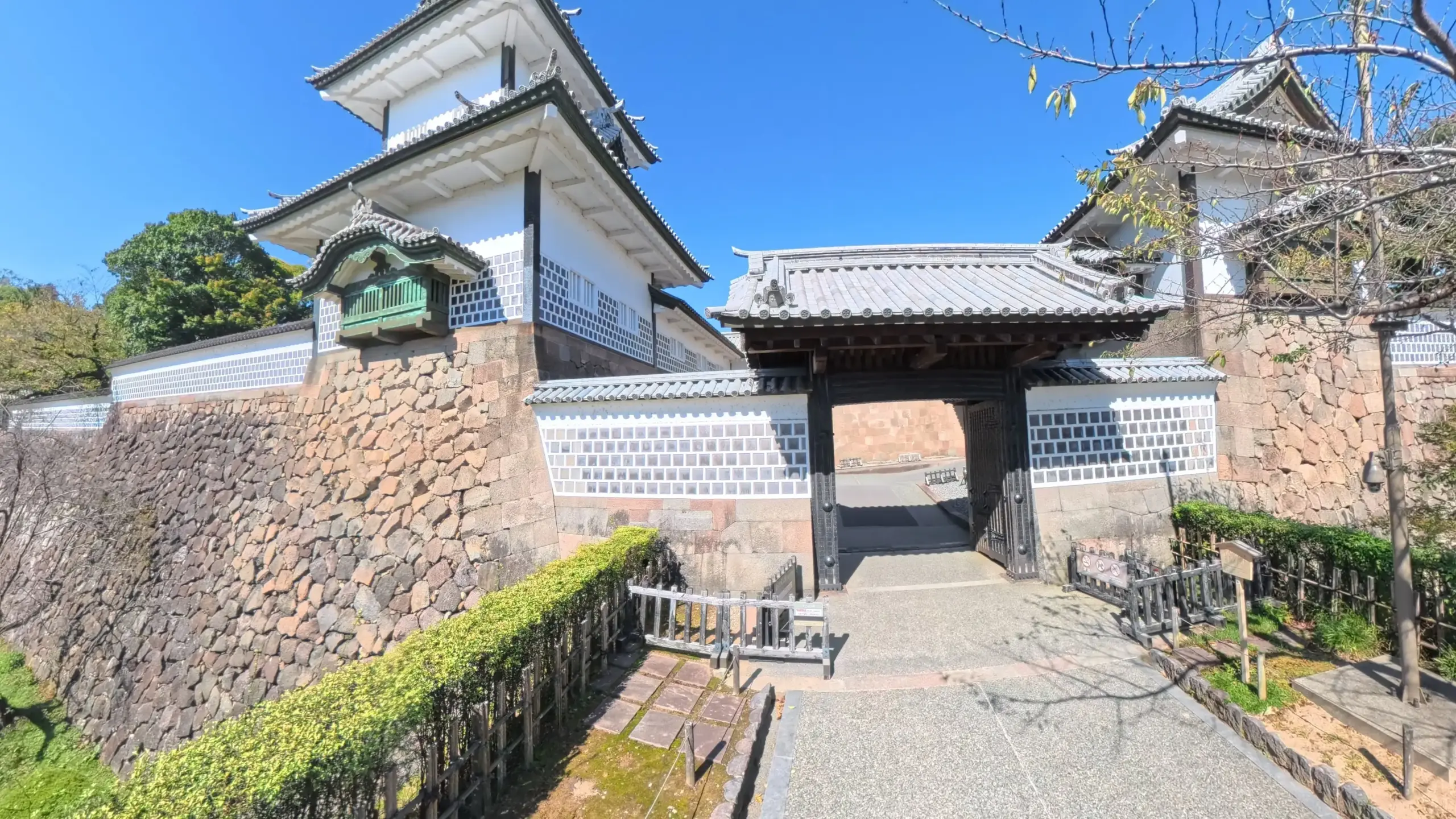
“Ishikawa-mon” is one of Kanazawa Castle’s signature gates and among the few surviving original castle structures. Located on the karamete (rear/secondary) side, it faces toward Ishikawa District — hence the name. In the Edo period, it was counted among the three principal gates known as the “Sango-mon.”
The gate you see today was rebuilt in 1788 after it burned in the 1759 fire. Ishikawa-mon comprises multiple elements — yagura-mon (turret gate), attached turrets, a korai-mon (outer gate), and a drum earthen wall — forming a robust masugata (box-shaped) defensive layout. The roof uses lead tiles; legend has it they could be melted down for bullets in wartime, a story often told though not proven.
After Maeda Toshiie moved his base to Kanazawa Castle, this gate grew in importance as the castle complex expanded. The placement of gates and turrets balanced prestige and defense, reflecting the daimyo’s authority.
- Masugata layout & gate sequence: A layered defense of korai-mon → turret gate → attached turret.
- Lead roof tiles: Notable for their patina; folklore says the lead could be melted for bullets (a popular legend).
- Night illumination: Lighting adds atmosphere (schedule varies by season/time).
- Setting within the landscape: Views tie in with Kenrokuen and the castle stone walls.
Panorama Photos
Quick look: ~10 min / In-depth: ~20 min
🗺 Address: 1-1 Marunouchi, Kanazawa, Ishikawa
🚶 Access: Nearest bus stop: “Kenrokuen-shita/Kanazawa Castle,” about 4 min on foot (≈300 m). About 30 minutes on foot (2.2 km) from JR Kanazawa Station.
Next: Kahoku-mon Gate → 2 min walk
| Year Built | 1788 (reconstruction) |
|---|---|
| Builder | Maeda clan (under Lord Maeda Harunaga) |
| Structure & Features | Yagura-mon, attached turret, korai-mon, masugata layout, drum earthen wall |
| Repairs/Restoration | Dismantling repairs and preservation works in the Shōwa era |
| Status | Standing original (National Important Cultural Property) |
| Loss/Damage | Destroyed by the 1759 fire → rebuilt |
| Cultural Designation | Designated a National Important Cultural Property in 1950 |
| Notes | One of the castle’s key cultural assets, alongside the Sanjikken Nagaya and Tsurumaru Storehouse |
- A “rear” gate: Functioned as the karamete (rear/secondary) gate — more defensive than ceremonial.
- Lead tile lore: The bullet-melting tale is often told but lacks firm contemporary documentation.
- One of the “Three Grand Gates”: Ishikawa-mon, Kahoku-mon, and Hashizume-mon formed the castle’s principal gates.
Spot 2: Kahoku-mon Gate (河北門)
The castle’s grand front entrance — rebuilt to Edo-era glory
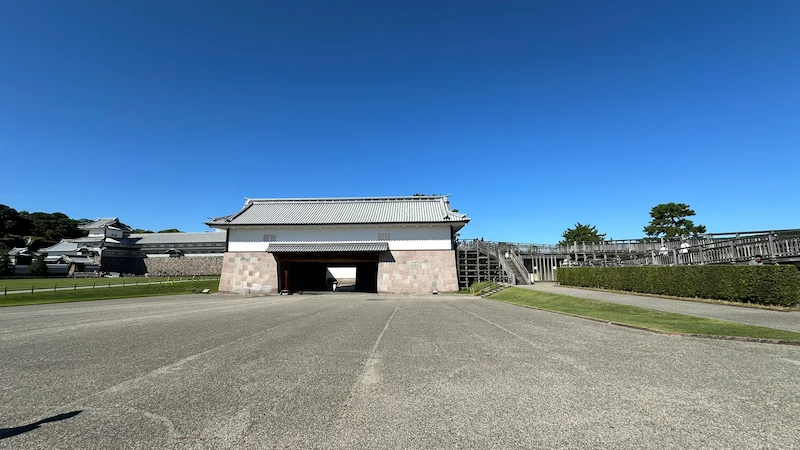
Kahoku-mon served as the castle’s practical “main gate” on the ote-guchi (front approach). As one of the “Three Grand Gates,” it shaped the castle’s face. The original burned in the 1759 Great Fire and was rebuilt in 1772, then removed in the Meiji era. A faithful reconstruction began in November 2007 and was completed in April 2010, based on old maps, photos, documents, and excavated remains. Traditional methods revived the Tomuro stone ramparts, white plaster walls, timber structure, and lead tiles.
Its composition — “First Gate (korai-mon)”, “Second Gate (yagura-mon)”, masugata courtyard/earthen moat, and a watch platform — combines dignity with defense. In the Maeda era, this front gate likely received the lord, processions for alternate attendance, and official visitors, embodying both status and security. Interior access is available for viewing.
- First Gate (korai-mon): White-plaster portal leading inside.
- Second Gate (yagura-mon) + masugata: Right-angled turn forces attackers to slow and expose flanks.
- Watch/attached turrets: Platforms and linked turrets for surveillance and defense.
- Interior viewing: Rebuilt with local Hinoki cypress (Noto Hiba) and open to visit (free).
- Day & night scenes: Bright stone-and-plaster contrast by day; seasonal illumination at night.
Panorama Photos
Quick look: ~5 min / In-depth: ~30 min (including interior)
🗺 Address: Around Marunouchi, Kanazawa, Ishikawa
🚶 Access: Right by Ishikawa-mon. About 2 minutes on foot via the castle path.
Next: Tsurunomaru Rest House → 2 min walk
| Year Built | 1772 (reconstruction in the An’ei era) |
|---|---|
| Builder | Rebuilt under the Maeda domain (Kaga) |
| Structure & Features | First Gate (korai-mon) + Second Gate (yagura-mon) + masugata + attached/watch turrets |
| Repairs/Restoration | Removed in Meiji → Reconstruction started 2007 → Completed 2010 |
| Status | Reconstructed and open to the public |
| Loss/Damage | Removed around 1882 (Meiji 15), later absent for decades |
| Cultural Designation | No specific cultural asset designation noted in public materials |
| Notes | Reconstruction respected archaeological remains and historical documents |
- Reborn after ~130 years: Vanished in the Meiji era, reconstructed in the Heisei era.
- Community-backed rebuild: Donors’ names/messages were inscribed on hidden panels/tiles.
- Arms storage (hypothesized): Likely stored archery gear under the bow officer’s purview in Edo times.
- Masugata ingenuity: Angled layout breaks straight-line advances to strengthen defense.
Spot 3: Tsurunomaru Rest House (鶴の丸休憩館)
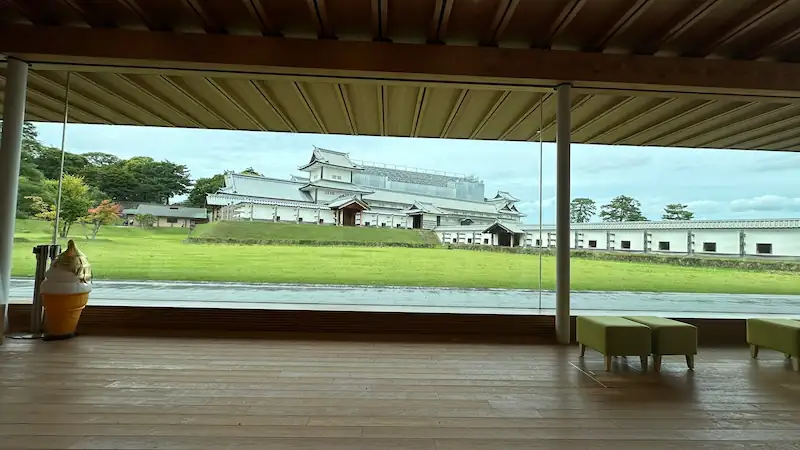
Panoramic glass views of Gojikken Nagaya — cafe, VR, and the best photo angle
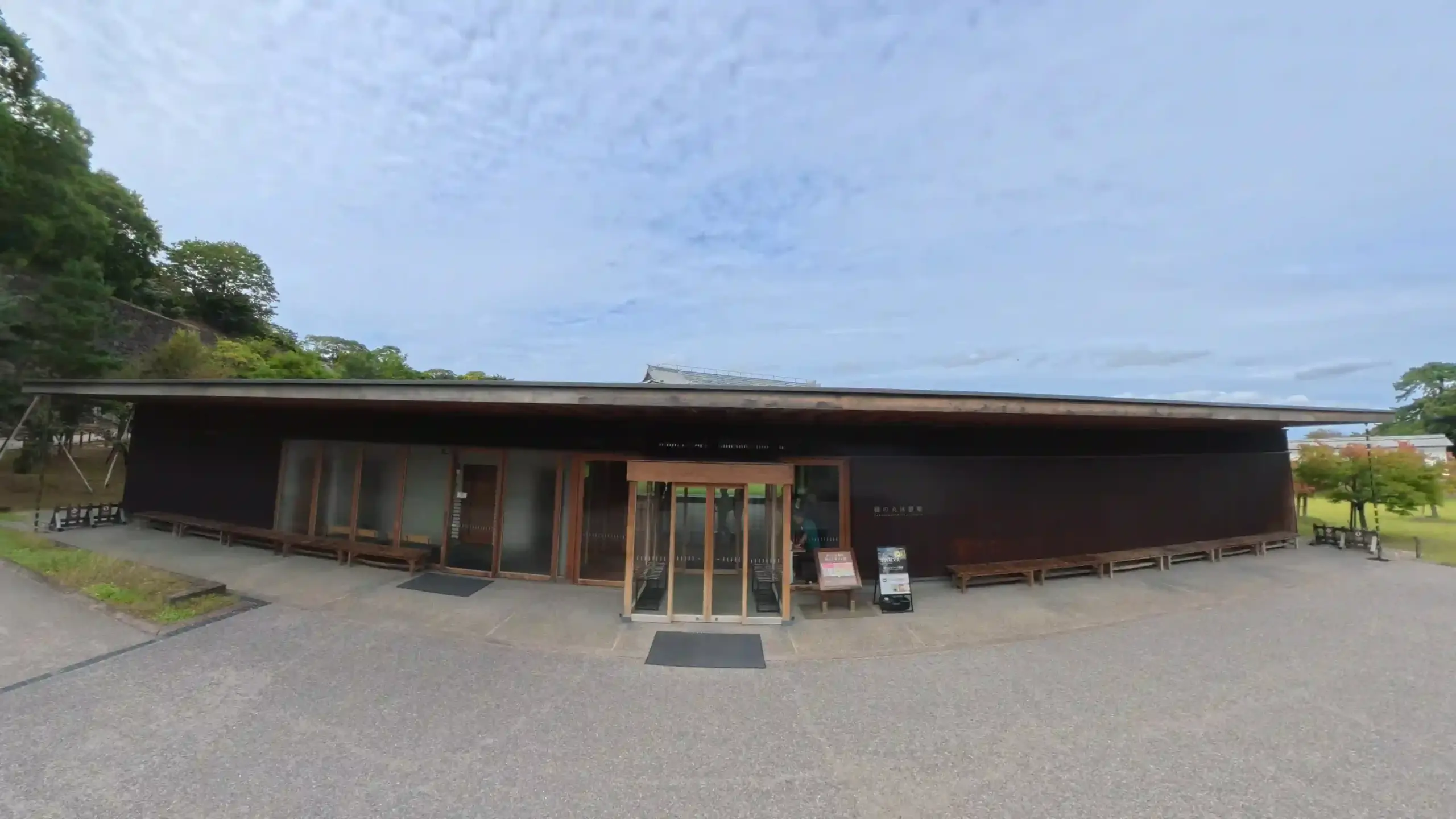
Opened in 2017 as a place for both travelers and locals to relax, the Tsurunomaru Rest House stands at the park’s center with sightlines to Hashizume-mon and Gojikken Nagaya. Warm timber finishes and expansive glass were chosen to showcase the castle panorama. The name “Tsurunomaru” comes from a former inner bailey and carries forward the Maeda family’s aesthetic legacy.
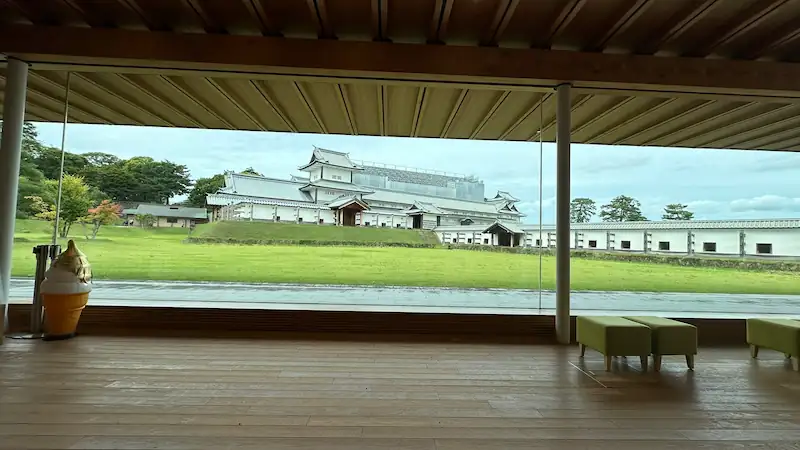
Inside you’ll find exhibits on reconstruction and archaeology, plus “Mamezara Chaya,” a cafe serving tea and Japanese sweets. The grand window view of Gojikken Nagaya and Hishi Yagura steals the show, changing with weather and seasons. A VR film, “Reviving the Kanazawa Castle Ninomaru Palace,” lets you digitally experience the castle in the era of Lord Maeda Toshiie and Lady Matsu.
- Panoramic glass views: A perfect vantage point over Gojikken Nagaya, Hishi Yagura, and Hashizume-mon.
- Mamezara Chaya: Popular sweets and light bites served on Kutani ware and Yamanaka lacquer.
- VR theater: CG recreation of the Ninomaru Palace immerses you in daimyo life.
- Local wood warmth: Notably Noto Hiba brings a calming, regional touch.
- Four seasons, four moods: Cherry blossoms, blue summer skies, autumn foliage, and winter snow-scapes.
Panorama Photos
Quick look: ~5 min / In-depth: ~30 min (cafe + VR film)
🗺 Address: 1-1 Marunouchi, Kanazawa (inside Kanazawa Castle Park)
🚶 Access: About 2 minutes (210 m) from the Tsurumaru Storehouse.
Next: Hashizume-mon Gate → 2 min walk
| Opened | 2017 |
|---|---|
| Design & Construction | Ishikawa Prefecture Construction Dept. & Goi Architects |
| Structure/Size | Steel frame with partial timber; single story; total floor area ≈ 422 m² |
| Main Facilities | Exhibition area, lounge, café (Mamezara Chaya), video corner |
| Features | Glass panorama space, locally sourced wood, harmony with castle scenery |
| Status | Open to the public (free entry) |
| Notes | Rebuilt in 2017, replacing the 2001 Tsurunomaru Rest Area |
- Context-sensitive design: Low profile and white-plaster tones blend into the castle scenery.
- Name origin: “Tsurunomaru” recalls a bailey linked to crane legends cherished by the Maeda family.
- More than a rest stop: A hub for information, cultural showcases, and learning.
- Hub of the walk: Centrally placed among the reconstructed buildings — ideal for breaks and meetups.
Spot 4: Hashizume-mon Gate (橋爪門)
The formal gateway to the Ninomaru — the castle’s most prestigious entrance
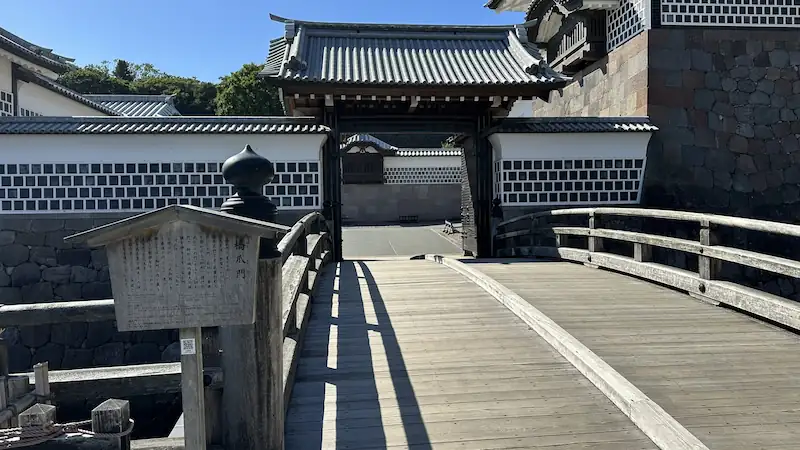
Hashizume-mon functioned as the main gate to the Ninomaru and is considered one of the most prestigious in the complex — also counted among the “Three Grand Gates.” Its design channelled all movement toward the castle’s core with deliberate control.
Architecturally, it features a layered defense: a “First Gate” in korai-mon style, a masugata courtyard, a “Second Gate” in yagura-mon style, and connected turrets. The masugata here was among the largest on site. In March 2015, the Second Gate was reconstructed as part of Phase 2 restoration, including a guard station. The First Gate dates to a 2001 reconstruction.
- Masugata layout: A classic defensive device that disrupts straight-line entry.
- Guard station recreated: Inside the Second Gate to evoke actual operations.
- Tomuro stone paving: Prestige signifiers appear in deliberate stonework.
- Linked turrets: Connectivity supports surveillance and control.
- Night illumination: Often lit with the adjacent Gojikken Nagaya.
Panorama Photos
Quick look: ~10 min / In-depth: ~20 min
🗺 Address: Around Marunouchi, Kanazawa
🚶 Access: About 2 minutes (≈180 m) from Tsurunomaru Rest House.
Next: Hishi Yagura & Gojikken Nagaya → 2 min walk
| Year (Re)Built | Reconstructed to the 1809 (Bunka 6) appearance |
|---|---|
| Structure & Features | First Gate (korai-mon) + masugata + Second Gate (yagura-mon) + attached turrets |
| Repairs/Restoration | Rebuilt in 1809 → Lost after Meiji → Reconstructed in Heisei (2001 & 2015) |
| Status | Reconstructed; Second Gate, guard station, and turrets open |
| Cultural Designation | Not individually designated; part of Kanazawa Castle historical site development |
| Notes | Details such as paving with Tomuro stone emphasize status and defense |
- Symbol of formality: One of the castle’s most restricted and ceremonial gates.
- Phased restoration: The First Gate came first (2001); the Second Gate followed in 2015.
- Maeda processional route: Processions to the Ninomaru Palace passed through here.
Spot 5: Hishi Yagura · Gojikken Nagaya · Hashizume-mon Tsuzuki Yagura
The castle’s signature trio — diamond turret, 90m storehouse, and traditional timber joinery
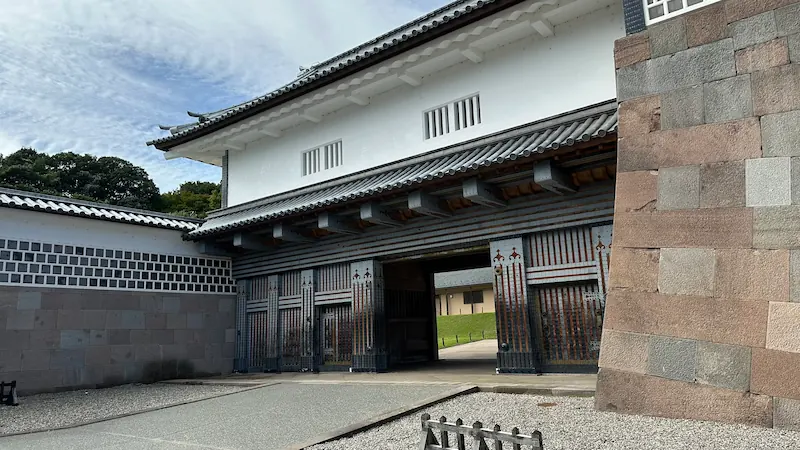
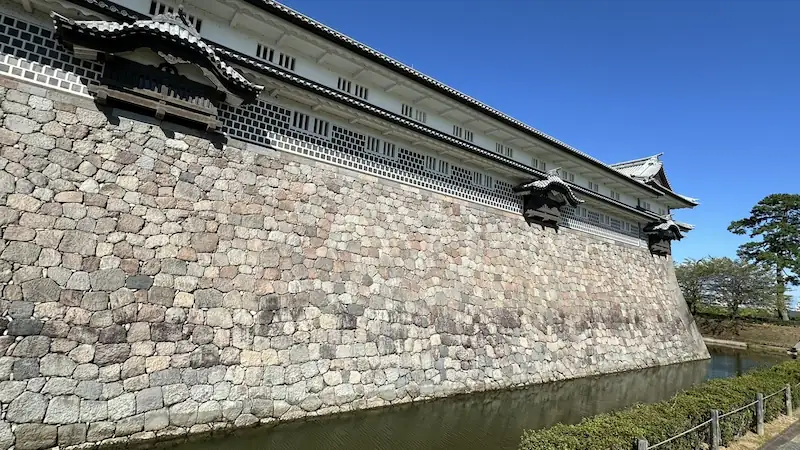
This emblematic trio — Hishi Yagura, Gojikken Nagaya, and the Hashizume-mon Tsuzuki Yagura — forms an integrated castle complex reconstructed in 2001 using archival research and excavation data. Alongside Ishikawa-mon and Sanjikken Nagaya, it’s among the site’s most significant restored structures. The three are directly connected: Hishi Yagura (three stories), Gojikken Nagaya (two stories), and the connecting turret (three stories) together formed a defensive line protecting the Ninomaru.
Interior exhibits showcase its timber joinery and design; you can go inside.
- Hishi Yagura’s diamond plan: Rare rhombic footprint; even some pillars are rhomboid with large through-posts.
- Timber joinery on display: Exposed beams/braces reveal traditional carpentry and joinery.
- Lookout vantage: The connecting turret surveys the Ninomaru approach via Hashizume-mon.
- Defensive fittings: Latticed windows, gunloops, and stone-drop chutes.
- Fire-conscious finishes: White plaster, namako walls, and lead tiles.
Panorama Photos
Quick look: ~15 min / In-depth: ~40 min (exhibits, models, structure)
🗺 Address: 1-1 Marunouchi, Kanazawa (inside Kanazawa Castle Park)
🚶 Access: About 2 minutes (≈170 m) from Hashizume-mon to the entrance.
🎫 Hours & Fees: 9:00–16:30 (last entry 16:00) / Adults ¥320, Children ¥100 (65+ free with ID)
Next: Gyokuseninmaru Garden → 5 min walk
| Completed | 2001 (Heisei 13) |
|---|---|
| Structure Overview | Hishi Yagura & Connecting Turret: timber, 3 stories / Gojikken Nagaya: timber, 2 stories |
| Use/Function | Hishi Yagura: watch/defense; Gojikken Nagaya: arsenal & curtain wall; Connecting Turret: lookout over Hashizume-mon |
| Features | Lattice windows, ishiochi (stone-drop chutes), teppō-zama (gunloops), white plaster & namako walls, lead tiles |
| Hours & Fees | 9:00–16:30 (last entry 16:00) / Adults ¥320, Children ¥100 (65+ free with ID) |
| Status | Reconstructed buildings open for paid entry |
- Three major fires: Burned in 1759, 1808, and 1881; repeatedly rebuilt.
- Entrance change: Since Sept 14, 2022, entry shifted from the Hishi Yagura side to the Gojikken Nagaya side.
- Continuous interior route: You can walk through all three structures inside.
- Largest-scale modern restoration: One of Japan’s largest post-Meiji timber castle reconstructions, taking 3 years and 4 months.
Spot 6: Gyokuseninmaru Garden (玉泉院丸庭園)
A daimyo’s strolling garden — cascading stonework, seasonal beauty, and night illumination
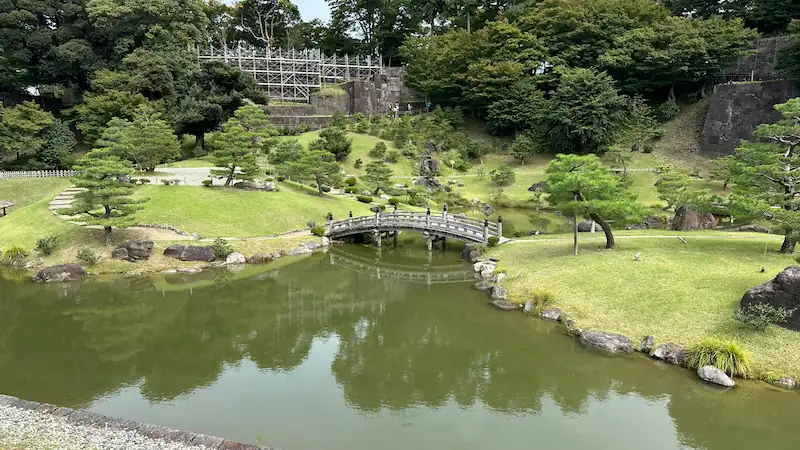
Gyokuseninmaru Garden is a daimyo garden within the castle’s western bailey that was re-created and reopened in March 2015 based on excavations and historical sources. Loved by the Maeda lords from the early 17th century, it fuses garden artistry with castle stonework in a dynamic, three-dimensional composition.
Fed by the Tatsumi Waterworks, the garden is a classic strolling pond garden. The vertical difference from pond bottom to the highest stone tier is about 22 meters. Waterfalls and streams weave through decorative “poem-card” style stonework, with paths that encourage slow exploration as the view evolves.
“Gyokusen-an,” a teahouse overlooking the garden, serves matcha with a seasonal sweet (~¥730). Tea service runs 9:00–16:30, in an architecture tuned to the surrounding landscape.
- Decorative stone walls: Straight and curved courses become ornamental features.
- Water choreography: Streams and falls create a living landscape over time.
- Pond, islands, and paths: Circling reveals new compositions at every turn.
- Borrowed scenery: Stone walls and Sanjikken Nagaya form dramatic backdrops.
- Light-up nights: A “fantasy space” illumination changes every seven minutes.
Panorama Photos
Quick look: ~5 min / In-depth: ~30 min (stonework, features, tea break)
🗺 Address: 1-1 Marunouchi, Kanazawa (inside Kanazawa Castle Park)
🚶 Access: About 5 minutes (≈350 m) from Hishi Yagura / Gojikken Nagaya.
🕰 Hours: Mar 1–Oct 15: 7:00–18:00 / Oct 16–End of Feb: 8:00–17:00
Next: Nezumitamon Gate & Bridge → 2 min walk
| Reopened | March 2015 (Heisei 27) |
|---|---|
| Style | Pond-centered strolling garden |
| Elevation Change | ≈ 22 m (pond bottom to top stone tier) |
| Key Features | Waterfalls & streams, decorative stone walls, garden stones, mounds, islands, walking paths |
| Rest Facility | Gyokusen-an (matcha + wagashi) |
| Admission | Free (garden area) |
| Hours | Mar 1–Oct 15: 7:00–18:00 / Oct 16–End of Feb: 8:00–17:00 |
| Cultural Status | Part of the nationally designated historic site of Kanazawa Castle |
- Name origin: “Gyokusenin” traces to Lady Eihime (Oda Nobunaga’s fourth daughter), wife of Maeda Toshinaga, who later took the name Gyokusen-in.
- Lost and reborn: The garden disappeared in the Meiji era and was revived from buried remains and old drawings.
- “Museum of Stone Walls” concept: The layered masonry is so artful it’s likened to a stonewall museum.
- Three-stage night lighting: Dusk → early night → moonlit scenes.
- Older than Kenrokuen?: Origins date to around 1634, possibly predating Kenrokuen’s formation.
Spot 7: Nezumitamon Gate & Bridge (鼠多門・鼠多門橋)
Black plaster meets timber bridge — the castle’s striking 2020 finale
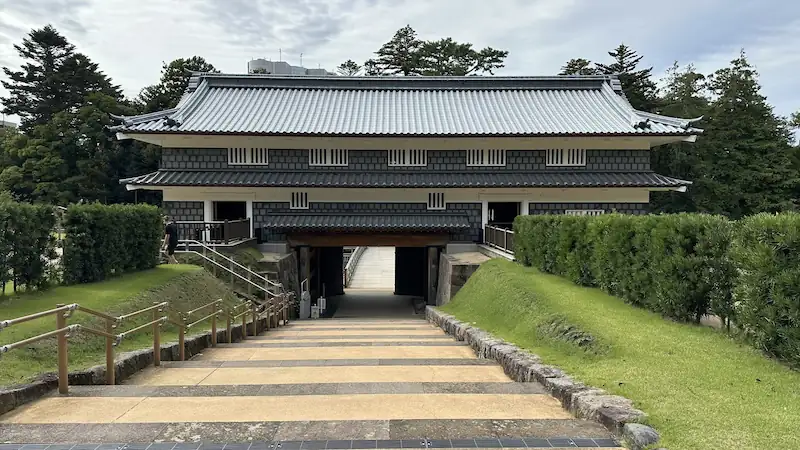
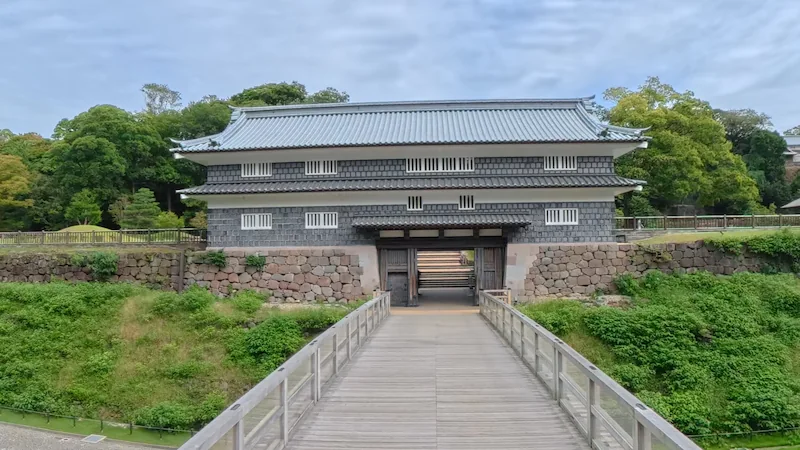
Nezumitamon is a turreted gate on the castle’s west (Gyokuseninmaru side). Historically it linked the Kanaya Demaru (near today’s Oyama Shrine) to Gyokuseninmaru via Nezumitamon Bridge, acting as a key entrance between baileys. The gate existed by the early Edo period and even survived the 1759 fire, but in the Meiji era the gate and bridge were lost and the route vanished from the landscape.
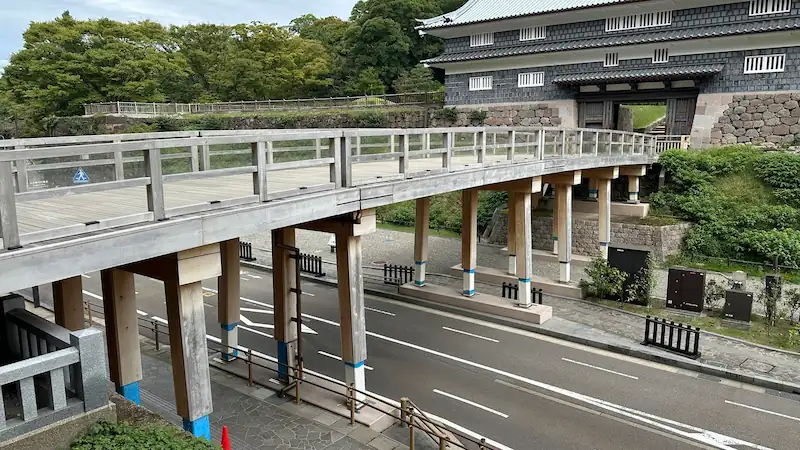
Following research from 2014 onward, the gate and bridge were reconstructed in July 2020, roughly 140 years after their disappearance. The gate’s hallmark is its black namako plaster — a distinctive finish not seen on other gates here. The bridge, the castle’s largest wooden span, uses a hybrid system: traditional timber externally with steel reinforcement inside for seismic safety.
- Black namako plaster: Contrasting black joints define the gate’s unique look.
- Bridge scale: The largest wooden-style bridge in the complex — feel the span and width.
- Interior exhibits: Displays on reconstruction and history, plus shifting viewpoints from the gate.
- Night lighting: Dramatic shadows make for atmospheric evening photos.
- Restored town-to-castle link: A revived pedestrian route between Oyama Shrine, Nezumitamon, Gyokuseninmaru, and the main grounds.
Panorama Photos
Quick look: ~5 min / In-depth: ~15 min (interior and photo spots)
🗺 Address: 1-1 Marunouchi, Kanazawa (inside Kanazawa Castle Park)
🚶 Access: About 2 minutes (≈120 m) from Gyokusen-an.
| Reconstruction Completed | July 18, 2020 (Reiwa 2) |
|---|---|
| Gate Structure & Features | Two-story turreted gate; lead tile roof; white plaster + namako wall; black-plaster joints |
| Bridge Scale/Structure | Largest wooden-style bridge in the castle; timber exterior with internal steel |
| Role | Route linking Oyama Shrine (demaru) to Gyokuseninmaru |
| Restoration Policy | Precise reconstruction based on excavations, drawings, and texts; traditional exterior + seismic inner frame |
| Status | Reconstructed; interior open (free) |
- Why “Nezumi” (mouse/gray)?: Likely named for the gate’s gray-toned plaster finish.
- Back after ~140 years: Its restoration restores the castle’s west entrance sequence.
- Hybrid engineering: Traditional timber exteriors with internal steel for quake resilience.
- A new sightseeing axis: The bridge re-links Oyama Shrine and the castle, enriching walking itineraries.
Back to the Kanazawa Castle Front Page
Frequently Asked Questions
Yes. This model route is designed to cover the 7 must-see highlights efficiently in about 60 minutes. If you enter the paid interior of Hishi Yagura and Gojikken Nagaya or take tea at Gyokusen-an, add 20–30 minutes.
Only the interior of Hishi Yagura, Gojikken Nagaya, and Hashizume-mon Tsuzuki Yagura requires a ticket (adults ¥320, children ¥100, seniors 65+ free). All other spots on this route — gates, gardens, and rest house — are free.
Start at Ishikawa-mon Gate on the Kenrokuen Garden side. It is the most popular entrance, closest to the main bus stops, and designated a National Important Cultural Property — making it the perfect gateway to the castle.
Yes. Each spot in this guide features interactive 360° panorama photos captured on-site, allowing you to virtually experience the castle as if you were standing there. These immersive views are exclusive to Following The Shogun.
The route ends at Nezumitamon Bridge on the castle’s west side, which leads directly toward Oyama Shrine and the samurai district of Nagamachi. From there you can continue exploring Kanazawa’s castle town on foot.
Information on this page is based on on-site research, official publications from Ishikawa Prefecture, and publicly available historical sources. Opening hours, fees, and access conditions are subject to change. We recommend checking the official website before your visit. Some historical interpretations are noted where sources conflict. 360° panorama photos were captured on-site by the author.


comment