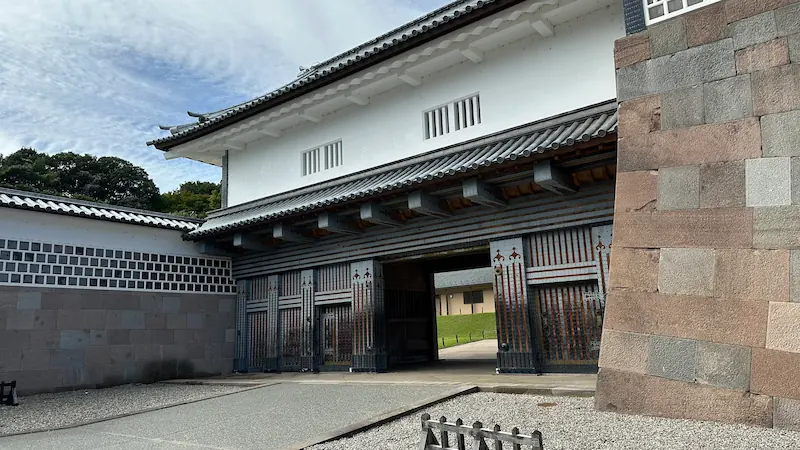
From history you “see” to history you can feel. The political heart, Ninomaru Plaza; the origin point of Kanazawa Castle, the Kanazawa Mido Site; the symbolic Gokuraku Bridge linking Honmaru and Ninomaru; the hands-on interiors of Hishi Yagura · Gojikken Nagaya · Hashizume-mon Attached Turret; and the surviving Important Cultural Property, the Sanjikken Nagaya. On this page, you can tour them all at once in 360° panoramas, immersing yourself in scale, circulation, and fine design details.
Ninomaru Core Area
Ninomaru Plaza (二の丸広場)
Where the lord’s palace once stood — the political heart of the Kaga Domain
The Ninomaru Plaza, the core of Kanazawa Castle, is where the Ninomaru Palace once stood in the Edo period. After the Honmaru Palace was destroyed in the Horeki Great Fire of 1759, the lord’s residence and governmental functions moved here, making this the political center of the Kaga Domain. Today, the plaza has been thoughtfully landscaped to preserve stone walls and plinth forms, opening the space as a lawn where you can sense the scale and layout of the former palace.
At its height, the Ninomaru Palace stretched roughly 90 meters north–south and 70 meters east–west, with the lord’s offices, audience halls, and upper state rooms in sequence. Foundation stones and garden remains have been identified on site. Roof tiles and gilt tiles unearthed during excavations are displayed as artifacts symbolizing the Maeda clan’s prestige.
- Rows of Foundation Stones: Stones outlining former buildings let you grasp the palace footprint on the lawn
- View into the Castle’s Core: Clear sightlines toward Honmaru and Sannomaru reveal the overall structure
- Harmony with Gokuraku Bridge: The lord’s processional route across the bridge and the palace area is legible as a restored historic landscape
- Spring Scene: Cherry trees around Ninomaru and manicured turf create a relaxing seasonal setting

Panorama Photo
Quick look: ~5 min / In-depth: ~15 min
🗺 Address: 1-1 Marunouchi, Kanazawa, Ishikawa (inside Kanazawa Castle Park)
🚶 Access: About a 1-minute walk (≈100 m) from the Former Sixth Brigade Headquarters.
Next: Kanazawa Mido Site → 1 min walk
| Year Established | From 1583 onward, during Maeda Toshiie’s castle construction |
|---|---|
| Builder | Maeda Toshiie (first lord of Kaga Domain) |
| Structure & Features | Palace and garden on leveled high ground; surrounded by stone walls, connected to Honmaru and Sannomaru |
| Current Status | Palace buildings do not survive; grounds, stone walls, and garden space are open to the public |
| Cultural Designation | Part of the National Historic Site “Kanazawa Castle Ruins” |
| Notes | The most formal kuruwa as the lord’s residence and government seat; now the central plaza of the park |
- “Ninomaru Palace” as the Beating Heart: After the Horeki fire, official business, audiences, and ceremonies all took place here.
- Excavation Finds: Gilt tiles, ceramics, and garden remains speak to the grandeur of late-Edo palace culture.
- Stage of Processions: The route from Hashizume-mon to the Ninomaru Palace was designed as a highly formal approach for the lord.
Kanazawa Mido Site (金沢御堂跡)
Where temple became castle — the origin point of Kanazawa Castle itself
Kanazawa Mido was originally a Buddhist temple founded in 1546. As the base of the Kaga Ikko-ikki movement, it functioned as a de facto religious city and stronghold. In 1580, Shibata Katsuie seized the area; Sakuma Morimasa then took up residence and began shaping a fortress on the former temple grounds — launching the site’s transformation into Kanazawa Castle. Today, what remains are primarily topography, archaeological traces, and interpretive signage.
- Where Temple Became Castle: The pivotal site where “Kanazawa Mido” gave way to “Kanazawa-jo”
- Moats & Ramparts Endure: Defensive features from the temple era fed directly into early castle construction
- Foundation for Stonewalls: The terrain later underpinned the development of the castle’s signature stonework

Quick look: ~2 min / In-depth: ~10 min
🗺 Address: 1-1 Marunouchi, Kanazawa (inside Kanazawa Castle Park)
🚶 Access: About a 1-minute, 60-meter walk from Ninomaru Plaza.
Next: Gokuraku Bridge → 1 min walk
| Founded | 1546 (Tenbun 15) |
|---|---|
| Founders | Jodo Shinshu lay followers / base of the Kaga Ikko-ikki |
| Structure & Features | Temple/monastic compound with fort-like traits: moats, earthen ramparts, palisades |
| Transition to Castle | Seized by Shibata Katsuie in 1580 → Sakuma Morimasa initiated castle development |
| Current Status | Temple structures lost; site, signage, and terrain features open to the public |
| Cultural Designation | Within the National Historic Site of the Kanazawa Castle Ruins |
- Temple–Castle Hybrid: Though a religious facility, Kanazawa Mido already had fort-like defenses.
- On the Eve of Maeda Rule: Sakuma Morimasa’s residence here set the stage for Maeda Toshiie’s entry.
- Why Traces Seem Subtle: Because the temple was repurposed into a castle early on, little stands above ground.
Gokuraku Bridge (極楽橋)
The lord’s exclusive span — linking Ninomaru and Honmaru across a 10m-deep moat
Spanning the inner moat, Gokuraku Bridge once linked the lord’s residence at Ninomaru with Honmaru. The “Gokuraku” (Pure Land) name reflects its sacred, serene path leading into the lord’s precinct. The present timber bridge was reconstructed in 2015 based on historical sources. It measures about 20.7 m long and 3.9 m wide, tracing an elegant arc between stone ramparts.
Since the time of Maeda Toshiie, Gokuraku Bridge symbolized Kanazawa Castle itself — codified as a “public ceremonial bridge” used by the lord en route to the Honmaru Palace. Traditional joinery and hardware — such as kasugai clamps and kagami-ita dome fasteners — were faithfully revived.
- Graceful Timber Arc: A flowing curve between moat and stone walls — great for photography
- Traditional Craft: Period joinery and hardware recreated down to the details
- The Lord’s Route: A symbolic span uniting Ninomaru (government) and Honmaru (residence)
- Night Illumination: Reflections on the moat create a dreamlike scene after dark

Panorama Photo
Quick look: ~5 min / In-depth: ~10 min
🗺 Address: 1-1 Marunouchi, Kanazawa (inside Kanazawa Castle Park, south side of Honmaru)
🚶 Access: About a 1-minute walk (approx. 0.4 km) from Kanazawa Mido Site.
Next: Hishi Yagura & Gojikken Nagaya → 2 min walk
| Year Built | Early Edo (first half of 17th c.) / reconstructed in 2015 |
|---|---|
| Builder | Maeda clan (reconstruction by Ishikawa Prefecture) |
| Structure & Features | Timber girder bridge (L ≈ 20.7 m, W ≈ 3.9 m); domestic woods; single-span between stone walls |
| Current Status | Reconstructed pedestrian bridge; open to cross |
| Notes | A lord’s exclusive bridge connecting Ninomaru and Honmaru; the moat below is about 10 m deep |
- Name Origins: “Gokuraku” is a Buddhist term symbolizing serenity — apt for a “pure” approach to the lord’s quarters.
- Pierless Span: A single-span bridge keeps supports out of the water — an Edo-period technical highlight.
- Source-Based Reconstruction: Designed from Edo-period drawings, early photos, and excavated remains.
- Honmaru–Ninomaru Relationship: Crossing the bridge signified authority; ordinary retainers were not allowed to use it.
Hishi Yagura · Gojikken Nagaya · Hashizume-mon Attached Turret
The castle’s signature trio — diamond turret, 90m storehouse, and traditional timber joinery
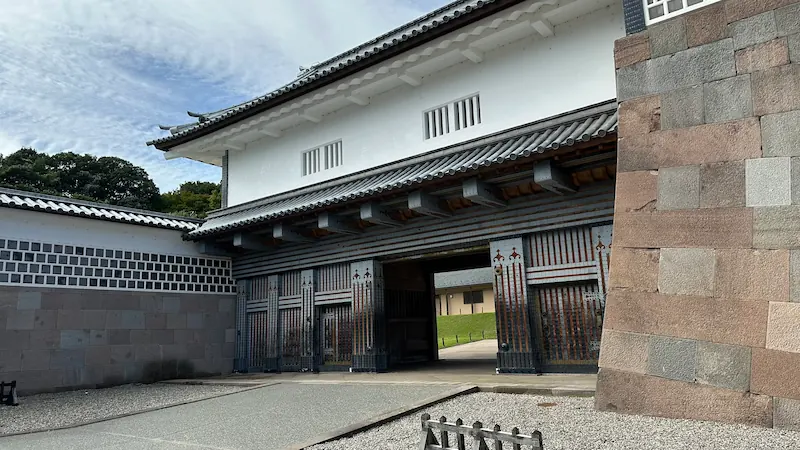
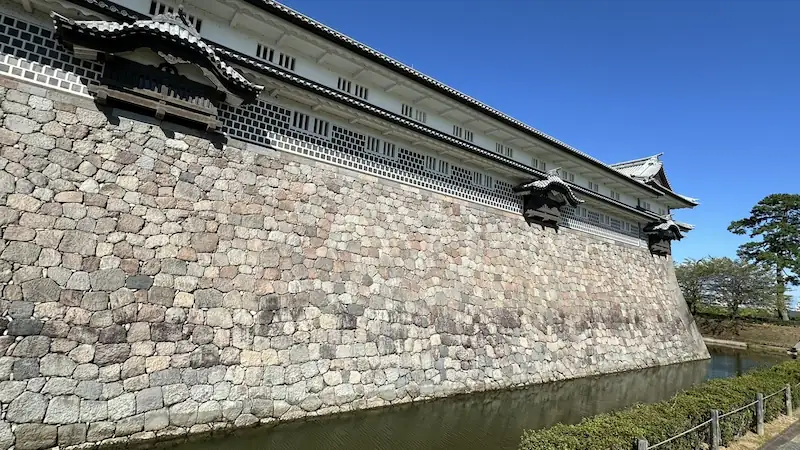
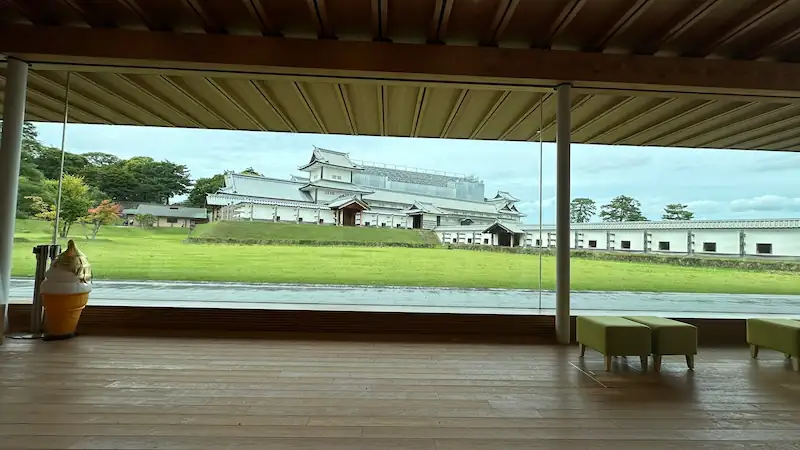
The emblematic trio — Hishi Yagura, Gojikken Nagaya, and the Hashizume-mon Attached Turret — forms an integrated complex. Reconstructed in 2001 from documents and excavations, it ranks among the park’s most notable standing reconstructions. The ensemble links a three-story Hishi Yagura to a two-story Gojikken Nagaya and a three-story attached turret, creating a defensive line for Ninomaru. You can go inside and view the timber construction up close.
- Hishi Yagura’s Diamond Plan: Rare rhombic footprint; even some columns are diamond-section
- Exposed Timberwork: Beams and girders reveal traditional post-and-beam framing and classic joints
- Views from the Attached Turret: A lookout oriented toward the Ninomaru main gate
- Defensive Details: Latticed windows, gun ports, and stone-drop openings speak to wartime readiness
- Fire-Resistant Finish: White plaster, namako tiling, and lead roof tiles
Panorama Photos
Quick look: ~15 min / In-depth: ~40 min (exhibits, models, structure)
🗺 Address: 1-1 Marunouchi, Kanazawa (inside Kanazawa Castle Park)
🚶 Access: About a 2-minute walk (≈120 m) from Gokuraku Bridge.
🎫 Hours & Fees: 9:00–16:30 (last entry 16:00) / Adults ¥320, Children ¥100 (65+ free with ID)
Next: Sanjikken Nagaya → 3 min walk
| Completed | 2001 (Heisei 13) |
|---|---|
| Structure | Hishi Yagura & Attached Turret: timber, 3 stories / Gojikken Nagaya: timber, 2 stories |
| Function | Hishi Yagura: lookout/defense; Gojikken Nagaya: armory & wall; Attached Turret: watchtower over gate forecourt |
| Features | Lattice windows, ishiochi (stone chutes), teppo-zama (gunloops); white plaster & namako walls; lead tiles |
| Hours & Fees | 9:00–16:30 (last entry 16:00) / Adults ¥320, Children ¥100 (65+ free with ID) |
- Three Major Fires & Rebuilds: Burned in 1759, 1808, and 1881; repeatedly rebuilt.
- Entrance Relocated: Since Sept 14, 2022, entry shifted from Hishi Yagura side to Gojikken Nagaya side.
- Continuous Interior Route: Passages connect all three buildings as one sequence.
- Largest Post-Meiji Reconstruction: Among Japan’s largest modern-era timber castle reconstructions, taking 3 years 4 months.
Sanjikken Nagaya (三十間長屋)
Surviving Edo-era gunpowder storehouse — 54m of white walls and lead tiles atop the rampart
The Sanjikken Nagaya is a two-story tamonyagura rebuilt in the late Edo period (1858–1860). Designated a National Important Cultural Property in 1957, it served as a storehouse for arms and gunpowder during domain rule. Thick plaster walls and lead tiles provide fire resistance; the straight white wall running atop the rampart is stunning — one of Kanazawa Castle’s most iconic views.
Visiting: Exterior only by default. During special openings, the interior is open on weekends and holiday periods from April to November, typically 9:30–15:30 (varies by year).
- Sleek White Walls: The long, straight white facade atop stone ramparts embodies Kanazawa’s calm aesthetic
- Peak Fireproofing: Thick earthen walls and a lead-tiled roof protected the gunpowder stores
- Balanced Proportions: Evenly spaced posts and small windows create a rhythmic, almost modernist cadence
- Night Lighting: At night, lit white walls and dark tiles form a striking chiaroscuro

Panorama Photos
Quick look: ~5 min (exterior) / In-depth: ~20 min (interior viewing)
🗺 Address: 1-1 Marunouchi, Kanazawa (inside Kanazawa Castle Park)
🚶 Access: About a 3-minute walk (≈180 m) from Gojikken Nagaya.
| Year Built | Rebuilt in late Edo (Ansei 5–Man’en 1, 1858–1860) |
|---|---|
| Builder | Maeda clan, Kaga Domain |
| Structure & Features | Two stories; irimoya (hip-and-gable) roof; lead tiles; total length ≈54 m; fire-resistant earthen-walled construction |
| Current Status | Extant |
| Cultural Designation | Important Cultural Property (designated 1950) |
| Notes | One of three Edo-period structures surviving at Kanazawa Castle (others: Ishikawa-mon and Tsurumaru Storehouse) |
- Name Origin: From its “thirty ken” (≈54 m) length; measured length is about 29.5 ken (≈53.6 m).
- A Near-Miraculous Survivor: Escaped the Horeki fire, preserving an Edo-period profile today.
- Changing Uses: Gunpowder store in domain times → army storehouse in Meiji → preserved as heritage after the war.
- Interior Structure: A single open space with regularly arrayed beams and posts — viewable only during special openings.
Next Page
Previous Page
Back to the Table of Contents
Information on this page is based on on-site research, official publications from Ishikawa Prefecture, and publicly available historical sources. Opening hours, fees, and access conditions are subject to change. We recommend checking the official website before your visit. 360° panorama photos were captured on-site by the author.

comment