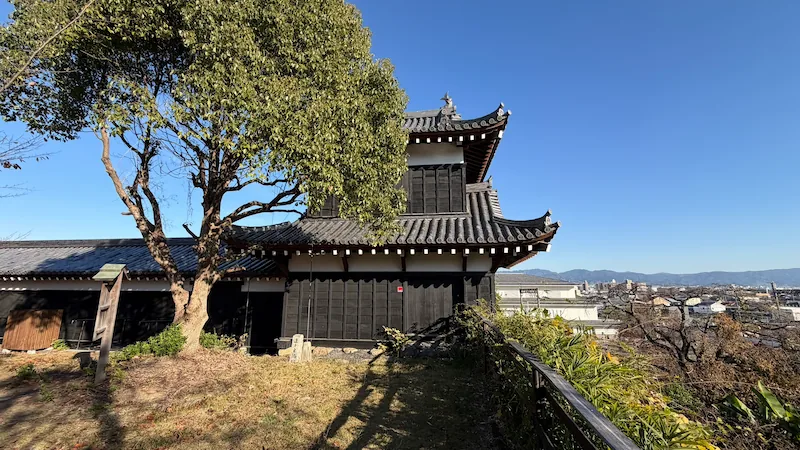
Toyotomi Hidenaga — the protagonist of the 2026 NHK Taiga Drama Toyotomi Brothers! — made Yamato Koriyama Castle his base of power. At the castle ruins where he governed, the exhibition “Hidenaga and the History of Koriyama” is currently on display in the Higashi Tamon Turret, a structure not normally open to the public. With over 300 archaeological artifacts spanning the Yayoi period through the early modern era, it is a richly rewarding exhibition. This article covers the highlights from an actual visit, along with practical information on admission, hours, and how to get there.
What this article covers: · Admission, dates, and opening hours · Access by train and car, with parking details, from Kintetsu Koriyama Station and JR Koriyama Station · How to find the Higashi Tamon Turret within the castle ruins · Highlights of the five-chapter exhibition, with photos · Tips for combining this with the Taiga Drama Museum
- Exhibition “Hidenaga and the History of Koriyama” — Essential Information
- Getting There — By Train and Car
- Finding the Higashi Tamon Turret — Navigating the Castle Ruins
- Exhibition Highlight ① — Prologue: “The Yamato Dainagon” Hidenaga — Demon Roof Tile and Portraits
- Exhibition Highlight ② — Chapters 1 & 2: Koriyama Before Hidenaga, from the Yayoi Period to the Sengoku Era
- Exhibition Highlight ③ — Chapters 3–5: The Castle and Castle Town Hidenaga Built
- Visitor Tips — Best Combined with the Taiga Drama Museum
Exhibition “Hidenaga and the History of Koriyama” — Essential Information
| Dates | January 22, 2026 – January 31, 2027 |
|---|---|
| Hours | 10:00 AM – 5:00 PM (last admission 4:30 PM) |
| Admission | General: ¥300 |
| Venue | Higashi Tamon Turret (within the Koriyama Castle Ruins Historic Site) ※ For access and parking details, see the “Full Visitor Information” section at the end of this article |
※ For the latest closure information, please check the Yamato Koriyama City official website
Getting There — By Train and Car
By train:
· Kintetsu Koriyama Station (Kintetsu Kashihara Line) — approximately 10 minutes on foot
· JR Koriyama Station (JR Kansai Main Line / Yamatoji Line) — approximately 20 minutes on foot
※ From Osaka Namba: approximately 37 minutes by Kintetsu (change at Yamato-Saidaiji). From Kyoto Station: approximately 37 minutes by Kintetsu Limited Express (change at Yamato-Saidaiji).
By car:
· Approximately 6.5 km (about 14 minutes) from the Koriyama IC on the Nishi-Meihan Expressway
· A free parking lot is available in front of the Bairin-mon gate (limited spaces)
· The Koriyama Castle Information Hall parking lot (free) is also available
· If those are full, the Sannomaru parking lot (paid) and the DMG MORI Yamato Koriyama Castle Hall parking lot (first 2 hours free, then ¥500; 170 spaces) are convenient alternatives
From Kintetsu Koriyama Station, head north from the exit and you’ll reach the castle ruins in about 10 minutes. By car, the free lot in front of the Bairin-mon gate is the most convenient option, but spaces are limited — arriving early is recommended on weekends.
From the Taiga Drama Museum:
· The Drama Museum is held at the DMG MORI Yamato Koriyama Castle Hall. Although the turret is visible from there, the route requires a detour — you’ll need to head back toward the station, cross the level crossing, and walk around to the castle ruins entrance. Allow approximately 10 minutes on foot.

Finding the Higashi Tamon Turret — Navigating the Castle Ruins
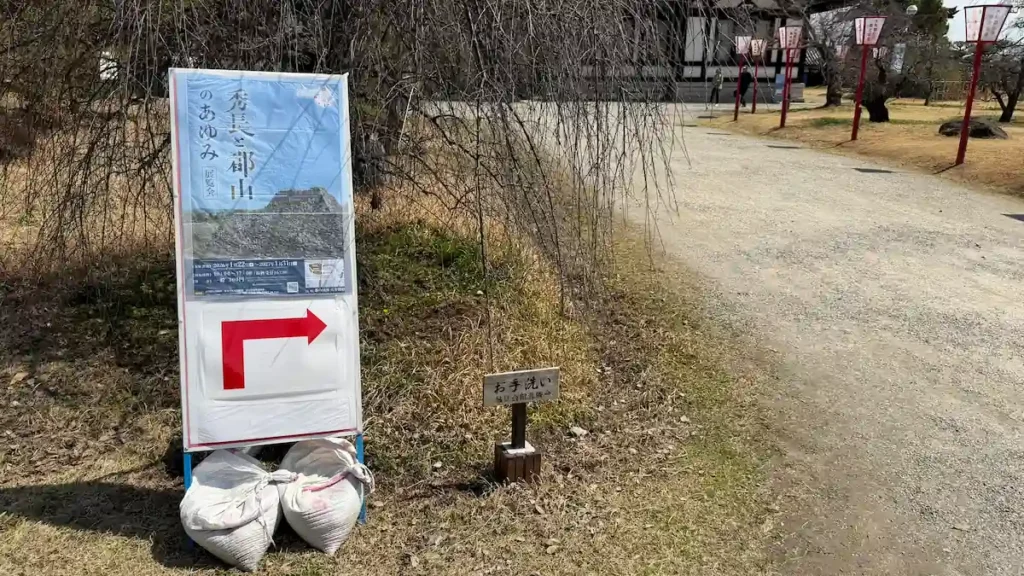
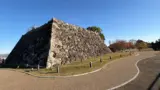
Enter through the Ōtemon gate and the Higashi Tamon Turret is a short walk in. Navigation is straightforward — exhibition signs for “Hidenaga and the History of Koriyama,” featuring a design of blue skies and stone walls, are posted throughout the grounds. Follow them and you’ll arrive without difficulty. From the Ōtemon entrance, pass the Jōshi Kaikan building and continue to the right — the turret is at the far end.
The Higashi Tamon Turret is a reconstructed turret within the Koriyama Castle Ruins Historic Site, opened as a gallery space for the duration of the exhibition. A large sign marks the entrance, so it’s immediately recognizable.
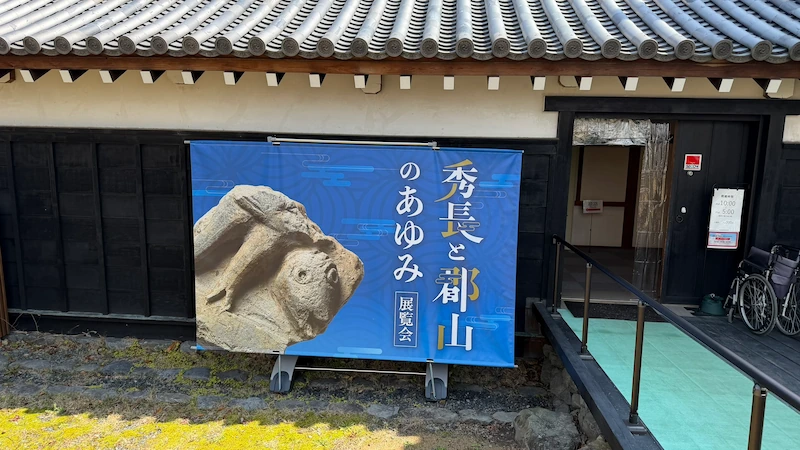
Exhibition Highlight ① — Prologue: “The Yamato Dainagon” Hidenaga — Demon Roof Tile and Portraits
The exhibition is organized into five chapters. The prologue puts Toyotomi Hidenaga himself at center stage — the same figure who is the protagonist of the current Taiga Drama.
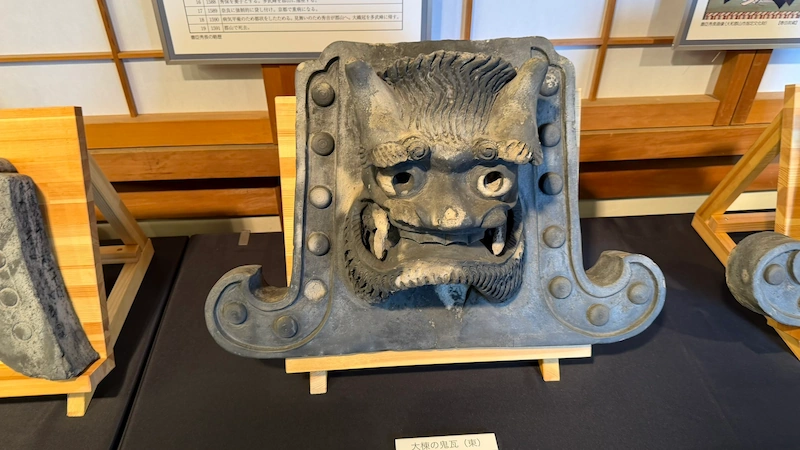
The first thing you encounter at the entrance is an onigawara — a demon-face roof tile — from the main hall of Shungakuin Temple, Hidenaga’s family memorial temple. (Onigawara are a traditional Japanese architectural element placed at the ridge ends of tiled roofs, combining a protective function with a decorative one; the demon face is meant to ward off evil.) The label identifies it as the “East Ridge Demon Tile.” The expression is fierce and somehow slightly absurd at the same time — it carries the weight of all the years it spent on that rooftop, and it stops you before you’ve fully stepped inside.
Beyond it, two portrait reproductions of Hidenaga are on display. One is the well-known image; the other I hadn’t encountered before. Standing in front of them — the historical Hidenaga, not the televised one — is a different kind of encounter. The display traces his life clearly: born in Owari, fighting alongside his brother Hideyoshi across the country, entering Yamato Koriyama, and dying there. One person’s life, laid out with care.
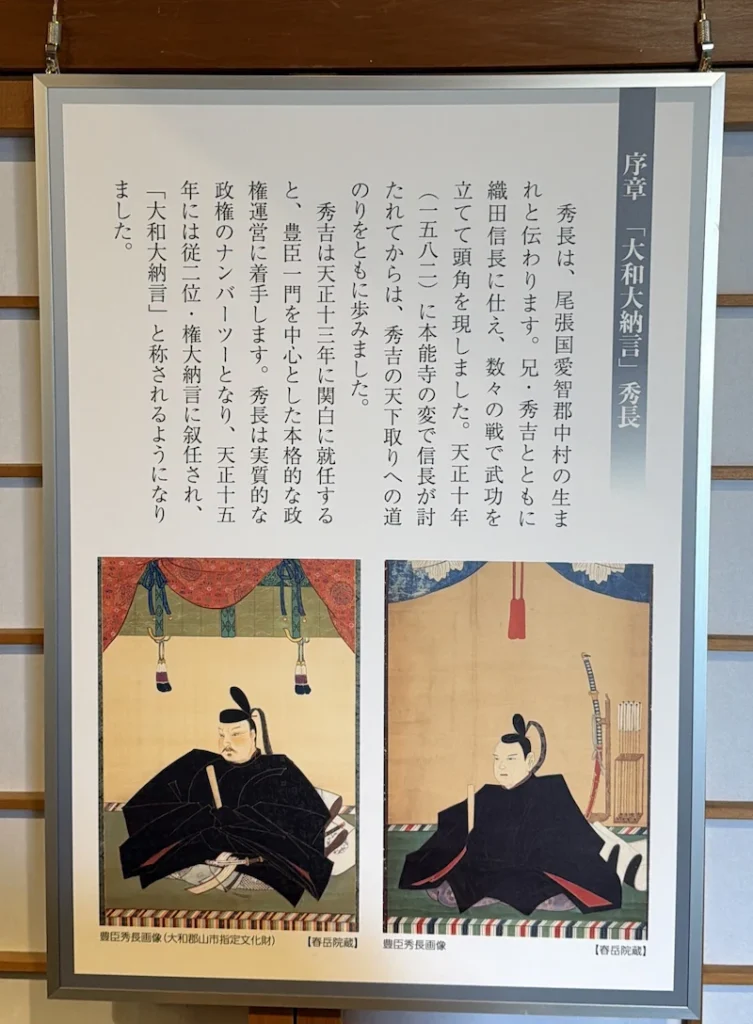
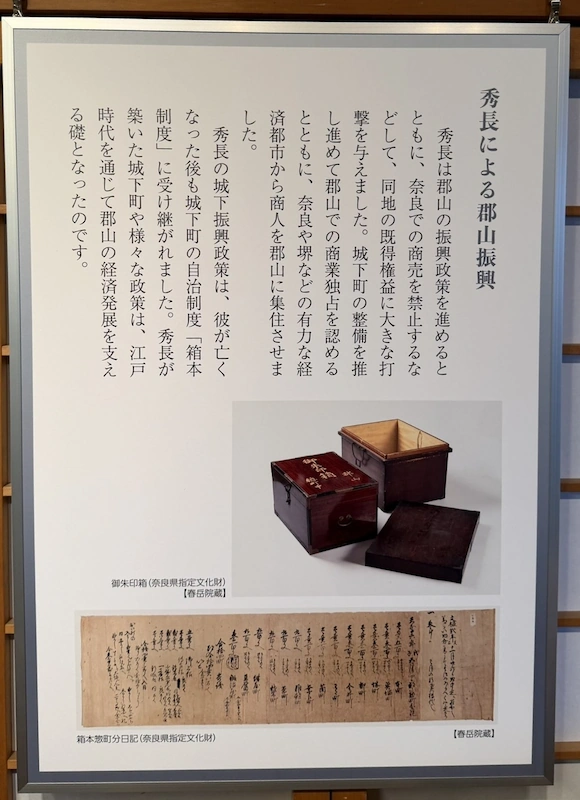
The prologue also covers the ink-seal box and an extensive diary preserved at Shungakuin Temple, with introductions to Hidenaga’s burial mound (the Dainagon-zuka) and the temple itself. It’s a section that shows how the people of Koriyama have remembered and honored Hidenaga — which, for a figure this central to the city’s history, is a story worth knowing before you walk the ruins.
Exhibition Highlight ② — Chapters 1 & 2: Koriyama Before Hidenaga, from the Yayoi Period to the Sengoku Era
What gives this exhibition more depth than a typical drama tie-in display is that it doesn’t stop at Hidenaga. Chapter 1, “The Dawn of Koriyama,” and Chapter 2, “On the Eve of Koriyama Castle,” trace the history of the area from the Yayoi period (roughly 300 BCE to 300 CE) through the Muromachi and Sengoku periods, with excavated artifacts throughout.
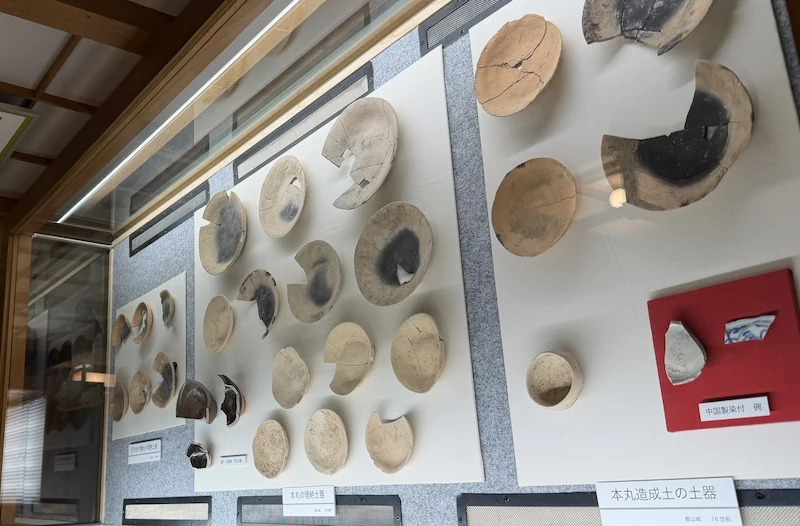
The Yayoi and Kofun period pottery — chipped at the rim, simple in form — is a reminder that people were living on this land long before there was a castle, a warlord, or a television drama about either. The human presence here predates Hidenaga by nearly two thousand years.
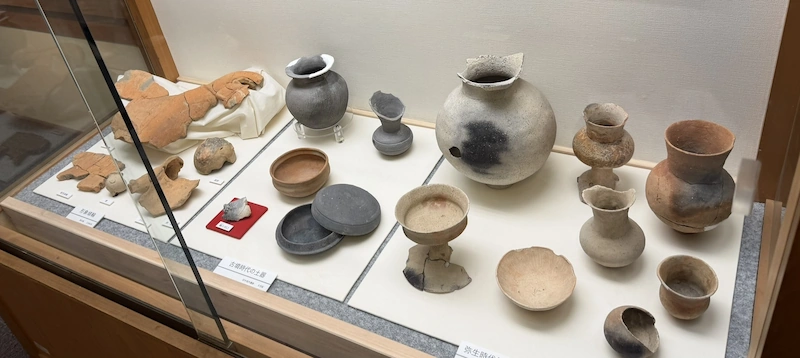
According to the exhibition catalogue, the collection includes Yayoi pottery from the Tanaka Kaito site, haniwa clay funerary figures from the Hiraki tomb, Wadōkaichin coins (Japan’s first officially minted currency, issued in 708 CE) from the eastern drainage ditch of the Shimotsu Road, an inkstone and bronze bells from sites south of the ancient Heijō-kyō capital, and lacquer containers, inkstones, and stone-belt blanks from the presumed site of the Nara Western Market. The catalogue’s claim of over 300 objects is well earned — the collection is genuinely broad. Chapter 2 extends into the Heian, Muromachi, and Sengoku periods, with sue ware and imported Chinese porcelain from the moat of Tsutsui Castle, iron bullets, and a bronze tea caddy lid among the exhibits. The conflicts between the Tsutsui clan and the warlord Matsunaga Hisahide are covered here — making clear that by the time Hidenaga arrived, the ground of Koriyama had already absorbed centuries of intense political and military history.
Exhibition Highlight ③ — Chapters 3–5: The Castle and Castle Town Hidenaga Built
On September 3, Tenshō 13 (1585), Hashiba Hidenaga entered Koriyama Castle with his brother Hideyoshi and 5,000 soldiers. This moment — which the Taiga Drama will almost certainly depict — was a turning point in Koriyama’s history. From that point, Koriyama Castle was developed on a substantial scale as the Toyotomi regime’s administrative center for the Kinai region, and the city’s foundational structure — the castle and castle town Hidenaga built — outlasted the Toyotomi clan itself and became the basis of modern Yamato Koriyama.
Chapter 3, “Hidenaga and Koriyama Castle,” covers the castle’s structure in detail — the layout of the compounds, the organization of the defensive system, and how the castle connected to the surrounding town. Seeing this before walking the ruins means the stone walls and topography make immediate sense in a way they otherwise wouldn’t.
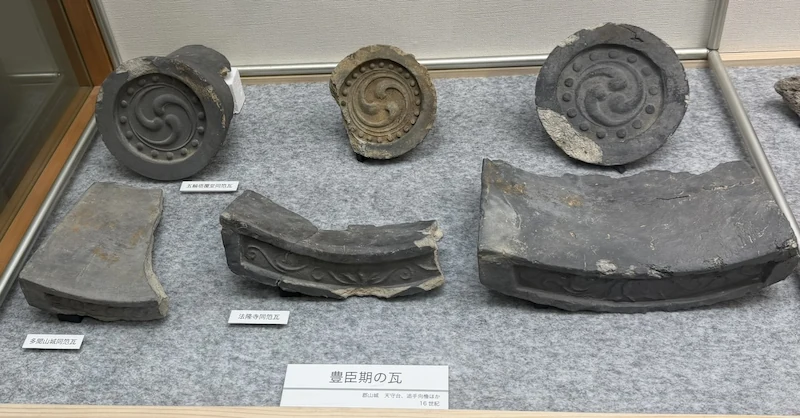
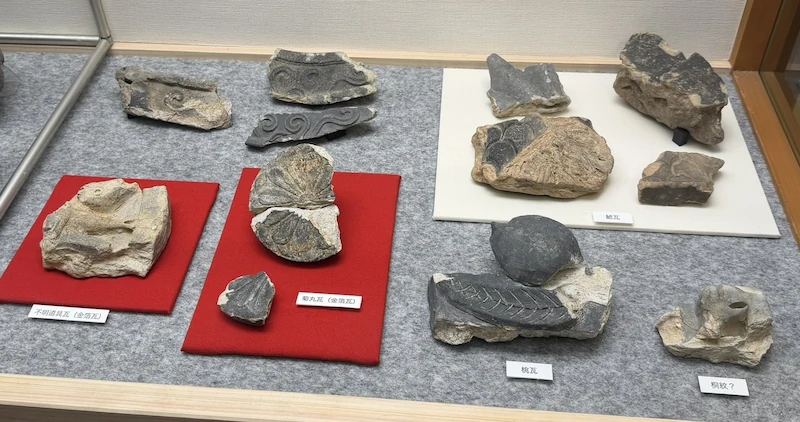
Chapter 4, “The Stone Walls of Koriyama Castle,” covers the repurposed materials incorporated into the castle keep platform’s walls — stone Buddha figures, stone pagodas, and stone millstones used as building material. The fact that religious and funerary stonework was built into the castle walls speaks to both the scale and the urgency of the construction Hidenaga was driving.
Chapter 5, “The Flourishing of Early Modern Koriyama,” is where the daily life of the castle town comes into view — ceramic and porcelain fragments, sword fittings (tsuba and seppagane), glassware, wooden brushes, and bellows nozzles (tuyères) from metalworking operations. This is not only the story of a warlord: it is the story of the people who lived and worked in the town he built. The texture of those lives, preserved in the objects they used and left behind, is one of the most quietly compelling parts of the exhibition.
Visitor Tips — Best Combined with the Taiga Drama Museum
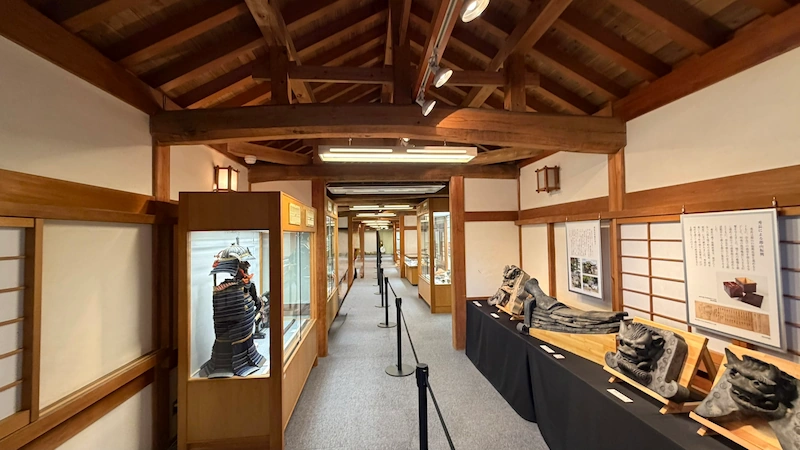
This exhibition works best as part of a combined visit with the Taiga Drama Museum. After the Drama Museum has brought Hidenaga to life as a character, tracing his history and the city he built through the artifacts at the Higashi Tamon Turret gives that engagement a different kind of depth — what the drama introduced, the exhibition grounds in something more specific and lasting. The two venues are close enough to cover in a single day, and it would genuinely be a shame to leave Yamato Koriyama without making the short additional walk to see both.
· Photography is permitted throughout the exhibition — feel free to photograph whatever catches your attention
· Free admission for middle school students and younger
· Allow 30 minutes to 1 hour for a complete visit
· Some exhibits rotate between early and late periods (marked ☆ for early, ★ for late in the exhibition catalogue)
· Parts of the castle grounds are unpaved — comfortable walking shoes are recommended
I originally stopped by the Higashi Tamon Turret on a chance mention I’d overheard at Shungakuin Temple — and it turned out to be the most significant discovery of the day. Following an offhand piece of information into a place you hadn’t planned to visit, and finding that the history there opens up in a way you didn’t expect — that’s the kind of thing that happens in Yamato Koriyama.
FAQ
Q. How long is the Higashi Tamon Turret open to visitors?
A. It is open only for the duration of the “Hidenaga and the History of Koriyama” exhibition (until January 31, 2027). There are currently no plans for public access after the exhibition closes.
Q. Is this the same venue as the Taiga Drama Museum?
A. No — they are separate. The Taiga Drama Museum is at the DMG MORI Yamato Koriyama Castle Hall; this exhibition is in the Higashi Tamon Turret within the castle ruins. The walk between them is approximately 10 minutes.
Q. Is photography permitted inside?
A. Yes — photography is freely permitted throughout the exhibition.
Q. How long should I allow for the visit?
A. Plan for 20–40 minutes at a moderate pace. Reading the exhibit labels carefully and spending time with the collection can extend the visit to around an hour.
Q. Does the exhibition change between early and late periods?
A. Yes — some exhibits rotate. Items marked ☆ are on display in the early period; items marked ★ are in the late period. The exhibition catalogue notes these distinctions.
Exhibition “Hidenaga and the History of Koriyama” — Full Visitor Information
| Exhibition | Hidenaga and the History of Koriyama |
|---|---|
| Dates | January 22, 2026 – January 31, 2027 |
| Hours | 10:00 AM – 5:00 PM (last admission 4:30 PM) |
| Closed | Generally open daily (closed year-end/New Year and on Taiga Drama Museum closure days) |
| Admission | General: ¥300 (free for middle school students and younger) |
| Venue | Higashi Tamon Turret (within the Koriyama Castle Ruins Historic Site) 253-2 Shironai-cho, Yamato Koriyama, Nara |
| Access | Approx. 10 minutes on foot from Kintetsu Koriyama Station / Approx. 15 minutes from JR Koriyama Station By car: approx. 14 minutes from the Koriyama IC on the Nishi-Meihan Expressway |
| Parking | Bairin-mon Gate parking lot (free; limited spaces) Koriyama Castle Information Hall parking lot (free) DMG MORI Yamato Koriyama Castle Hall parking lot (first 2 hours free; 170 spaces) |
| Official page | Yamato Koriyama City official website(Japanese Only) |
Further Reading
The 2026 Taiga Drama Museum for Toyotomi Brothers! in Yamato Koriyama.
A complete guide to the Yamato Koriyama Castle Ruins.
Hidenaga-related sites in Yamato Koriyama.
Places connected to Toyotomi Hidenaga.



comment