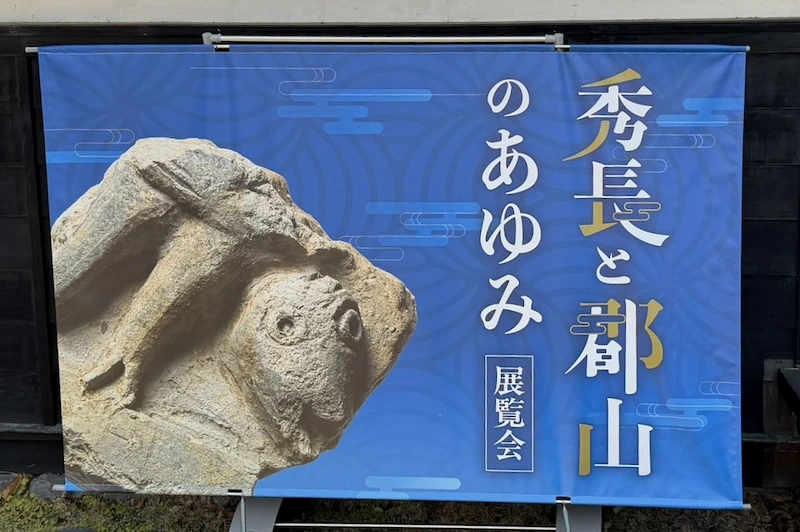
If a volunteer guide at Shungakuin Temple hadn’t mentioned it — “The onigawara demon-face roof tiles they removed during repairs are on display right now, up in one of the castle turrets” — I might never have discovered this exhibition at all.
It happened on my way back from the Taiga Drama Museum. I’d stopped by Shungakuin, the temple where Toyotomi Hidenaga is laid to rest, and while hearing about the recent restoration of the main hall, I asked what had become of the original roof tiles. The guide pointed me toward the Higashi Tamon Turret inside the castle grounds — a structure normally closed to the public, but specially opened as the venue for the “Hidenaga and the History of Koriyama” exhibition.
Admission was just ¥300 (about $2 USD). Inside, I found more than 300 archaeological artifacts arranged in careful order, spanning from the Yayoi period (roughly 300 BC–300 AD) through the Toyotomi era. Roof tiles that Hidenaga himself may have gazed upon. Earthenware vessels he may have held. Far from the spectacle of the Taiga Drama Museum, this was a different kind of encounter — quiet, unhurried, layered with the weight of centuries.
| Dates | January 22, 2026 – January 31, 2027 |
|---|---|
| Hours | 10:00 AM – 5:00 PM (last entry at 4:30 PM) |
| Admission | ¥300 for adults (free for junior high school students and younger) |
| Venue | Higashi Tamon Turret (within the Koriyama Castle ruins, a nationally designated historic site) ※ For detailed access and parking information, see the “Exhibition Details” section at the end of this article |
※ For the latest information on closure days, please check the official Yamatokoriyama City website (Japanese)
・Admission, exhibition dates, and opening hours
・A recommended route: Taiga Drama Museum → Shungakuin Temple → Higashi Tamon Turret → Castle ruins walk
・Directions to the Higashi Tamon Turret within the castle grounds
・Highlights from all five exhibition chapters (with photos)
・What it’s actually like inside the turret — a space you can only experience by stepping through the door
・How this exhibition compares with the Taiga Drama Museum, and why you should visit both
- Getting There — By Train and By Car
- The Best Way to Visit — From the Taiga Drama Museum to Higashi Tamon Turret
- Finding the Higashi Tamon Turret — Navigating the Castle Grounds
- Stepping Inside — A Surprisingly Bright Exhibition Space
- Exhibition Highlights ① — Prologue: “The Great Lord of Yamato” — Onigawara Roof Tiles and Portraits from Shungakuin Temple
- Exhibition Highlights ② — Chapters 1 & 2: From the Yayoi Period to the Sengoku Era — Koriyama Before Hidenaga
- Exhibition Highlights ③ — Chapters 3–5: The Castle and Castle Town That Hidenaga Built
- How Does It Compare with the Taiga Drama Museum? — Why You Should See Both
- A Word of Thanks to the Guide at Shungakuin — When a Chance Encounter Becomes the Best Discovery of the Day
Getting There — By Train and By Car
【By Train】
・Kintetsu Koriyama Station — about 10 minutes on foot (Kintetsu Kashihara Line)
・JR Koriyama Station — about 20 minutes on foot (JR Kansai Main Line / Yamatoji Line)
※ Approximately 37 minutes from Osaka-Namba Station via Kintetsu (transfer at Yamato-Saidaiji), or 37 minutes from Kyoto Station via Kintetsu limited express (transfer at Yamato-Saidaiji)
【By Car】
・About 6.5 km (approximately 14 minutes) from the Koriyama IC on the Nishi-Meihan Expressway
・Free parking is available in front of the Bairinmon Gate (limited spaces)
・The Koriyama Castle Information Center parking lot (free) is also available
・If those are full, try the Sannomaru parking lot (paid) or the Yamato Koriyama Castle Hall parking lot (free for 2 hours, then ¥500; 170 spaces)
From Kintetsu Koriyama Station, head straight north from the station exit and you’ll reach the castle grounds in about 10 minutes. If you’re driving, the free lot in front of the Bairinmon Gate is the most convenient option, but spaces are limited — arriving early on weekends is a good idea.
【From the Taiga Drama Museum】
From the “DMG MORI Yamato Koriyama Castle Hall,” where the Taiga Drama Museum is housed, you can actually see the castle turrets in the distance — but reaching them requires a roundabout route back toward the station and across the railroad crossing, a walk of about 10 minutes. It looks deceptively close, yet that short journey serves a purpose: it gives you time to shift gears from the lively buzz of the museum to the quiet stillness of the castle grounds.
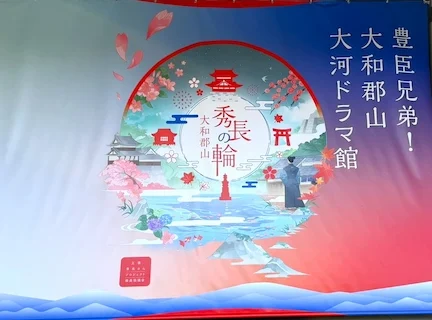
The Best Way to Visit — From the Taiga Drama Museum to Higashi Tamon Turret
The route I followed was: Taiga Drama Museum → Shungakuin Temple → Higashi Tamon Turret → Castle ruins walk. Having done it, I’m convinced this is the ideal order.
Start at the Taiga Drama Museum to build your curiosity about who Hidenaga was. Then visit Shungakuin Temple, where you’ll stand at the very place where he was laid to rest. With that context fresh in your mind, the exhibition at Higashi Tamon Turret transforms book knowledge into something visceral and real. And when you walk the castle grounds afterward, the stone walls and terrain take on entirely new meaning.
❶ Taiga Drama Museum (DMG MORI Yamato Koriyama Castle Hall) — approx. 60 minutes
❷ Shungakuin Temple (Hidenaga’s memorial temple) — approx. 20–30 minutes ※ The volunteer guides here are well worth your time
❸ Higashi Tamon Turret — “Hidenaga and the History of Koriyama” Exhibition — approx. 30 minutes to 1 hour
❹ Castle Ruins Walk (castle tower base, stone walls, Gokuraku Bridge, etc.) — approx. 30–40 minutes
※ The Taiga Drama Museum can get crowded, but the Higashi Tamon Turret is relatively quiet even on weekends. The calm atmosphere is part of the appeal.
Many visitors leave after seeing only the Taiga Drama Museum, and that’s a real shame. Just 10 minutes on foot and ¥300 further lies an exhibition that reveals what the TV drama can never fully capture — the physical memory of the place where Hidenaga actually lived.
Finding the Higashi Tamon Turret — Navigating the Castle Grounds
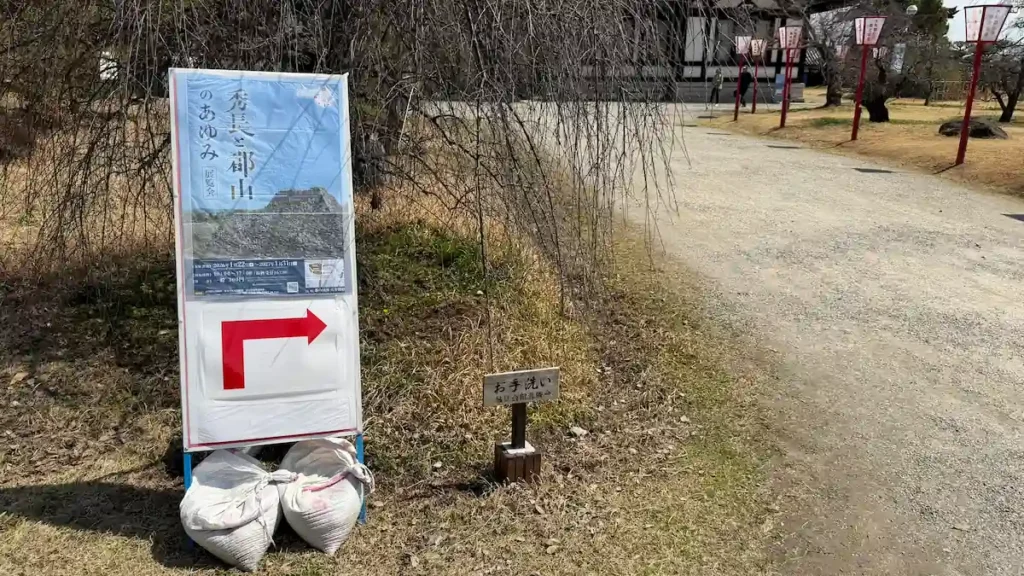
Once you enter Yamato Koriyama Castle through the Otemon (main gate), the Higashi Tamon Turret is tucked slightly deeper within the grounds. Don’t worry about getting lost, though. Blue signboards featuring an illustration of stone walls against a wide sky — the exhibition’s visual identity — are posted throughout the castle site. Follow the red arrows on these signs and you’ll arrive without trouble. From the Otemon, walk past the Castle Site Hall and continue toward the far right.
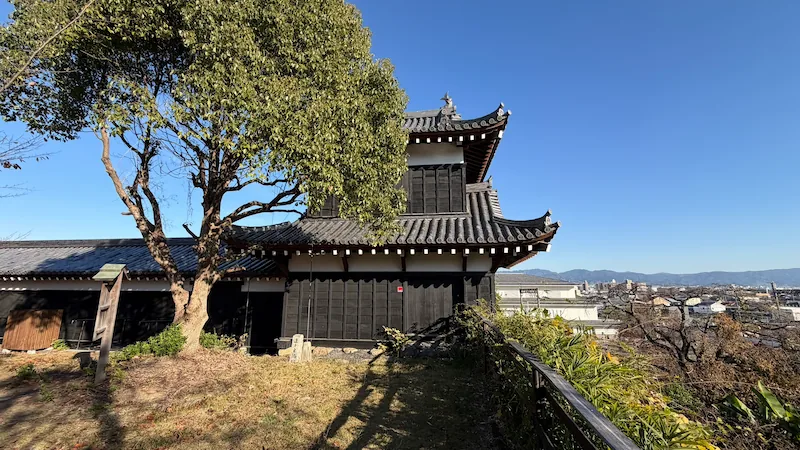
The Higashi Tamon Turret is a wooden reconstruction completed in 1984. Normally, the interior is closed to the public, but for the duration of this exhibition it has been specially opened as a gallery space. A large banner at the entrance makes it easy to spot.
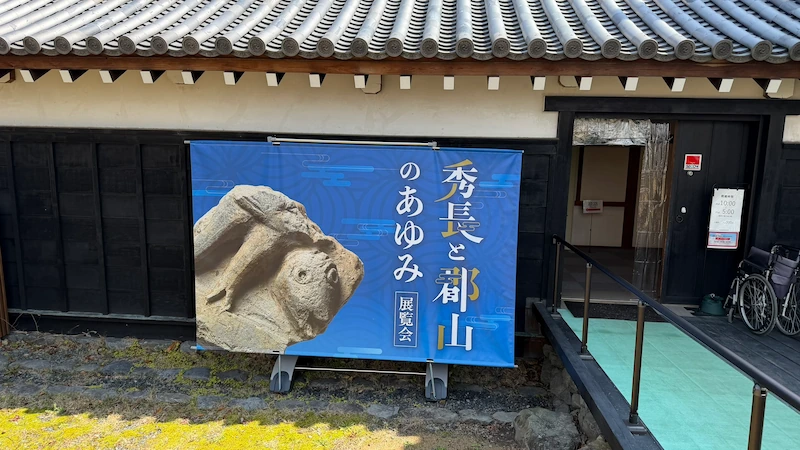
Stepping Inside — A Surprisingly Bright Exhibition Space
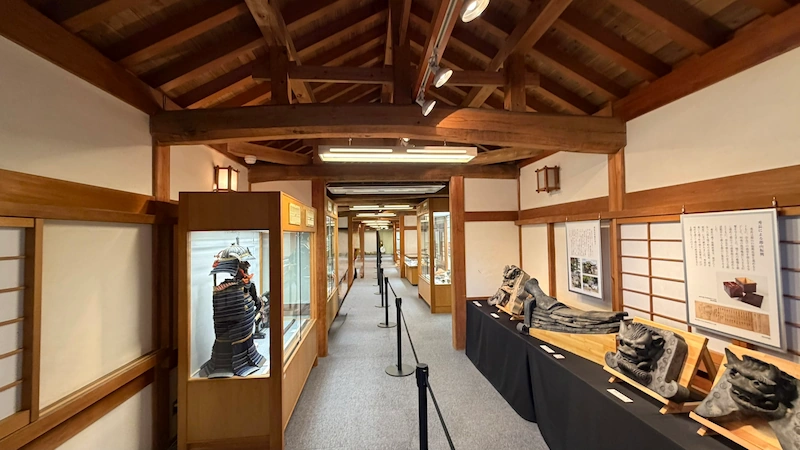
When you hear “inside a castle turret,” you probably picture a dim, musty wooden interior. I certainly did. But the reality was nothing like that. The space was far brighter and more open than I’d expected. Fluorescent lighting illuminated every display case clearly, and climate control kept the air fresh and comfortable — more like a modern museum than a centuries-old fortification.
You can also walk in wearing your shoes, which is a welcome touch. (In Japan, many historic buildings require visitors to remove footwear at the entrance.) Compared to turrets I’ve visited at other castles, this one has been outfitted with a notably modern, accessible interior — comfortable for families with children and elderly visitors alike.
I visited on a weekend, and the contrast with the bustling Taiga Drama Museum was striking. Inside the turret, it was quiet and calm — the kind of space where you can take your time with each display and absorb what’s in front of you. For the quality and quantity of what’s on show, ¥300 is an extraordinary bargain.
Exhibition Highlights ① — Prologue: “The Great Lord of Yamato” — Onigawara Roof Tiles and Portraits from Shungakuin Temple
The exhibition is organized into five chapters. The prologue shines a spotlight on Toyotomi Hidenaga himself — the central figure of the 2026 NHK Taiga Drama series Toyotomi Brothers!
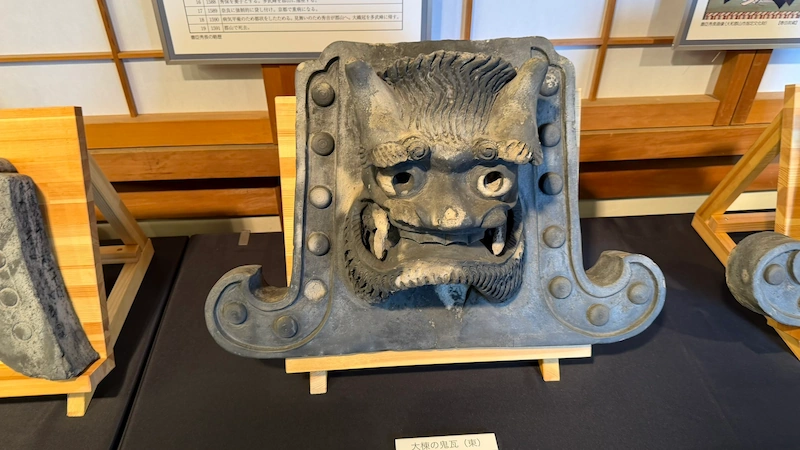
The first thing that catches your eye upon entering is a massive onigawara — a fearsome demon-face roof tile — from the main hall of Shungakuin Temple. The label reads “Ridge-end onigawara (east).” This was the very tile the temple guide had told me about: the one removed during the recent restoration. Having just visited the temple and heard the story firsthand, it no longer felt like a museum artifact behind glass. It felt like a living relic — something that had been perched on a rooftop enduring wind and rain until very recently. The demon’s expression is fierce yet faintly humorous, and you can sense the long years it spent watching over the temple from above.
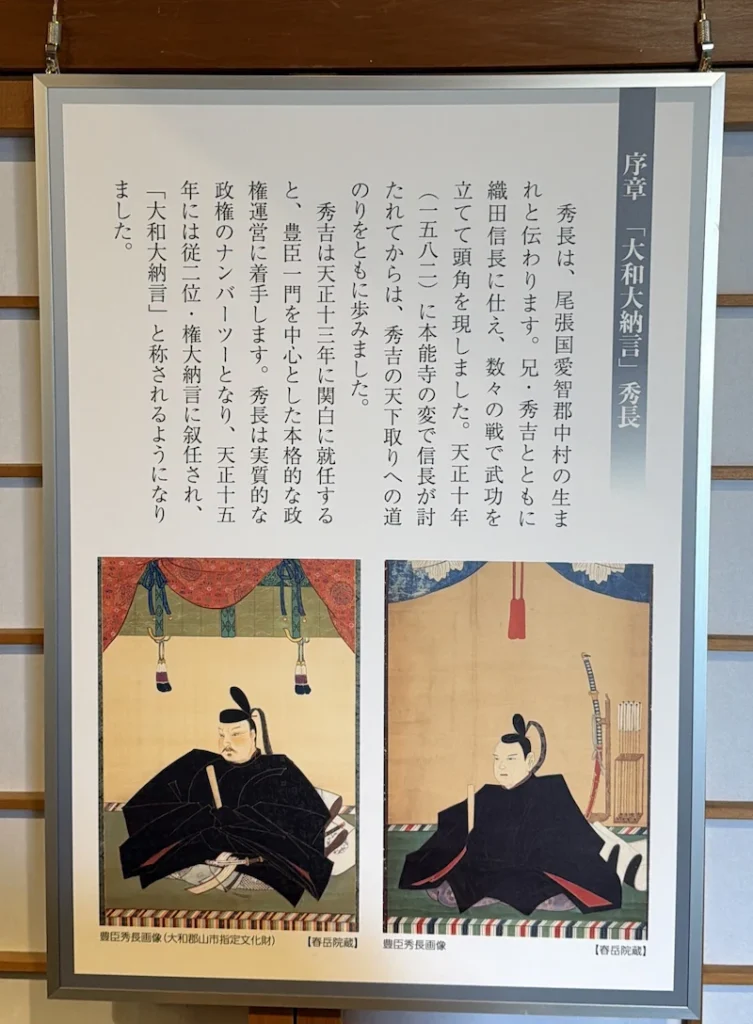
Next come two portrait reproductions of Hidenaga. One is the well-known image; the other was new to me. They present a Hidenaga quite different from the one being portrayed in the TV drama — a figure rooted in documented history rather than dramatic narrative. Born in Owari Province (present-day western Aichi Prefecture), he fought alongside his elder brother Hideyoshi across the country before eventually settling in Yamato Koriyama, where he spent his final years. His life story is presented here with careful, understated detail.
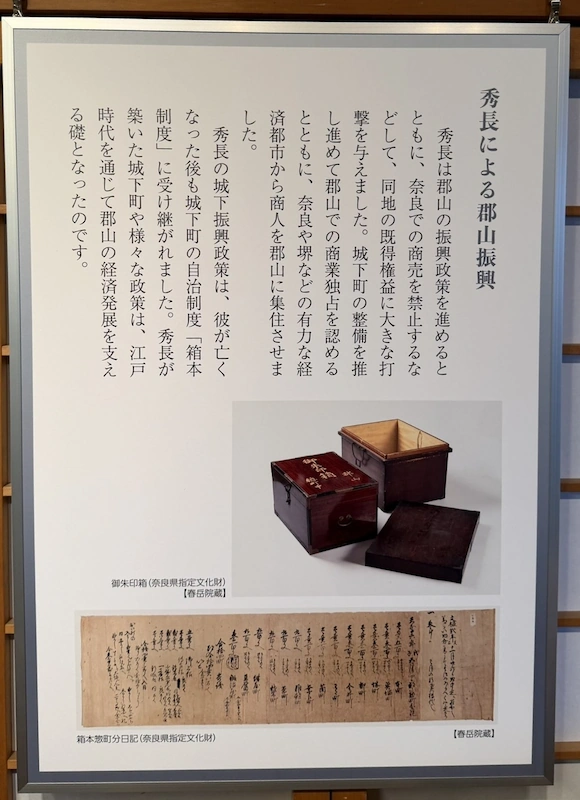
The prologue also covers items handed down at Shungakuin — including a goshuin (official seal) box and lengthy diary entries — as well as information about Hidenaga’s grave and the Dainagon-zuka memorial mound. If you’ve already visited Shungakuin before coming here, there’s a strange and wonderful feeling of seeing objects “from that very place” now resting inside a glass case just a few hundred meters away. This section reveals how the people of Koriyama have honored and remembered Hidenaga across the centuries.
Exhibition Highlights ② — Chapters 1 & 2: From the Yayoi Period to the Sengoku Era — Koriyama Before Hidenaga
What gives this exhibition its depth is that it doesn’t stop at Hidenaga. Chapter 1, “The Dawn of Koriyama,” and Chapter 2, “On the Eve of Koriyama Castle,” trace the region’s history from the Yayoi period (roughly 300 BC–300 AD) through the Muromachi and Sengoku (Warring States) periods, with excavated artifacts to match.
The Yayoi and Kofun-period pottery — chipped rims, rough-hewn shapes — speaks to a simple but powerful truth: people lived on this land long before any castle or warlord entered the picture.
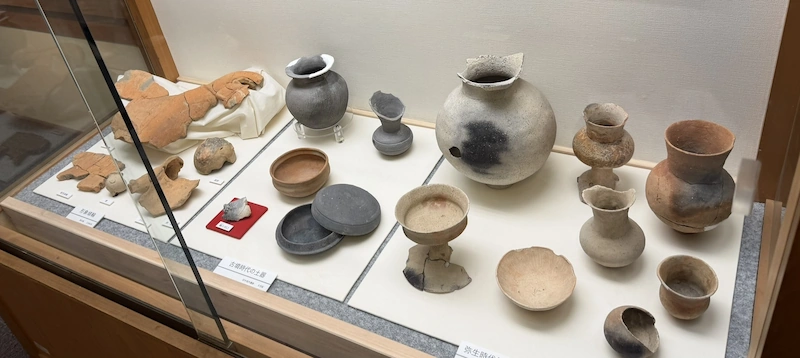
According to the exhibition catalog, the collection ranges widely: Yayoi pottery from the Tanaka-Gaito site, haniwa figurines from the Hiraki burial mound, wadōkaichin coins (Japan’s first official currency, minted in 708 AD) from the Shimotsumichi east drainage channel, an inkstone with hoofed legs and a bronze bell from sites south of the Heijō Palace complex in nearby Nara, and lacquerware jars, inkstones, and unfinished stone belt ornaments from the presumed site of Nara’s ancient western market. With more than 300 pieces on display, the sheer breadth is impressive.
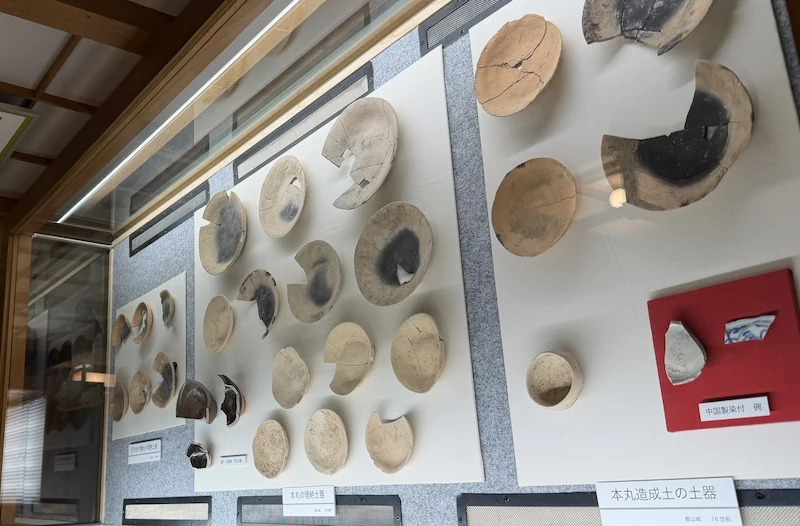
Chapter 2, “On the Eve of Koriyama Castle,” moves from the Heian period through the Muromachi era and into the Sengoku (Warring States) period. On display are haji earthenware and a large imported porcelain dish excavated from the moat of Tsutsui Castle, along with musket balls and a bronze tea kettle lid — all traces of the fierce power struggles between the Tsutsui clan and the notorious warlord Matsunaga Hisahide. Even before Hidenaga arrived, this land had already been shaped by centuries of conflict.
Exhibition Highlights ③ — Chapters 3–5: The Castle and Castle Town That Hidenaga Built
On September 3, 1585, Hashiba Hidenaga — as he was then known — entered Koriyama Castle with 5,000 soldiers, accompanied by his elder brother Hideyoshi. This moment, which will almost certainly be depicted in the NHK drama Toyotomi Brothers!, marked a turning point in Koriyama’s history. From that day forward, the castle was massively expanded as a strategic hub for the Toyotomi regime’s governance of the Kinai heartland (the region surrounding Kyoto, Osaka, and Nara). The foundations Hidenaga laid — both for the castle and the surrounding town — survived the fall of the Toyotomi clan and continue to shape the modern city of Yamatokoriyama today.
Chapter 3, “Hidenaga and Koriyama Castle,” explains the castle’s structure: the layout of its kuruwa (defensive enclosures), how its defenses were organized, and how the castle connected to the town below. Seeing this before walking the actual ruins makes all the difference — the stone walls and terrain suddenly make sense.
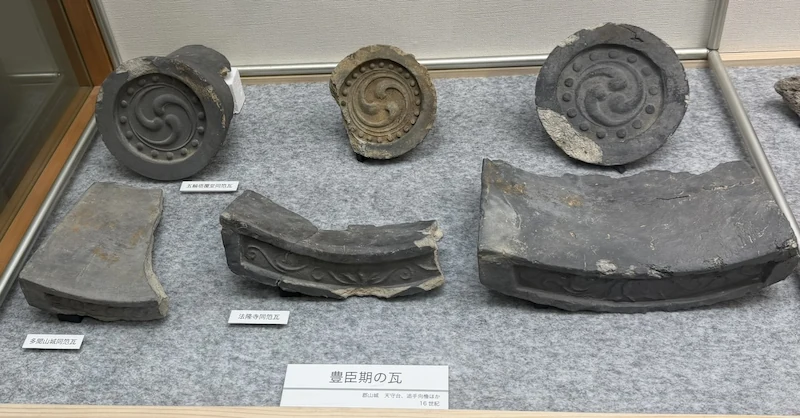
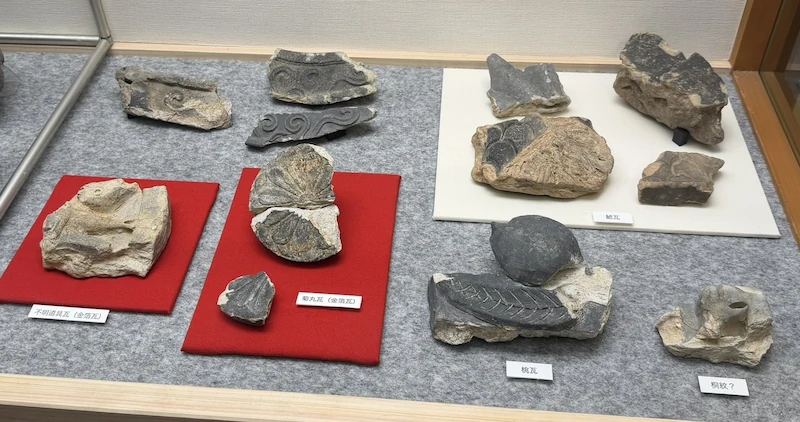
This was the section where I lingered the longest. The haji earthenware, imported porcelain, and roof tiles excavated from Koriyama Castle were things actually used during Hidenaga’s time here. Standing before the glass cases, studying the surface of a roof tile, I found myself wondering: Did Hidenaga see this very tile? Was it once on the roof of this very castle? The TV drama brings Hidenaga to life through actors and sets, but here was something different — the material reality of the past, tangible and unmediated.
Chapter 4, “The Stone Walls of Koriyama Castle,” introduces the repurposed stones built into the castle tower base — Buddhist statues, stone pagodas, and millstones pressed into service as construction material. The fact that sacred Buddhist carvings and gravestones were mixed in among the building stones tells you everything about the scale and urgency of the castle’s construction. After viewing the exhibition, head to the castle tower base to see the actual repurposed stones for yourself, including the famous “Upside-Down Jizō” — a Buddhist statue set into the wall inverted — and you’ll understand the story on a much deeper level.
Chapter 5, “The Prosperity of Early Modern Koriyama,” displays artifacts from the castle town itself: fragments of ceramics, tsuba sword guards and seppa washers from blade fittings, glassware, wooden brushes, and even bellows nozzles from metalworking forges. This final chapter moves beyond the footsteps of warlords to reveal the daily lives of ordinary people who called this town home.
How Does It Compare with the Taiga Drama Museum? — Why You Should See Both
The Taiga Drama Museum and the Higashi Tamon Turret exhibition both focus on Hidenaga, but they deliver completely different experiences. The Drama Museum is about immersion in the TV series: vibrant, media-rich, filled with costumes, video clips, and photo panels. The Higashi Tamon Turret, by contrast, is a space filled with the real thing — authentic archaeological artifacts displayed in quiet, contemplative surroundings.
If the Drama Museum is where you “learn about Hidenaga,” the turret exhibition is where you “touch the era Hidenaga lived in.” Experiencing both reveals something neither can deliver alone: the realization that the drama’s storyline isn’t mere fiction, but a narrative built upon fragments pulled from the very soil beneath your feet.
When I visited on a weekend, the Drama Museum was packed, while the Higashi Tamon Turret was comparatively uncrowded. Being able to study more than 300 genuine artifacts in a quiet setting — that alone makes the trip worthwhile.
・Photography is allowed throughout the exhibition — feel free to snap photos of anything that catches your eye
・No need to remove your shoes — you can enter wearing them
・Admission is free for junior high school students and younger
・Plan for about 30 minutes to 1 hour
・Some exhibits are rotated between the first and second halves of the exhibition period (marked with ☆ and ★ in the exhibit catalog)
・Parts of the castle grounds are unpaved, so comfortable walking shoes are recommended
A Word of Thanks to the Guide at Shungakuin — When a Chance Encounter Becomes the Best Discovery of the Day
If it weren’t for that casual conversation with the volunteer guide at Shungakuin Temple, I would have left Koriyama without ever knowing this exhibition existed. “The roof tiles they removed during repairs are on display right now, up in one of the castle turrets” — that single sentence sent me on a short walk that led to the best discovery of my entire visit.
When I think about the effort behind this exhibition — the work of assembling more than 300 archaeological artifacts and opening a turret that’s normally off-limits to the public — I feel a deep sense of gratitude toward everyone involved. This isn’t a flash-in-the-pan event riding the wave of a popular TV show. It’s a sincere, carefully crafted effort to share the full sweep of this land’s history, and that sincerity comes through in every corner of the exhibition.
Yamato Koriyama is the kind of town where a stray piece of information, overheard almost by accident, can lead you somewhere unexpectedly profound. After you’ve seen the Taiga Drama Museum, take just 10 more minutes to walk a little further. What you’ll find is well worth the detour.
Frequently Asked Questions (FAQ)
Q. How long is the Higashi Tamon Turret open to the public?
A. It is open only for the duration of the “Hidenaga and the History of Koriyama” exhibition (through January 31, 2027). Since the turret is normally closed to visitors, there’s no telling when the next opportunity will come.
Q. Is this in the same location as the Taiga Drama Museum?
A. No, they are in separate locations. The Taiga Drama Museum is at “DMG MORI Yamato Koriyama Castle Hall,” while the exhibition is inside the Higashi Tamon Turret within the castle ruins. It’s about a 10-minute walk from the Drama Museum to the turret.
Q. Can I take photos of the exhibits?
A. Yes, photography is freely permitted throughout the exhibition.
Q. Do I need to take off my shoes?
A. No, you can enter wearing your shoes.
Q. How much time should I plan for?
A. A quick visit takes about 20–40 minutes. If you read every panel carefully, allow about an hour.
Q. Do the exhibits change between the first and second halves of the exhibition?
A. Yes, some items are rotated. The exhibit catalog marks first-half items with ☆ and second-half items with ★. View the exhibit catalog here (PDF)
Q. Should I visit the Taiga Drama Museum or the Higashi Tamon Turret first?
A. I’d recommend starting with the Taiga Drama Museum. Building your interest in Hidenaga there first makes the real artifacts at Higashi Tamon Turret far more meaningful. If you can, stop by Shungakuin Temple in between — it makes the exhibition’s prologue resonate even more deeply.
Q. Is it worth the ¥300 admission?
A. Absolutely. The chance to see more than 300 genuine archaeological artifacts inside a turret that’s normally closed to the public is rare and remarkable. Paired with the Taiga Drama Museum (¥600 admission), you can experience Hidenaga’s legacy and Koriyama’s history from multiple angles — all for a combined ¥900 (about $6 USD).
“Hidenaga and the History of Koriyama” — Exhibition Details
| Exhibition | Hidenaga and the History of Koriyama (秀長と郡山のあゆみ) |
|---|---|
| Dates | January 22, 2026 – January 31, 2027 |
| Hours | 10:00 AM – 5:00 PM (last entry at 4:30 PM) |
| Closures | Open year-round in principle (closed during New Year holidays and on Taiga Drama Museum closure days) |
| Admission | ¥300 for adults (free for junior high school students and younger) |
| Venue | Higashi Tamon Turret (within the Koriyama Castle ruins, a nationally designated historic site) 253-2 Jonaichō, Yamatokoriyama, Nara Prefecture |
| Access | 10-minute walk from Kintetsu Koriyama Station / 15-minute walk from JR Koriyama Station By car: approx. 14 minutes from Koriyama IC on the Nishi-Meihan Expressway |
| Parking | Bairinmon Gate lot (free, limited spaces) Koriyama Castle Information Center lot (free) Yamato Koriyama Castle Hall lot (free for 2 hours; 170 spaces) |
| Official Page | Yamatokoriyama City Official Website (Japanese) |
Related Reading
Our guide to the Yamato Koriyama Taiga Drama Museum for the NHK drama Toyotomi Brothers!
A detailed guide to the history and highlights of the Yamato Koriyama Castle ruins.

Exploring the sites connected to Hidenaga’s legacy in Yamato Koriyama.

A nationwide guide to sites connected to Toyotomi Hidenaga across Japan.



comment