


Walking in the Footsteps of Toyotomi Hidenaga: A Complete Guide to Yamatokoriyama, Nara
Yamatokoriyama is a quiet former castle town in Nara Prefecture, within easy reach of both Nara City and Osaka. If the NHK taiga drama "Toyotomi Kyodai" (a year-long historical drama series) has piqued your interest in Toyotomi Hidenaga, this is where to walk in his footsteps — from Genkuro Inari Shrine and Tosenji Temple to Shungakuin Temple and his grave at Dainagonzuka, all connected on foot from Kintetsu Koriyama Station or JR Koriyama Station.
Toyotomi Hidenaga (1540–1591) was the younger half-brother of the famous unifier Toyotomi Hideyoshi. A capable general and, even more, a skilled administrator, Hidenaga governed a vast domain covering Yamato (modern Nara Prefecture), Kii, and Izumi from his base at Koriyama Castle. If Hideyoshi was the public face of the Toyotomi regime, Hidenaga was widely seen as the steady hand who made it function — which is why the 2026 taiga drama "Toyotomi Kyodai" ("The Toyotomi Brothers") has put a spotlight on him and on this town.
One quick note on names: this Koriyama (郡山) is a small castle town in Nara Prefecture, in the Kansai region of western Japan. It is unrelated to the much larger city of Koriyama in Fukushima Prefecture, far to the northeast — the place names are simply identical in Japanese, so it's worth double-checking you have the right one when searching for trains or hotels.
Yamatokoriyama sits a short train ride south of Nara City and is easily combined with a day trip from Osaka. The town is served by two separate, unconnected train operators whose stations share almost the same name: Kintetsu Koriyama Station (近鉄郡山駅), on the Kintetsu Kashihara Line, and JR Koriyama Station (JR郡山駅), on the JR Yamatoji Line. The two stations are close to each other and both make good starting points for this walk, but they are not the same station — check which one your train actually stops at.
This guide covers the sites connected to Hidenaga scattered around the town — most of them within easy walking distance of each other. Several of the streets are narrow and some entrances are easy to miss, so we've flagged the spots where Google Maps' "shortest route" sent us to the wrong entrance when we visited, along with alternative route maps.
Access at a Glance
| Nearest stations | Kintetsu Koriyama Station (Kintetsu Kashihara Line, B30) and JR Koriyama Station (JR Yamatoji Line, JR-Q34). The names are nearly identical but these are two separate stations. |
|---|---|
| Walk from the station | Roughly 5–15 minutes to each site; all 11 stops connect on foot. Per-site walking times are given in the sections below. |
| Practical shinkansen station | Kyoto Station (one transfer, via the Kintetsu Kyoto and Kashihara lines) |
| From major cities | Kyoto: approximately 35–50 minutes by Kintetsu, changing at Yamato-Saidaiji. Osaka Namba: approximately 35–45 minutes by Kintetsu, changing at Yamato-Saidaiji. Both vary by train and connection. |
| On-site difficulty | The castle-town area is largely flat and walkable. Several sites sit down narrow residential lanes, and some stretches were damp underfoot when we visited. |
| Recommended transport | On foot from either station — the most reliable way to cover the castle town. Parking is limited at individual sites. |
| Things to watch for | Entrances in residential areas are easy to miss, and when we visited, Google Maps' shortest route sent us to secondary entrances at two shrines (see the route maps in this guide). Some temples, such as Tosenji, require advance arrangement to enter the main hall. Hours and admission can change, so confirm current details before visiting. |
Getting Here from Osaka, Kyoto & Nara (Tōdai-ji)
Without local knowledge of the Kansai region, it isn't always obvious where Yamatokoriyama actually is. Here's how to get here from three common starting points — Osaka, Kyoto, and the Nara / Tōdai-ji area — each with a route map. Tap a heading to open the map.
From Namba Station, take the Kintetsu Nara and Kashihara lines (change at Yamato-Saidaiji) to Kintetsu Koriyama Station — roughly 35–45 minutes, depending on the train and connection. From JR Osaka Station (Umeda), a subway-to-Kintetsu transfer also works, but the direct Kintetsu service from Namba is the simplest option.
This map shows the general route (Namba Station to Kintetsu Koriyama Station). Check a transit app for current timetables.
From Kyoto Station, take the Kintetsu Kyoto and Kashihara lines (change at Yamato-Saidaiji; limited express available) to Kintetsu Koriyama Station — roughly 35–50 minutes, depending on the train and connection.
This map shows the general route (Kyoto Station to Kintetsu Koriyama Station). Check a transit app for current timetables.
Tōdai-ji is about a 20-minute walk from JR Nara Station or Kintetsu Nara Station. From Kintetsu Nara Station, take the Kintetsu Nara and Kashihara lines (change at Yamato-Saidaiji) to Kintetsu Koriyama Station — roughly 30–45 minutes in total, including walking and connection time. A JR Yamatoji Line route from JR Nara Station to JR Koriyama Station is another option.
This map shows the general route (Tōdai-ji to Kintetsu Koriyama Station). Check a transit app for current timetables.
What you'll find in this guide:
・The story behind each site and its connection to Hidenaga's era
・Where entrances are easy to miss, and which temples require advance confirmation for visits
・What to expect for goshuin (temple/shrine stamps) and admission, where known
The Sites
Koriyama Hachiman Shrine (郡山八幡神社)
Rating Historical value: ☆☆ Visual appeal: ☆☆ Experience: ☆☆
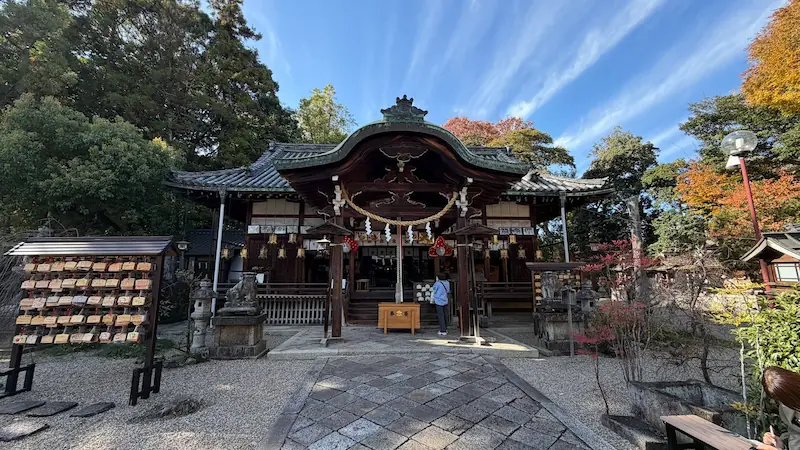
Koriyama Hachiman Shrine, connected to Toyotomi Hidenaga, sits in the Yanagi neighborhood of Yamatokoriyama and once guarded the southern approach to Koriyama Castle. Hachiman is a Shinto deity long associated with warriors and protection, which is why shrines dedicated to Hachiman were often placed to watch over castle towns. This shrine is said to have been founded in the Muromachi period, and when Hidenaga carried out his major expansion of Koriyama Castle in Tensho 13 (1585), its role as guardian shrine was reinforced and it was relocated to its present site.
Tap to enlarge
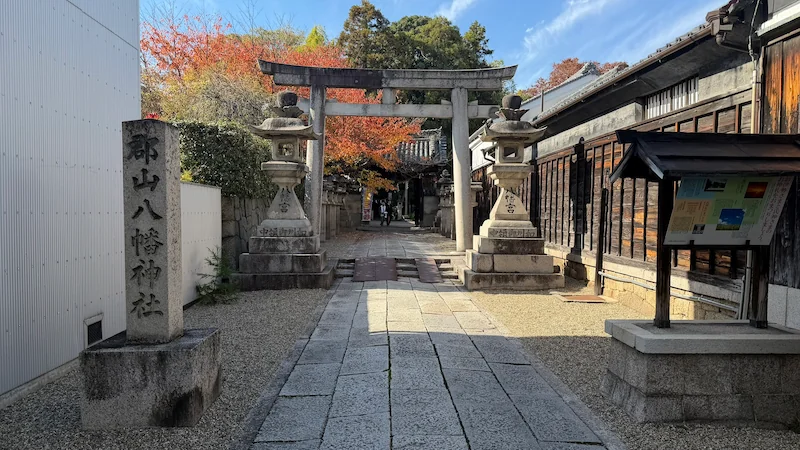
When we visited in November 2025, following Google Maps' "shortest route" led us not to the main approach with its torii gate, but to a side path that opens directly onto a side gate of the shrine grounds. The route itself isn't wrong, but it skips the proper entrance experience. It's worth taking the slightly longer route via the main approach and torii gate instead. Routing can change, so check the entrance location on arrival as well. The map below shows the route we actually walked from the station.
| Founded | Muromachi period (exact year unknown) |
|---|---|
| Founder | Unknown; long served as the local guardian shrine |
| Structure | Main hall, torii gate, and the standard layout of a Hachiman shrine |
| Restorations | Relocated to its present site in Tensho 13 (1585), when Toyotomi Hidenaga built up Koriyama Castle, according to the shrine's own record |
| Condition today | Well preserved; open to visitors |
| Cultural designation | No national designation, but recognized as a locally significant heritage site |
| Note | Recently nicknamed the "Glove Shrine" for baseball-related prayers and offerings |
🗺 Address: 4-chome-25 Yanagi, Yamatokoriyama, Nara
🚶 Access: About 5–8 minutes' walk (roughly 500 m) from Kintetsu Koriyama Station.
⏳ Suggested visit time: About 15 minutes for a quick look; up to 30 minutes if visiting unhurried.
📍 Highlights
- A quiet approach and grounds: Tucked into a residential neighborhood, the shrine feels calm and set apart the moment you pass through the torii gate.
- A guardian shrine for the samurai era: Hachiman, the enshrined deity, was long venerated as a protector of warriors and castle towns, tying this shrine directly to Koriyama's Sengoku- and Momoyama-period history.
- A modern twist on old traditions: The shrine has become known among baseball players and fans as the "Glove Shrine," where old gloves are ritually retired and players pray for skill and success.
Genkuro Inari Shrine (源九郎稲荷神社)
Rating Historical value: ☆☆☆ Visual appeal: ☆☆ Experience: ☆☆☆
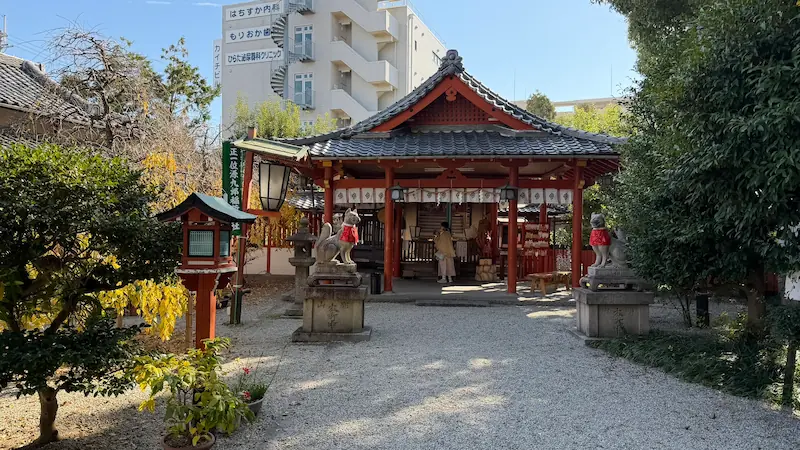
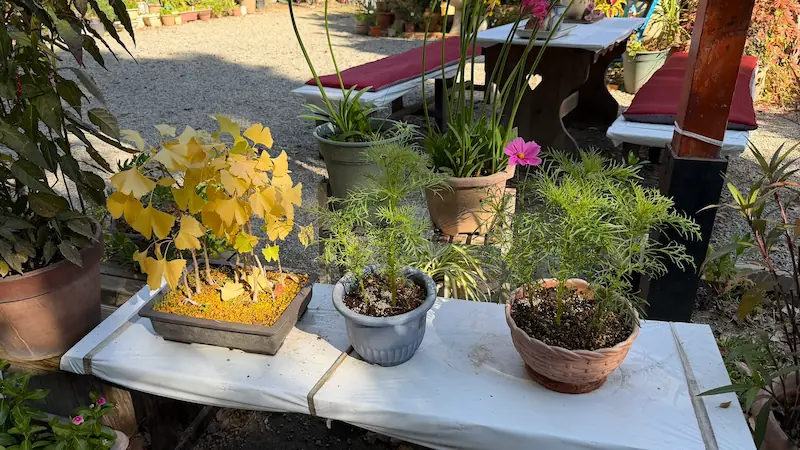
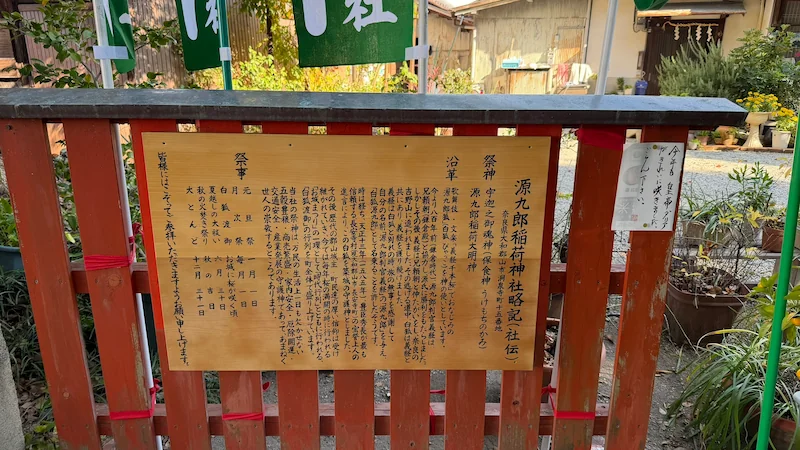
Genkuro Inari Shrine, in the Tosenjicho neighborhood of Yamatokoriyama, is said to have been founded by Toyotomi Hidenaga in Tensho 13 (1585) as the guardian shrine of Koriyama Castle. Inari shrines are dedicated to the deity of harvests, business, and prosperity, and are easily recognized by their fox ("kitsune") guardian statues in place of the more familiar guardian dogs.
Tap to enlarge
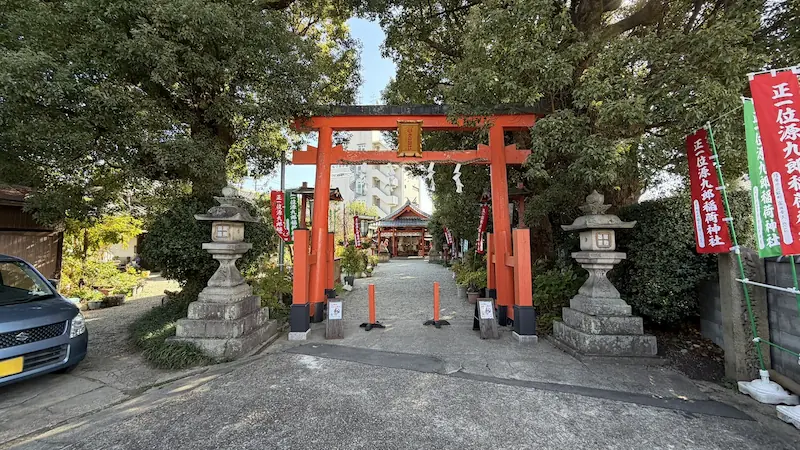
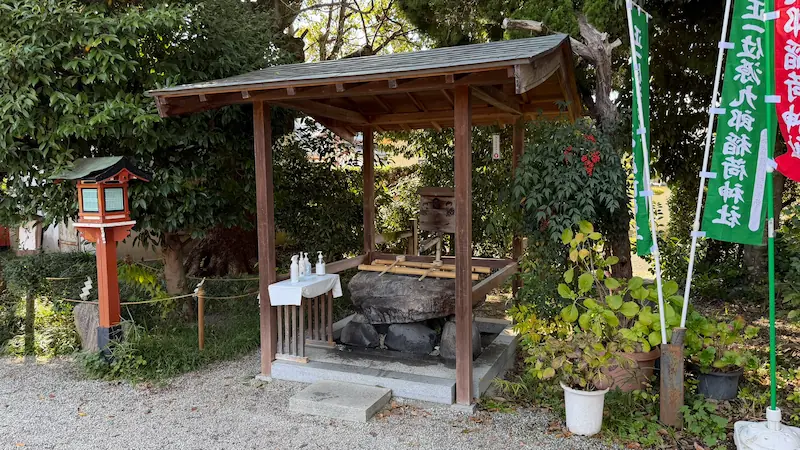
Of all the sites in this guide, this is the one where routing gave us the most trouble. When we visited in November 2025, approaching from the south as the default route suggested, we ended up circling well out of the way because the entrance is actually on the north side. On the map the straight-line distance looks short, but the walking route is not what it appears — heading for the north entrance from the start is the reliable approach. Routing can change, so use the My Maps route below alongside a check of the entrance location on arrival.
| Founded | Tensho 13 (1585), according to tradition |
|---|---|
| Founder | Toyotomi Hidenaga, by tradition |
| Structure | Main hall, worship hall, shrine office, and fox guardian statues in place of the usual guardian dogs |
| Restorations | Relocated to the present site in Kyoho 4 (1719); current main hall built in Taisho 14 (1925) |
| Condition today | Well preserved; open to visitors |
| Cultural designation | No national designation, but a recognized local historical asset |
| Note | Sometimes ranked among the "Three Great Inari Shrines of the Kansai region" |
🗺 Address: 15 Tosenjicho, Yamatokoriyama, Nara
🚶 Access: About 8–10 minutes' walk (roughly 0.6–0.8 km) from either Kintetsu Koriyama Station or JR Koriyama Station.
⏳ Suggested visit time: About 10 minutes for a quick visit; up to 30 minutes to look around unhurried.
📍 Highlights
- Fox guardian statues: In place of the usual guardian dogs, this shrine's fox statues hold a scroll and a jewel in their mouths — the jewel symbolizing good fortune in business, the scroll symbolizing wisdom and academic success.
- A crossroads of history and legend: Founded by Hidenaga as the castle's guardian shrine, it is also tied to the "Genkuro fox" legend connected to the medieval general Minamoto no Yoshitsune, blending real castle-town history with folklore.
- A living local tradition: Known locally as "Genkuro-san," the shrine hosts an annual spring festival ("Byakko Togyo") in which children wearing white fox masks parade through town.
Tosenji Temple (洞泉寺)
Rating Historical value: ☆☆☆ Visual appeal: ☆☆ Experience: ☆☆
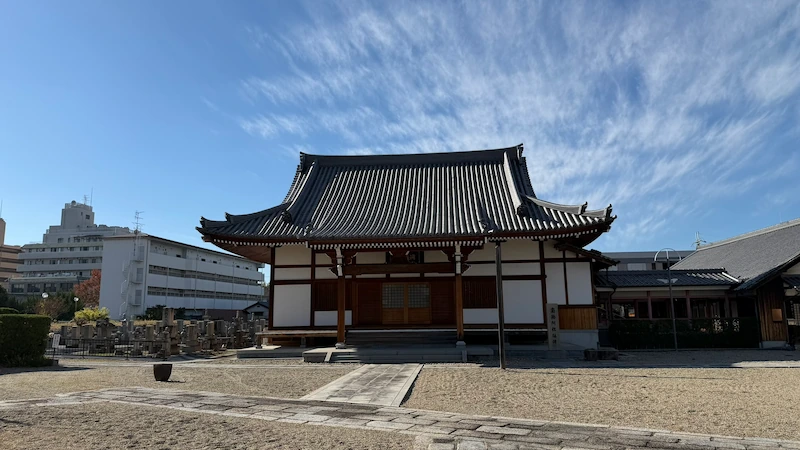
Tosenji Temple, in Yamatokoriyama, is a Pure Land Buddhist (Jodo-shu) temple connected to Toyotomi Hidenaga. It originated in what is now Aichi Prefecture, in the historical province of Mikawa, and was relocated to this site by Hidenaga when he entered Koriyama Castle in 1585 — placing it firmly at the intersection of the castle town's development and the early Toyotomi regime.
| Founded / relocated | Originally founded in Mikawa Province (modern eastern Aichi Prefecture); relocated here in Tensho 13 (1585) |
|---|---|
| Founder | Founded by the priest Hoyo Shonin; later relocated by Toyotomi Hidenaga |
| Structure | Main hall (irimoya-style, tiled roof), Jizo hall, and other temple buildings |
| Restorations | Main hall built in Manji 2 (1659); maintained through the Edo period and beyond |
| Condition today | Grounds are open to visitors; entry to the main hall requires advance reservation (confirm hours and any fee on the day) |
| Cultural designation | The principal image, a wooden Amida Nyorai flanked by two attendant statues, is a National Important Cultural Property |
| Note | The grounds include a stone Jizo statue said to have been carved from a stepping stone once used at Koriyama Castle |
🗺 Address: 15-1 Tosenjicho, Yamatokoriyama, Nara
🚶 Access: About 7–10 minutes' walk (roughly 0.5–0.8 km) from either Kintetsu Koriyama Station or JR Koriyama Station.
⏳ Suggested visit time: About 10 minutes for a quick visit; up to 20 minutes to look around unhurried.
📍 Highlights
- The principal Amida triad: A wooden Amida Nyorai with two attendant bodhisattvas, traditionally attributed to the renowned Kamakura-period sculptor Kaikei and designated a National Important Cultural Property.
- The "grime-scrubbing Jizo" legend: According to local legend, when a stone once used as a stepping stone at Koriyama Castle was dug up, a Jizo image was found within it — it was moved to the temple and enshrined as this "grime-scrubbing Jizo" (Akakaki Jizo).
- Where the castle town meets religion: Hidenaga's decision to relocate this temple here reflects how castle lords used religious institutions to help secure the stability and protection of their domains.
Koriyama Castle Outer Moat Park (郡山城外堀緑地)
Rating Historical value: ☆☆ Visual appeal: ☆☆ Experience: ☆☆
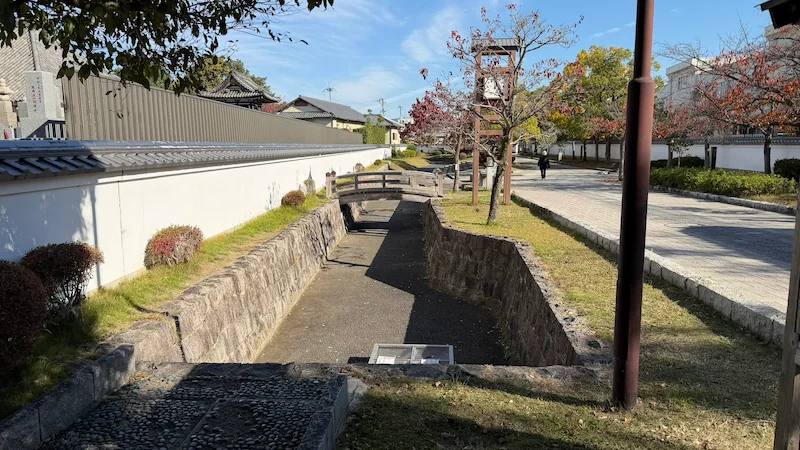
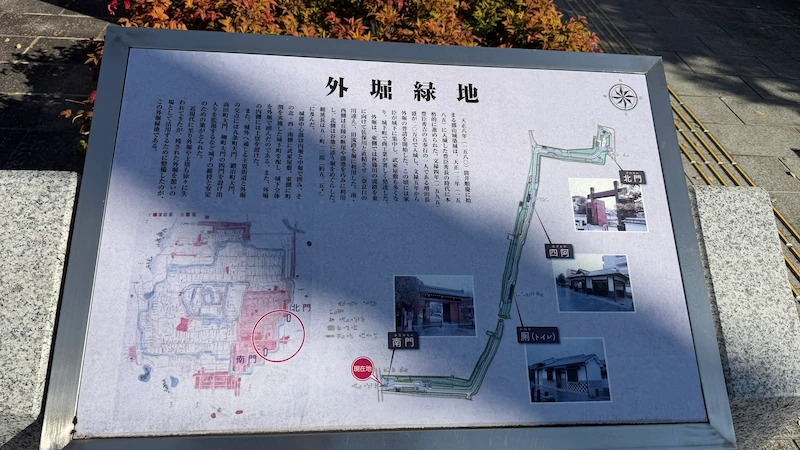
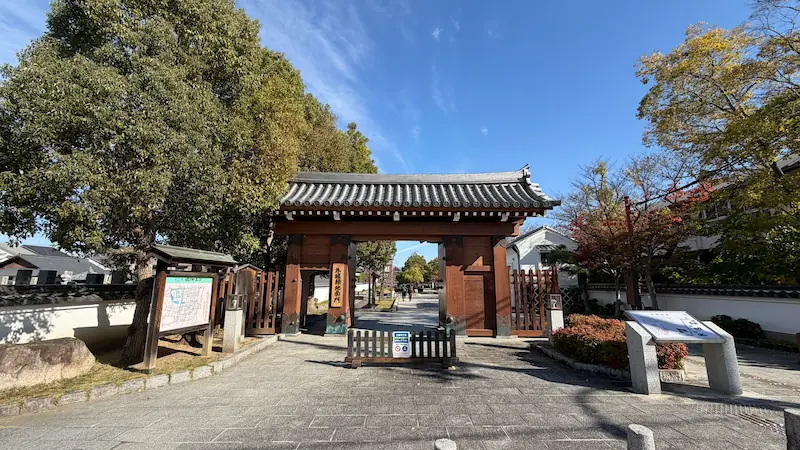
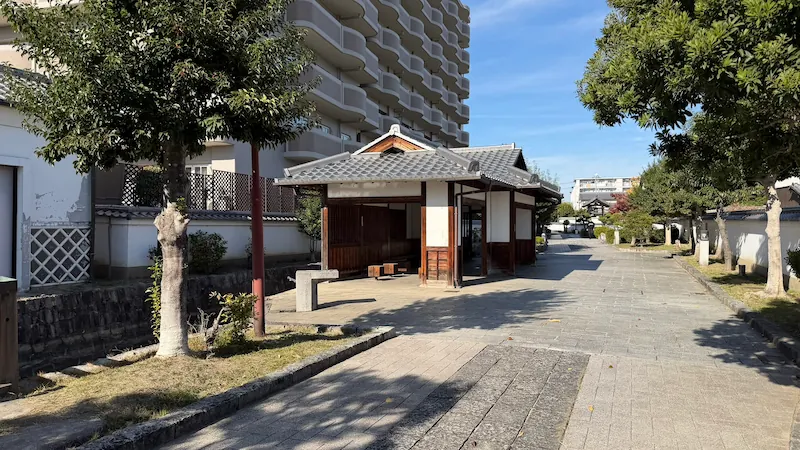
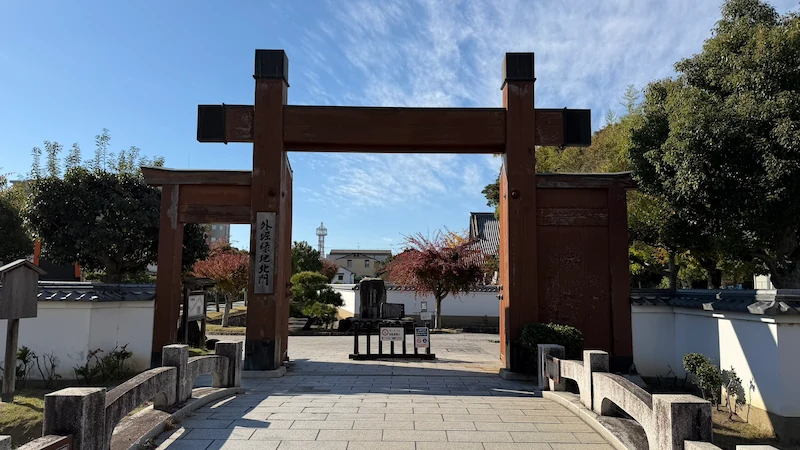
Part of Koriyama Castle's outer moat has been preserved and developed into this park, complete with a walking path, waterways, reconstructed gates, and information boards. The outer moat once marked the boundary between the castle and its surrounding town, and walking this restored stretch today is one of the clearest ways to grasp the physical scale of the old castle town. It's now a favorite spot for both local residents and visitors.
Tap to enlarge
| Origin | Part of Koriyama Castle's outer moat; major development followed Hidenaga's entry into the castle in 1585 |
|---|---|
| Form today | The former moat line has been turned into a park with a walking path, waterways, and reconstructed gates |
| Structure | A roughly 580-meter walkable stretch of the outer moat, with a reconstructed kabukimon-style North Gate and a koraimon-style South Gate marking the entrances |
| Condition today | Well maintained; freely open as a public park |
| Cultural designation | No individual structure is designated, but the moat is part of the nationally designated Koriyama Castle Historic Site |
| Note | Some sections also serve a modern flood-control role, helping retain rainwater during heavy storms |
🗺 Address: Around Zaimokucho, Yamatokoriyama, Nara (park entrance)
🚶 Access: About 6–10 minutes' walk from either Kintetsu Koriyama Station or JR Koriyama Station.
⏳ Suggested visit time: About 20 minutes for a walk and a rest; up to 45 minutes to follow the full waterway path unhurried.
📍 Highlights
- Reconstructed North and South Gates: Built in the historical style of the original entrances, giving a real sense of what it felt like to enter or leave the castle town's outer perimeter.
- Moat remnants, ponds & waterside views: Traces of the original water-filled moat remain, sometimes with koi or goldfish swimming, making for a relaxed waterside stroll.
- An easy, pleasant walk any season: With paved paths, pavilions, and benches, the park is popular with locals for everyday walks and especially lovely in cherry blossom season alongside the nearby castle ruins.
Hakomotokan "Konya" & the Konya River (箱本館「紺屋」と紺屋川)
Rating Historical value: ☆☆ Visual appeal: ☆☆☆ Experience: ☆☆
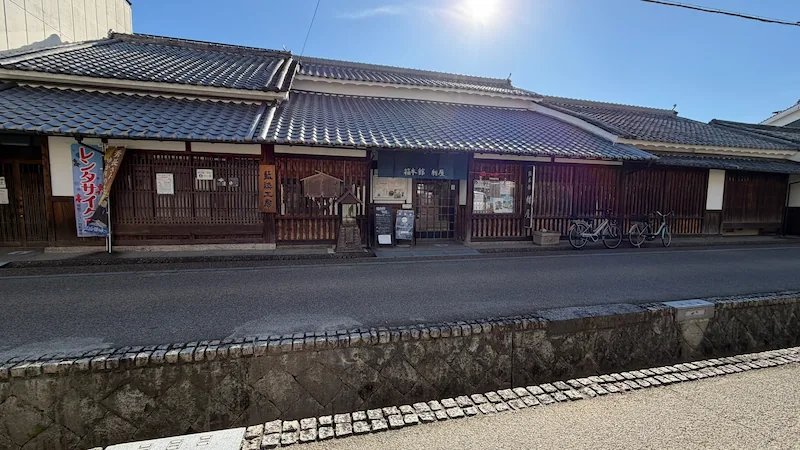
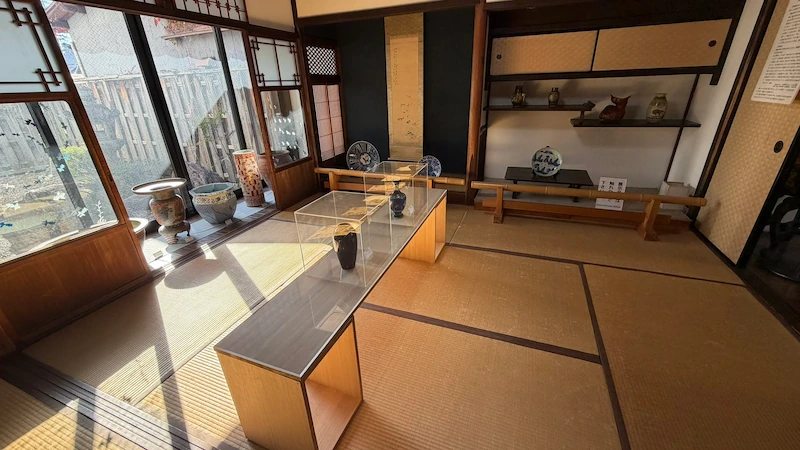
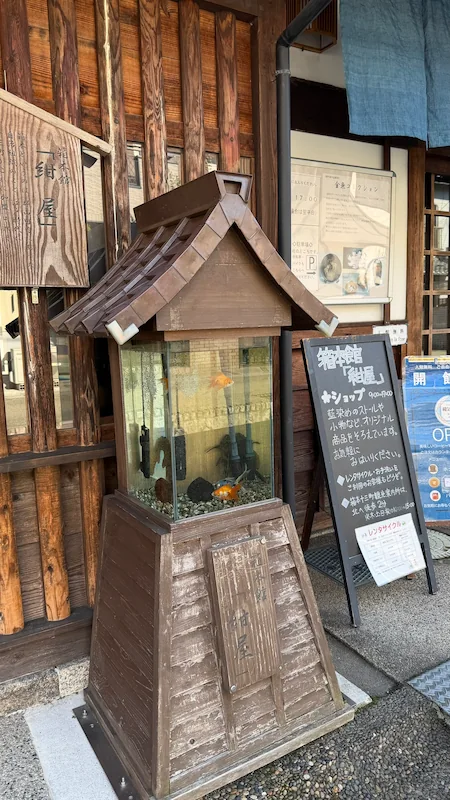
On the walk from the Outer Moat Park toward Shungakuin Temple, you'll pass a quietly preserved historic building: Hakomotokan "Konya" (箱本館「紺屋」, "konya" meaning indigo-dye workshop). Originally an Edo-period dye house, it's now open to the public as part of the town's historic preservation efforts, with exhibits on traditional dyeing and on Yamatokoriyama's well-known ornamental goldfish — a reminder that this was a castle town built on everyday craft and commerce as much as on military history.
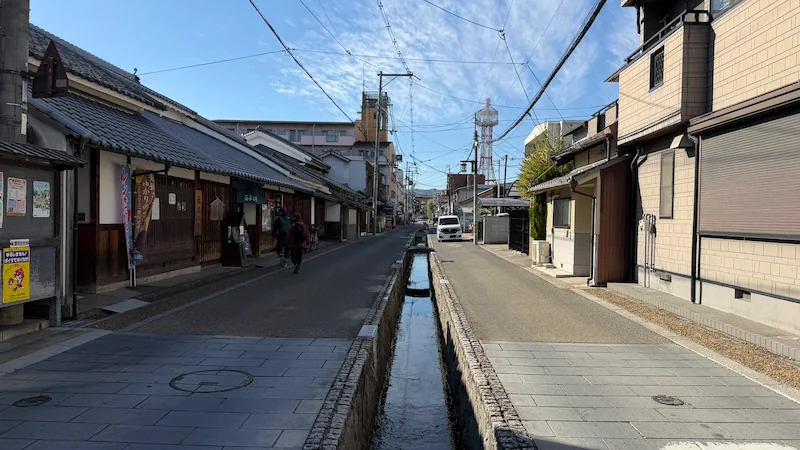
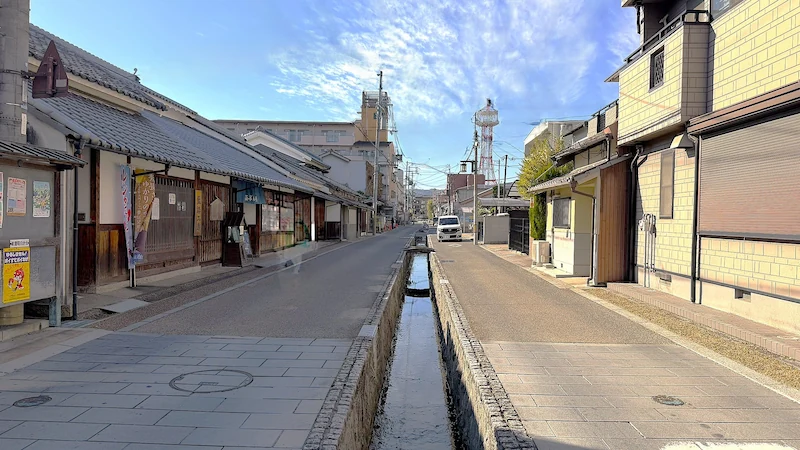
What's most striking here isn't the building itself so much as the street in front of it. The Konya River (紺屋川) runs in a straight line down the very center of the road, with small footbridges crossing it here and there — an unusual streetscape rarely seen elsewhere in Japan. The channel is narrow, but the sight of water running right through the middle of everyday street life says a lot about how this town has always worked.
Tap to enlarge
| Origin | A townhouse that operated as an indigo-dye workshop for generations, from around Kyoho 13 (1728) |
|---|---|
| Structure | A restored dye-house townhouse; now displays a goldfish collection and dyeing tools, and offers indigo-dyeing experiences |
| About the Konya River | A waterway running down the center of the street in Konyacho; it originally drew water from Koriyama Castle's moat and was used to rinse dyed cloth and thread |
| Condition today | Well preserved; open to the public as a municipal facility |
| Cultural designation | No national designation, but promoted by the city as part of Yamatokoriyama's historic townscape preservation |
| Note | The Okuno family, who ran the dye business for generations, eventually closed it, after which the city restored the building as Hakomotokan "Konya" |
🗺 Address: 19-1 Konyacho, Yamatokoriyama, Nara 639-1148
🚶 Access: About 5 minutes' walk from Kintetsu Koriyama Station.
🕐 Hours: 9:00 AM–5:00 PM
💴 Admission: Free
Closed: Mondays (or the following weekday if Monday is a holiday), the day after national holidays, and the New Year period (Dec. 28–Jan. 4), plus occasional additional closures
Sources: Yamatokoriyama Tourism Association — Hakomotokan "Konya" (Japanese) / Hakomotokan "Konya" official site (Japanese)
⏳ Suggested visit time: About 20–30 minutes inside; up to 40 minutes including a stroll along the Konya River street.
📍 Highlights
- A river running down the middle of the street: One of the more unusual streetscapes in Japan — a waterway flowing straight down the center of the road, crossed here and there by small footbridges.
- Indigo dyeing and goldfish exhibits: Displays of dyeing tools and indigo-dyed goods from the building's working days, alongside Yamatokoriyama's famous ornamental goldfish, plus hands-on dyeing experiences.
- A window into everyday castle-town life: A reminder that Koriyama wasn't only a military and administrative center — it was also a working town of craftspeople and artisans.
Kikuya Honten (本家 菊屋本店)
Rating Historical value: ☆☆☆ Visual appeal: ☆☆ Experience: ☆☆☆
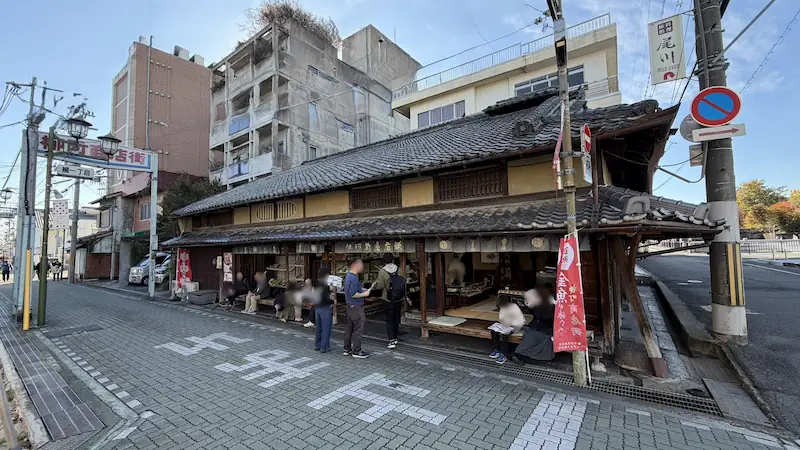
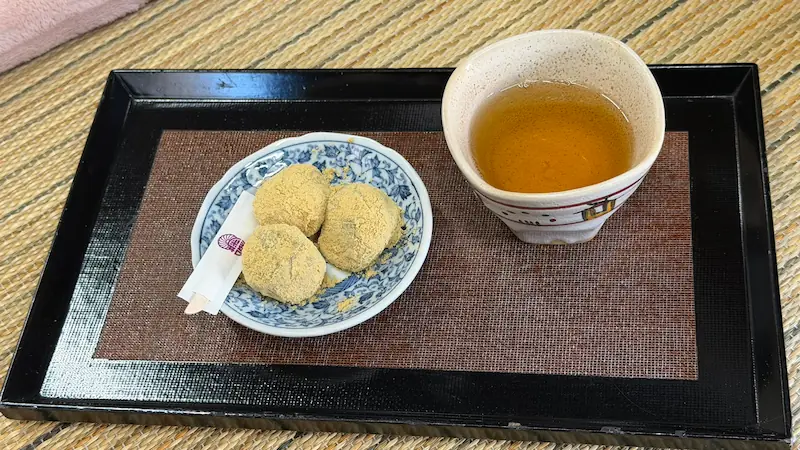
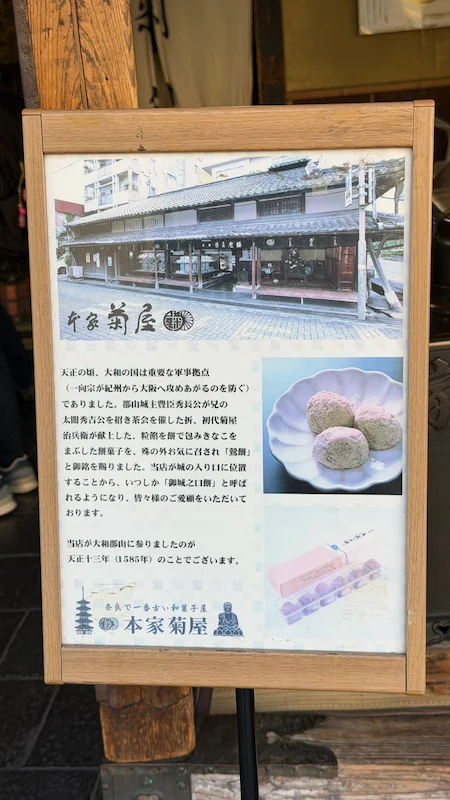
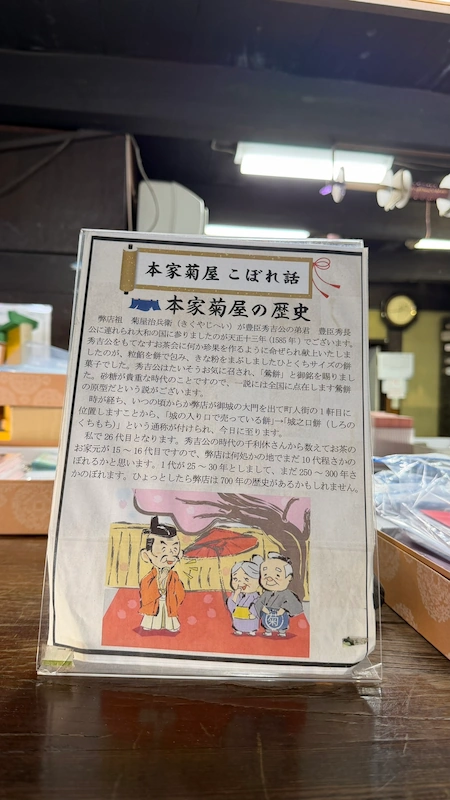
Kikuya Honten is a long-established Japanese confectionery shop in Yamatokoriyama, founded in Tensho 13 (1585) — the very same year Toyotomi Hidenaga took control of Yamato Province and entered Koriyama Castle. According to the shop's own account, Hidenaga asked its founder, Kikuya Jihei, to create something distinctive for a tea gathering held to entertain his older brother, the famous unifier Toyotomi Hideyoshi. The result was a simple treat of sweet bean paste wrapped in mochi and dusted with roasted soybean flour, which became known as "Oshiro-no-Kuchi Mochi" (sometimes called "uguisu mochi," or bush-warbler mochi, for its color). Website: https://kikuya.co.jp/
Tap to enlarge
| Founded | Tensho 13 (1585) |
|---|---|
| Founder | Kikuya Jihei, who moved to Yamato Province along with Toyotomi Hidenaga |
| Structure | A traditional merchant-house building; the shop interior still displays rows of antique wooden confectionery molds hanging from the ceiling |
| Restorations | No specific restoration record made public, but the shop has continued operating as a long-established business to this day |
| Condition today | Still in operation |
| Cultural designation | No national designation, but recognized as a local business with over 400 years of continuous history |
| Note | Now run by the 26th-generation owner; a special taiga-drama-themed package for the signature "Oshiro-no-Kuchi Mochi" launched in 2025 |
🗺 Address: 1-11 Yanagi, Yamatokoriyama, Nara
🚶 Access: About 5 minutes' walk from either Kintetsu Koriyama Station or JR Koriyama Station.
⏳ Suggested visit time: About 20 minutes to browse and shop.
📍 Highlights & things to enjoy
- Oshiro-no-Kuchi Mochi: The shop's signature confection, said to have been created for a tea gathering Hidenaga hosted for his brother Hideyoshi — a soft balance of roasted soybean flour, mochi, and sweet bean paste.
- A historic shop interior: A traditional merchant-house building where antique wooden confectionery molds still hang from the ceiling, offering a tangible feel for the craft and history of Japanese sweets.
- A name tied to the castle town: The confection's name, meaning roughly "mochi from the castle entrance," reflects the shop's original location just outside the castle's main gate, at the boundary between the castle and the merchant district.
Shungakuin Temple (春岳院)
Rating Historical value: ☆☆☆ Visual appeal: ☆☆ Experience: ☆☆
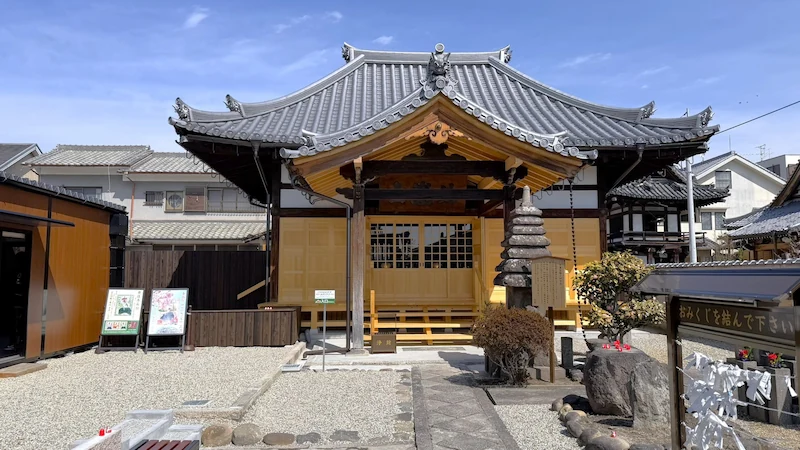
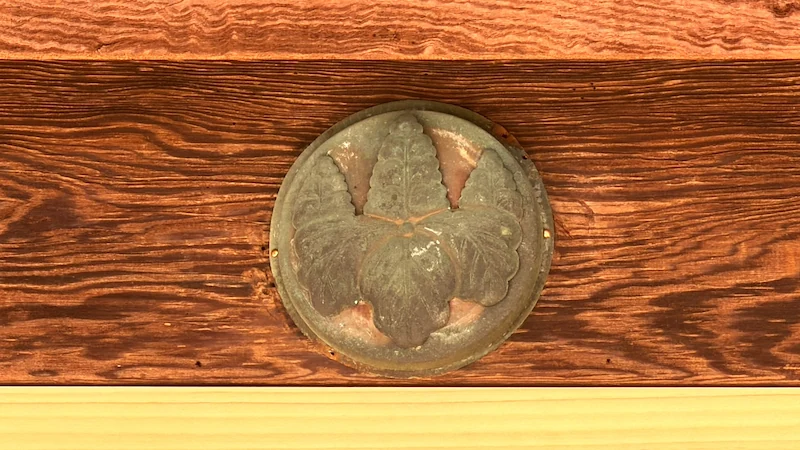
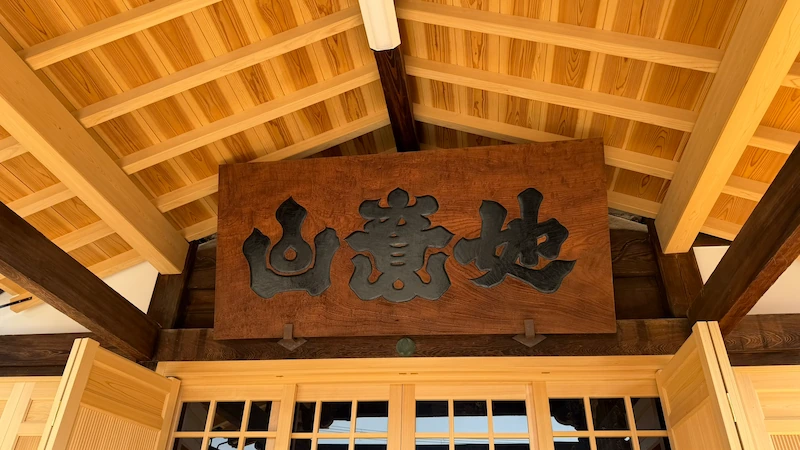
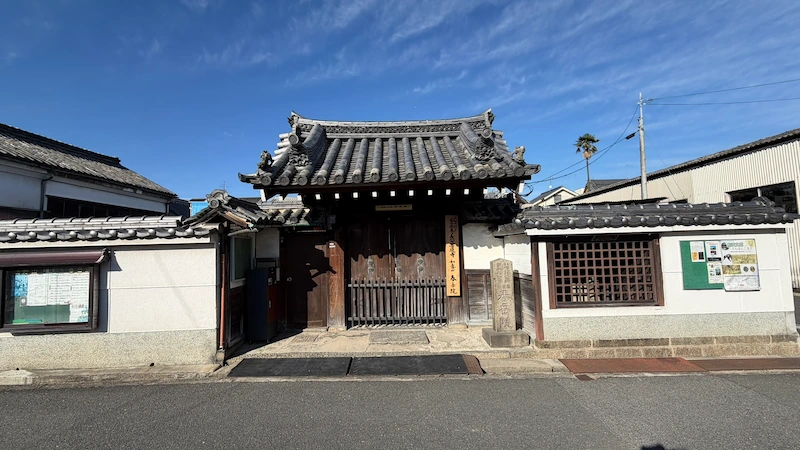
Shungakuin Temple, in the Shinnakamachi neighborhood of Yamatokoriyama, is known as the family temple ("bodaiji") of Toyotomi Hidenaga — the place tasked with honoring his memory after death. It was originally called Tokoji Temple, and was renamed Shungakuin after Hidenaga's posthumous Buddhist name once it became his family temple.
Following the "Reiwa-era restoration" of its main hall, the temple reopened to visitors on January 15, 2026.
Visiting hours: 9:00 AM–4:30 PM (last entry 4:00 PM)
Admission: ¥500 (free for elementary school age and under)
Hours and closure days can change. We'd recommend calling ahead to confirm details: Shungakuin, ☎ +81-743-53-3033 (in Japanese), or checking the Yamato Koriyama Tourist Association's current listing.
When we visited in November 2025, the temple's main hall was in the middle of a major restoration project, and the grounds were closed to visitors. Looking in from the gate, we could see scaffolding and protective sheeting set up around the building — access was temporarily restricted. The temple has since reopened to visitors, on January 15, 2026 (9:00 AM–4:30 PM, last entry 4:00 PM; admission ¥500, free for elementary school age and under). The photographs here were taken during the restoration period.
Local tourism guides describe goshuin (temple stamps) here as available by calling ahead, but on the day we visited, the resident priest was out and we were unable to receive one. If you'd like a goshuin or to view the interior, it's worth calling ahead to check both the current construction status and whether visits have resumed before you go.
Tap to enlarge
| Founded | Mid-Kamakura period (based on stone pagodas on the grounds); originally named Tokoji, later renamed Shungakuin |
|---|---|
| School & principal image | Koyasan Shingon school; principal image is Amida Nyorai |
| Restorations | Main hall traditionally rebuilt in Shotoku 1 (1711) |
| Condition today | Reopened to visitors on January 15, 2026 following the "Reiwa-era restoration" of the main hall. Hours 9:00 AM–4:30 PM (last entry 4:00 PM); admission ¥500 (free for elementary school age and under). Details can change — please confirm current status with the temple or the local tourist association. |
| Notable holdings | A portrait of Hidenaga (a locally designated cultural property) and records related to the "Hakomoto" self-governance system used by the castle-town merchant guilds, including a goshuin storage box and documents |
| Address | 2 Shinnakamachi, Yamatokoriyama, Nara |
| Note | Calling ahead is advisable for specific requests, such as viewing the temple's holdings |
🗺 Address: 2 Shinnakamachi, Yamatokoriyama, Nara
🚶 Access: About 10 minutes' walk from Kintetsu Koriyama Station.
⏳ Suggested visit time: About 10 minutes for a brief look; up to 30 minutes to view the temple's holdings and records in detail.
📍 Highlights
- Hidenaga's portrait and memorial items: An Edo-period portrait of Hidenaga (on display as a reproduction) along with a more recently made memorial statue and mortuary tablet — valuable material connecting the Momoyama and Edo periods to the Toyotomi family's legacy. (Photography not permitted.)
- Records of the "Hakomoto" merchant self-governance system: Documents and a goshuin storage box related to the castle town's "Hakomoto" system, offering a glimpse into how the town organized and governed itself. Not on permanent public display.
- A quiet historic precinct: A modest temple tucked into the townscape, with an atmosphere that still hints at the castle town's earlier era.
Koriyama Castle (郡山城)
Rating Historical value: ☆☆☆ Visual appeal: ☆☆☆ Experience: ☆☆☆
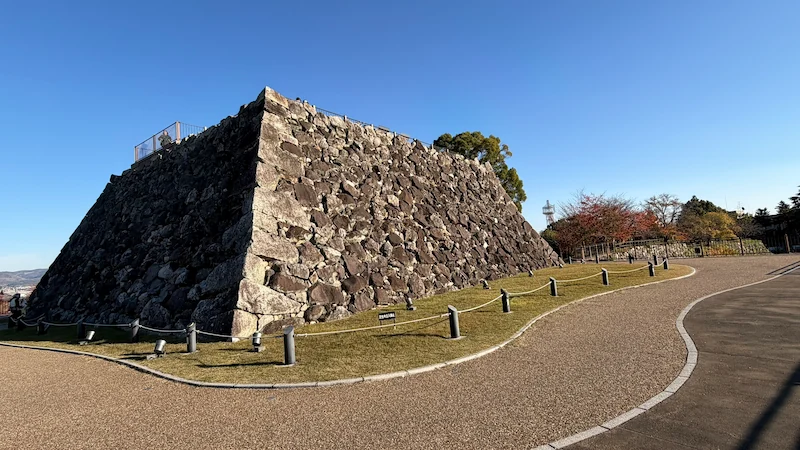
Koriyama Castle, the site most closely associated with Toyotomi Hidenaga, sits at the heart of Yamatokoriyama and preserves an important chapter of Japan's late-Sengoku and early-Edo castle history. Construction began under the local warlord Tsutsui Junkei, but in Tensho 13 (1585) Hidenaga entered the castle as lord of a combined 1-million-koku domain spanning Yamato, Kii, and Izumi provinces, and greatly expanded it into the region's key stronghold for Toyotomi rule.
Read our complete guide to Koriyama Castle
| Construction began | Tensho 8 (1580) |
|---|---|
| Major expansion | Tensho 13 (1585) and the following Toyotomi era |
| Builders | Begun by Tsutsui Junkei; greatly expanded by Toyotomi Hidenaga after he took the castle |
| Structure | A main enclosure ("honmaru") with multiple sub-enclosures, a triple-moat system (inner, middle, and outer moats), and extensive stone walls, including many stones repurposed from other structures |
| Later history | Maintained through the Edo period under successive lords; buildings were lost when the castle was abandoned in the Meiji era, though the main gate and turrets were reconstructed in the Showa era; a viewing platform has since been added on the former tenshu (keep) foundation |
| Condition today | The original buildings are gone, but the stone walls, moats, and keep foundation survive in good condition and the site is preserved as a public park |
| Cultural designation | Designated a National Historic Site on November 10, 2022 |
| Note | The stone walls incorporate repurposed stones from shrines and temples — including foundation stones, stone Buddhas, and five-ring pagodas — offering a glimpse into how stone was sourced for castle construction at the time |
🗺 Address: Jonaicho and surrounding area, Yamatokoriyama, Nara
🚶 Access: About 7–10 minutes' walk from either Kintetsu Koriyama Station or JR Koriyama Station.
⏳ Suggested visit time: About 20 minutes to see the stone walls, moats, and keep foundation; up to 1.5 hours for a leisurely walk including nearby shrines and temples.
📍 Highlights
- Stone walls and moat remnants: "Nozura-zumi"-style stone walls, including repurposed stones, and a triple-moat system that together evoke both the castle's defenses and its role in organizing the surrounding town.
- The keep foundation and viewing platform: The former site of the main tower ("tenshu") is now a public viewing platform, offering sweeping views over the Nara Basin.
- Cherry blossoms and castle scenery: Around 800 cherry trees bloom here each spring, earning the site a place among Japan's "Top 100 Cherry Blossom Spots" — a wonderful combination of nature and history.
Eikeiji Temple (永慶寺) — The Temple With Koriyama Castle's Relocated Gate
Rating Historical value: ☆☆☆ Visual appeal: ☆☆ Experience: ☆☆
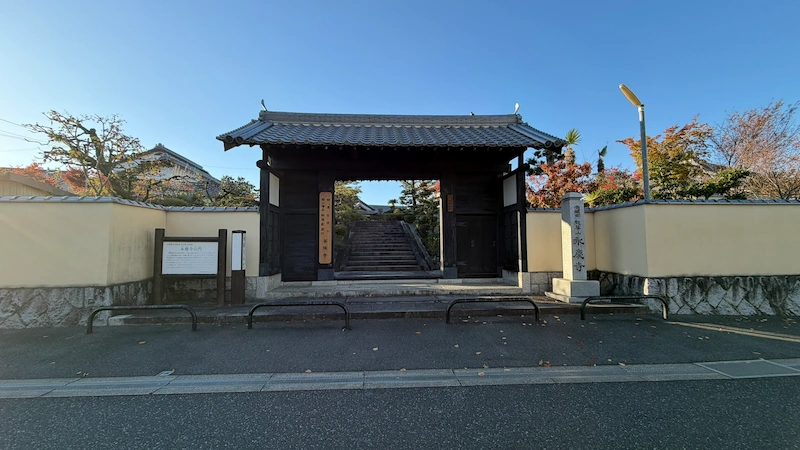
Eikeiji Temple, in Yamatokoriyama, belongs today to the Obaku school of Zen Buddhism. It was officially founded in Hoei 1 (1704), during the Edo period — well after Hidenaga's time. What makes it especially notable for this walk is that its main gate is said to be a relocated gate from Koriyama Castle itself, making it a rare physical survivor of the original castle structure.
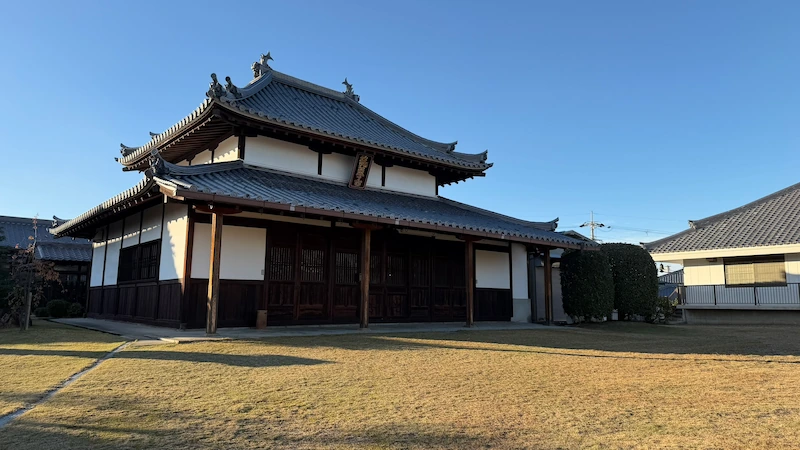
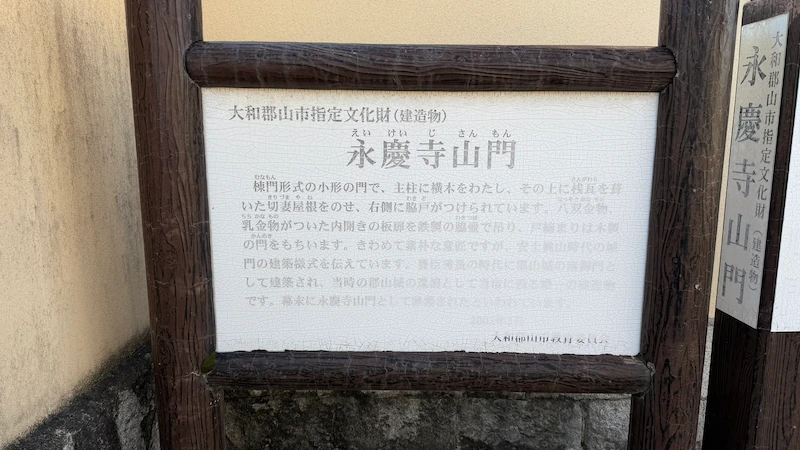
Tap to enlarge
| Temple name | Ryugesan Eikeiji |
|---|---|
| Founded | Hoei 1 (1704) |
| Founder | Yanagisawa Yoshiyasu and his family |
| School | Obaku Zen Buddhism |
| Structure | Main hall, Buddha hall, and the main gate — said to have been relocated from Koriyama Castle |
| Origin of the gate | Said to be the former South Gate of Koriyama Castle, relocated here as Eikeiji's main gate |
| Condition today | Well preserved; temple grounds, including the gate, are open to visitors |
| Cultural designation | The gate is a City-Designated Cultural Property |
| Note | Described by the Yamato Koriyama Tourist Association as the only surviving original structure from Koriyama Castle |
🗺 Address: 5-76 Eikeijicho, Yamatokoriyama, Nara
🚶 Access: About 7–10 minutes' walk from either Kintetsu Koriyama Station or JR Koriyama Station.
⏳ Suggested visit time: About 10–20 minutes to see the temple and gate.
📍 Highlights
- The relocated castle gate ("Kuromon"): Believed to be Koriyama Castle's former South Gate, this is the only structure from the original castle known to survive — a rare chance to see an actual piece of the castle's fabric rather than just its stone foundations.
- Where castle history meets temple history: After the castle was dismantled in the Meiji era, this gate found new life as a temple gate — a tangible link between the castle era and what came after.
- Family temple of the Yanagisawa clan: Eikeiji was built as the family temple of the Yanagisawa clan, who governed Koriyama Castle during the Edo period, offering insight into the relationship between the ruling samurai class and Buddhist institutions.
The Camphor Tree of Daishokukan (大職冠のクスノキ) — A Living Trace of Hidenaga's Era
Rating Historical value: ☆☆ Visual appeal: ☆☆ Experience: ☆
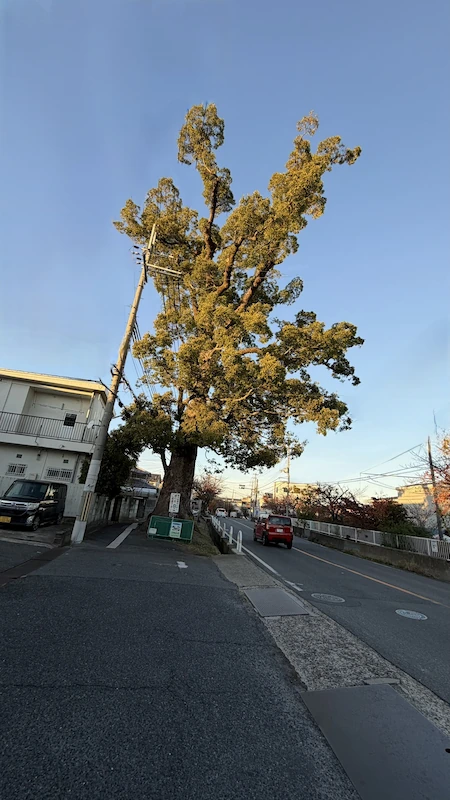
"The Camphor Tree of Daishokukan" is a massive camphor tree in the Minamikoriyamacho area of Yamatokoriyama — about 5.7 meters around the trunk, roughly 25 meters tall, and estimated at around 500 years old. It stands on land once occupied by the "Daishokukan Shrine," which enshrined the spirit of the historical figure Fujiwara no Kamatari and served as a guardian shrine for Koriyama Castle.
This area takes its name, "Daishokukan," from the highest court rank in ancient Japan's cap-and-rank system — a rank historically associated with Kamatari. When Toyotomi Hidenaga became lord of Koriyama Castle in Tensho 13 (1585), he had Kamatari's spirit invited here from Tonomine (present-day Tanzan Shrine) to serve as the castle's guardian deity, and the surrounding area came to be known by this name.
| Species | Camphor tree (kusunoki) |
|---|---|
| Estimated age / size | Estimated at roughly 500 years old; trunk circumference about 5.7 m; height about 25 m (figures as given in local tourism information, not measured by us) |
| Location | Near Minamikoriyamacho, Yamatokoriyama, Nara (the historical "Daishokukan" area) |
| Background | Growing on the site once occupied by Daishokukan Shrine, established after Hidenaga took Koriyama Castle in 1585 to invite the guardian spirit of Fujiwara no Kamatari from Tonomine; the tree survived even after the shrine itself was later relocated |
| Condition today | In good health; visible from the roadside, with a public information sign nearby |
| Cultural designation | We could not confirm any national or prefectural designation either way; locally it is noted as a landmark connected to Koriyama Castle and the Daishokukan area |
🗺 Address: Around 464-11 Minamikoriyamacho, Yamatokoriyama, Nara (the Daishokukan area)
🚶 Access: About 8–10 minutes' walk east of Kintetsu Koriyama Station, then a short distance north along Prefectural Route 9.
⏳ Suggested visit time: About 5–10 minutes; it's easily seen from the road on your way to or from other sites.
📍 Highlights
- A genuinely striking old tree: Despite being surrounded by houses and roads, this camphor tree's sheer size — a 5.7-meter trunk and 25-meter height — makes it hard to miss and impressive up close.
- A name that carries centuries of memory: The old court rank "Daishokukan," the shrine once dedicated to Fujiwara no Kamatari, and this centuries-old tree together form a rare, layered anchor to the area's deep history.
- A living witness to Hidenaga's castle town: At an estimated 500 years old, this tree would already have been growing when Hidenaga governed Koriyama in the late 16th century — a rare natural link to that period.
Dainagonzuka (大納言塚) — The Grave of Toyotomi Hidenaga
Rating Historical value: ☆☆☆ Visual appeal: ☆☆ Experience: ☆☆
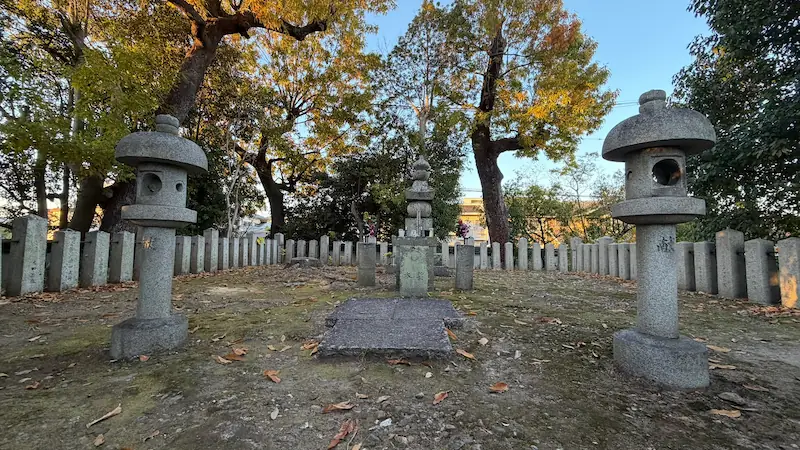
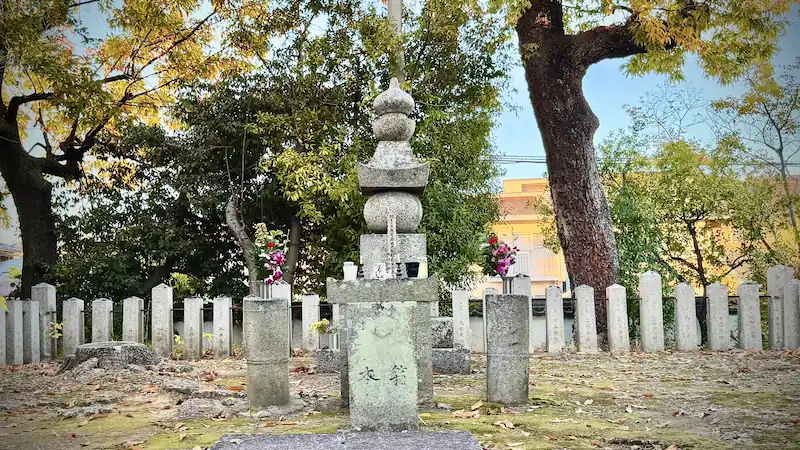
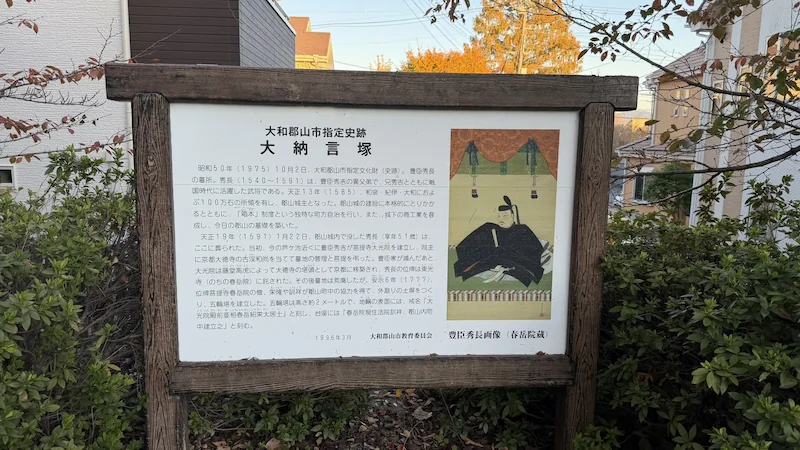
Dainagonzuka is the grave of Toyotomi Hidenaga, who died at Koriyama Castle in 1591. He was first buried at Daikoin Temple, built by his brother Hideyoshi, but after the fall of the Toyotomi clan the temple was relocated to Kyoto and the grave fell into disrepair. It wasn't until the mid-Edo period, in An'ei 6 (1777), that monks from Shungakuin Temple and local townspeople restored the site and erected the roughly 2-meter stone pagoda ("gorinto") inscribed with Hidenaga's posthumous name that still stands today. The site is now maintained by the city and the local community, and is open for anyone to visit.
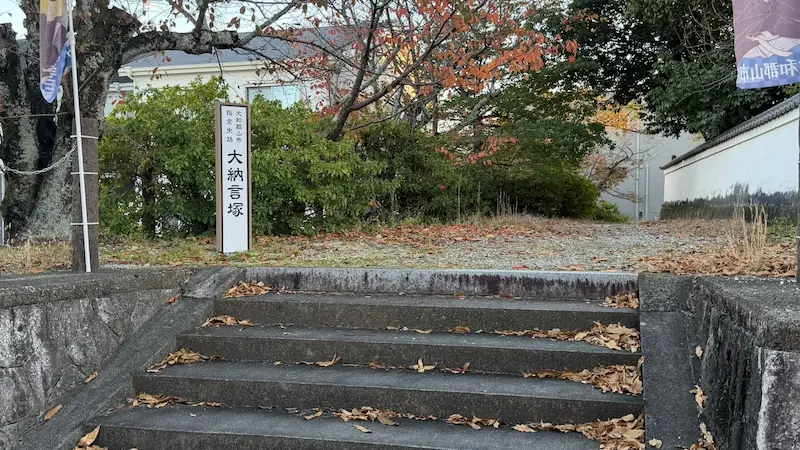
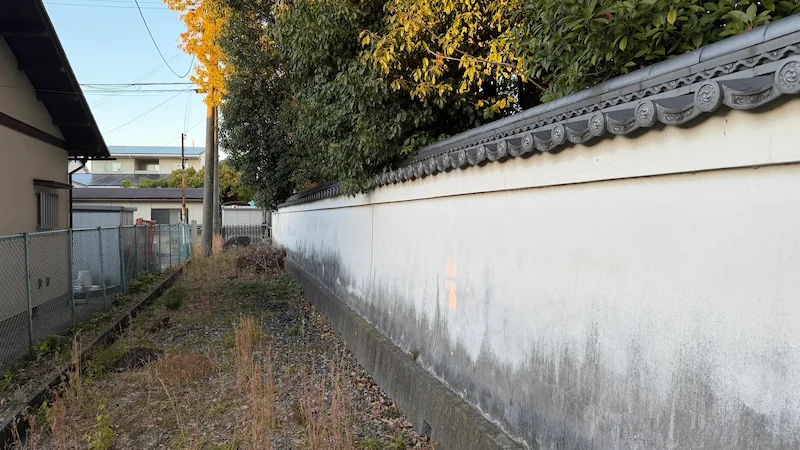
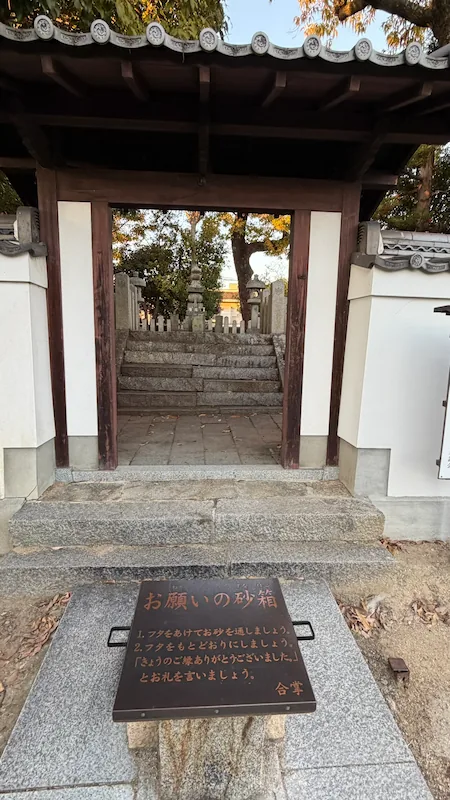
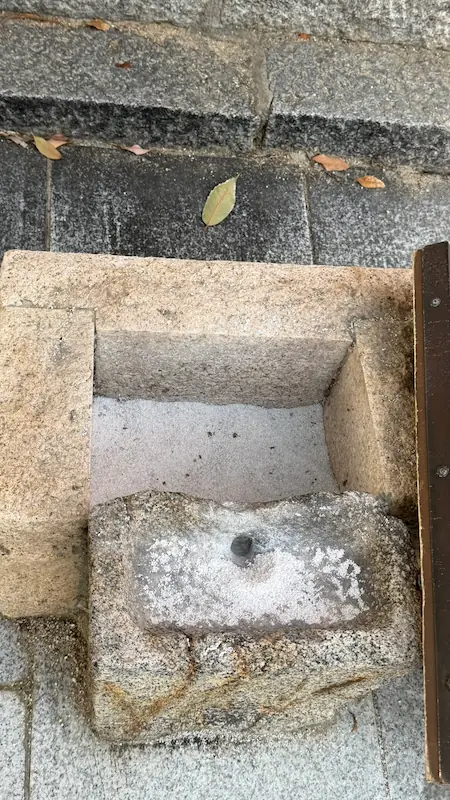
Tap to enlarge
| Location | 14 Minoyamacho, Yamatokoriyama, Nara |
|---|---|
| Original burial | 1591, following Hidenaga's death |
| Restoration | An'ei 6 (1777): the gorinto (five-ring stone pagoda) was erected and the site restored |
| Structure | A raised earthen mound topped by a stone gorinto about 2 m tall, historically enclosed by an earthen wall |
| Condition today | Well preserved; the gorinto still stands and the site is freely open to visitors |
| Cultural designation | City-Designated Historic Site |
| Note | A wish-granting sand box sits in front of the grave as part of a local prayer custom |
🗺 Address: 14 Minoyamacho, Yamatokoriyama, Nara
🚶 Access: About 10–15 minutes' walk from either Kintetsu Koriyama Station or JR Koriyama Station.
⏳ Suggested visit time: About 5 minutes for a brief visit; up to 15 minutes to pay respects unhurried.
📍 Highlights
- The gorinto memorial stone: A roughly 2-meter stone pagoda at the center of the grave, inscribed on the front with Hidenaga's posthumous Buddhist name, "Daikoin-den Zenasho Shungaku Joei Koji," and on the back with the names of those who funded its restoration — a stone that carries both regional history and the devotion of the people who preserved it.
- The "wish-granting sand box": Visitors place a paper with their name and wish into a sand box in front of the memorial stone and pass sand through it, in a local custom said to help wishes come true — prayers here often relate to Hidenaga's own reputation for academic success, military fortune, and safe childbirth.
- A quiet historic spot within a residential neighborhood: Tucked into an ordinary residential street rather than a tourist district, the grave's quiet setting makes the connection between Hidenaga's era and the present day feel especially tangible.
FAQ
Yes — all of these sites are walkable from either Kintetsu Koriyama Station or JR Koriyama Station (two separate stations run by different companies, a short walk apart). A couple of routes are worth extra care: when we visited, Google Maps' "shortest route" led us to side or back entrances at both Koriyama Hachiman Shrine and Genkuro Inari Shrine rather than the main approach, so we've included alternative route maps for those two spots in this guide. Routing can change, so check the entrance location on arrival as well.
You can see the main highlights of each site fairly quickly, but a couple of temples require advance arrangement to enter the main hall, so build in extra time if you want to go inside rather than just see the grounds.
The Outer Moat Park has stone paving and waterside sections which, in our experience on the day, looked likely to get slippery in wet weather, so comfortable, grippy footwear is a good idea regardless of the forecast.
Shrines here generally offer goshuin during set hours at their shrine office. Shungakuin Temple reopened on January 15, 2026 after the restoration of its main hall, with hours of 9:00 AM–4:30 PM (last entry 4:00 PM) and admission of ¥500 (free for elementary school age and under). Goshuin availability on the day can vary, so calling ahead in Japanese (+81-743-53-3033) is worthwhile.
Yes. Koriyama Castle's stone walls and moats are the main highlights of the castle site itself. The Outer Moat Park preserves and reconstructs part of the outer moat and its gates, and Eikeiji Temple's gate is believed to be the only original structure from the castle still standing anywhere.
On the day we walked it, much of the route was flat, with some narrow lanes and sections that were damp underfoot. With a stroller, the paved stretches around the Outer Moat Park and the Konya River area are the easiest going; some temple grounds have uneven ground or steps.
Complete Guide to Koriyama Castle
More on Toyotomi Hidenaga and Related Sites
☕ Support This Site
Following the Shogun is built on original fieldwork and on-site research.
If you found this guide useful, your support helps keep it going.

You can also support via QR code
Back to the Main Page



comment