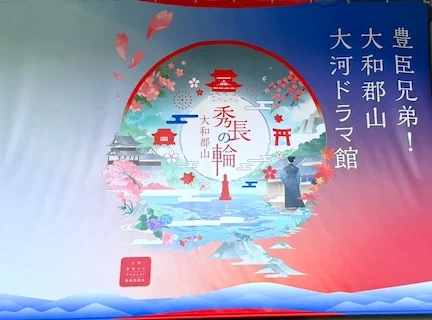
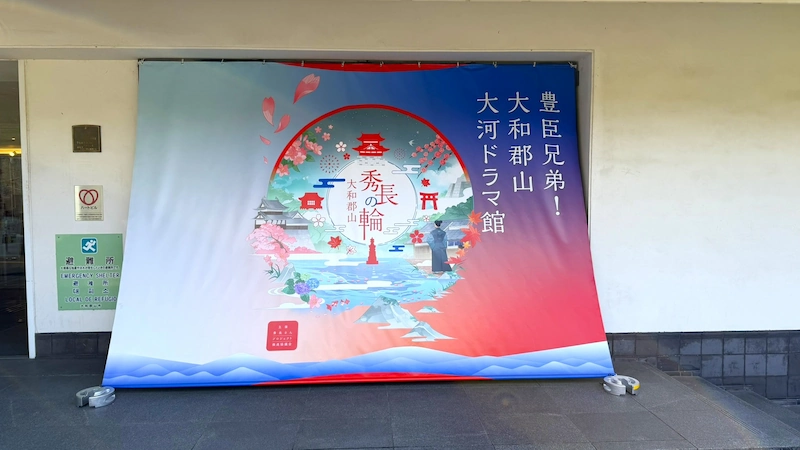
I visited the Toyotomi Brothers! Yamato Koriyama Taiga Drama Museum — a limited-time exhibition opened in Yamato Koriyama, Nara Prefecture, to coincide with the 2026 NHK Taiga Drama series Toyotomi Brothers! (Note: “Taiga Drama” refers to NHK’s flagship annual historical drama series, a beloved Japanese television institution comparable in cultural prestige to a major HBO or BBC period production.) This guide covers everything from access and admission to what’s inside — the costumes, props, stone artifacts, history displays, and the 4K theater — plus the limited-time exhibitions worth visiting nearby.
What you’ll find on this page
- Access, admission prices, and opening hours for the Yamato Koriyama Taiga Drama Museum
- What’s inside and what to look for (costumes, props, stone artifacts, history displays, 4K theater)
- The meaning behind the “lion and peony” motif woven into the costumes — a detail shared by a staff member on site
- The welcome message from actor Taiga Nakano
- How this museum differs from the Drama Museums in Nagoya Nakamura and Nagahama
- Nearby limited-time exhibitions worth combining with your visit: Shungakuin Temple and the Higashi Tamon Turret
- FAQ (how long to allow, visiting in the rain, castle stamps, and more)
Getting There
Venue: DMG MORI Yamato Koriyama Castle Hall (Shironai-cho, Yamato Koriyama City)
Nearest station: Approximately 10 minutes on foot from Yamato Koriyama Station on the JR Yamatoji Line
Dates: Monday, March 2, 2026 – Friday, January 22, 2027 (Please check the official website for the latest information)
Opening hours: 10:00 AM – 5:00 PM (last admission at 4:30 PM)
Closed on:
March 27 (Fri) / April 21 (Tue) / April 28 (Tue) / June 2 (Tue) / June 16 (Tue) / September 1 (Tue) / September 8 (Tue) / November 17 (Tue) / November 24 (Tue) / December 1 (Tue) / December 28 (Mon) – January 4, 2027 (Mon)
*Closures follow the hall’s regular schedule.
Official website: Toyotomi Brothers! Yamato Koriyama Taiga Drama Museum (Japanese Only)
0.
Admission
| Category | Individual | Group (15 or more) |
|---|---|---|
| Adult (high school age and above) | ¥600 | ¥500 |
| Child (elementary and middle school) | ¥300 | ¥250 |
| Preschool children | Free | Free |
*Prices reflect information at the time of my visit. Please check the official website for current rates and any available discounts.
The Entrance
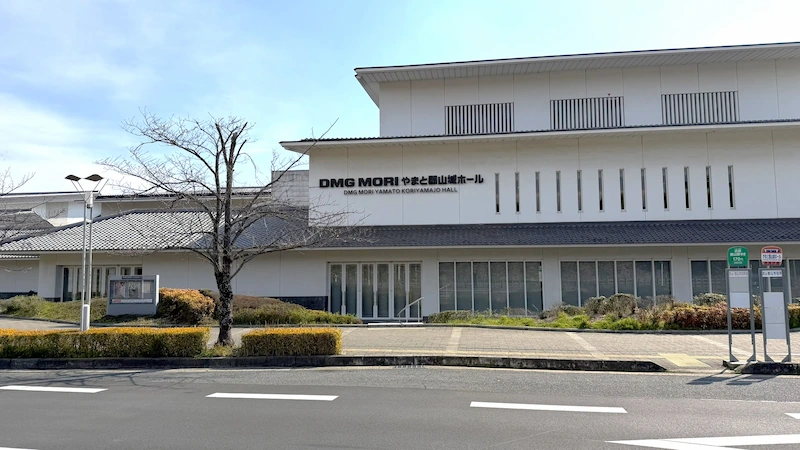
Yamato Koriyama is best known to most Japanese visitors as the “town of goldfish” — a charming local identity built around the area’s centuries-old tradition of ornamental fish breeding. But it is also the city where Toyotomi Hidenaga (Hideyoshi’s younger brother and the drama’s protagonist) extensively rebuilt Koriyama Castle and established it as the administrative hub of the Yamato, Izumi, and Kii provinces. While the Drama Museums in Nagoya Nakamura and Nagahama focus on Hideyoshi and Hidenaga’s origins and early careers, this museum tells the story of Toyotomi Brothers! from the perspective of the land Hidenaga actually governed.
Stepping off the train at Yamato Koriyama Station, you’re immediately greeted by a large banner on the platform reading “Welcome to Yamato Koriyama.”
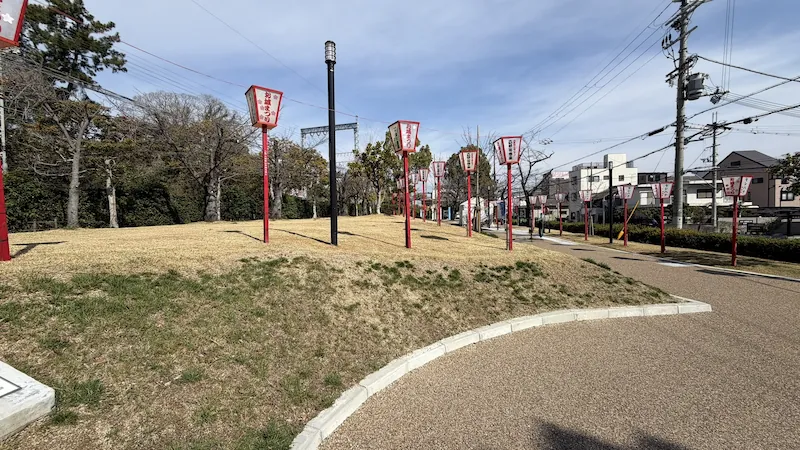
On the way to the venue, you pass through what was once the site of the castle’s Yanagikura — a storage complex associated with the old Koriyama Castle grounds. Today it’s an unremarkable stretch of roadside park; nothing signals that this was once part of a castle complex unless you already know to look. Koriyama Castle itself has a layered history: it was originally built by Tsutsui Junkei, substantially developed under Toyotomi Hidenaga, and then expanded further by Masuda Nagamori, who completed the outer moats. Walking those streets, knowing that centuries of political ambition and military tension are folded into the ground beneath your feet, you find yourself moving a little differently.
Continue on, and the venue comes into view on your right: the DMG MORI Yamato Koriyama Castle Hall, a multi-purpose civic complex housing a cultural hall, public library, and martial arts gymnasium under one roof. Directly across the street, turrets from the Yamato Koriyama Castle ruins rise above the tree line — a quietly surreal juxtaposition of a modern public building and a 16th-century fortification, separated only by a road.
A large banner for the Toyotomi Brothers! Yamato Koriyama Taiga Drama Museum hangs at the entrance. I arrived around 9:45 AM to find a queue of about twenty people already waiting for the doors to open. There’s a particular energy to that pre-opening crowd — part excitement, part shared purpose — that’s hard to replicate once you’re inside.
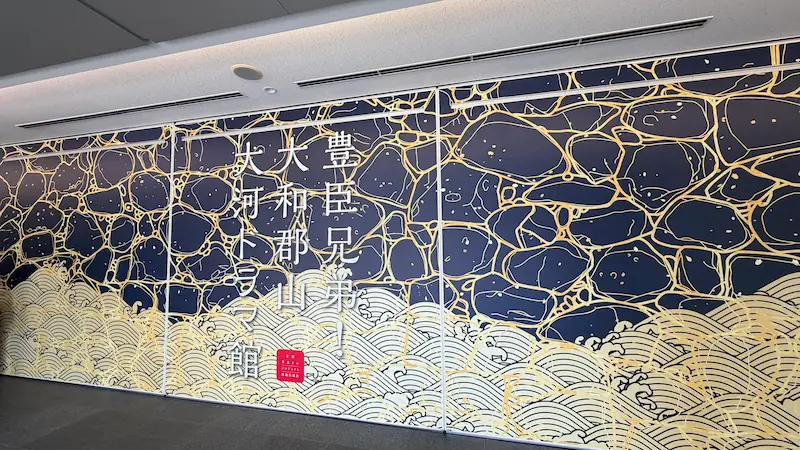
One detail worth pausing on: the exterior wall of the exhibition hall is decorated with a design that traces the stone masonry pattern of Koriyama Castle’s walls. It’s a subtle but considered touch — a nod to the castle’s architecture woven into the modern building’s facade. One panel also features a portrait of Hidenaga himself, making clear that this town is greeting visitors as “Hidenaga’s town.”
Inside the Museum
The Entrance Hall — Oversized Poster and Photo Opportunities
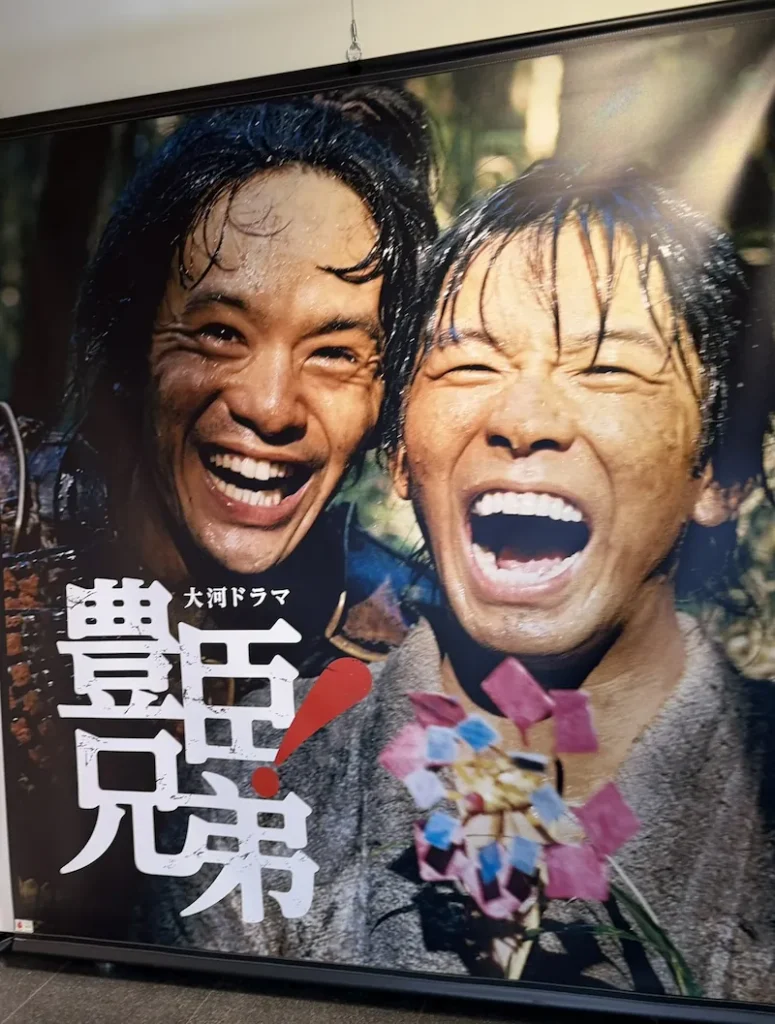
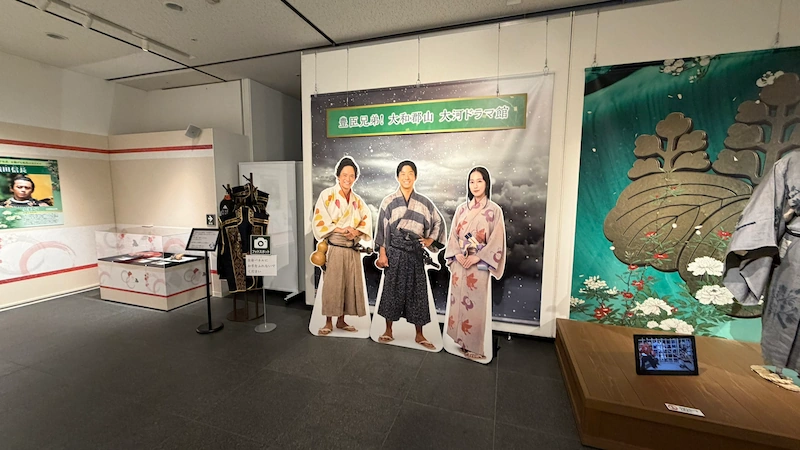
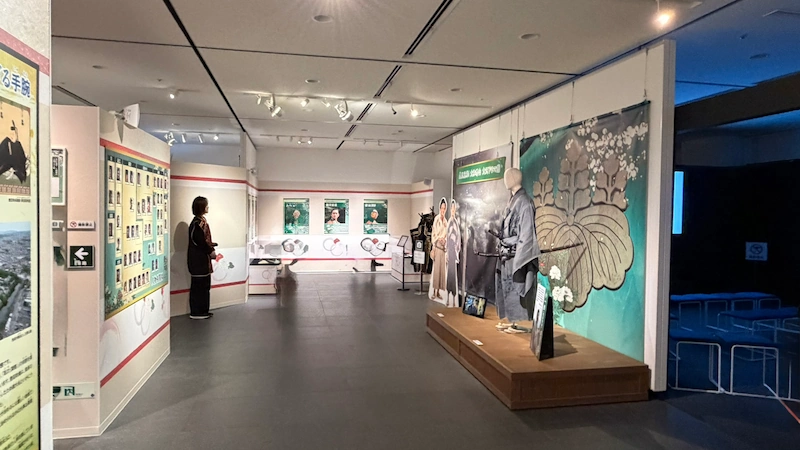
Walking in, the first thing that stops you is a massive Toyotomi Brothers! key visual — the same iconic poster image you’ve seen everywhere, blown up to full-wall scale. It hits with a sense of arrival: you’re here.
Just beyond it, a welcome video plays on loop, featuring Taiga Nakano — the actor who plays Hidenaga. He speaks directly to visitors about why Yamato Koriyama matters: this was the city where Hidenaga served as lord, brought prosperity, and spent the final six years of his life. He invites visitors not just to engage with the drama’s world through the exhibition, but to discover what he calls the “miracles still preserved” in Yamato Koriyama today. Hearing those words from the actor himself, before you’ve even reached the main displays, sets an unexpectedly meaningful tone for everything that follows.
The photo spot features life-size character panels of Hideyoshi, Hidenaga, and others from the cast. A jinbaori — a sleeveless surcoat worn over armor by samurai commanders in the Sengoku period, Japan’s era of civil war in the 16th century — is also available to try on. Slipping it over your shoulders for a photo is a small thing, but it transforms a standard souvenir snapshot into something that carries a little more weight.
Costumes and Props — A Different Angle Than the Other Museums
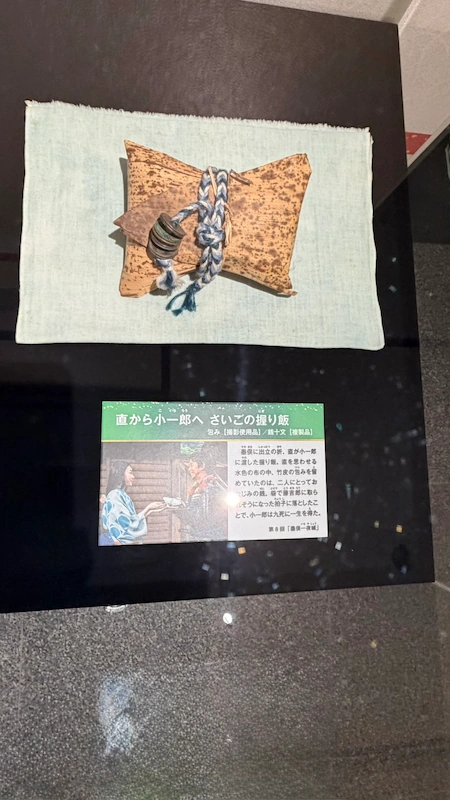
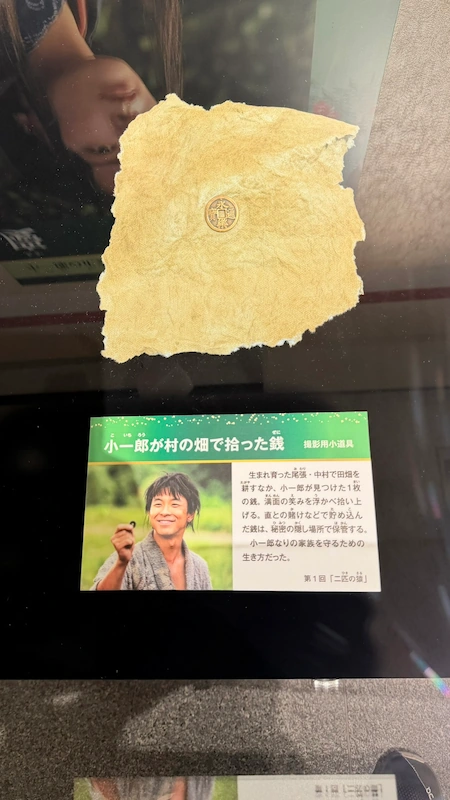
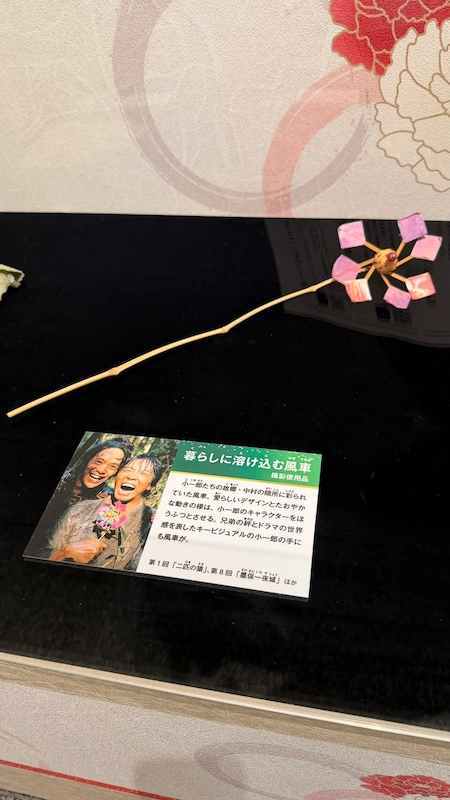
The production-used costumes and props on display here are the real thing — worn and handled on set. Compared to other Taiga Drama museums for this series, such as the Toyotomi Museum in Nakamura, the overall scale is somewhat smaller. But that constraint works in the exhibition’s favor: rather than spreading wide, it stays focused. Everything here connects back to Hidenaga and Yamato Koriyama, and the curation is tighter for it. Visitors making the rounds of multiple Drama Museums will also find costumes here that aren’t on display elsewhere, which keeps the experience fresh.
A detail shared by a staff member: the hidden language of “lion and peony”
According to a staff member on site, the costume design for this series follows a consistent symbolic logic throughout: Hideyoshi’s costumes carry the motif of a lion, while Hidenaga’s carry the motif of a peony. This thread runs through the entire drama, even as the costumes change from episode to episode. The symbolism draws on an old East Asian legend: the lion, king of beasts, is said to be powerful against almost everything — but vulnerable to a particular internal parasite. The one cure, according to tradition, is the night dew that collects on peony blossoms. In other words, Hideyoshi needs Hidenaga — and that dependency is quietly encoded into the fabric of every costume they wear. Once you know this, looking at the costumes becomes a completely different experience.
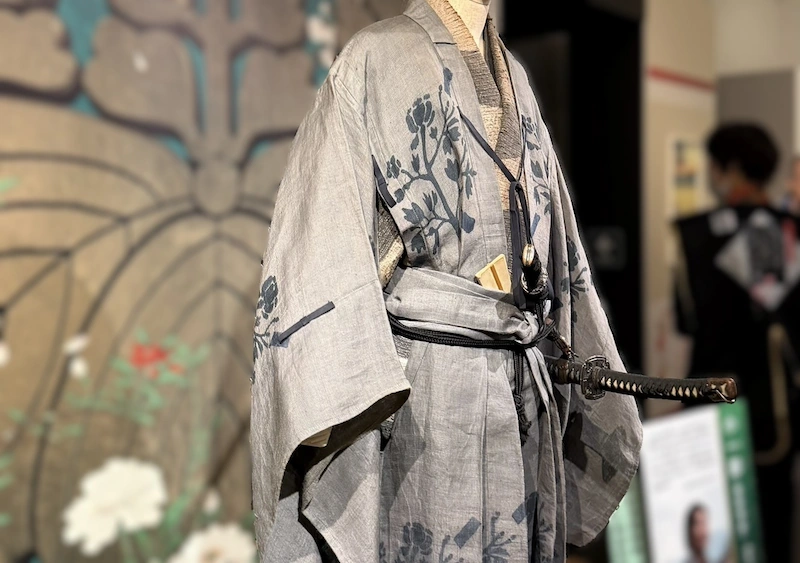
There’s another layer to Hidenaga’s costume design that the staff member mentioned. Hidenaga was known historically as a man of frugality — careful with resources, uninterested in personal extravagance. That reputation has been built into the costume construction itself: his formal robes are designed to be worn layered over simple, everyday garments underneath. Presentable on the outside; understated beneath. It’s exactly in keeping with what history tells us about him. This is the kind of detail you’d never pick up on your own, and it’s the sort of thing that only makes itself available when you show up in person.
The prop display is equally worthwhile. Pinwheels, talismans, and larger set pieces from production are arranged so that you can see them up close — objects that previously existed only within the frame of a television screen, now sitting right in front of you. That shift in proximity does something.
Touchable Stone Artifacts
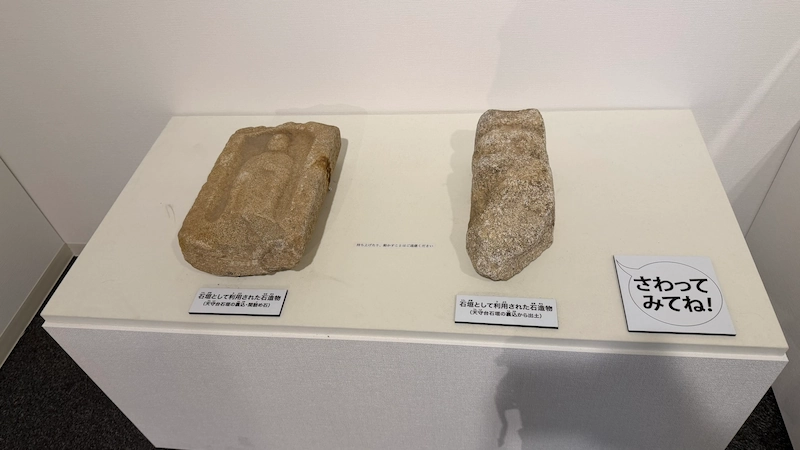
One of the most memorable parts of the exhibition is a display of stone artifacts that visitors are invited to touch. Cold, rough, solid — the physical reality of them is something photographs can’t convey. There’s a very different feeling between looking at an object and putting your hand on it.
The context matters here. When Hidenaga undertook his major expansion of Koriyama Castle, the region was short on suitable building stone. To complete the castle walls — which ultimately reached twelve meters in height — workers repurposed grave markers, stone Buddha statues, and other religious stonework as foundation material. This practice, known in Japanese as tenchi-gaeshi (literally “inverting heaven and earth”), was controversial even at the time but reflects the pragmatic urgency of the construction project. Being able to physically handle a piece of stone from that world — to feel its weight and texture — connects you to that history in a way that a display case simply doesn’t.
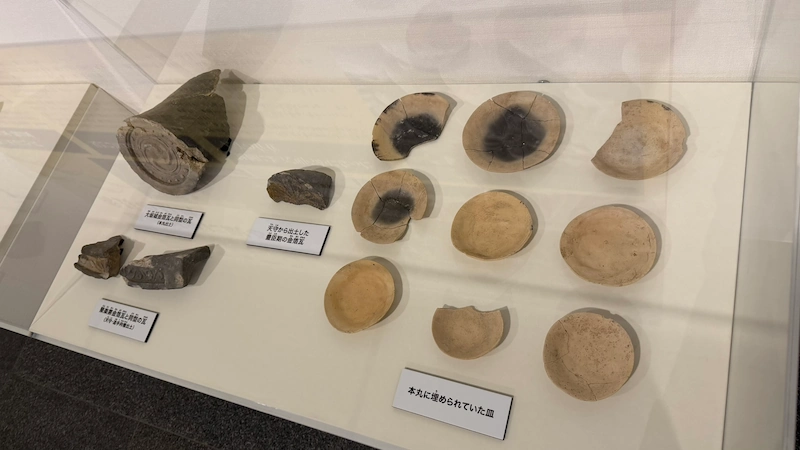
Roof tiles and pottery are also on display — items that feel less like drama props and more like primary sources. The overall effect is of an exhibition that uses the drama as a doorway but ultimately leads you into genuine local history. It operates simultaneously as a tourist attraction and a regional heritage museum, and the balance holds.
History Exhibition — Hidenaga as a Lord in His Own Right
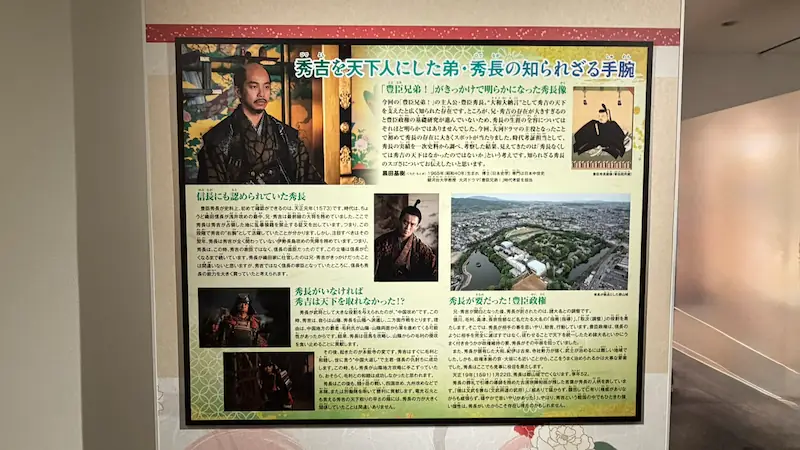
The dedicated history section is the most substantive part of the exhibition, and the one most likely to reward visitors who come knowing relatively little about Hidenaga.
Toyotomi Hidenaga is usually discussed in relation to his brother — the loyal deputy, the indispensable right hand. But in Yamato Koriyama, you see what that actually looked like in practice. From Koriyama Castle as his base, Hidenaga built an administrative structure for governing the Yamato region, drawing people into the castle town and organizing them into thirteen distinct districts by occupation and origin. The names of some of those districts survive in the city’s neighborhood names today: Zakkoku-cho (miscellaneous grains), Kon’ya-cho (indigo dyers), Tofu-cho (tofu makers). That kind of administrative specificity, embedded in the present-day landscape, is one of the more striking things Hidenaga left behind.
The exhibition also covers his tax relief policies, the degree of civic autonomy he extended to local communities, and his decision to enshrine Genkuro Inari Shrine — a Shinto fox deity deeply beloved by the townspeople — within the castle grounds as a spiritual anchor for the community. What emerges is a portrait of a man who governed with both competence and a degree of genuine care for the people under his administration. The display is clear-eyed and specific, and it gives Hidenaga a distinct historical identity that goes well beyond “Hideyoshi’s brother.”
The 4K Theater
For me personally, the 4K theater screening was the highlight of the entire visit.
The program runs in two parts: one focused on the drama production itself, the other a visual tour of Yamato Koriyama’s major sights. Running roughly ten minutes and five minutes respectively, it’s paced well — long enough to draw you in, short enough that your attention doesn’t wander. After walking through the exhibits on your feet, sitting down to watch a well-produced film provides a natural change of pace.
The drama segment features the show’s producer and several cast members speaking candidly about the making of Toyotomi Brothers! — why Hidenaga was chosen as the protagonist, how the two lead actors built their chemistry and the relationship between their characters, and what Yamato Koriyama represents within the story’s emotional geography. If you’ve already been watching the series, this section contains several moments of genuine revelation — the kind where you think, “So that’s why that scene played out the way it did.” If you’re coming to the drama fresh, it’s an effective piece of pre-viewing context.
I won’t go into specifics — part of the value is discovering it for yourself — but the screening is exclusive to this venue. Don’t skip it.
Final Thoughts
The Toyotomi Brothers! Yamato Koriyama Taiga Drama Museum isn’t a recap of the show.
You see the costumes and props up close. You put your hand on a piece of stone that carries real history. You sit in the theater and hear the people who made the drama talk about why they made it the way they did. Then you walk through the history section and see what Hidenaga actually built here. By the time you leave, the drama — if you’re watching it — looks different. The same scenes carry more weight.
The museums in Nakamura and Nagahama each frame Toyotomi Brothers! through their own local lens. This one does it through the perspective of the land Hidenaga governed — and that makes it the richest stop for anyone who wants to understand Hidenaga as something more than a supporting character in his brother’s story.
My recommendation: watch the drama first, then come here. The more you already know, the more you’ll find.
FAQ
- Q. Is it easy to find from the station?
- A. About 10 minutes on foot from Yamato Koriyama Station on the JR Yamatoji Line. There are banners on the platform to point you in the right direction, and the walk itself takes you past remnants of the old castle town.
- Q. How long should I allow?
- A. Plan for 20–40 minutes inside, including the 4K theater screening (approximately 15 minutes). Add another 30 minutes if you want time at the gift shop or a look around the surrounding area.
- Q. Can I visit if it’s raining?
- A. The exhibition itself is entirely indoors, so the visit is unaffected. The walk from the station to the venue is outdoors, so bring an umbrella and wear appropriate footwear.
- Q. How does this compare to the other Drama Museums?
- A. It’s smaller in scale, but more focused. The costumes on display here aren’t the same ones shown at the other venues, and the local history section and 4K theater content are unique to Yamato Koriyama.
- Q. Are there any closures I should know about?
- A. Yes — the museum follows the hall’s regular closure schedule. Check the official website before you go.
- Q. Are there group discounts?
- A. Group pricing is available for parties of 15 or more. See the official website for details.
- Q. Can I buy a castle stamp here?
- A. Yes. The gift shop near the entrance sells the official go-shiro-in (castle stamp) for Yamato Koriyama Castle — a collectible ink stamp unique to each castle, similar in concept to the passport stamp culture popular at national parks in the U.S. and Europe. A range of samurai general merchandise and limited Toyotomi Brothers! exclusive items are also available.
While You’re in the Area
Don’t let the Drama Museum be your only stop. The area around the venue rewards a longer look.
From the entrance, you can see the castle turrets across the road — their stone wall patterns echoed in the very wall you’re standing beside. On the walk from the station, the former site of the castle’s Yanagikura storage complex has become a quiet roadside park. You’d walk right past it without knowing. But knowing changes what you see.
Yamato Koriyama holds two identities in easy tension: a soft, unhurried town built around the culture of ornamental goldfish, and a city shaped by one of the most capable administrators of Japan’s civil war era. Both are genuinely here, and both are worth your time.
Nearby Exhibitions Not to Miss
Beyond the Drama Museum itself, several limited-time exhibitions are running in the area during the drama’s broadcast period.
Shungakuin Temple — The family temple established in memory of Toyotomi Hidenaga. A reproduction of Hidenaga’s portrait is on display, and depending on the day, you may be able to see a lacquered incense box dating back over 400 years. Visiting after the Drama Museum, when you already know what Hidenaga accomplished here, adds a different kind of weight to standing in the place where he is memorialized.
Shungakuin Temple — visitor information
“Hidenaga and the History of Koriyama” (Yamato Koriyama Castle — Higashi Tamon Turret: Normally Closed to the Public) — This special exhibition has been opened to the public specifically to coincide with the drama’s broadcast. It traces Hidenaga’s legacy through artifacts excavated from Koriyama Castle and examines how the city evolved across different historical periods. The turret itself is not normally accessible, which makes this a genuine opportunity for anyone interested in castle architecture. After the Drama Museum gives you the story, this exhibition gives you the physical evidence — and together they ask the same question from different angles: why did Hidenaga choose this place, and what did he leave behind?
Hidenaga and the History of Koriyama — visitor guide
Think of the walk itself as part of the experience, not just the transit between stops.
*The information in this article is based on conditions at the time of my visit. Exhibition content and admission prices are subject to change. Please check the official website for the most current details before you go.
Further Reading
Taiga Drama Museum in Nagahama, Shiga Prefecture
The Taiga Drama Museum in Nagoya Nakamura
Places connected to Hideyoshi


comment