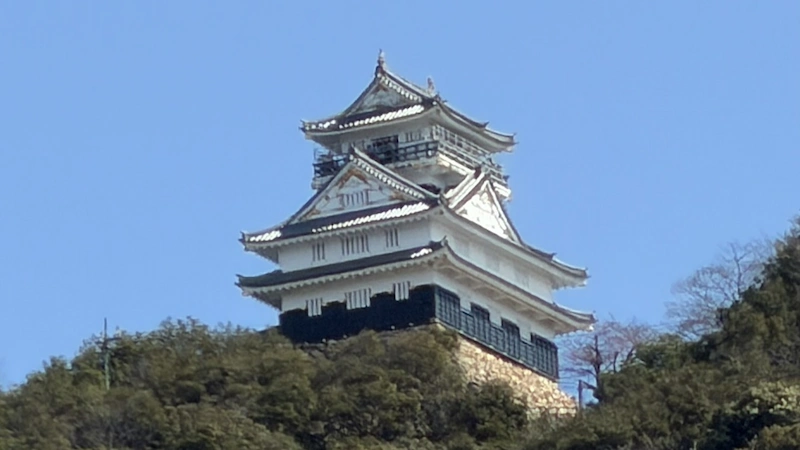
From the summit of Mount Kinka down to Gifu Park at its base, the area surrounding Gifu Castle is dotted with points of interest including gate ruins, stone walls, wells, and residence sites. A ride up the ropeway to the keep is rewarding in itself, but walking the ruins and historical sites on the lower slopes gives you a much clearer sense of how Gifu Castle and its surrounding structures were laid out during Nobunaga’s era.
There are essentially two ways to approach the visit. If you’re short on time, focusing on the summit — “Mountaintop Station → Gate Ruins & Stone Walls → Well → Around the Keep” — makes for a satisfying route. If you have half a day, starting from the base and working your way up — “Gifu Park → Residence Ruins & Garden → Mitarashi Pond → Three-Story Pagoda → Ropeway → Summit” — is the more natural flow.
Please note that Gifu Castle Keep is scheduled to close for seismic retrofitting from May 19, 2026 through late October 2027. As construction schedules and reopening dates are subject to change, be sure to check the latest information on the City of Gifu’s official website before your visit.
The upper mountain section involves stone steps and slopes toward the end of the route, and the rocks and paving become slippery in wet weather. Wear comfortable shoes and allow plenty of time. On the other hand, winter is actually an ideal season for observing ruins, as the undergrowth dies back and the outlines of the stone walls become much easier to read.
What you’ll find in this article
- How reviewing excavation findings before you walk the ruins changes what you see (and how to use the information center)
- A clear visiting order starting from either the ropeway mountaintop station or Gifu Park, with tips on where to add detours
- The connection between “what you can see today” and “what it was used for” at sites like the Presumed First Gate Ruins, stone walls, and well remains
- Spots where rain and winter conditions make footing treacherous — and how to adjust your route accordingly
- Two model course approaches: a short visit (summit-focused) and a leisurely one (lower slopes + summit)
Access
From JR Gifu Station, take a Gifu Bus and alight at the “Gifu Park / Gifu Castle” stop, a short walk from the park entrance (approximately 20 minutes). ※ Bus stop numbers and routes are subject to change; please check on-site signage on the day of your visit.
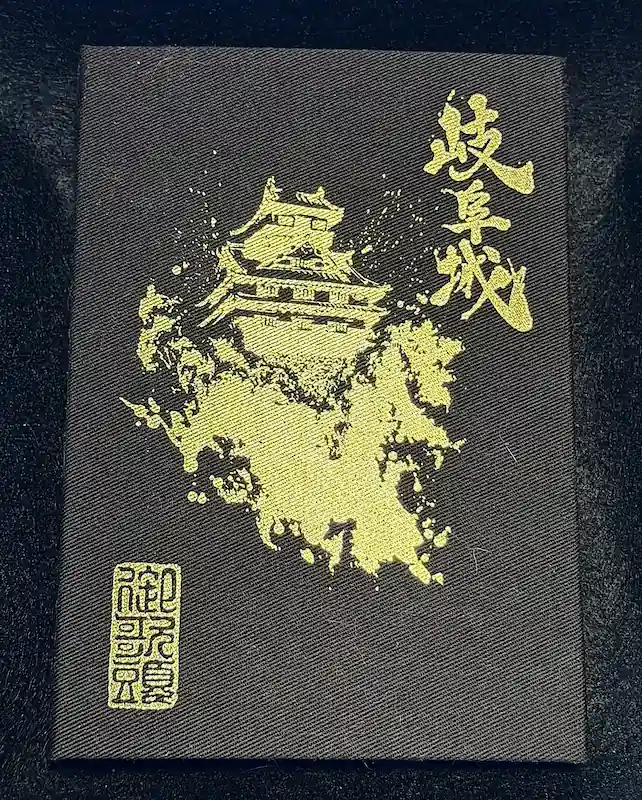
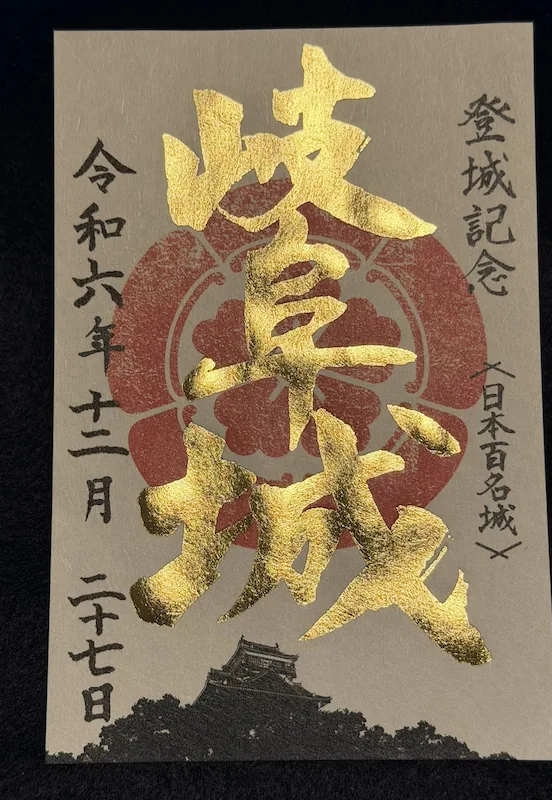
Castle Stamps (Goshuin-style)
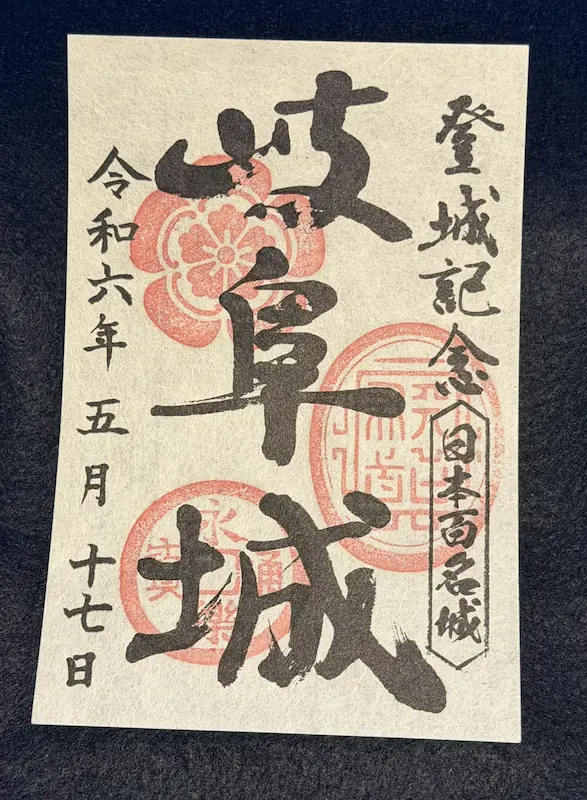
Castle stamps (御城印) and stamp books for Gifu Castle are available for purchase on the 1st floor of the ropeway valley station.
※ The gold edition stamp is sold only on the last Friday of each month. (As of February 2026)
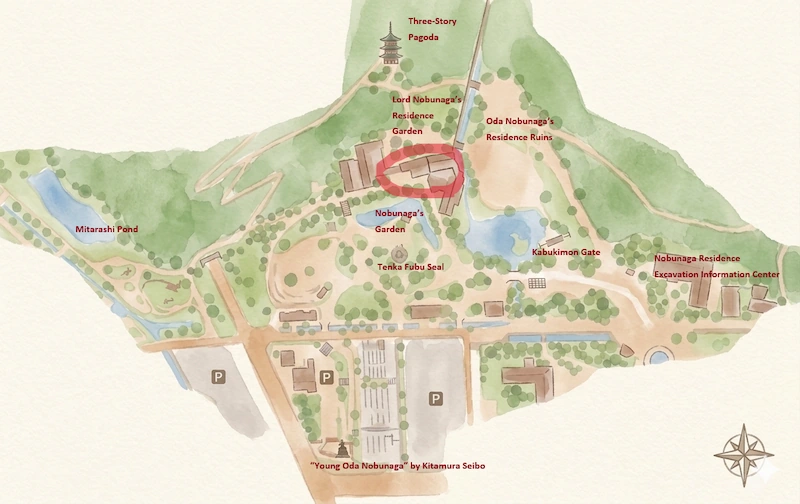
- Mount Kinka Summit Area
- Gifu Park Area
- Mitarashi Pond
- Kabukimon Gate (Entrance to Lord Nobunaga’s Residence Ruins)
- Oda Nobunaga’s Residence Ruins (Kyokan Ato)
- Lord Nobunaga’s Residence Garden (Nobunaga-ko Kyokan Teien)
- Three-Story Pagoda (Sanjunoto)
- Nobunaga’s Garden (Nobunaga no Niwa)
- Tenka Fubu Seal (Tenka Fubu In)
- “Young Oda Nobunaga” by Kitamura Seibo
- Nobunaga Residence Excavation Information Center
- FAQ
- Related Pages
Mount Kinka Summit Area
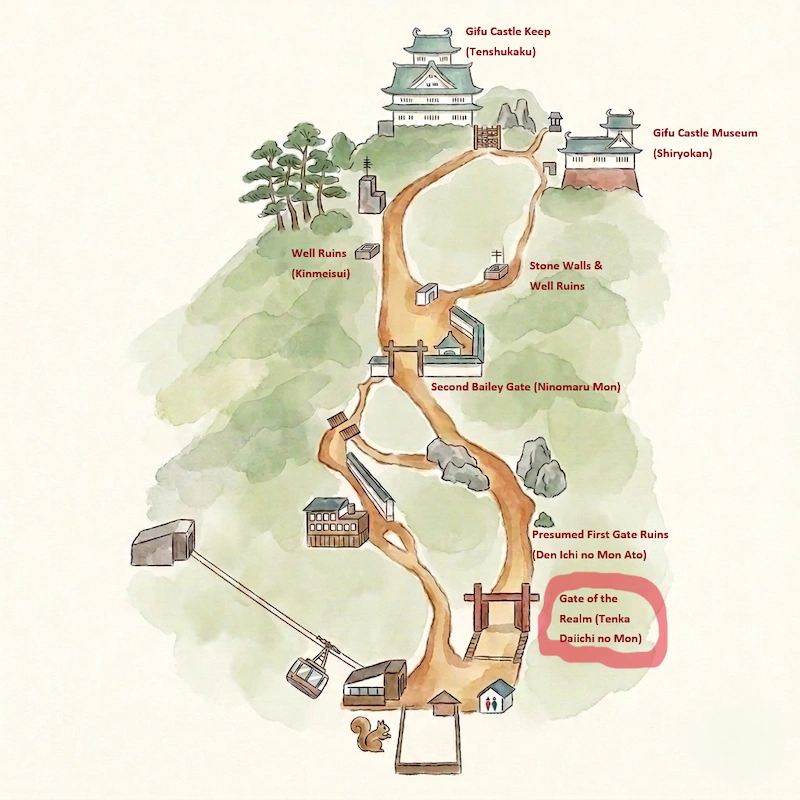
Gifu Castle – Gate of the Realm (Tenka Daiichi no Mon)
⭐ Recommended Rating
Historical Value:☆☆
Visual Appeal:☆☆
Experiential Value:☆☆
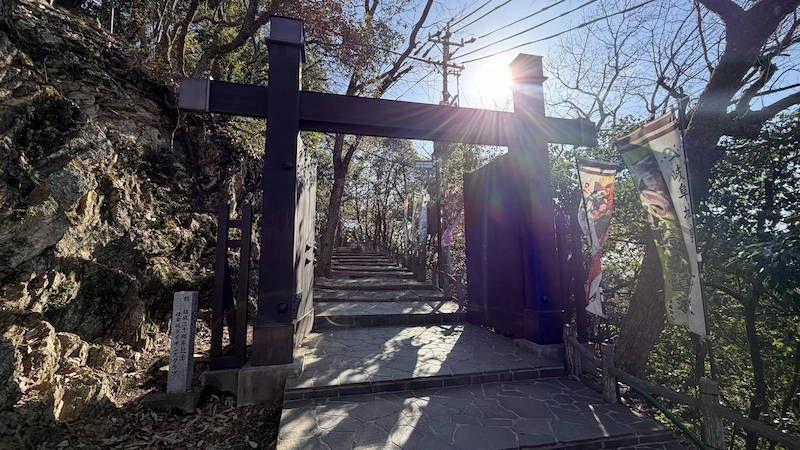
On the path from the ropeway’s mountaintop station toward the keep, you’ll pass through the “Gate of the Realm” (Tenka Daiichi no Mon). This is not a reconstruction of an actual warring-states-era gate; it is best understood as a symbolic kabukimon (crossbeam gate) erected to evoke the imagery of Gifu Castle and Oda Nobunaga. It is sometimes mentioned in connection with the period when Nobunaga renamed Inokuchi as “Gifu” after pacifying Mino Province, but the gate itself is a modern installation. Keeping that in mind as you pass through it makes it easier to understand its role as the entrance marker for the mountaintop walking trail.
| Year Built | Unknown (not a warring-states-era structure; installed in the modern era) |
|---|---|
| Builder | City of Gifu (kabukimon erected as a commemorative/symbolic gate) |
| Structure & Features | Kabukimon (crossbeam gate) / Symbolizes the “entrance” near the old main approach and Third Bailey area / Named in reference to the word “tenka” (the realm) |
| Renovation / Reconstruction History | Unknown |
| Current Status | Standing |
| Loss / Damage | Unknown |
| Cultural Property Designation | Unknown (no confirmed cultural property designation for the gate itself) |
| Notes | This is the first gate you pass through on the path from the ropeway mountaintop station toward the keep |
🗺 Location
⏳ Time Estimate
Quick visit: approx. 5 minutes
Leisurely visit: approx. 10 minutes (including checking the surrounding route and taking photos)
📍 Highlights
- A gate that puts you in a “entering the castle” mindset: It’s a natural pause point that shifts your focus from rushing to the keep toward a more thoughtful historical walk.
- Simple timber construction: Unfussy and in harmony with the mountain scenery. Shooting straight on captures a satisfying sense of depth along the path.
- Seasonal highlights: During fresh spring greenery and autumn foliage, the wooden gate blends beautifully into the landscape and the trail beyond it becomes especially photogenic.
📌 Trivia
- Surprising historical background: The site is not where a warring-states-era gate actually stood; local guides describe it as a commemorative kabukimon installed by the City of Gifu to honor Nobunaga’s grand ambitions.
- Lesser-known detail: Positioned near the old main approach and Third Bailey, it serves as the first gate encountered on the path from the mountaintop station to the keep.
- Famous figure connection: The name draws on the word “tenka” (the realm), a term Nobunaga famously embraced. It reflects the intent to symbolize Gifu Castle as the launching point of his bid for national unification.
Gifu Castle – Presumed First Gate Ruins (Den Ichi no Mon Ato)
⭐ Recommended Rating
Historical Value:☆☆☆
Visual Appeal:☆☆
Experiential Value:☆☆
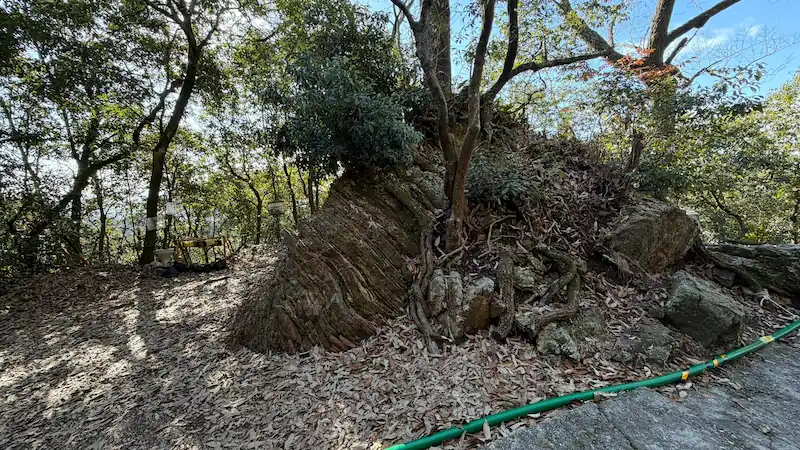
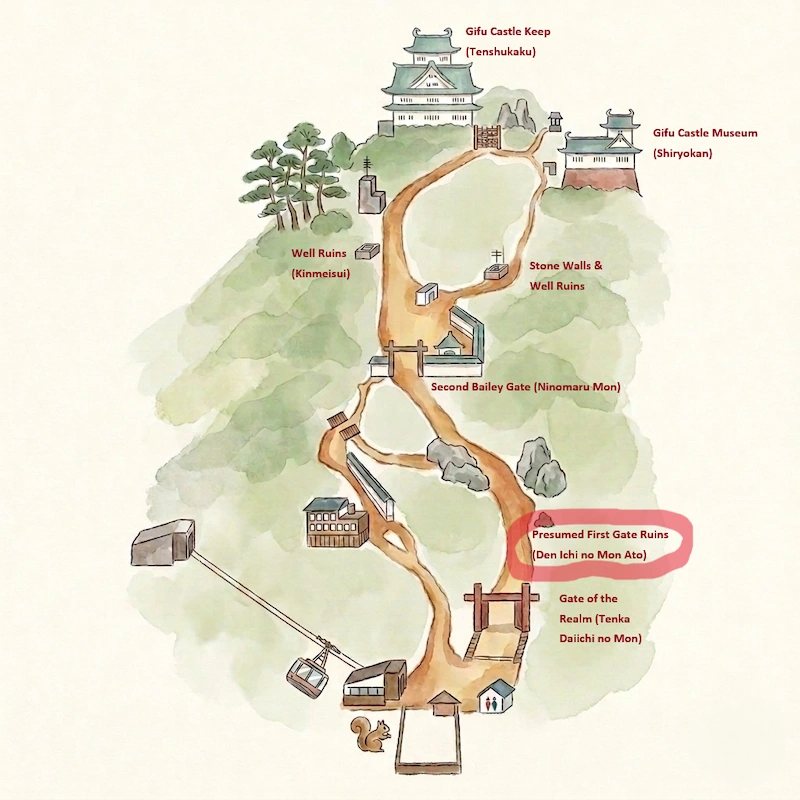
Step off the ropeway at the mountaintop station and start walking toward the keep — almost immediately, you’re greeted by the “Presumed First Gate Ruins.” What you see today are fallen boulders, remnants of stone walls, and the undulating bedrock. Yet this was the entrance to the inner citadel (the upper castle), the very first checkpoint for anyone entering the castle grounds. According to excavation surveys conducted by the City of Gifu, the site features a pathway that bends at an angle, along with massive boulder stone walls and evidence of bedrock that was deliberately worked and shaped.
What makes this spot especially compelling is its direct link to Nobunaga’s Gifu. Excavations revealed possible post-hole markings where gate pillars may have stood, along with burnt wall plaster and roof tiles, suggesting that after Nobunaga entered Gifu in 1567 (Eiroku 10; some sources say Eiroku 7), the gate may have been upgraded to one with a tiled roof. Then in 1600 (Keicho 5), during the battle that preceded Sekigahara, the castle caught fire and the gate likely collapsed — layered within this single “gate” are echoes of Nobunaga’s era of accelerating unification and the eve of Sekigahara, when the Oda clan’s fate turned dramatically. Before rushing to the keep, take a moment to pause here. Stone and bedrock alone tell you more about the castle’s intentions than you might expect.
| Year Built | First half of the 16th century (identified through excavation surveys by the City of Gifu as constructed during the Saito Dosan period) |
|---|---|
| Builder | Saito Dosan (based on City of Gifu survey findings) |
| Structure & Features | Stone walls and large boulders arranged around a raised section of bedrock; a bent pathway controlled the movement of those entering the castle / Boulder arrangement conveyed authority |
| Renovation / Reconstruction History | Possibly upgraded to a tiled-roof gate after Nobunaga’s entry in 1567 (Eiroku 10), based on excavated artifacts / Structure confirmed through excavation surveys in fiscal year 2020 (Reiwa 2) |
| Current Status | Partially surviving as ruins (stone walls, boulders, etc.) |
| Loss / Damage | Likely burned and collapsed during the pre-Sekigahara battle fire in 1600 (Keicho 5), based on survey findings |
| Cultural Property Designation | National Historic Site |
| Notes | Introduced on the on-site signage as the location identified as “Ichi no Mon” (First Gate) in Edo-period maps and records / Source: City of Gifu excavation survey findings (Gifu Castle ruins, upper section of Mount Kinka) |
🗺 Location
⏳ Time Estimate
Quick visit: approx. 3 minutes
Leisurely visit: approx. 10 minutes (including nearby gate ruins and dry moat)
📍 Highlights
- A bent pathway carved through the bedrock: By preventing straight-line passage, the design stripped intruders of both speed and sightlines — a piece of mountain castle defensive thinking you can feel with your body.
- The commanding presence of the boulder stone walls: Large boulders lined up beside the gate projected authority onto anyone entering the castle. The sheer size of the stones conveys exactly how power was displayed in that era.
- Seasonal highlights: Winter is ideal for ruin observation as the undergrowth falls away, making the rock surfaces and stonework easy to see. In summer, the shade is dense and the walk is pleasantly cool.
📌 Trivia
- Surprising historical background: Excavation findings indicate that the First Gate was likely constructed by Saito Dosan using techniques and methods related to those used at Oyagajo Castle (Yamagata City).
- Lesser-known detail: Multiple straight tool marks were confirmed in the bedrock, and it has been pointed out that these may be traces of where gate pillars were set.
- Famous figure connection: After Nobunaga entered Gifu in 1567 (some sources say Eiroku 7), the gate was likely upgraded to a tiled-roof structure — a sign that Nobunaga’s “upgrading of the castle’s status” is physically inscribed in these ruins.
Gifu Castle – Second Bailey Gate (Ninomaru Mon)
⭐ Recommended Rating
Historical Value:☆☆
Visual Appeal:☆
Experiential Value:☆☆
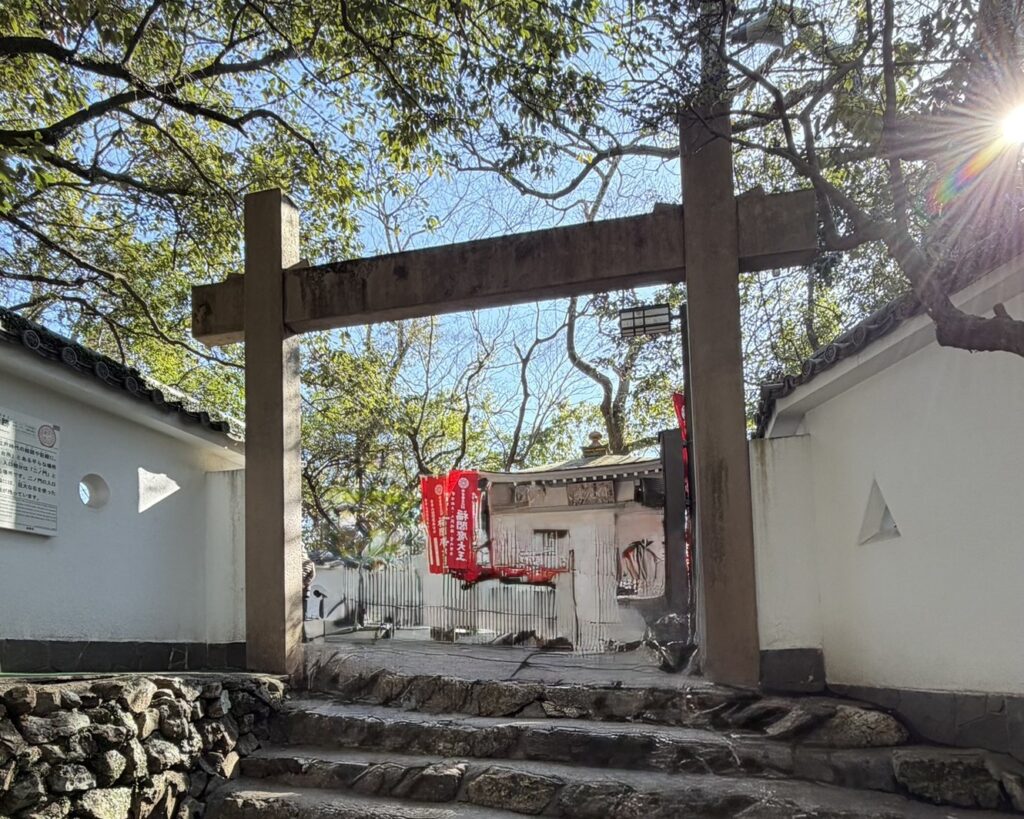
On the summit of Mount Kinka, there is a point where the flow of visitors heading toward the keep naturally falls into single file — that is the “Second Bailey Gate” (Ninomaru Mon). During the age when Oda Nobunaga seized Inabayama Castle and turned Gifu into his base of operations, a castle’s strength lay not only in the height of its keep, but in the layering of enclosures (kuruwa) and the funneling of movement through gates and passages. The second bailey (ninomaru) was a critical tier directly supporting the main bailey (honmaru) with the keep platform. The simple presence of a gate at its entrance is enough to remind you viscerally that Gifu Castle was a controlled stronghold, not merely a scenic overlook.
According to City of Gifu materials, the Second Bailey Gate on the upper mountain is a concrete structure installed as a tourist facility in the modern era. It was not built to reconstruct the position or form of a warring-states-era gate. As such, it is best understood on-site not as a historical ruin, but as a landmark and atmospheric feature along the walking trail.
| Year Built | Unknown (City of Gifu materials note that it was installed as a tourist facility, apparently following the NHK taiga drama broadcast in 1973) |
|---|---|
| Builder | Unknown (installed as part of the upper-mountain tourist facilities at Gifu Castle) |
| Structure & Features | Concrete gate (upper mountain section) / Installed as a passageway point into the second bailey |
| Renovation / Reconstruction History | Unknown |
| Current Status | Standing |
| Loss / Damage | Unknown |
| Cultural Property Designation | Unknown (no confirmed cultural property designation for the gate itself) |
| Notes | Materials note that this historic site facility gate was erected without undergoing historical research or verification |
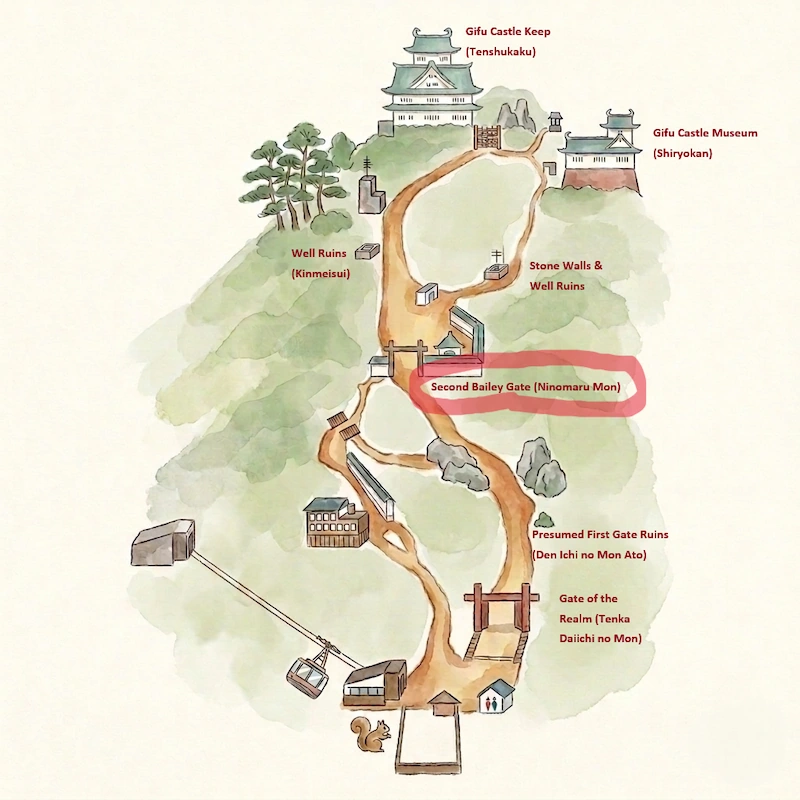
🗺 Location
⏳ Time Estimate
Quick visit: approx. 3 minutes
Leisurely visit: approx. 10 minutes (including a walk around the second bailey)
📍 Highlights
- The feeling of passing through a gate into an enclosure: It gives you a moment to collect yourself before pressing on to the keep, instilling a sense of “moving deeper into the castle.”
- Understanding the layout of the second bailey: As the enclosure directly supporting the main bailey below the keep platform, this is a useful waypoint for visualizing the three-dimensional structure of the castle.
- Seasonal highlights: In winter, as undergrowth clears, the ruins and stone walls along the path become easier to observe — the best season for castle exploring on foot.
📌 Trivia
- Surprising historical background: City of Gifu materials describe the Second Bailey Gate as a concrete structure built as a modern tourist facility, not a historical reconstruction.
- Lesser-known detail: The same materials note that gates, walls, and other castle structures installed here were erected without the benefit of historical research or verification.
- Famous figure connection: What Nobunaga aimed to create at Gifu was not just a defensible stronghold, but a base for receiving, impressing, and managing people. Simply passing through the gate helps you walk with the castle’s structure in mind.
Gifu Castle – Well Ruins (Kinmeisui)
⭐ Recommended Rating
Historical Value:☆☆☆
Visual Appeal:☆
Experiential Value:☆☆
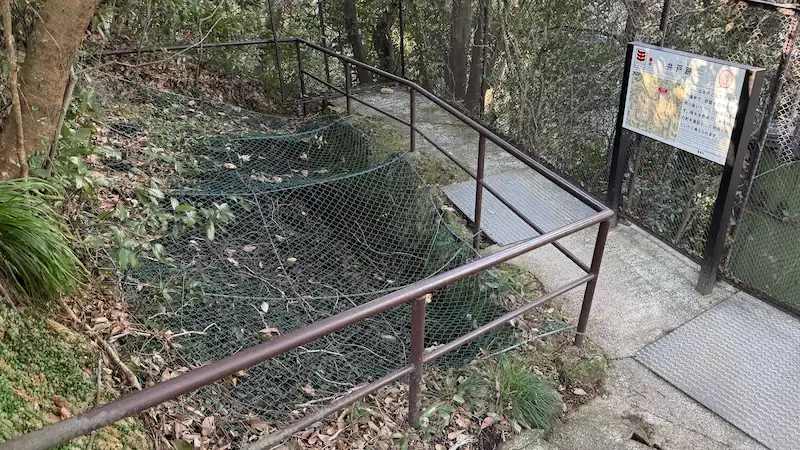
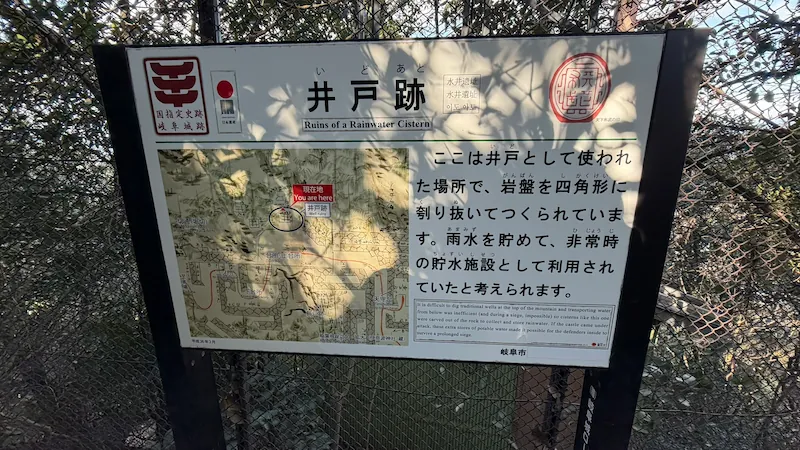
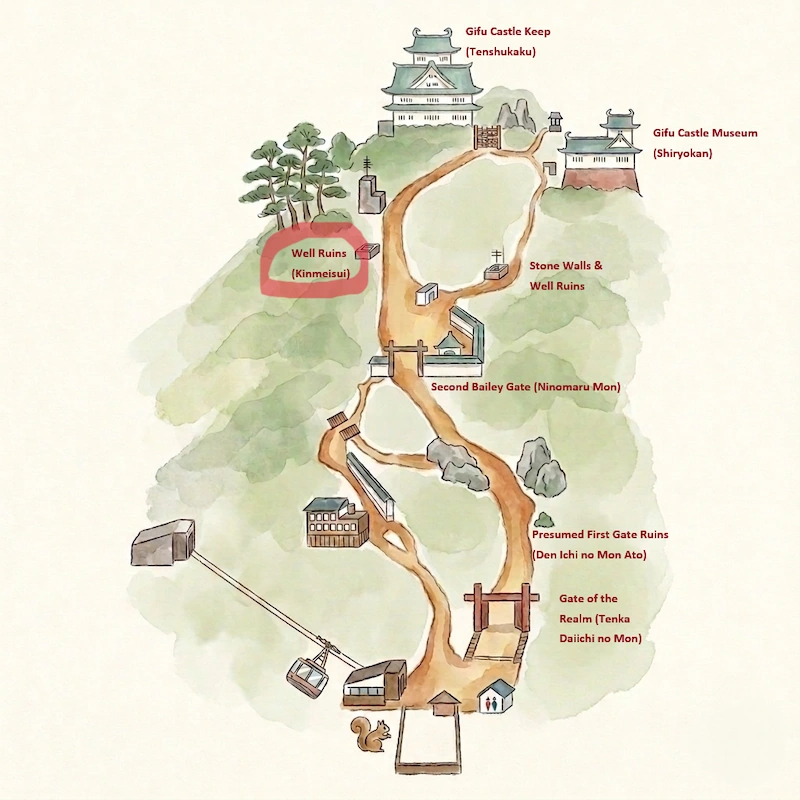
Walking the summit of Gifu Castle, you come across something that stands in stark contrast to the castle keep’s grandeur — a raw, practical reality. That is “Kinmeisui” (Golden Clear Water), traditionally described as a military well. Mount Kinka is essentially a solid mass of rock, with almost no natural spring water to speak of, making drinking water the greatest vulnerability of any siege defense. That is precisely why someone took the effort to dig down through rock to create a device for capturing water — a well designed to collect rainwater and the faint seepage from cracks in the rock. The City of Gifu’s on-site explanation describes it exactly this way: Mount Kinka’s rocky composition makes natural springs nearly impossible to tap, so the well was dug to collect rainwater and moisture filtering through the stone.
When Nobunaga entered Gifu and elevated this fortress into his platform for national domination, the castle was required not just to be strong but to be sustainable. War doesn’t end with a single victory. Both attackers and defenders need water to keep their soldiers going. This well sits slightly off the main path to the keep, but it is worth stopping at for what it reveals about the castle’s practical side. The fact that water comes up before stone walls and gates says a great deal about the harsh reality of life in a mountain castle.
| Year Built | Unknown (said to have been dug during the warring states period for siege use) |
|---|---|
| Builder | Unknown |
| Structure & Features | A well designed not to tap groundwater but to collect rainwater and moisture seeping through rock (effectively a water storage facility) / Located on the west side of the second bailey |
| Renovation / Reconstruction History | Unknown |
| Current Status | Surviving as ruins (open for viewing) |
| Loss / Damage | Unknown |
| Cultural Property Designation | National Historic Site (within the designated area of Gifu Castle ruins) |
| Notes | Signage and other guides note that the upper section of Mount Kinka has a total of four wells: multiple on the west side of the second bailey and one on the east side (exact positions should be confirmed on-site) |
🗺 Location
⏳ Time Estimate
Quick visit: approx. 3 minutes
Leisurely visit: approx. 10 minutes (including the nearby enclosures and gate ruins)
📍 Highlights
- The warring-states reality of a “well that doesn’t spring”: The very concept of collecting rainwater and rock seepage, rather than tapping groundwater, speaks volumes about the harsh conditions of mountain castle life.
- A “logistics” perspective in the shadow of the keep: This is the prompt that shifts your gaze from the castle’s scenic grandeur to its functional, practical side — and suddenly Nobunaga’s operational thinking comes vividly to mind.
- Seasonal highlights: After rain, the well’s role as a water storage facility becomes intuitively convincing. The site takes on a different character from drier days — watch your footing.
📌 Trivia
- Surprising historical background: The City of Gifu explains that because Mount Kinka is a rocky mass, spring water was essentially unavailable, making securing drinking water for a siege “extremely difficult.”
- Lesser-known detail: Signage indicates that the upper section of Mount Kinka has multiple wells on the west side of the second bailey and one on the east side. Kinmeisui is introduced as one of these.
- Famous figure connection: When Nobunaga elevated Gifu Castle to his base for the conquest of the realm, the castle needed not just impressive looks but genuine staying power for a siege. Kinmeisui represents the ingenuity behind that effort.
Gifu Castle Keep (Tenshukaku)
⭐ Recommended Rating
Historical Value:☆☆☆
Visual Appeal:☆☆☆
Experiential Value:☆☆☆
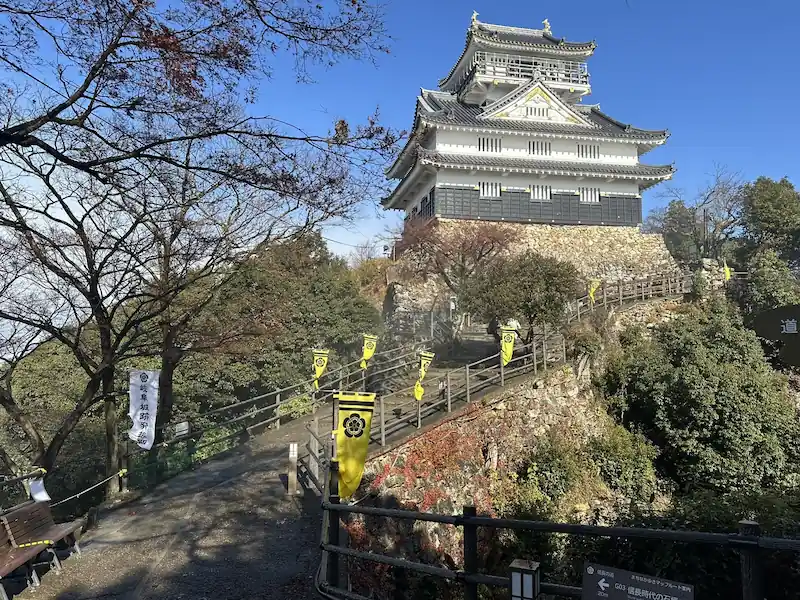
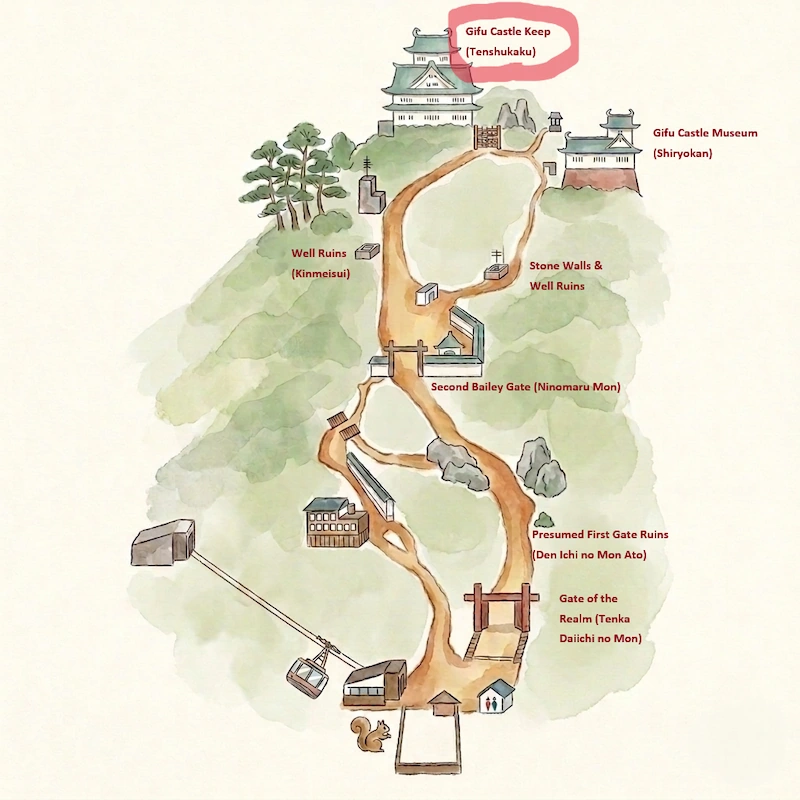
The one place you absolutely must visit on any Nobunaga pilgrimage in Gifu is the Gifu Castle Keep. In 1567 (Eiroku 10; some sources say Eiroku 7), when Nobunaga seized Inabayama Castle and renamed it “Gifu,” the mountain summit was transformed from a mere fortification into “a stage for displaying his reach toward national rule.” Below, the Nagara River; in the distance, the Nobi Plain. The more the view opens up, the more naturally you feel in your bones what it meant for Nobunaga to govern both politics and military affairs from this very spot.
The keep we climb today is not the original warring-states structure; it is a reconstruction rebuilt in 1956 (Showa 31). But that is precisely what makes it interesting. Here, the “functional logic of the castle” that Nobunaga carved into Mount Kinka and the “symbol of Gifu” that modern residents have protected and nurtured exist in the same place at the same time. Walking the upper-mountain path to the keep, you pass gate ruins, stone walls, and well remains — “the mechanisms that kept the castle alive” — and the keep’s panorama at the end pulls it all together. Standing on the observation deck and gazing out over the Nobi Plain, you understand without being told why Nobunaga chose this mountain. Note that the keep is scheduled to close for a period due to seismic retrofitting work (see Notes).
🏯 Inside the Keep: Experiencing Nobunaga’s Ambition and Aesthetic
The interior of the reconstructed keep offers far more than just views. The exhibits on each floor confront you with one facet of Nobunaga’s character after another.
First to catch the eye are two suits of armor reconstructed in 2017. One is a warring-states suit rendered in green and gold; the other is “Southern Barbarian armor” — Western plate armor worn with a velvet mantle. Both, with no need for explanation, show just how far outside the conventions of his time Nobunaga stood.
Among the exhibits, what leaves the deepest impression is the placard for the Rakuichi-Rakuza free-market decree (reproduction). What we would call “deregulation” today, this man proclaimed on a single piece of wood and posted it in the marketplace. The fact that his handwriting (in reproduction) is right there in front of you — that a political decision is visible to the naked eye — carries a weight entirely different from reading about it in a textbook.
The exhibit covering the 1569 visit by Portuguese missionary Luis Frois to Gifu Castle presents his eight-day stay documented day by day. Reading about how warmly Nobunaga received him, alongside the CG reconstruction of the residence complex, suddenly makes the description “a paradise on earth” feel startlingly real.
The corner explaining the origin of the place name “Gifu” is not to be missed either. “Gi” comes from Mount Qi (Qishan) in China — the place where King Wen of Zhou established order over the realm — while “fu” comes from Qufu, the birthplace of Confucius. Those two characters combined give us “Gifu.” Packing that much philosophical intent into a single place name. Here, quietly, it sinks in that Nobunaga was no ordinary warlord.
A slightly different note is struck by the display of an uchikake (outer robe) actually worn by actress Momoko Kikuchi in her role as Lady No in the 1992 NHK taiga drama “Nobunaga: King of Zipangu.” After so much historical gravity, having a moment like this in the corner is not unwelcome.
| Year Built | Traditionally: Kennin era (1201–1204) / Nobunaga’s Gifu Castle period: from 1567 (Eiroku 10) / Current keep: rebuilt 1956 (Showa 31) |
|---|---|
| Builder | Traditionally: Nikai-do Yukimasa (various theories) / Warring-states development: Saito clan → Oda Nobunaga |
| Structure & Features | Reconstructed keep at the heart of the mountain castle on the summit of Mount Kinka / The panoramic view is the prime attraction (overlooking the Nagara River and Nobi Plain) |
| Renovation / Reconstruction History | 1910 (Meiji 43): replica keep constructed → 1943 (Showa 18): destroyed by fire → 1956 (Showa 31): current reconstructed keep built |
| Current Status | Standing (operating as a public facility) |
| Loss / Damage | Replica keep destroyed by fire in 1943 (current keep rebuilt 1956) |
| Cultural Property Designation | National Historic Site “Gifu Castle Ruins” (within designated area) |
| Notes | Scheduled closure for construction: May 19, 2026 – late October 2027 (planned) / Reopening: November 2027 (planned) ※ Please check the City of Gifu’s official website for the latest information |
🗺 Location
⏳ Time Estimate
Quick visit: approx. 20 minutes
Leisurely visit: approx. 40 minutes
📍 Highlights
- 360-degree panorama from the keep: The Nagara River and Nobi Plain in full view. The reason Nobunaga “made the terrain his ally” becomes legible from the view itself.
- The mountain castle’s approach (combined with gate ruins and stone walls): Ruins are scattered along the path from the mountaintop station to the keep, making it clear that Gifu Castle was protected by “systems,” not just scenery.
- Seasonal highlights: During the limited-period evening event “Gifu Castle Panorama Night View,” you can experience the sky shifting from dusk to darkness over the realm. (Check official sources for event dates.)
📌 Trivia
- Surprising historical background: The current keep is a reconstruction from 1956 (Showa 31) — the warring-states-era keep itself no longer stands.
- Lesser-known detail: It’s an 8-minute walk from the mountaintop station to the keep. If you arrive close to closing time, you may not make it — building in a little buffer when you arrive at the mountaintop station is key.
- Famous figure connection: Described as the starting point from which Nobunaga reached for national rule.
Gifu Castle Museum (Shiryokan)
⭐ Recommended Rating
Historical Value:☆☆☆
Visual Appeal:☆☆
Experiential Value:☆☆
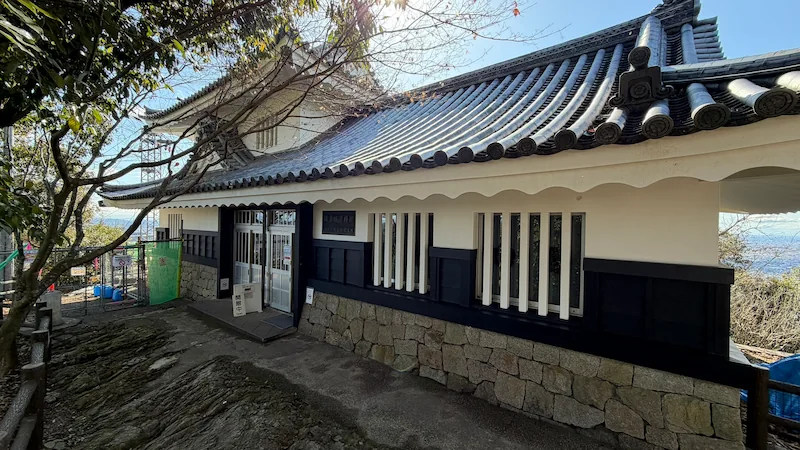
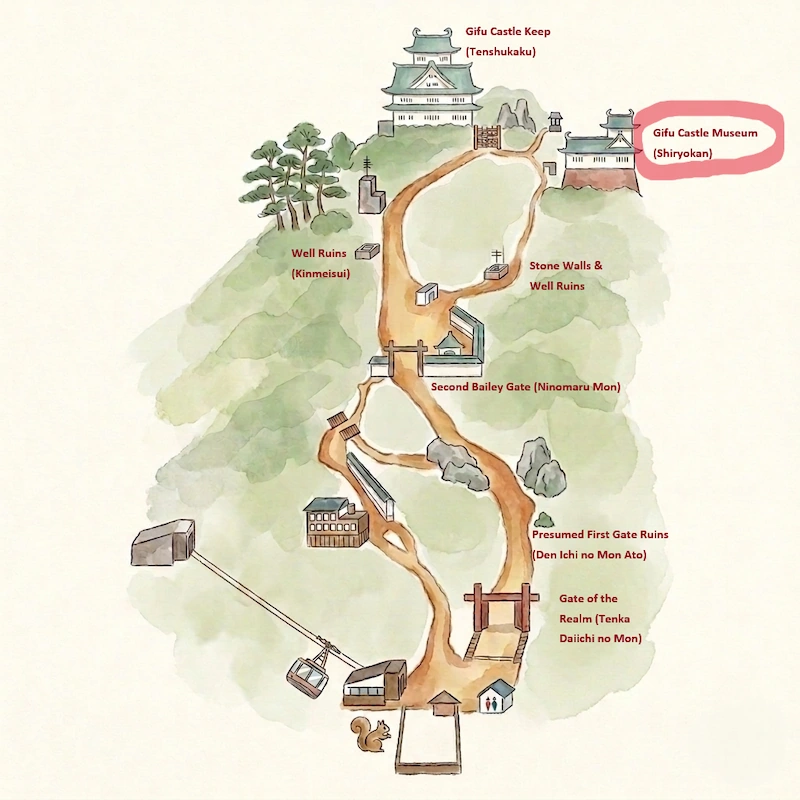
Along the path to the keep, there is another face of the castle waiting to be discovered — the Gifu Castle Museum. Built in 1975 (Showa 50) as a recreation of the old armory and granary in a corner-turret castle style, if the keep is the “castle as spectacle,” this building is the place that lets you imagine the castle’s behind-the-scenes reality.
At the entrance, a life-size figure of Nobunaga in a red mantle greets you, accompanied by the words “Return to Mino as many times as you like” — reportedly what Nobunaga said to Frois at their parting.
The most compelling display inside is related to the 2020 NHK taiga drama “Kirin ga Kuru.” On view are the black-laced ridge helmet (kurogawa odoshi suji kabuto) actually worn by Masahiro Motoki in his role as Saito Dosan, alongside the Akechi Mitsuhide costume worn by Hiroki Hasegawa and the Nobunaga costume worn by Sho染谷将太. There is a peculiar poignancy in watching a historical figure become real through an actor’s performance, only to return to the very castle it all revolved around.
On the walls hang portrait paintings of Nobunaga and Dosan by Tsuyoshi Nagano, the illustrator best known for the “Nobunaga’s Ambition” game series. The image of Nobunaga — Southern Barbarian armor, matchlock rifle at the ready — painted with Gifu Castle in mind, carries a power that is neither historical artwork nor manga, but something entirely its own.
Neither the keep nor the museum alone is quite enough. It takes both together to feel like you’ve truly seen Gifu Castle.
| Year Built | April 1975 (Showa 50) (reconstructed and developed) |
|---|---|
| Builder | City of Gifu (developed and operated) |
| Structure & Features | Recreation of the old armory and granary in “corner-turret castle style” (sumiyagura shiro-kaku zukuri) / Houses Gifu Castle-related exhibits / Interior presented as a photo spot |
| Renovation / Reconstruction History | Unknown (scheduled closure for seismic retrofitting; see below) |
| Current Status | Standing (operating as a public facility) |
| Loss / Damage | Unknown |
| Cultural Property Designation | Unknown (no confirmed cultural property designation for the building itself) |
| Notes | Admission is shared with Gifu Castle Keep / Museum tickets must be purchased at the keep; they are not sold at the museum / Scheduled closure: April 1, 2026 – late October 2027 (planned) |
🗺 Location
⏳ Time Estimate
Quick visit: approx. 15 minutes
Leisurely visit: approx. 25 minutes
📍 Highlights
- The corner-turret castle-style exterior: White walls and tiled roof set against the mountain scenery — a different kind of castle charm from the keep itself.
- Exhibits that deepen your understanding of Gifu Castle: If the keep delivers “awe,” the museum delivers “clarity.” It takes your reading of the castle one level deeper.
- Seasonal highlights: The exterior photographs well on sunny days, and during autumn foliage the color against the white walls gives photos a striking quality.
📌 Trivia
- Surprising historical background: City of Gifu materials describe it as a building modeled on the old armory and granary, reconstructed in a corner-turret castle style in April 1975 (Showa 50).
- Lesser-known detail: Museum tickets are purchased at the keep, not at the museum itself — worth remembering to avoid confusion.
- Famous figure connection: Nobunaga’s Gifu Castle was “a base for reaching toward the realm.” The museum prompts you to look beyond the drama of military glory to the stores and military logistics that kept the castle running.
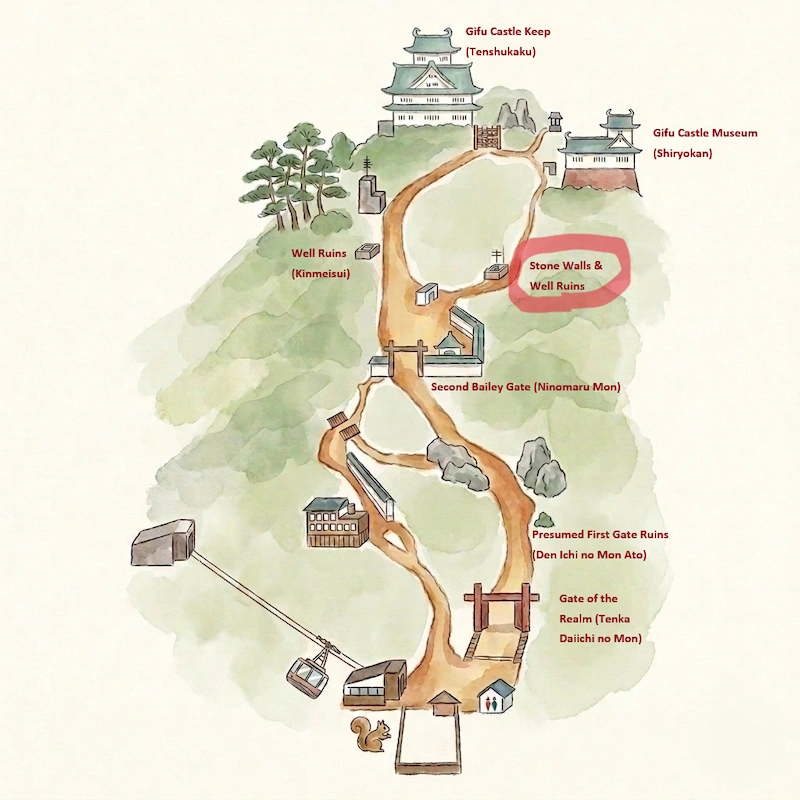
Stone Walls & Well Ruins
⭐ Recommended Rating
Historical Value:☆☆☆
Visual Appeal:☆☆
Experiential Value:☆☆
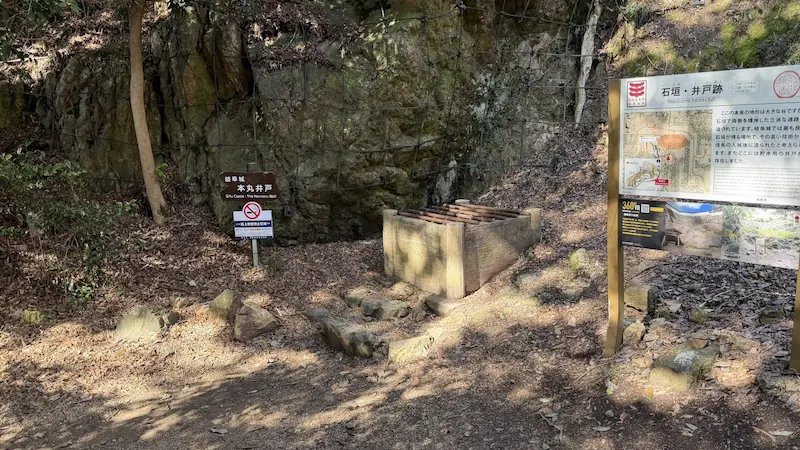
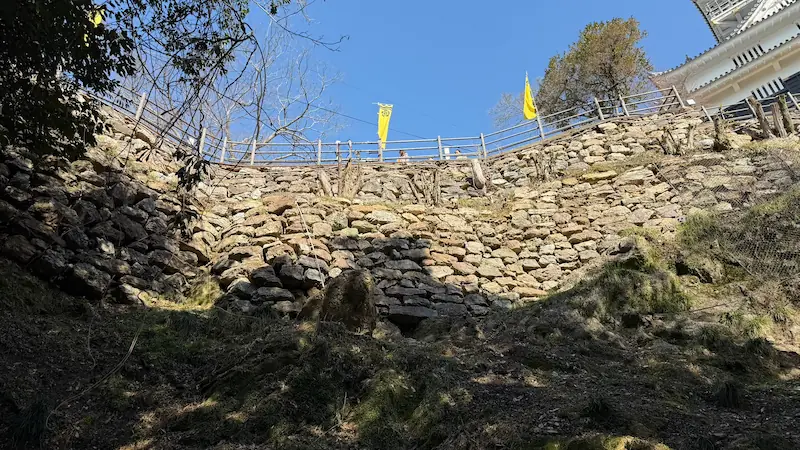
On the upper section of Mount Kinka, there is a spot where you want to set aside the keep’s photogenic appeal and just walk. That spot is the “Stone Walls and Well Ruins.” This area was originally a deep valley formed by the mountain’s natural topography; both sides were then faced with stone walls to convert it into a proper passageway that could serve as a functional route within the castle. The point of interest here is less “stone for stone’s sake” and more the act of reading the terrain, cutting into it, and stacking stone to turn it into a usable path — that one act of effort transformed a mountain castle into a truly operational stronghold.
When Oda Nobunaga seized Inabayama Castle and elevated it as “Gifu Castle” — his platform for dominating the realm — the castle evolved from a scenic fortification into a hub running both governance and military operations in tandem. That transformation was inscribed not only in the gates and enclosures, but in the very way the stone walls were stacked. City of Gifu surveys have identified examples of stone walls classified as “post-Nobunaga” based on the shape and stacking method of the stone, and there is also the possibility that roof tiles from the Nobunaga era will be unearthed here. The well ruins visible further along the stone walls are likewise described as a water storage facility — designed for collecting rainwater rather than accessing a spring — a logistical backstop that sustained the castle’s ability to hold out under siege.
| Year Built | Unknown (stone walls date to the warring states period; some sections were likely constructed after Nobunaga’s entry) |
|---|---|
| Builder | Unknown (part of the warring-states-era development of Gifu Castle) |
| Structure & Features | Valley terrain faced on both sides with stone walls to create a passageway / Considered one of the better-preserved stone wall sections at Gifu Castle / Well ruins designed for storing rainwater and similar sources |
| Renovation / Reconstruction History | Unknown |
| Current Status | Surviving as ruins (open for viewing) |
| Loss / Damage | Unknown (many sections said to have collapsed due to intentional dismantling after the castle fell and subsequent weathering) |
| Cultural Property Designation | National Historic Site |
| Notes | On-site signage explains the sequence: “natural valley terrain → retaining stone walls → conversion to pathway” and the “water storage well” |
🗺 Location
⏳ Time Estimate
Quick visit: approx. 3 minutes
Leisurely visit: approx. 15 minutes (including a round trip to the keep and nearby ruins)
📍 Highlights
- The “valley passageway” created by retaining stone walls: Rather than leaving the natural terrain as-is, the decision to face both sides with stone and turn it into a route conveys the practical intelligence behind mountain castle operations.
- The well ruins as the core of logistics: Water-securing ruins right beside the magnificent keep. Here you feel in your body that a castle’s strength is decided not by scenery, but by its basic infrastructure.
- Seasonal highlights: Winter is the best season for ruin observation as undergrowth clears and the stonework is easy to see. After rain, the “water storage” explanation gains an intuitive persuasiveness — watch your footing.
📌 Trivia
- Surprising historical background: City of Gifu surveys have reported examples of stone walls classified as “post-Nobunaga entry” based on the shape and stacking characteristics of the stone, providing supporting evidence for Nobunaga-era renovations.
- Lesser-known detail: This location is known as a spot where “stone walls survive well,” and the view of the stone walls and keep framed from the well ruins is quietly popular among visitors.
- Famous figure connection: In the era when Nobunaga established Gifu as the base for his conquest of the realm, the castle had to be simultaneously a venue for display and a practical installation capable of surviving a prolonged siege. The stone walls and well ruins speak to that “other side of Nobunaga.”
Gifu Park Area
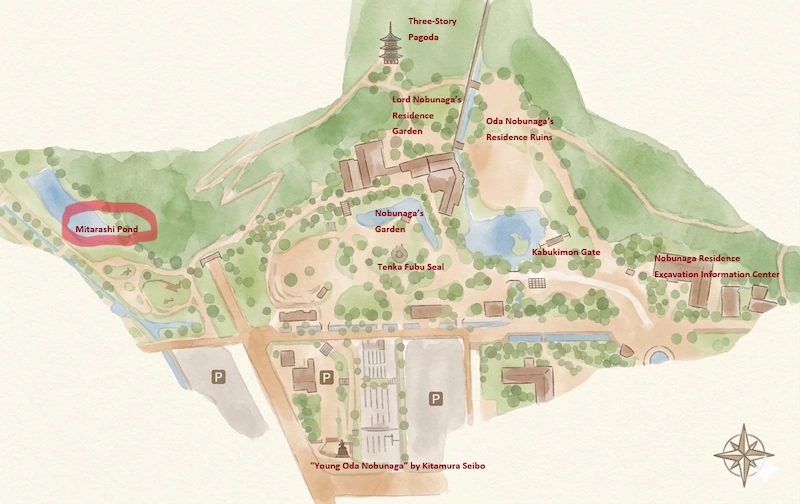
Mitarashi Pond
⭐ Recommended Rating
Historical Value:☆☆☆
Visual Appeal:☆☆
Experiential Value:☆☆
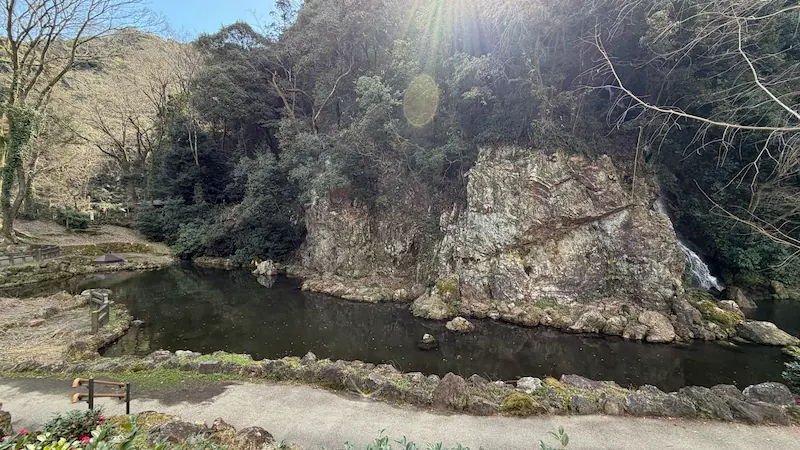
In the northeast corner of Gifu Park, in a quiet nook where the shadows of the trees fall across the water’s surface, lies Mitarashi Pond. This spot sits at the very foot of the “starting point of Tenka Fubu” — where Nobunaga defeated Inabayama Castle and proclaimed “Gifu” — yet it offers a way to feel this land’s history from a slightly different angle than Nobunaga’s victories. The name comes from the time when Inaba Shrine stood on Mount Kinka and nearby Maruyama hill, and worshippers would wash their hands here before entering the shrine grounds — meaning the place name carries a memory of this as a sacred space of prayer, predating the castle itself.
And layered over the pond is a legend from the final chapter of the warring states period. In 1600 (Keicho 5), during the battle for Gifu Castle that preceded Sekigahara, when Nobunaga’s grandson Oda Hidenobu was defeated as castle lord, it is said that people within the castle threw themselves into this pond — a tradition passed down through the generations (※ as introduced in on-site signage and similar sources). The arc from Nobunaga’s establishment of Gifu as a rising power to the Oda clan’s defeat here in his grandson’s era — the upswing and the downswing — intersect at this single spot at the base of the same mountain. When you think about it again, there is something deeply moving in that. In recent years, the surrounding paths have been made more accessible and the landscape better maintained, making this a well-kept strolling spot where you can take in the waterfall tumbling over rock faces and the rocky cliffs of Mount Kinka while settling into the historical atmosphere.
| Year Built | Unknown (origin of the pond is unknown) |
|---|---|
| Builder | Unknown |
| Structure & Features | Pond within Gifu Park / Name derives from the “temizu” (ritual hand-washing) practice associated with Inaba Shrine / Rocky banks with a waterfall |
| Renovation / Reconstruction History | Excavation of the pond bottom in 1987 (Showa 62) — no castle-related artifacts were reportedly found / Pond renovation and barrier-free path improvements completed in 2021 (Reiwa 3) |
| Current Status | Standing (open for strolling) |
| Loss / Damage | Unknown |
| Cultural Property Designation | Unknown (no confirmed cultural property designation for the pond itself) |
| Notes | The story of people throwing themselves into the pond at the fall of Gifu Castle is a legend (introduced in on-site signage and similar sources). |
🗺 Address:〒500-8002 385-4 Mitarashi, Gifu City, Gifu Prefecture
🚶 Access
Nearest station: approx. 3-minute walk from the “Valley Station” of the Gifu Kinka Ropeway (approx. 0.2 km)
⏳ Time Estimate
Quick visit: approx. 10 minutes
Leisurely visit: approx. 20 minutes
📍 Highlights
- The waterside scenery set against the rock face: The dramatic rocky cliffs of Mount Kinka paired with the still water surface leave a strong impression — you can “feel” the natural terrain of the castle town in your body.
- The waterfall point: The sound of water dropping from the rock face into the pond cuts you off from the bustle of the park — a restorative stretch of the walk.
- Seasonal highlights: In autumn, the foliage reflects in the water’s surface and photos take on real depth. In summer, the shade is dense and the spot is perfect for a rest.
📌 Trivia
- Surprising historical background: The name “Mitarashi” derives from the practice of washing one’s hands here before ascending to Inaba Shrine, which once stood on Maruyama hill.
- Lesser-known detail: Excavation of the pond bottom was carried out in 1987 (Showa 62), but no castle-related artifacts were found, according to the records.
- Famous figure connection: Tradition holds that when Nobunaga’s grandson Oda Hidenobu was defeated as Gifu Castle lord in 1600, people inside the castle threw themselves into this pond — a place to feel the rise and fall of the Oda clan by the water’s edge.
Kabukimon Gate (Entrance to Lord Nobunaga’s Residence Ruins)
⭐ Recommended Rating
Historical Value:☆☆
Visual Appeal:☆☆
Experiential Value:☆☆
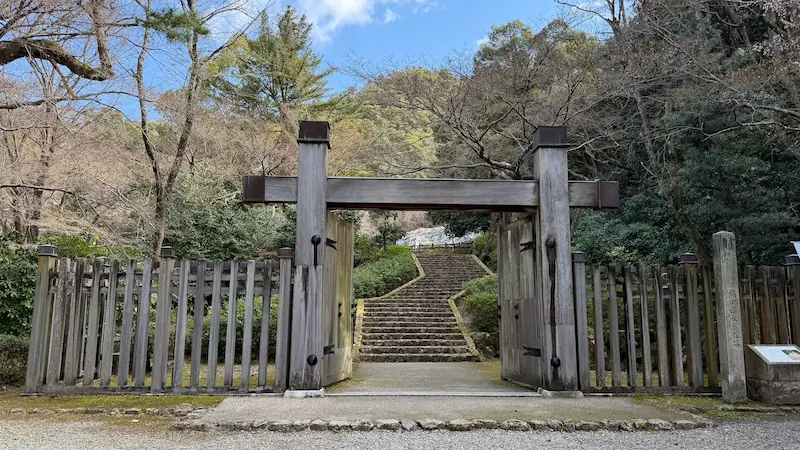
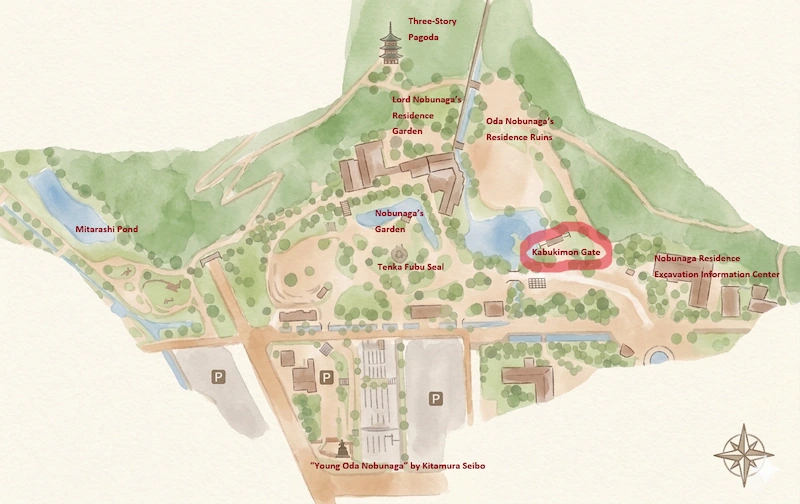
Walking through Gifu Park, you come upon the gate that marks the entrance to the residence ruins area. This is the kabukimon (crossbeam gate) set just before the stone steps leading up to Lord Nobunaga’s Residence Ruins. Its presence is less the grandeur of a great castle gate and more the simple, organic quality of timber merging with nature — a quiet, wooden announcement that “beyond this point, human life was once dense and active.” In 1567 (Eiroku 10; some sources say Eiroku 7), Nobunaga moved his base to Mino, and the residence he built here was reported by Frois to have had the splendor of a “palace.” This kabukimon serves as an “entrance statement” into that stage — a way of composing the traveler’s mind before stepping through.
Of course, the gate itself is not a warring-states-era ruin; it was installed in the modern era to “evoke the atmosphere” of the past. Even so, simply passing through the gate and climbing the stone steps naturally shifts something in you. On occasion, the gate is lit up for evening events, and there is a sense that Gifu today is carrying forward the “power to display and impress” that defined Nobunaga’s Gifu. A perfect place to pause at as an entrance before walking the residence ruins.
| Year Built | Unknown (modern installation) |
|---|---|
| Builder | Unknown |
| Structure & Features | Entrance gate before the stone steps leading to Lord Nobunaga’s Residence Ruins inside Gifu Park / Installed to “evoke the atmosphere of the era when the residence stood” |
| Renovation / Reconstruction History | Unknown |
| Current Status | Standing |
| Loss / Damage | Unknown |
| Cultural Property Designation | Unknown (no confirmed cultural property designation for the gate itself) |
| Notes | A separate kabukimon known as the “Gate of the Realm” (Tenka Daiichi no Mon) is located on the mountaintop side of Gifu Castle (a different site) |
🗺 Location
⏳ Time Estimate
Quick visit: approx. 3 minutes
Leisurely visit: approx. 10 minutes (including a walk through the residence ruins and surrounding area)
📍 Highlights
- The moment of “switching modes” as you pass through the gate: A shift from the easy atmosphere of park strolling into “historic site mode” — the switch is immediate.
- The composition of stone steps and gate: Shooting from the front, the stone steps stretching beyond the gate create a strong sense of depth that tightens up a photo.
- Seasonal highlights: During winter and early spring light-up events, the area in front of the kabukimon sometimes serves as the focal point of the illumination — an atmosphere entirely different from daytime (dates vary by year).
📌 Trivia
- Surprising historical background: This kabukimon is not a warring-states-era ruin; it is described as having been installed at the entrance to the residence ruins to “evoke the atmosphere” of the era.
- Lesser-known detail: There is also a kabukimon called the “Gate of the Realm” (Tenka Daiichi no Mon) on the Gifu Castle mountaintop side, erected to honor Nobunaga’s achievements — two “kabukimon” in two separate locations is a common source of confusion.
- Famous figure connection: Beyond the gate lies the area of the residence that Nobunaga built in Gifu. Excavation surveys have confirmed garden ruins and other features, and the outlines of Nobunaga’s “hosting culture” in Gifu are beginning to come into focus.
Oda Nobunaga’s Residence Ruins (Kyokan Ato)
⭐ Recommended Rating
Historical Value:☆☆☆
Visual Appeal:☆☆
Experiential Value:☆☆
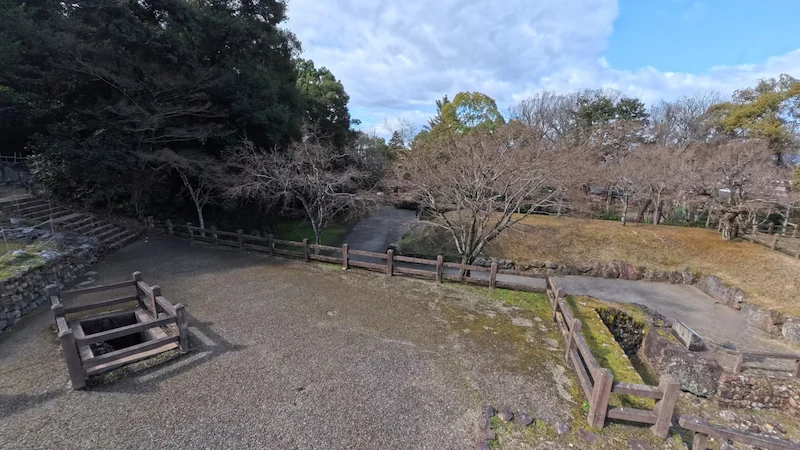
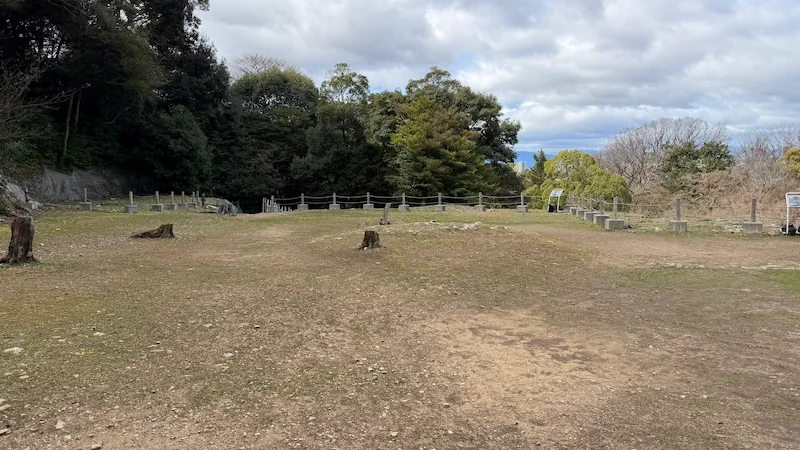
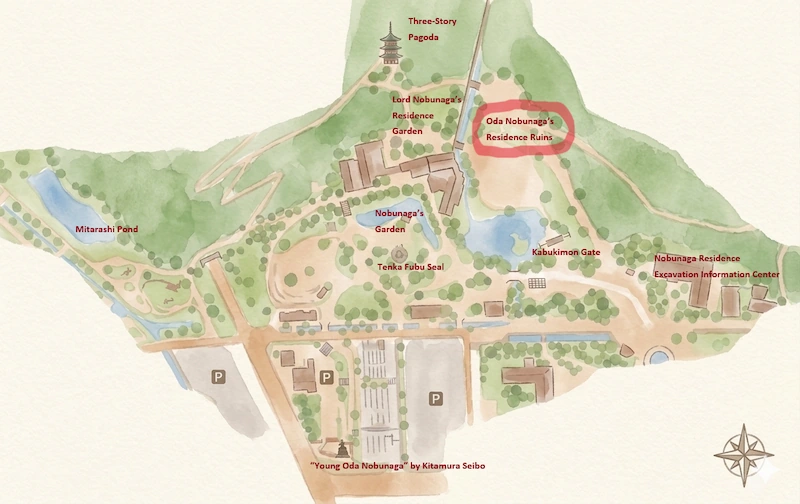
At the base of Mount Kinka, along the valley of the Senjojiki, the ruins of Nobunaga’s residence spread out before you. Originally shaped during the Saito clan period, the complex was reportedly transformed through large-scale construction and renovation after Nobunaga entered Gifu. Excavation surveys have revealed an entrance marked by a row of standing boulders, buildings that used gold-foil roof tiles, and the presence of a garden designed against the backdrop of the bedrock — showing clearly that this was not merely a living space but a carefully staged environment for receiving guests and projecting authority. The “visual sensibility” that Nobunaga honed in Gifu would go on to inform Azuchi. Even without any buildings standing, the undulation of the ground and the arrangement of the stones make the spatial intentions of the era surprisingly readable. This is the place to feel that Azuchi was born from what came before it, right here.
| Year Built | During the Saito clan period: unknown / Major renovation by Nobunaga: from 1567 onward |
|---|---|
| Builder | Saito clan (initial construction) / Oda Nobunaga (large-scale renovation) |
| Structure & Features | Boulder-lined entrance, building foundations, garden traces, etc. (based on excavation findings) |
| Renovation / Reconstruction History | Viewing environment developed based on excavation surveys (year unknown) |
| Current Status | Open for on-site viewing as ruins |
| Loss / Damage | Buildings no longer standing (ruins only) |
| Cultural Property Designation | National Historic Site |
| Notes | Within Gifu Park (Senjojiki / Tsukitani area) |
🗺 Location
⏳ Time Estimate
Quick visit: approx. 10 minutes
Leisurely visit: approx. 20 minutes
📍 Highlights
- The boulder row as “staging”: Simply arranging natural stones in a line conjures an aura of power — Nobunaga’s way of showing is right there to be read.
- Imagining the scale of the residence from the terrain: Experiencing the topography rather than a floor plan makes the spatial design of the era suddenly vivid.
- Seasonal highlights: Autumn foliage highlights the contours of the ruins and gives photos a “warring-states depth.”
📌 Trivia
- Surprising historical background: Gold-foil roof tiles have been confirmed from Nobunaga’s era of the residence, showing that the idea of “grandeur as politics” was already in motion in Gifu.
- Lesser-known detail: The real attraction is “the absence of buildings.” A warring-states space that speaks only through stone and topography paradoxically fires the imagination more intensely.
- Famous figure connection: The protagonist is, of course, Oda Nobunaga. His work on the residence in Gifu was the warm-up for the aesthetic that would culminate at Azuchi.
Lord Nobunaga’s Residence Garden (Nobunaga-ko Kyokan Teien)
⭐ Recommended Rating
Historical Value:☆☆☆
Visual Appeal:☆☆
Experiential Value:☆☆
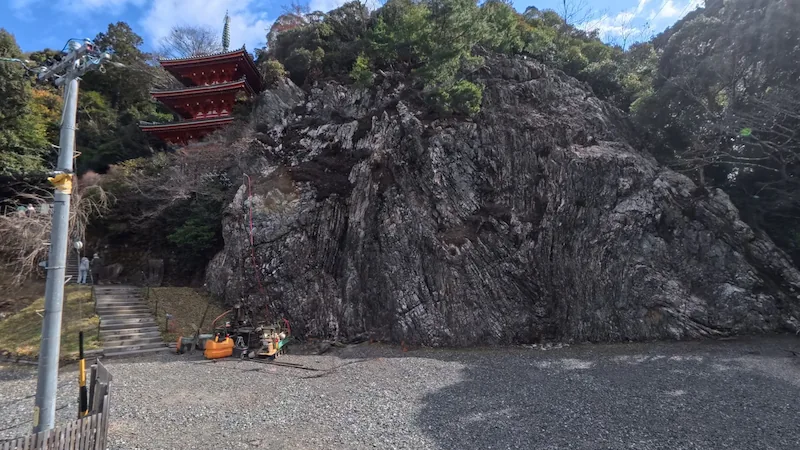
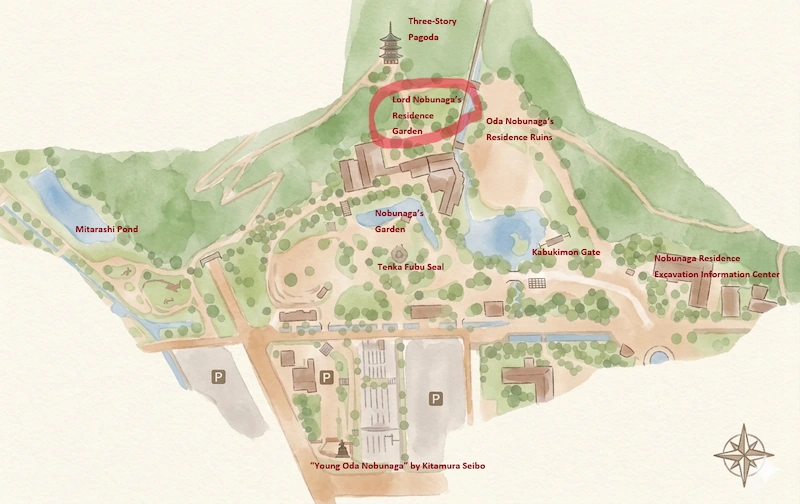
Excavation findings from around Lord Nobunaga’s residence suggest that there may have been a garden-like space that incorporated large rock formations and the natural terrain. On-site, rather than looking for a neatly preserved garden, it is easier to approach the space by reading the spatial composition through the topography, stone arrangements, and level changes. There is speculation that the design was intended with visitors in mind, but what is visible on-site today is primarily ruins, and this is not a restoration of the original landscape.
| Year Built | Estimated from 1567 onward / Restoration development: unknown |
|---|---|
| Builder | Oda Nobunaga (as part of the residence complex development) |
| Structure & Features | Garden concept incorporating bedrock, stone arrangements, and natural terrain (based on excavation findings) |
| Renovation / Reconstruction History | Viewing environment developed based on excavation findings (year unknown) |
| Current Status | Garden ruins visible on-site |
| Loss / Damage | Original garden no longer surviving (ruins only) |
| Cultural Property Designation | Unknown |
| Notes | Treated as garden-related ruins within the “Oda Nobunaga Residence Ruins” area |
🗺 Location
⏳ Time Estimate
Quick visit: approx. 10 minutes
Leisurely visit: approx. 20 minutes
📍 Highlights
- The idea of using bedrock as a “borrowed scenery” backdrop: Not commanding nature, but making nature the stage set — a very Nobunaga kind of aesthetic.
- The movement created by stone and level changes: The changes in elevation you discover only by walking them prompt you to imagine the “viewing route” that was intended at the time.
- Seasonal highlights: After rain, the wet stone darkens and sharpens, making the shadows and contours of the terrain easier to read.
📌 Trivia
- Surprising historical background: The garden may have functioned not merely as a space for aesthetic appreciation, but as a political space for receiving guests.
- Lesser-known detail: Shooting with more distance between you and the subject helps convey the spatial intent. Getting too close makes it hard to grasp the overall picture.
- Famous figure connection: A place to imagine the “core” of the residential culture that Oda Nobunaga built in Gifu.
Three-Story Pagoda (Sanjunoto)
⭐ Recommended Rating
Historical Value:☆☆
Visual Appeal:☆☆☆
Experiential Value:☆☆
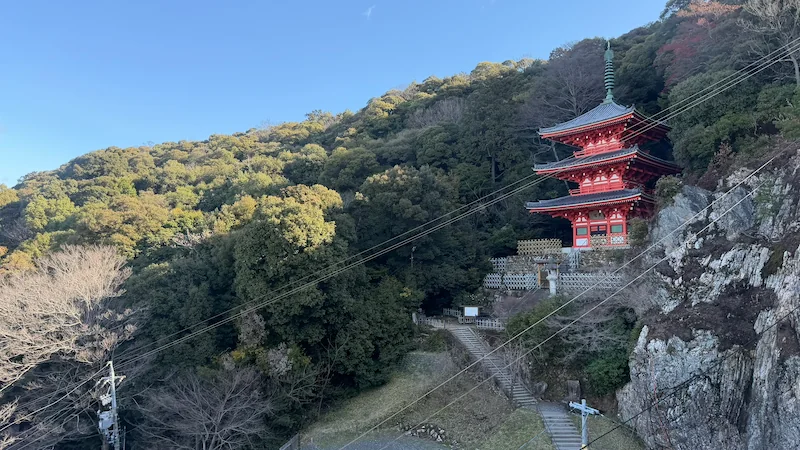
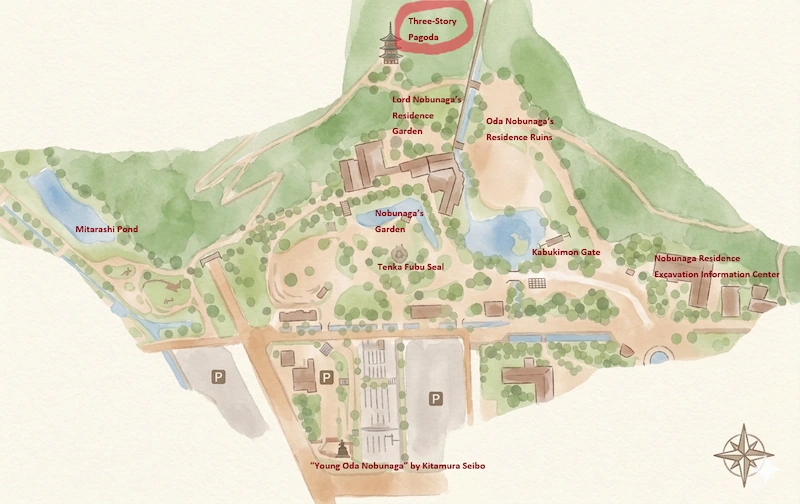
Walking through Gifu Park, your eye is suddenly caught by a flash of vermilion — that is the “Three-Story Pagoda of Gifu Park.” When Nobunaga seized Inabayama Castle and established Gifu as his base for national domination, the whole of Mount Kinka and its surroundings functioned as a “political stage” where castle and residence worked in concert. The pagoda itself is not a warring-states ruin, but the grounds on which it stands — indeed, the entire Mount Kinka area — fall within the nationally designated historic site of “Gifu Castle Ruins.” In other words, this is a landmark where modern Gifu has layered “celebration” and “beauty” onto a place that still breathes the air of Nobunaga’s castle town.
The pagoda was built in 1917 (Taisho 6) as a commemorative project for the enthronement of Emperor Taisho, funded through public donations solicited by the City of Gifu. Its designer was architect Ito Chuta, who also worked on Meiji Jingu Shrine and Tsukiji Honganji Temple. The restrained, classically inspired design brings out the elegant proportions of the wooden three-story pagoda, and the vermilion stands out all the more vividly among the seasonal greenery and autumn foliage of the mountain. Among Gifu Park’s many Nobunaga-related spots, this pagoda stands apart as something built by the citizens of modern Gifu. Looking up at it, you begin to sense the accumulated time of a city that has protected its history while nurturing its landscape.
| Year Built | 1917 (Taisho 6) |
|---|---|
| Builder | City of Gifu (erected as a commemorative project for the imperial enthronement, funded by citizen donations) |
| Structure & Features | Wooden, three-bay three-story pagoda, tiled roof / Total height: 22m / Migoroshi (bracket) construction with suspended central pillar |
| Renovation / Reconstruction History | Unknown |
| Current Status | Standing |
| Loss / Damage | Unknown |
| Cultural Property Designation | Nationally Registered Tangible Cultural Property (building) |
| Notes | The entire Mount Kinka area (including the pagoda grounds) falls within the nationally designated historic site “Gifu Castle Ruins” |
🗺 Location
⏳ Time Estimate
Quick visit: approx. 5 minutes
Leisurely visit: approx. 20 minutes
📍 Highlights
- The contrast of vermilion against green: The red stands out brilliantly against the trees of the Mount Kinka foothills — a landmark that photographs well in both sun and cloud.
- Ito Chuta’s “classically restrained design”: The appeal lies in its spare elegance — a modern design that carries the dignity of traditional architecture.
- Seasonal highlights: In the autumn foliage season, the vermilion of the pagoda appears even deeper, and photo satisfaction jumps noticeably.
📌 Trivia
- Surprising historical background: It is a rare example of a “three-story pagoda built by the city” as a commemorative project, rather than as a temple structure.
- Lesser-known detail: Total height is 22.168m. Set on a mountain slope, it feels noticeably larger than its measurements when viewed from below.
- Famous figure connection: While not from Nobunaga’s era itself, it stands within the nationally designated historic site “Gifu Castle Ruins” and can be enjoyed as part of the scenery of Nobunaga’s stronghold.
Nobunaga’s Garden (Nobunaga no Niwa)
⭐ Recommended Rating
Historical Value:☆
Visual Appeal:☆☆☆
Experiential Value:☆☆
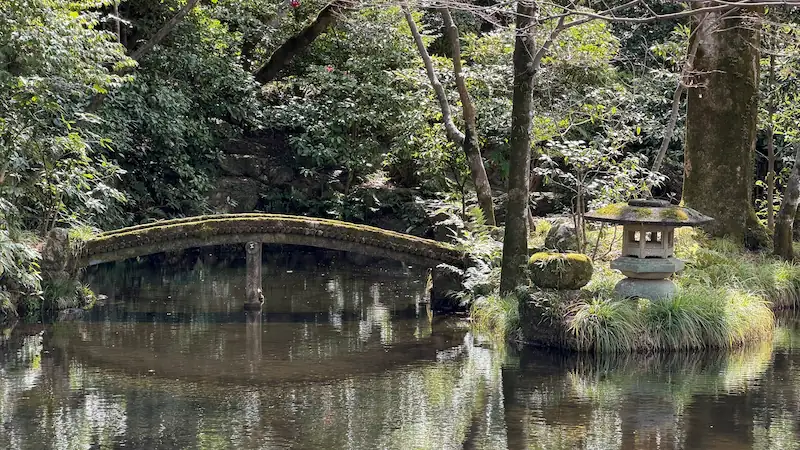
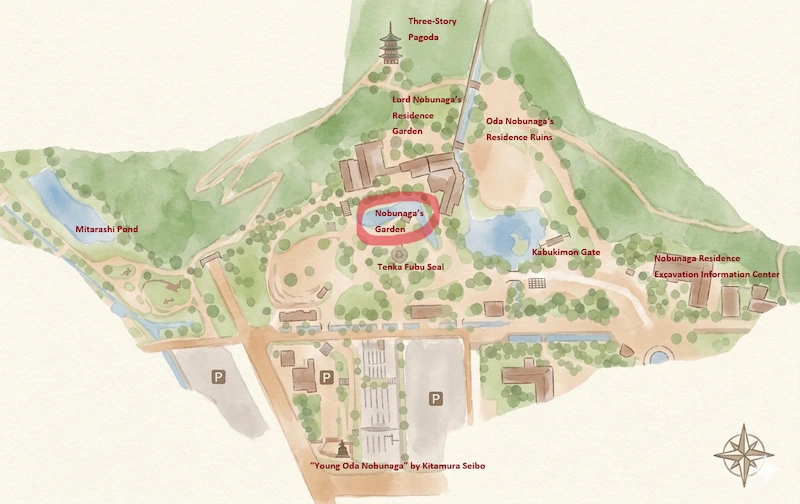
After chasing the “past” of historic ruins, there is something to be gained from deliberately going to meet the “Nobunaga image that the present day has created” — and that is Gifu Park’s “Nobunaga’s Garden.” Inspired by the ferocity of the warring states era, this rock garden uses enormous stones from along the Nagara River (approximately 1,000 tonnes in total) and is said to be composed of three waterfalls and a pond representing “strength,” “stillness,” and “elegance.” In other words, this is not a historical reconstruction but a translation of Nobunaga’s way of living into landscape. The sound of waterfalls and the weight of the stone generate a power unlike any conventional garden. Coming here after the ruins, you get a clear sense of how present-day Gifu interprets Nobunaga — and that in itself is interesting.
| Year Built | 2001 |
|---|---|
| Builder | Unknown |
| Structure & Features | Three waterfalls and a pond — “strength,” “stillness,” “elegance” / Rock garden with extensive use of large boulders |
| Renovation / Reconstruction History | Unknown |
| Current Status | Standing |
| Loss / Damage | Unknown |
| Cultural Property Designation | None |
| Notes | Within Gifu Park (near the ropeway boarding area) |
🗺 Location
⏳ Time Estimate
Quick visit: approx. 10 minutes
Leisurely visit: approx. 30 minutes
📍 Highlights
- The three waterfalls — “strength, stillness, elegance”: The same water sounds differently in each section, letting you feel Nobunaga’s many dimensions through the garden.
- The “warring-states pressure” of the stone’s mass: Plants are not the protagonists here — stone is. The force that comes at you from the ground is distinctive.
- Seasonal highlights: In early summer fresh greenery, the water surface reflections are beautiful and the waterfalls and light combine to create a “cool retreat” in the garden.
📌 Trivia
- Surprising historical background: This is not a reconstruction of a historic site; it is a place that expresses “the image of Nobunaga’s era” as a modern garden.
- Lesser-known detail: Walking from the ruins (residence site) to the modern garden (Nobunaga’s Garden) in sequence gives you a three-dimensional sense of Gifu’s relationship with Nobunaga.
- Famous figure connection: The theme is Oda Nobunaga. Here you can retrace, through landscape, the image of the warlord who dreamed of national rule from Gifu.
Tenka Fubu Seal (Tenka Fubu In)
⭐ Recommended Rating
Historical Value:☆
Visual Appeal:☆☆
Experiential Value:☆
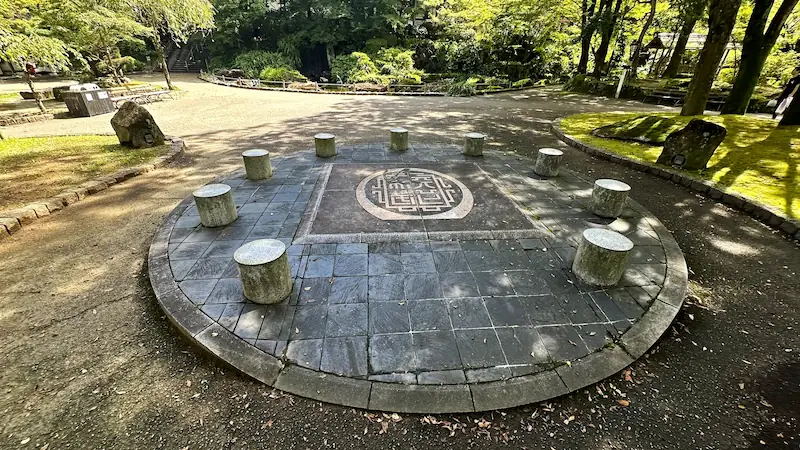
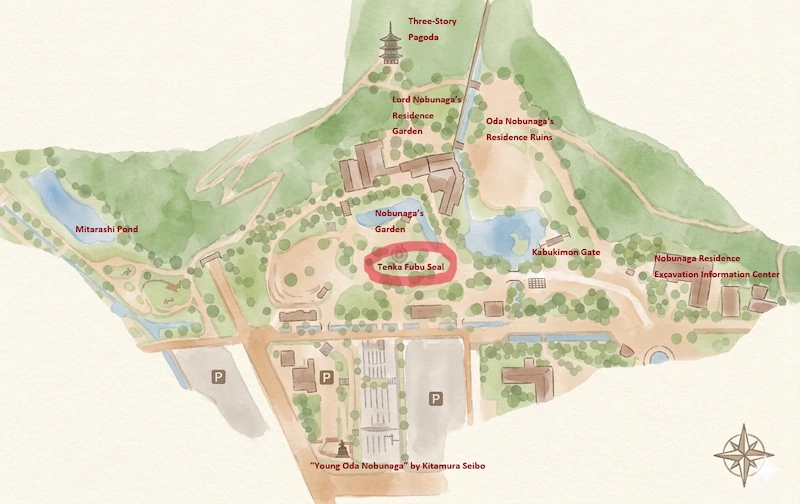
The “Tenka Fubu Seal” is best enjoyed as a design element within Gifu Park that visually expresses “Tenka Fubu” — words closely associated with Nobunaga — rather than a place exhibiting the actual historical seal artifact. It is not an exhibition of a historical document but a scenic feature intended to keep Nobunaga’s connection to Gifu in mind while strolling. It is most accurate to present it as a monument-style element, so as not to be mistaken for a primary historical source.
| Year Built | Unknown |
|---|---|
| Builder | Unknown |
| Structure & Features | Pavement design motif based on “Tenka Fubu” (monument-style element) |
| Renovation / Reconstruction History | Unknown |
| Current Status | Standing |
| Loss / Damage | Unknown |
| Cultural Property Designation | None |
| Notes | Following the Gifu Park redevelopment, it is currently designed into the pavement and signage area around “Nobunaga’s Garden.” |
🗺 Location
⏳ Time Estimate
Quick visit: approx. 3 minutes
Leisurely visit: approx. 10 minutes
📍 Highlights
- Treading on “Tenka Fubu” underfoot: Not a castle you look up at, but a rallying cry you step on. A physical experience that stays with you.
- A photo opportunity: Snapping this mid-Nobunaga-tour works as a travel marker that pays off later when looking back through the photos.
- Seasonal highlights: Evening angled light deepens the shadows of the pattern, giving photos more definition.
📌 Trivia
- Surprising historical background: “Tenka Fubu” is known as Nobunaga’s political slogan, tightly linked to Gifu as the place it was proclaimed.
- Lesser-known detail: Finding it along the route to the castle adds a treasure-hunt quality that makes the walk more enjoyable.
- Famous figure connection: Oda Nobunaga’s defining phrase “Tenka Fubu” can be felt through contemporary landscape design.
“Young Oda Nobunaga” by Kitamura Seibo
⭐ Recommended Rating
Historical Value:☆
Visual Appeal:☆☆
Experiential Value:☆
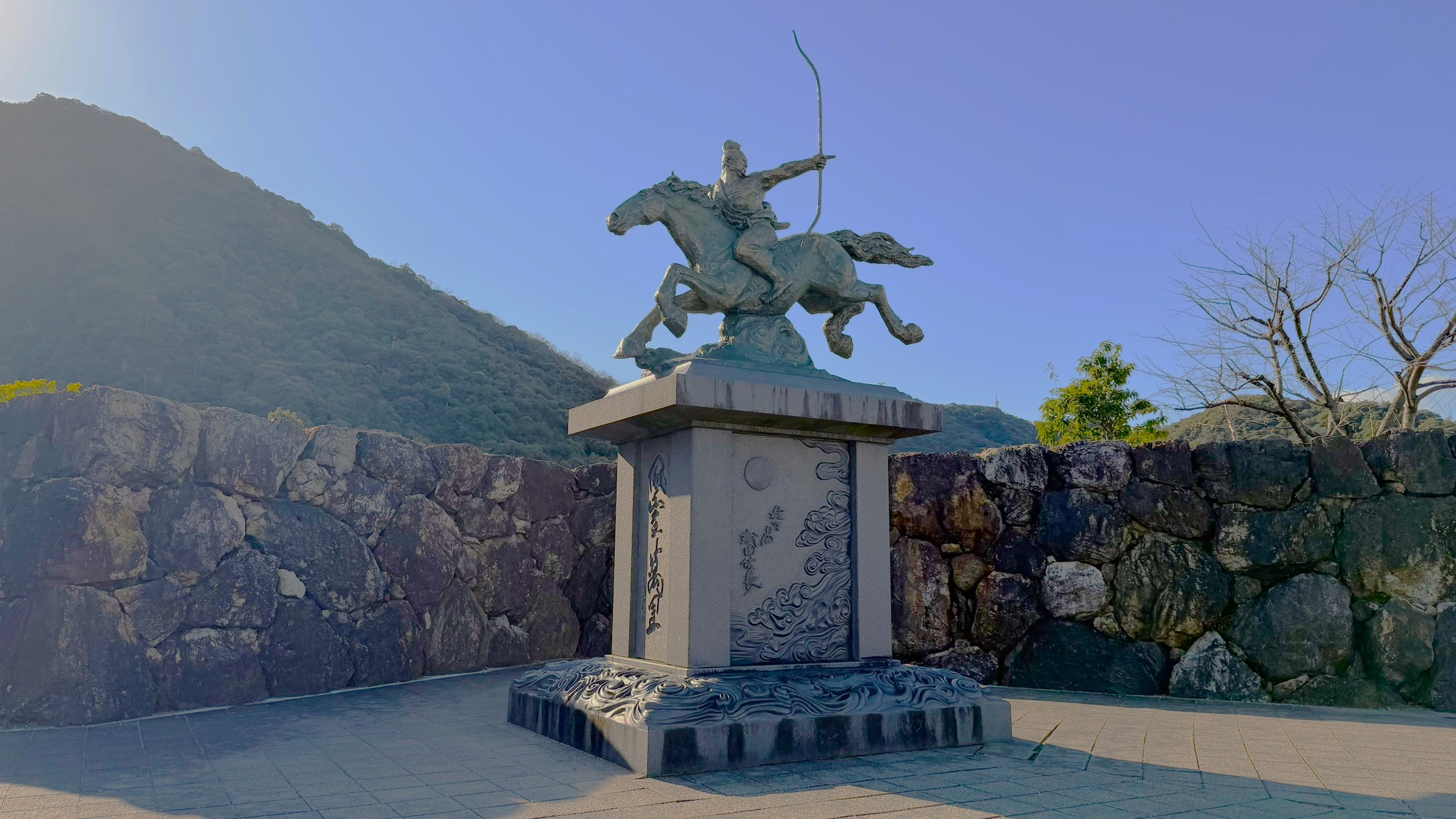
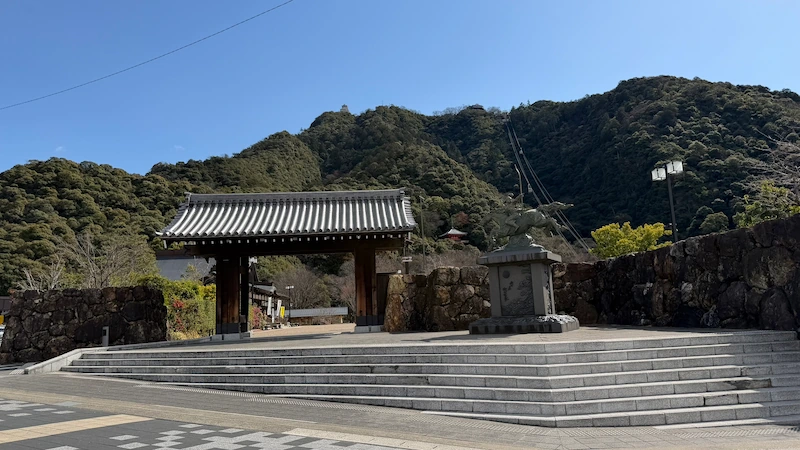
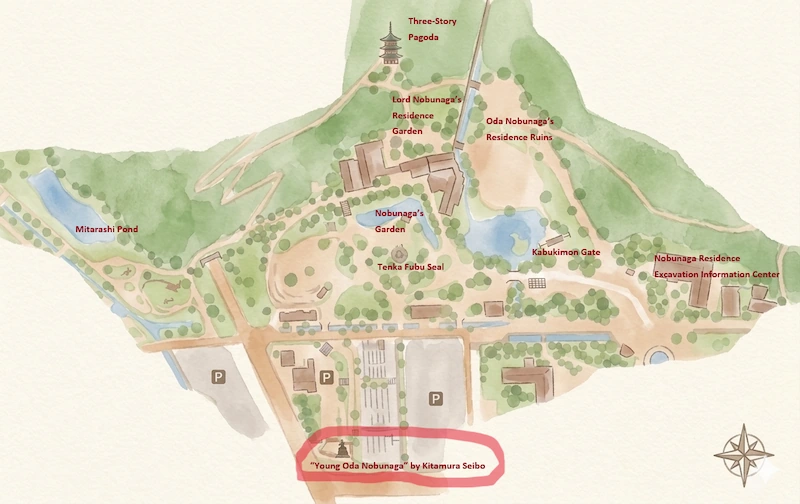
Standing before the main gate of Gifu Park is a bronze statue capturing the instant of a young Nobunaga on horseback, bow drawn, caught mid-gallop. The sculptor is Kitamura Seibo, also known for the Peace Statue in Nagasaki. Created over four hundred years after Nobunaga entered Gifu in 1567 (Eiroku 10), it was donated to the City of Gifu in 1988 (Showa 63) as part of the centennial celebrations of Gifu’s city charter, then later moved to its present position in front of the main gate of Gifu Park in 2009 (Heisei 21). It is not a historic site in itself, but standing here, with the ridgeline of Mount Kinka and Gifu Castle visible beyond, you can capture in both photos and physical experience the atmosphere of Nobunaga fixing his gaze on “the realm” from this very ground. An easy and iconic photo stop to include at the start of any visit.
| Year Created | 1988 (Showa 63) |
|---|---|
| Creator | Sculptor: Kitamura Seibo / (Donated to Gifu City as a commemoration of the city’s 100th anniversary) |
| Structure & Features | Bronze statue / Depicts “Young Nobunaga” drawing a bow on horseback / Popular as a photo spot |
| Renovation / Relocation History | Relocated to the front of Gifu Park’s main gate in 2009 (Heisei 21) |
| Current Status | Standing |
| Loss / Damage | Unknown |
| Cultural Property Designation | Unknown (no confirmed cultural property designation for the statue itself) |
| Notes | Similar equestrian statues attributed to the same sculptor and title have been introduced at various locations. As installation circumstances and whether they share the same original casting can differ across sources, this entry refers specifically to “the statue installed in front of the main gate of Gifu Park.” |
🗺 Location
⏳ Time Estimate
Quick visit: approx. 3 minutes
Leisurely visit: approx. 10 minutes
📍 Highlights
- The dynamic form of the equestrian statue: The torso drawing the bow and the surging body of the horse flow together as one, visually capturing Nobunaga’s “forward speed.”
- Photographing with Gifu Castle as the backdrop: Adjusting your position slightly lets you frame the statue “charging toward the realm” with Mount Kinka and Gifu Castle behind it.
- Seasonal highlights: In spring, the cherry blossoms of Gifu Park, and in autumn, the foliage, provide color that sets off the statue’s silhouette beautifully for photos.
📌 Trivia
- Surprising historical background: The statue was not created in the warring-states era; it was born from the 1988 centennial anniversary of Gifu’s city charter — a piece of “modern Nobunaga legacy.”
- Lesser-known detail: Relocated to the front of Gifu Park’s main gate in 2009, bringing it to its current arrangement where Gifu Castle can be seen in the background.
- Famous figure connection: Sculptor Kitamura Seibo is recognized as one of Japan’s leading sculptors, widely known as the creator of the Peace Statue in Nagasaki.
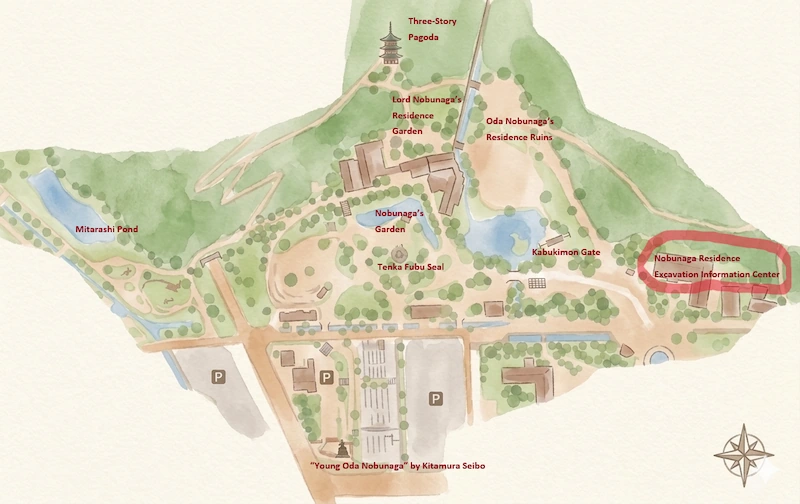
Nobunaga Residence Excavation Information Center
⭐ Recommended Rating
Historical Value:☆☆☆
Visual Appeal:☆
Experiential Value:☆☆
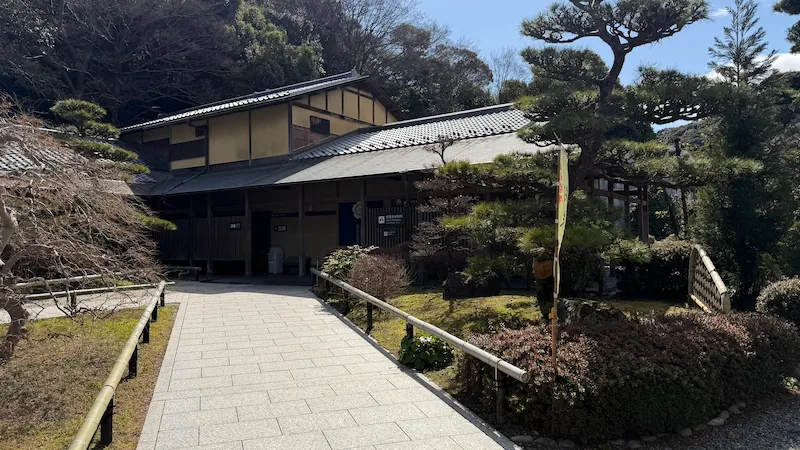
Walking through Gifu Park, the stone steps and terraced ground can look like nothing more than ordinary park topography. This information center changes all of that in an instant.
Relocated into the park’s visitor rest facility as part of the Gifu Park redevelopment project, the “Japan Heritage Nobunaga Residence Excavation Information Center” greets you inside with a large illustration of Nobunaga’s Gifu Castle by artist Gentaro Kagawa. It is a sweeping bird’s-eye view of the entire castle complex from summit to base, distilling the structures revealed by excavation into a single image. Seeing this before you walk the site — versus not seeing it — makes an enormous difference in what you notice on the ground.
The exhibit panels with the most depth to them cover excavation survey reports from the upper section of Gifu Castle on Mount Kinka. Warring-states-era stone walls have been found on the north and west faces of the keep platform; large river stones and quantities of unglazed earthenware dishes were unearthed from beside the pathways, hinting at garden-like spaces — recent surveys have begun to reveal the possibility that Nobunaga had created “spaces for hospitality” even on the mountaintop.
The panels on the lowland residence are equally unmissable. A central building roofed with gold-foil tiles, a garden set against a backdrop of enormous boulders, three types of stone-arranged terraces — the actual form of the residence that Frois described as “a paradise on earth” is slowly taking shape through excavation findings.
It is not a flashy exhibition. But after spending twenty minutes here and then standing on the stone steps of the residence site, the same ground looks like an entirely different place.
| Year Established | Unknown (opening year of the information center is unknown) |
|---|---|
| Operator | Unknown |
| Structure & Features | Exhibition and information space within the Gifu Park visitor rest facility / Introduces excavation findings from Nobunaga’s residence (panels, video, etc.) |
| Renovation / Relocation History | Relocated to the “Gifu Park Visitor Rest Facility” as part of the Gifu Park redevelopment (relocation date: April 2023, Reiwa 5) |
| Current Status | Open (with staff assistance) |
| Loss / Damage | Unknown |
| Cultural Property Designation | Unknown (no confirmed cultural property designation for the facility itself) |
| Notes | Staff hours: 9:00–16:00 (closed Tuesdays — if a national holiday, closed the following day — and Dec. 29–Jan. 3) / Free admission |
🗺 Location
⏳ Time Estimate
Quick visit: approx. 10 minutes
Leisurely visit: approx. 30 minutes
📍 Highlights
- Excavation “prep work” that transforms how you see the ruins: Before walking the residence site and garden ruins, knowing what was actually found there gives meaning to every stone and level change you encounter on the ground.
- Video content that creates rapid understanding: An overview of Japan Heritage and an introduction to excavation findings — even a brief visit lets “Gifu as Nobunaga’s base” settle naturally in your mind.
- Seasonal highlights: On days when outdoor walking is tough — a scorching summer day or heavy rain — start here to take in the information, then switch to a short outdoor walk and your satisfaction level stays high.
📌 Trivia
- Surprising historical background: As part of the Gifu Park redevelopment, the center is now operating from its new location inside the “Gifu Park Visitor Rest Facility.”
- Lesser-known detail: Staff are available from 9:00 to 16:00. Closed Tuesdays (or the following day if Tuesday is a national holiday) and over the New Year period (Dec. 29–Jan. 3). Timing your visit to align with staffed hours is the smart move.
- Famous figure connection: Excavation findings have brought the actual form of Nobunaga’s residence in Gifu into sharper focus. This center is the fastest route to “getting close to the historical reality of Nobunaga’s residence.”
FAQ
Q. Is Gifu Castle Keep accessible now (in 2026)?
A. Gifu Castle Keep is scheduled to close for seismic retrofitting from May 19, 2026 through late October 2027. Gifu Castle Museum is also scheduled to close from April 1, 2026 through the same period. As both schedules are subject to change, please check the City of Gifu’s official website for the latest information before your visit.
Q. Can I enjoy just the lower slopes? Are there things to see without going up to the keep?
A. Absolutely. The lower slope area alone — including the residence ruins, garden ruins, Mitarashi Pond, Three-Story Pagoda, Nobunaga’s Garden, and the excavation information center — can easily fill half a day. Visiting the information center first and then walking the residence ruins makes a noticeable difference in how much you get from the ruins.
Q. How long does it take to cover Gifu Park and Gifu Castle?
A. If focusing on the summit, allow 1–2 hours. For a thorough visit including the lower slopes, plan for half a day (3–4 hours). If you’re including the excavation information center, residence ruins, and garden, leaving plenty of extra time is recommended.
Q. Is the Gifu Castle keep from Nobunaga’s era?
A. The current keep is not a surviving structure from the warring-states period; it is a reconstructed keep rebuilt in 1956 (Showa 31). The warring-states-era keep was lost in the early Edo period, a replica keep was built during the Meiji era, and that too was destroyed by fire in 1943. By contrast, the residence ruins on the lower slopes and the gate ruins and stone walls on the upper mountain can be visited as ruins verified through excavation surveys.
Q. Is it better to start from the summit or the lower slopes?
A. If you have limited time, starting from the summit is more practical. If you have half a day or more, starting from the lower slopes and working your way up is easier to organize. For the lower-slopes-first approach, the order “Excavation Information Center → Residence Ruins & Garden Ruins → Mitarashi Pond → Three-Story Pagoda → Ropeway → Summit” lets you absorb the excavation findings before visiting the sites. In rainy weather or when the keep is closed, shifting to a lower-slopes-focused itinerary is also a natural choice.
Q. Is the excavation information center free? What are the opening hours and closed days?
A. Free admission. Staff are available 9:00–16:00. Closed on Tuesdays (or the following day if Tuesday is a national holiday) and over the New Year period (Dec. 29–Jan. 3). As the center has moved to the Gifu Park Visitor Rest Facility, confirming the location in advance will make finding it easier.




comment