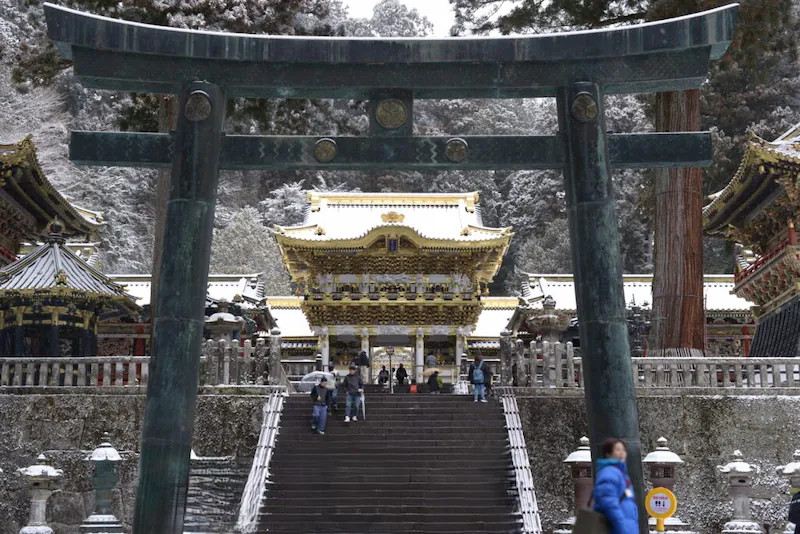
If you came here because Shōgun made you curious about “Toranaga,” you’re already close to the real story. Tokugawa Ieyasu—the historical figure behind that archetype—was enshrined at Nikkō, and his grandson, the third shogun Iemitsu, rebuilt Tōshōgū to feel like the nation’s spiritual center. This isn’t a sightseeing checklist: we’ll read what the shrine’s design is trying to make you believe as you walk.
Quick note on names: “Nikkō” is the place, “Tōshōgū” is the shrine, and “Tōshō Daigongen” is Ieyasu’s divine title.
Who this is for
• If Shōgun sparked your curiosity—and you want the real history behind the vibe
• If you’re visiting Nikkō and want to understand what you’re looking at (not just photograph it)
• If you’ve heard of Yōmeimon, the Three Monkeys, or the Sleeping Cat—but want to know how they “work” together
• If you want a simple on-site route that matches the shrine’s intended experience
What you’ll learn in this article
• The path to Ieyasu being enshrined at Nikkō (from Kunōzan to Nikkō)
• What Iemitsu’s large-scale reconstruction “locked in”
• How Tōshōgū’s space reshapes a visitor’s psychology and behavior
• The “switch points” you can verify on site
- How to read this article (not for “tourism,” but for understanding)
- From Warring States warlord Ieyasu to “Tōshō Daigongen”
- Why Nikkō? (What the place means)
- What Iemitsu’s great reconstruction (the Kan’ei-era major rebuilding) means
- Summary of the Treasure House film | The Ieyasu image drawn through “Martial Skill, Wisdom, Righteousness”
- Tokugawa legitimacy told through architecture and space
- What to verify on site (a guide toward the Complete version)
- A guide toward the Complete version
- FAQ
- Back to the Tokugawa Ieyasu page
- Back to the main page
How to read this article (not for “tourism,” but for understanding)
The first thing that hits you at Tōshōgū is that, unlike a castle built to “defend,” it’s built relentlessly to be seen—to enshrine.
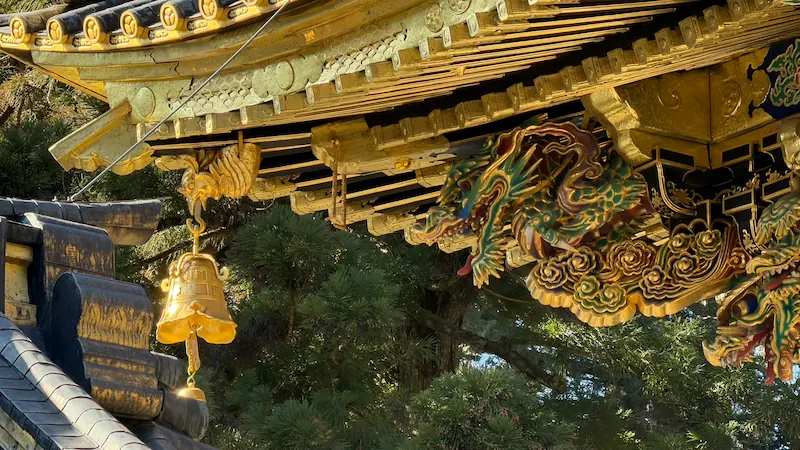
Money and skill—everything—is poured into ornament and staging. And the ornamentation isn’t just loud; it becomes a narrative that speaks of “peace.”
Here, I could see the values that emerged after the Warring States period ended.
Instead of stopping at “It’s impressive because it’s lavish,” we’ll follow meaning: why it was made lavish, and what it was made to say.
A policy of separating fact / tradition / interpretation
When you talk about history, being too cautious can drain the life from an explanation, while chasing entertainment too hard can cost you trust. In this article, we’ll build on solid facts, while carefully gathering the “wishes” and “readings” people of the time poured into the place.
So in the main text, we’ll treat the content as three layers (without slapping labels on every paragraph—so you can tell by tone).
- Facts (Fact)
What can be confirmed through dates, systems, events—standard historical narratives, official information, and multiple reliable explanations. - Tradition / storytelling (Narrative)
On-site guide signs, exhibitions, oral accounts, widely circulated theories—things that are “told that way.”
This has value. Even if later invention is mixed in, it shows how people wanted to understand it. - The author’s interpretation (Interpretation)
Based on the two above, reading “why it’s told that way” and “what it emphasizes.”
This won’t be presented as a verdict, but as a reading—“this interpretation makes the most sense.”
We’ll handle “rumors,” but we’ll be explicit about how
Nikkō has rumors tied to Akechi Mitsuhide and Tenkai (Akechidaira, details in Yōmeimon’s design, the “Tenkai = Akechi” theory, and so on). Even when they aren’t established as fact, they’re part of what makes history fun.
This site won’t dismiss those stories outright. Instead, we’ll handle them by these rules:
- If credibility is thin, we’ll say plainly: “rumor / tradition.”
- Then we’ll read why the rumor is compelling (what desire it satisfies, what story it offers)
- We won’t mix it into sections meant to be read as fact (dates, institutions, relationships)
Here, rumors won’t be treated as “evidence.” We’ll treat them as material for reading “why people want to tell it that way.”
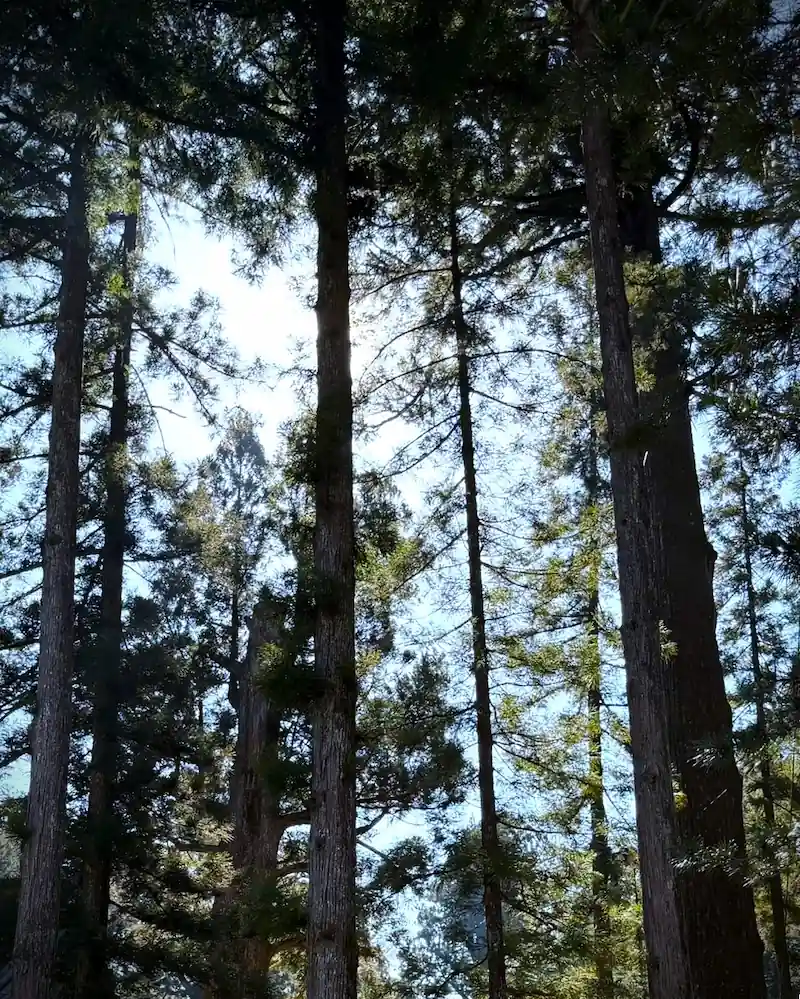
If you read with that policy in mind, Tōshōgū stops being “a lavish tourist attraction” and starts to look like
a place that rewrote the end of the Warring States into a story everyone could accept.
From Warring States warlord Ieyasu to “Tōshō Daigongen”
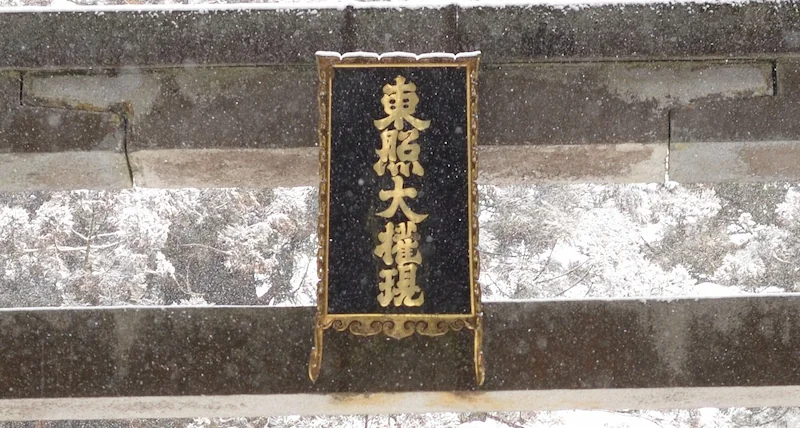
Walking through Nikkō Tōshōgū, there’s a moment when you can physically feel, “This isn’t an extension of the Warring States.”
For me, it was right after passing under Yōmeimon. The air tightened by a notch, and as the flow carried me toward the main sanctuary and the Okumiya, it became natural to feel, “This is the center of the Tōshōgū shrines spread across Japan.”
Inside the precincts, there’s a strong awareness that Ieyasu is enshrined under the divine title “Tōshō Daigongen.”
At the same time, there’s also the history of how the shrine came to be called “Tōshōgū” as its shrine name (its gō). Keeping those concepts separate makes things less confusing.
Because the wording on plaques and talismans varies by location, this article focuses on function: “a place where Ieyasu is enshrined as Tōshō Daigongen.”
The Ieyasu here is no longer simply a “warlord” or a “shogun.” He has been elevated into a “deity” who watches over Tokugawa peace for eternity. The winner of the Warring States, after death, moves to the side that protects. The more you walk Tōshōgū, the more you can feel that turn.
Ieyasu as the victor of the Warring States
The path Ieyasu walked was a history of pouring his life not just into “winning,” but into “how to lock in the order after winning.”
- He lived as a hostage from childhood and learned the reality of the era early, in his body
- He survived between stronger powers like the Imagawa and Oda, making judgment calls that grew his influence
- Under the Toyotomi regime, he stored up power within the order and kept his eyes on the next era
- He seized initiative at Sekigahara and opened the Edo shogunate
Up to here, it’s the textbook Ieyasu.
But what truly matters for understanding Tōshōgū isn’t the mere fact that “Ieyasu won,” but how the winning Ieyasu gets retold.
The Warring States period was brutal in ways that are hard to picture from today’s sensibilities. Even living as a hostage is heavy enough, and depending on the moment, there were situations where the deaths of family or close companions were unavoidable. With that backdrop in mind, I found myself feeling that some warlords—including Ieyasu—weren’t driven only by the will to win, but also, somewhere inside, by a longing for a stable world where people could live without killing one another.
From that angle, the symbols of peace overflowing through Tōshōgū start to land not as mere propaganda, but as the raw prayers of people who survived civil war.
The shrine’s lavish decoration and narrative carvings are pushed not toward the practical needs of “attacking” or “defending,” but thoroughly toward “enshrining” and “being seen.” To me, that feels like a sign of a values shift.
Deification as a political–religious apparatus
Enshrining Ieyasu as “Tōshō Daigongen” is not simple mourning.
What’s happening here can be read as taking Ieyasu the “human” and moving him closer to a Tokugawa-supporting standard of “rightness.”
The peace right after the Warring States ended was still fragile. That’s exactly why politics leans on the immovable authority of “faith.” Tōshōgū feels like a place that makes that idea visible as space.
What’s interesting is that the Ieyasu told here isn’t framed only as a “hero of force,” but easily becomes an ideal figure for how people can live in peace.
The next section (the Treasure House film’s “Martial Skill, Wisdom, Righteousness”) made that “idealization”—how it’s assembled—especially easy to see.
Why Nikkō? (What the place means)
If you read Nikkō Tōshōgū not as “a tourist spot” but as “the terminus of the Warring States,” there’s a question you can’t avoid.
Why was Ieyasu enshrined in Nikkō? Why was the “center” placed not in Edo (the political capital) or Suruga (Ieyasu’s own base), but in a mountain-ringed sacred ground?
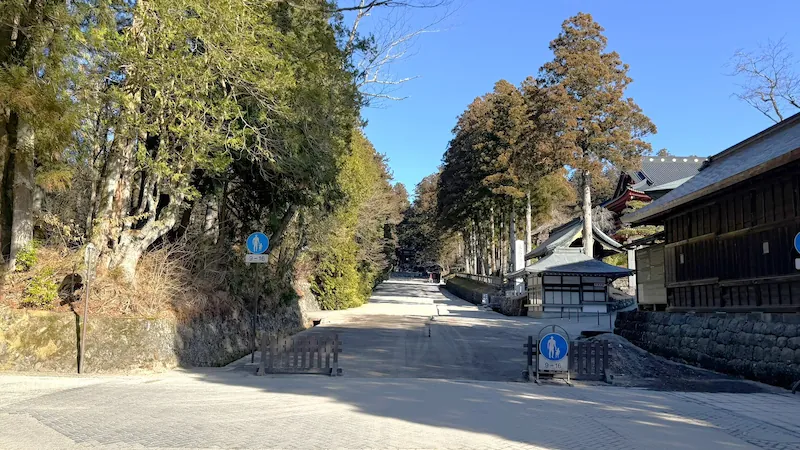
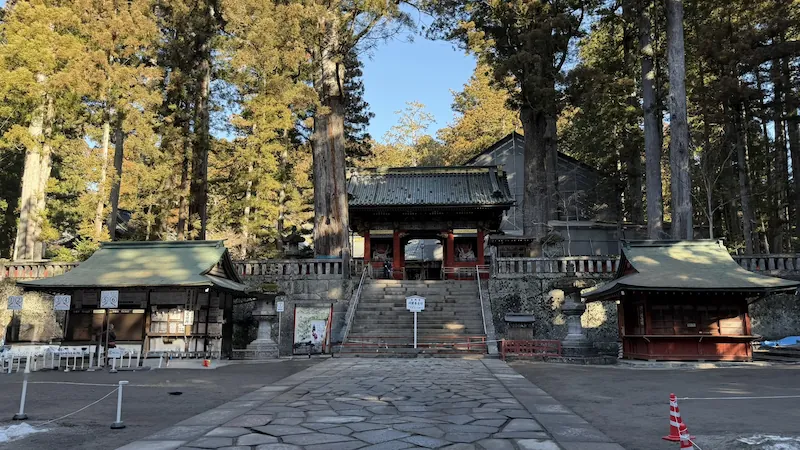
I felt it most strongly right after passing through the First Torii. The five-story pagoda and the Omote-mon come into view, and from there the experience flips: it stops feeling like casual shrine-hopping and becomes “you’ve entered Nikkō.” It had the tactile feel of crossing a boundary line.
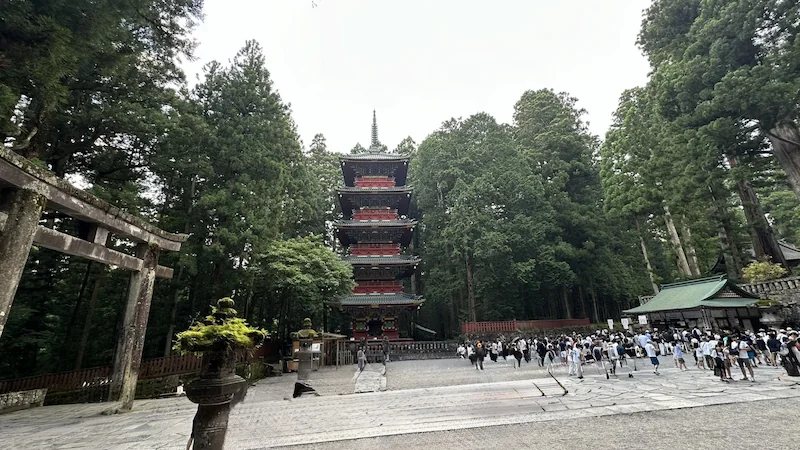
And the path changes texture—from asphalt road to gravel and earth, into the formal approach. Buildings of Rinnō-ji appear along the side, and you start getting swallowed into the “town” of the sacred precinct called Sannai. Nikkō was a place where, just by walking, your state of mind switches.
Where geography, sacred ground, and power intersect
The fact that Tōshōgū, Rinnō-ji, and Futarasan Shrine stand so close together in the Nikkō Sannai area is itself part of the site’s power.
By placing the center of Ieyasu’s enshrinement on top of the depth of an established sacred ground, Tokugawa order seems to connect itself to a vessel of longer time—not merely “the convenience of the victor of that era.”
This is a place of faith, and at the same time, a place where Tokugawa order can be made to look “right.”
As you walk it, Tōshōgū’s lavishness can’t be fully explained by “faith” alone. In Iemitsu’s era, dignity is reflected directly into buildings and ornamentation, and Ieyasu’s deification feels made visible not only as religion, but also as political power.
But the key is that the stage isn’t “the center of Edo.” It’s deliberately placed in a sacred ground.
Edo’s power might shift. The weight of a sacred site carries far longer time. Putting Ieyasu in Nikkō looks like a way to connect Tokugawa order not to “the victor’s convenience,” but to a larger time scale (faith, holy place, nature)—and that reading holds together.
As an ending to the Warring States, that idea is remarkably rational.
If you end it by force alone, the next generation can overturn it by force again. So to lock in the “end,” you enshrine the victor as a “deity,” and you place that deity into the strong vessel of a sacred site. Nikkō can be read as the vessel that was chosen.
(And realistically, once you include the later era when the shogunate slid toward financial strain, you also start to see that this enormous stage apparatus was an “authority with heavy upkeep.” Lavishness isn’t eternal—if anything, it becomes a burden. With that included, Nikkō reflects both Tokugawa strength and Tokugawa limits.)
The relationship with Kunōzan (key points)
It’s explained that Ieyasu was buried at Kunōzan immediately after his death, and then, based on his will, he was transferred to Nikkō the following year and enshrined there.
Think of “Kunōzan → Nikkō” less as a logistical transfer and more as a narrative upgrade: from a regional memorial to a nation-level center designed to endure.
Interestingly, that’s also what makes it compelling as a story.
Even if the “Kunōzan → Nikkō” sequence is famous as knowledge, the on-site experience of Nikkō stands on its own without needing that premise. Nikkō has the power to become the “center” the moment you arrive. In fact, the way your senses switch on the inside of the First Torii—“I’ve entered Nikkō”—is evidence of that.
So rather than thinking of Kunōzan as a mere “move” on a chronology, it may be clearer to treat it as “completion” in a narrative.
If Kunōzan is the “beginning,” Nikkō is the “definitive edition.” Nikkō is where Ieyasu’s deification is completed as a national Tokugawa story—and read that way, it links naturally to the meaning of Iemitsu’s great reconstruction (the Kan’ei-era major rebuilding) that comes next.
What Iemitsu’s great reconstruction (the Kan’ei-era major rebuilding) means
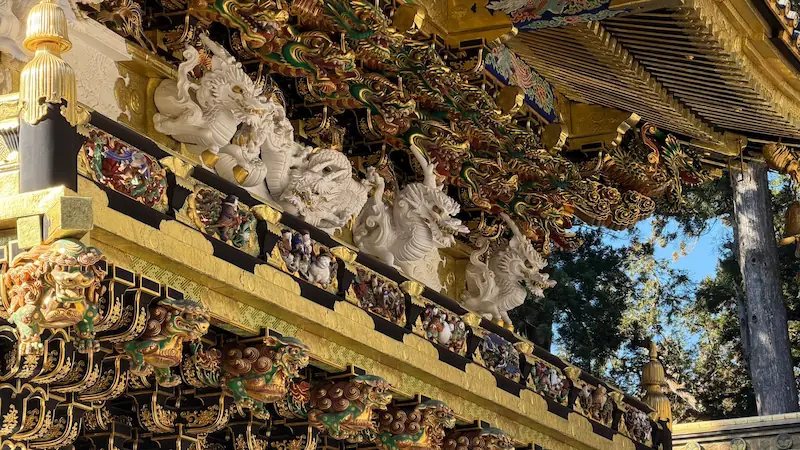
Nikkō Tōshōgū’s “lavishness” isn’t mere luxury. In the Kan’ei era, a large-scale rebuilding was carried out by order of the third shogun, Iemitsu—this is how it’s organized even in official learning materials.
What matters here is that the rebuilding didn’t only “make it more lavish.” It worked to lock in an Ieyasu-centered order as the very experience of pilgrimage itself.
The way tension rises the farther you proceed—from torii to Okumiya—becomes easier to understand as both architectural artistry and a staging of political legitimacy.
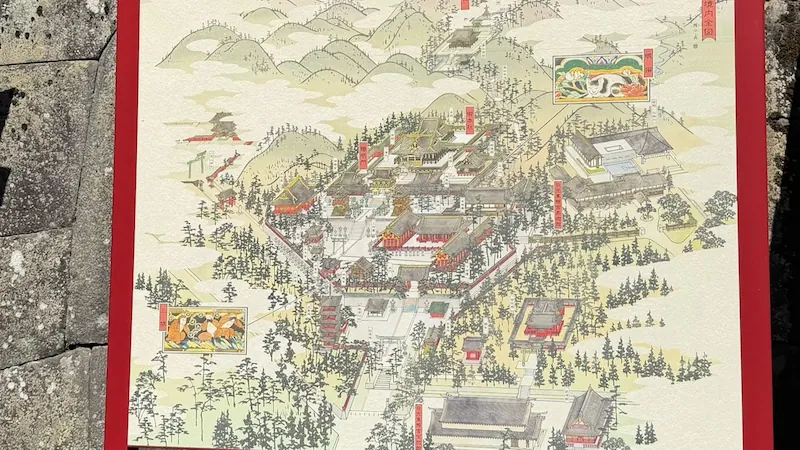
The moment I felt, “This is national-scale,” was as I advanced from the torii to the Omote-mon, to Yōmeimon, to the main sanctuary, and then to the Okumiya: the sheer breadth of the grounds, and above all the “fineness of the buildings and ornamentation,” were obviously different even compared with other major shrines. There are other big shrines, sure—but at Tōshōgū, the density of detail is unreal. It doesn’t compete on austere dignity. It commits itself to “showing” and “telling.” That difference is the doorway into reading Iemitsu’s reconstruction.
Reading “lavishness” as an expression of authority
When you stand before Yōmeimon, what hits you first is the number of carvings, the precision of each one, and the use of color.
That volume of information isn’t there just to amaze you—it has the pressure to make your body understand: “This is the Tokugawa center.”
Warring States architecture is basically practical—built around goals like “defend” or “attack.” But Tōshōgū pours time and money into ornament, and then chains that ornament across the whole complex.
This kind of lavishness only works if you assume it won’t be destroyed. In other words, it’s also a way to visualize the world the Tokugawa wanted to realize—an order that presumes peace will continue.
It’s not “lavish, therefore great.” It’s that by making it lavish,
Tokugawa order is nudged from “it lasts because it’s strong” toward “it lasts because it’s right.”
That’s lavishness as an expression of authority.
The logic that turns Tōshōgū into a “state apparatus”
If you read Iemitsu’s reconstruction as nothing but “filial devotion to Ieyasu,” it doesn’t quite cover it. Of course there was reverence. But reverence alone can’t fully explain that scale and density.
Even compared to other major shrines, Tōshōgū’s density of detail is in a class of its own. You can see the intent to make visitors memorize “the Tokugawa center” with their bodies.
Tōshōgū looks built to tell pilgrims this:
- This is not a private grave
- This is the Tokugawa center—the center of order
- Therefore this “ending” (the end of the Warring States) will not be shaken
Even more important is that this isn’t carved into you with words, but engraved as a spatial experience. You pass through torii and gates, move inward, and as you head toward the Okumiya, the tension rises. As you walk, you’re made to accept “the Tokugawa center” before logic can catch up. More than anything you can read, the experience itself presses Tokugawa legitimacy into your senses. That’s the strength of it as a “state apparatus.”
And this “state apparatus” isn’t eternal. The shogunate later turns toward financial strain, and lavishness becomes both “proof of peace” and a burden of upkeep. With that included, Nikkō reflects both Tokugawa strength and Tokugawa limits.
The contrast with Taiyūin reinforces Iemitsu’s intent
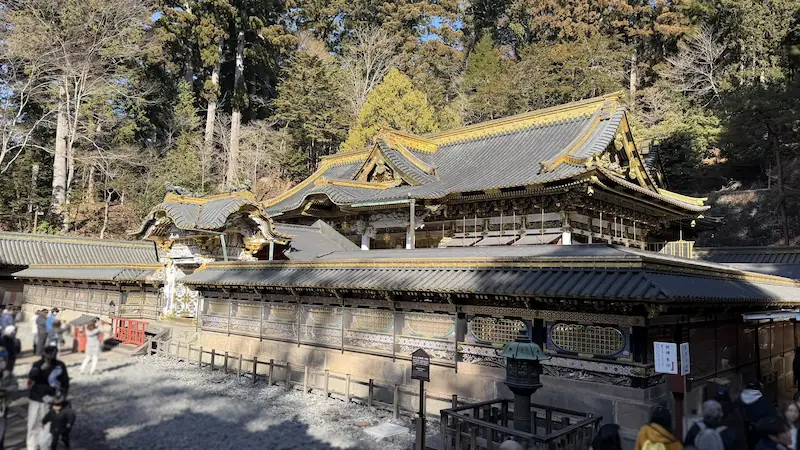
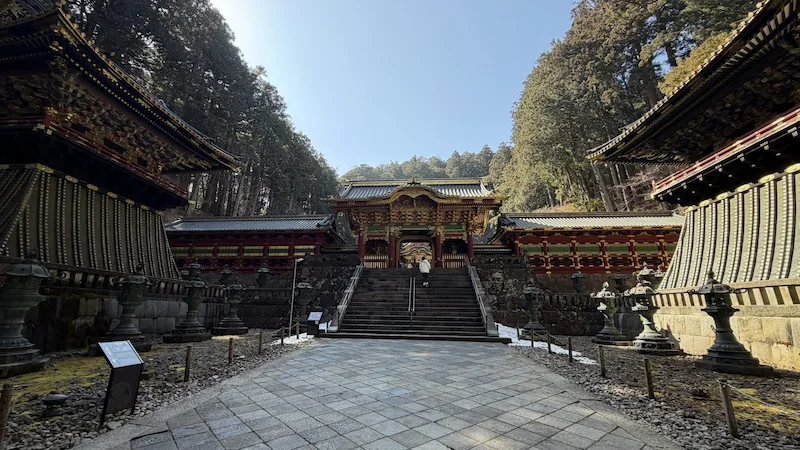
Looking at Taiyūin, I felt, “If Tōshōgū is motion, Taiyūin is stillness.” That matters.
It’s the same “golden world,” and yet it resonates differently—not as rivalry, but as inheritance.
Iemitsu places his grandfather (Ieyasu) at the center as a deity, and sets his own mausoleum beside it.
The difference in placement and atmosphere lets Tokugawa succession stand without collapsing the hierarchy that says “the center is Ieyasu.”
Read this way, Iemitsu’s great reconstruction strengthened Ieyasu through lavishness while also fixing Iemitsu’s own position inside the order—and you start seeing Tōshōgū and Taiyūin as a paired set.
Summary of the Treasure House film | The Ieyasu image drawn through “Martial Skill, Wisdom, Righteousness”
The film in the first room after you enter the Treasure House is, in effect, a “preamble to the exhibition.”
It’s a closed, mini-theater-like room with cinema-style seats; you sit wherever it’s open and watch. Runtime: about 20 minutes. In other words, it’s positioned as a story the Treasure House hands you first—the “Ieyasu image” it most wants to show.
This film treats Ieyasu’s “historical facts” less aggressively, instead collecting his virtues into a single through-line so you can comfortably understand him as a “hero who created peace.”
Rather than verifying fine points of history, we’ll organize what values the film uses to depict Ieyasu along three axes—“Martial Skill, Wisdom, Righteousness” (this is a summary of the film as the “story” it tells).
Martial skill (the power to survive the Warring States)
The film’s Ieyasu isn’t drawn from the start as an “ambitious conqueror.” Instead, his childhood hostage experience and youth pulled into war become the starting point, placing him as someone who connects to a resolve to “end war”.
Even battle scenes tend to be framed less as swaggering heroics and more as “unavoidable fights” and “fights you learn from by losing.” What stands out is how fear and pain of defeat are converted into “lessons to keep,” with martial skill linked not to “destruction,” but to “discipline” and “rebuilding.”
That depiction meshes with Tōshōgū’s atmosphere. Tōshōgū isn’t defensive architecture; it commits itself to ornament meant to be seen and to enshrine. In other words, the film’s “martial skill” isn’t positioned to praise Warring States violence itself, but as martial skill that was necessary to create the conditions for peace.
Wisdom (governance and long-term strategy)
The “wisdom” the film emphasizes isn’t bragging about intelligence—it’s wisdom for governance. Encountering learning while living as a hostage, building organizations and systems, and connecting that to city planning (the shaping of Edo) are told as one continuous line.
What matters here is that wisdom is depicted not as “cunning,” but as a “practical technology for sustaining order over time.”
The idea of improving a city rather than just enlarging a castle also functions in the film as “wisdom for building a vessel for peace.”
It also fits with Tōshōgū’s lavishness (investing time and resources on the assumption peace will continue). The film’s wisdom rises less as “wisdom to win wars” and more as wisdom to shift society toward a place where wars are less likely to happen.
Righteousness (legitimacy, moralization)
The core of the film may actually be here. The Ieyasu image leans less toward “he made people obey because he was strong,” and more toward “people gathered because they resonated with his aims.” Values like not nursing grudges, honoring trust, and cherishing an upright order are repeatedly pushed to the front.
This “righteousness” doesn’t end as a moral lecture.
It functions as an apparatus for “legitimacy” in how the Warring States ended—creating the air that says, “This peace isn’t just the victor’s convenience; it’s a rightness that should be protected.” Ieyasu being enshrined after death (Kunōzan, and then to Nikkō) is also connected here to the line of “a presence that watches over peace.”
The film is structured so that martial skill and wisdom ultimately converge into “righteousness” in order to move Ieyasu from “victor” to “protector.”
In doing so, it reinforces in words what the space of Tōshōgū carries as meaning: “the terminus of the Warring States.”
After watching the film, walking the grounds makes the carvings and the gates’ lavishness easier to see not as “decoration,” but as an “apparatus for fixing the story of peace.” From here on, we’ll look at how that apparatus is assembled through architecture and space (gates, corridors, the main shrine buildings, the Okumiya).
Tokugawa legitimacy told through architecture and space
The “wow” of Nikkō Tōshōgū isn’t only that lavish buildings are scattered across the site.
What’s truly powerful is that the farther you walk, the more the “rank” rises—and even your mood gets changed. The buildings aren’t simply lined up; the route itself—through gates, corridors, shrine buildings, and on to the Okumiya—becomes a single narrative.
That the place where I felt “the rank rises” most intensely was Yōmeimon is deeply symbolic. Yōmeimon is the boundary where Tōshōgū switches from “famous spot” to “center.” Past it, the lavishness stops being playful display and flips into the sensation of entering the core of sacred ground.
The hierarchy of gates, corridors, and the main shrine
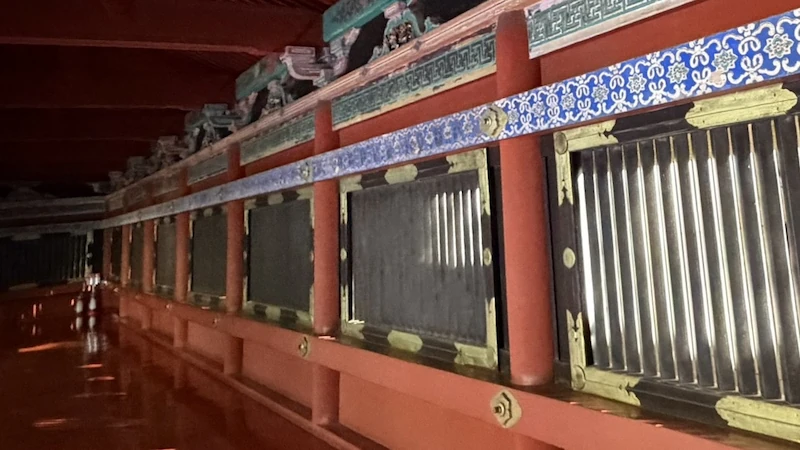
Tōshōgū is built so that each time you pass through a gate, your body understands: “From here on, it’s on another level.”
Yōmeimon is the clearest switching point. The density of carvings, the richness of color, the sheer flood of detail—everything hits at once and makes you accept, “This is the Tokugawa center.”
Past that, the texture of space changes. Walking the corridor means moving with your shoes off over lacquer-like wood, leaving a cool sensation in your soles. Some areas are dim, and you’re gradually cut off from the brightness and bustle outside.
This isn’t just a pathway. It’s closer to a “ritual passage” that tunes a pilgrim’s state of mind. In other words, the space turns a “sightseer” into a “worshipper.”
Entering the main sanctuary / worship hall makes that feeling decisive. What stayed with me was the dimness, the paintings on old wall coverings, and the construction of the front. There isn’t a typical offertory box; instead there’s a broad, shallow box lined with cloth, and there’s a mirror. It feels like a center, a boundary, and a ritual space—not an exhibit. The no-photography rule also works as a device that flips the mode from “looking” to “facing.”
This process—from gate to worship hall—completes
“be overwhelmed (see)” → “compose yourself (walk)” → “confront (pray)”
as a design for finishing a visitor’s psychology. That’s where Tokugawa legitimacy gains the power to be imprinted not as “explanation,” but as “experience.”
Okumiya (the space of deification) and what it does
The route toward the Okumiya shifts the air even further.
Sakashita-mon beyond the Sleeping Cat has fine carvings too, and the moment you pass under it your body knows: “I’ve entered the Okumiya area.” And beyond Sakashita-mon, the decorated world you were in flips into a stone pathway surrounded by towering cedars, as if you’ve been thrown into the forest. It’s in nature, yet the path is “ordered” in stone. A tension you can’t get anywhere else—where the border between nature and human craft gets blurred.
Then, atop the stone steps, a copper torii rises above you. And truly, when you pass under it, “the level of sacredness jumps.” That sense of arrival is proof that the Okumiya isn’t just “the back,” but is designed as the endpoint of deification.
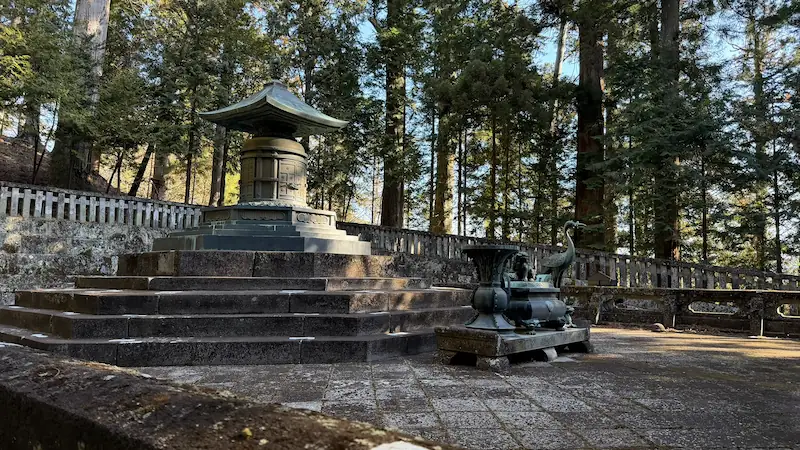
And what’s fascinating is how you’re naturally guided to the worship hall “on the way back.” You see the hōtō (pagoda-tomb) first, feel that this is the center, and only then pray at the worship hall.
Because the order is built that way, you don’t just feel “I saw it”—you feel “I arrived.” The Okumiya functions not only as the spatial center, but as the endpoint of the story.
What you want to remember when you walk Tōshōgū is that this lavishness isn’t mere ornament. Layers of staging that raises rank accumulate, and the closer you get to the Okumiya, the stronger the feeling of “I’ve made it.” That’s the fun of this place.
What to verify on site (a guide toward the Complete version)
If you’ve read this far—“Why Nikkō,” “Iemitsu’s reconstruction,” “the Treasure House film’s Ieyasu image”—then on site it gets more interesting to decide what you’ll verify, and where, rather than hunting for “highlights.”
In this section, I’ll condense the points where I actually walked and felt, “The story switches here,” into the quickest form you can check.
Yōmeimon / Three Wise Monkeys / Sleeping Cat / Okumiya
Yōmeimon: the truth of “lavishness” is composition and narrative
Before you study the carvings up close, first look at the spatial relationships around Yōmeimon.
What stayed with me most strongly was the composition where a torii overlaps in line with Yōmeimon’s front. Your gaze is drawn naturally toward the center, and your body understands: “From here on, it’s the core.”
Next: it’s not that “there are carvings on the gate.” It can look like the gate is buried inside the carvings—that’s how much information there is. And the carvings aren’t just decoration; they’re arranged with narrative (story) in mind.
Here you can verify the reading that “lavish = flashy” isn’t the point—lavishness itself becomes the density that speaks “Tokugawa legitimacy.”
Three Wise Monkeys: don’t just look at the three and leave
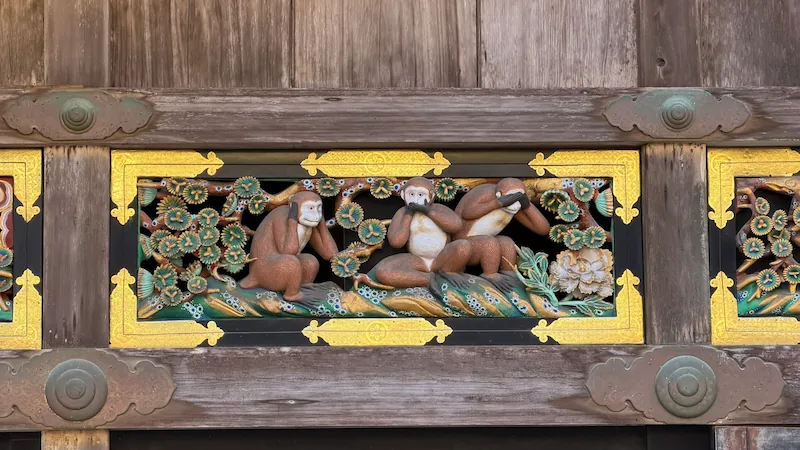
The Three Wise Monkeys are famous, but what you want to notice on site is what’s “other than” the three.
On the building where the monkeys are carved, there are multiple monkey carvings, and they can be read as a flow expressing a whole life, from birth onward.
This is one piece of evidence that Tōshōgū leans its story not toward “victory by force,” but toward “how people should live” (order, moral teaching).
Sleeping Cat → Sakashita-mon: pass through the “boundary” to the Okumiya
Beyond the Sleeping Cat, the air changes.
Sakashita-mon has carvings too, but instead of Yōmeimon’s glittering color, what lingers is the more restrained paint. There’s a “strength of stillness” here.
Rather than overwhelming you with flash, the farther you go inward, the more “quiet” increases. That switch teaches you that the Okumiya isn’t merely the back side, but the entrance to the deification space.
Okumiya: the hōtō, and the sensation of “the sky opening up”
What made the Okumiya feel like an “endpoint” wasn’t only the instant I stood before the hōtō.
Even though you’re surrounded by tall cedars, only the area around the hōtō can feel like the sky opens up—that spatial experience is the deciding factor.
The Okumiya is built so your body can understand “this is the center” without reading any explanation.
Architecture and nature fuse to raise the rank of the “place where one is enshrined.” By the time you reach it, it becomes easier to internalize the idea that Tōshōgū fixes “the terminus of the Warring States” as architectural experience.
Taiyūin (Iemitsu’s “succession”)
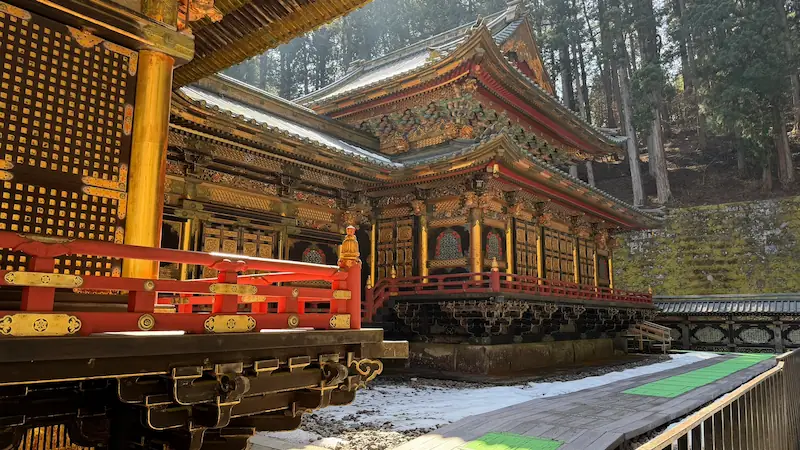
Taiyūin carries the same “gold” as Tōshōgū, and yet the impression changes.
The easiest difference to grasp is color and light.
- Tōshōgū: lots of white and gold; combined with how sunlight hits, the gold tends to read as “bright gold”
- Taiyūin: a stronger pairing of vermilion and gold; surrounded by trees, the gold can feel more like “dark gold”
As a result, the contrast emerges: if Tōshōgū is “motion,” Taiyūin is “stillness.”
This doesn’t feel like mere preference. It starts to look like the distance Iemitsu needed to “honor the center (Ieyasu) while placing himself as succession.” Seeing Taiyūin after Tōshōgū makes that “staging of succession” easier to read.
A guide toward the Complete version
For readers who want to verify on site the “reading” presented here as a story, the Complete version will compile the following:
- Photos of on-site signs (the local narrative): recording what is explained, and how, in a way that avoids misunderstanding
- 360° (re-experiencing): letting you follow the “rank” of space from your own viewpoint around Yōmeimon and the Okumiya hōtō, and more
If you can do the loop—“read → walk → read again”—Tōshōgū becomes, all at once, a place you can truly understand.
FAQ
Q1. I came from Shōgun. Is Tokugawa Ieyasu the “real Toranaga”?
A. Toranaga is fictional, but he’s built from real political patterns of the era—especially the kind of long-game strategy associated with Tokugawa Ieyasu. This article uses Nikkō Tōshōgū to show what happened after the wars: how the Tokugawa regime turned victory into an order people were meant to accept as “natural.”
Q2. With “Kunōzan → Nikkō,” what moved—and why?
A. It’s generally told that after Ieyasu’s death he was buried at Kunōzan, and later transferred to Nikkō. What matters here is that this is easily understood not as mere relocation, but as a step that lifts Ieyasu’s deification from a “local enshrinement” to a “national center.” If Kunōzan is the “beginning,” Nikkō is sometimes told as the “definitive edition.”
Q3. Do “Tōshō Daigongen” and “Tōshōgū” mean the same thing?
A. They’re sometimes used to refer to the same thing, but separating how you grasp them makes understanding easier. “Tōshō Daigongen” is often foregrounded as the divine title used when enshrining Ieyasu as a deity, while “Tōshōgū” is discussed as the shrine’s name (its shrine title). In this article, we focus less on fine points of naming and more on “what becomes possible when Ieyasu is enshrined as a deity.”
Q4. So what did Iemitsu’s great reconstruction (the Kan’ei-era rebuilding) actually change?
A. Rather than “making it more lavish,” it makes more sense to read it as fixing “legitimacy as experience.” Each gate raises rank, the corridor shapes behavior, and the Okumiya rises as an endpoint. The flow itself becomes an apparatus that imprints Tokugawa order not as “explanation,” but as “bodily sense.”
Q5. Aren’t the Three Wise Monkeys and the Sleeping Cat just famous motifs?
A. Their fame is value in itself—but if you read it as story, “placement” and “sequence” become the protagonists. The Three Wise Monkeys don’t end as a standalone lesson; with the surrounding carvings, they can be read as a “life flow.” The Sleeping Cat sits at the boundary to the Okumiya, and beyond it the air switches to stillness. Focusing less on the motifs’ isolated meanings and more on their positions as switching points deepens understanding.
Q6. Why did Tōshōgū become architecture to “show/enshrine” rather than a castle?
A. Tōshōgū’s lavishness is used less for defense or utility and more to make visible a “narrative” that keeps order lasting. It transfers the Warring States victor to the side that protects after death. And it makes you experience that transfer through architecture, ornamentation, and the pilgrimage route. Read that way, lavishness isn’t indulgence; it’s an investment in fixing the story of peace.
Q7. What does “the terminus of the Warring States” mean? (Is it a historical term?)
A. It’s not a fixed technical term so much as a phrase for this page’s way of reading. Even if fighting ended at Sekigahara or the Siege of Osaka, fixing the fact of “it ended” into a form everyone accepts is a separate task. Tōshōgū can be read as the place where that fixing work took shape as deification and spatial staging. In other words, it’s not just “the Warring States ended,” but “the point where ‘ended’ was reorganized into an unshakable story.”
Q8. How much should we believe the rumors about Tenkai or Akechi Mitsuhide?
A. For stories not established as fact, it’s safest not to treat them as evidence, but to enjoy the way they’re told. Why is the rumor so compelling? Why do people want to place a “shadow key player” in Nikkō? In that, you can see another kind of history: how people wanted to understand Tōshōgū—history as memory and narrative.
Q9. What do you learn by seeing Tōshōgū and Taiyūin as a set?
A. It becomes easier to see the composition that fixes Iemitsu’s own position as “succession” after setting his grandfather (Ieyasu) at the center. Even with similar lavishness, Tōshōgū carries the pressure of a “center,” while Taiyūin feels like it stays close in “stillness”—and that can be read as staging of inheritance that doesn’t become rivalry and doesn’t collapse hierarchy.
Q10. Ultimately, what is this page for verifying on site?
A. In one line: to verify “where the story switches.” The sense that the air changes at Yōmeimon, the corridor pulling you from “sightseer” toward “worshipper,” the switch to stillness beyond the Sleeping Cat, and the Okumiya rising as an endpoint. If you walk with those in mind, Tōshōgū becomes easier to see not as a famous spot, but as “the place that fixed the end of the Warring States.”


comment